Interpreting the Bible

Tommie Kidd and Gerald McDermott try to salvage providential history. Of course, such an exercise is dangerous:

Over-readings of God’s providence were relatively easy targets of ridicule for the new skeptics and deists of the eighteenth century. For them, Edwards’ kind of interpretation raised obvious questions with no easy answers. Does an absence of drought or worms mean that people are without sin? What did it mean when non-Christians around the world enjoyed abundant harvests, and heavily Christian regions went without? And what of Matthew 5:45’s statement that God “makes his sun rise on the evil and on the good, and sends rain on the just and on the unjust”? Many traditional Christians abandoned close providential readings of current events because, with all due respect to Edwards, those interpretations are easier to defend when no one is asking difficult questions about them.

But we lose something without it:

Yet Gerald McDermott suggests that we also lost good things when we gave up on providential readings of history. Christians certainly believe that God is the Lord of history, and that all things have meaning and purpose within God’s economy. No ruler comes to power, and no nation falls, without God’s sovereign permission. Providential interpretations of a nation’s suffering and turmoil remind us that we stand under universal moral standards. No matter how powerful and wealthy, no nation (perhaps especially those with high rates of professed Christian faith) can expect to provoke God forever with no consequences.

We didn’t already have those assertions from simply reading the Bible? And if we read the Bible and cogitated on its status as God’s word, we might notice that God is the one who interprets history, which is what happens in the pages of Holy Writ — something happens, and we learn its meaning from the apostles and prophets. When things happen and God doesn’t interpret, why would we ever think we have the capacity to fill the void?

Even so, Kidd will not relent:

The most appropriate occasions when we can make modest assertions about God’s historical interventions are when we detect dynamics of reaping and sowing. For example, the financial meltdown of 2008 was clearly connected to irresponsible practices and products, like the infamous “credit default swaps.” At a minimum, we can say that in 2008, God let our nation reap what we had sown financially. We are still trying to recover from the disaster that ensued.

Well, knowing that you reap what you sow is something that farmers understand without the aid of providential history. The challenge for arguments like Kidd’s is the dark side of providential history (and the fall more generally). If God let the nation reap what the banks had sown, isn’t it also the case that God let the banks sow?

Are providentialists really up to tackling the problem of evil? I don’t think so.

The Problem with England

H. L. Mencken explains:

The badness of English cooking is proverbial all over the world, but no one seems to have investigated its causes. I suggest that it may be due, at least in part, to two things, the first being that the English have a Puritan distrust of whatever is bodily pleasant, and the second that it is practically impossible to grow good food in their country. The first point needs no laboring. Every American who has been in England in winter knows who the whole population shivers and freezes. The simple device of putting in adequate stoves has apparently never occurred to anyone — or, if it has, it has been rejected as unmanly. The English prefer to be uncomfortable, and think of their preferences as heroic.

So at the table. Most Englishmen have been abroad, and know very well what good victuals taste like. But when they are at home they take a gloomy, stubborn, idiotic delight in eating badly. To say that they have a diseased taste and actually enjoy their flabby flavorless, badly cooked dishes, — this is to go beyond plain facts. It takes only a glance to see that they suffer almost as much as visitors to their country. But they can’t get rid of the feeling that it is virtuous to suffer — that eating better stuff would be frenchified, wicked, and against God. So they remain faithful to a cuisine which Nietzsche long ago described as next door to cannibalism.

I have hinted that the native victuals of the English are all bad. An exception, of course should be made of their incomparable mutton, and another, perhaps, of their sole, but beyond that the judgment holds. Their beef, for all their touching veneration of it, is distinctly inferior to ours, as anyone may discover by eating in the form of steaks. Their pork, at best, is only so-so, and their veal is not better. They seldom eat lamb at all. Of the stuff they get out of the sea, not much is really good. Their oysters are vile, and their turbot is flabby and almost tasteless. Their salmon is better, but it is surely not to be mentioned in the same breath with our mackerel, blue-fish and shad. That leaves their excellent sole — usually ruined in the cooking. . . .

What saves England from complete culinary darkness is the mutton. At its best, it is probably the most magnificent red meat to be had in the world. . . . I believe it is one of the great glories of the English people — a greater glory, indeed, than their poetry, their policemen, their hearty complexions, or their gift for moral indignation. It is the product of English grass — unquestionably the best grass on this piebald ball. Ah, that the English nobility and gentry could dine as well as their sheep. (“Note on Victuals,” 1930)

How Does Reform Happen?

Megan Hill defends praying for big toes, and then goes a step too far:

When we pray together as the church, we should regularly and deliberately pray for the God-directed mission of the church: the advance of the kingdom, the strengthening of the body, and the exaltation of Christ.

But it is no mark of holiness to disparage the small and sometimes immature requests of those who are also in the body. As people who are being built up together into Christ who is the head, we have good reasons–kingdom reasons!–to sometimes pray together for dead birds and ill aunts and next-door neighbors who have had bad news.

It may not be a mark of holiness, but to reform a church you have to break some eggs (and wound some egos). Imagine if Luther and Calvin had thought criticizing the veneration of saints were marks of unholiness.

So why not make an argument based on Scripture or wisdom, rather than questioning the holiness of those who question the oddities of small group prayer?

Human Flourishing is Flabby

Here’s another reason for thinking that the language of human flourishing (HF) is a cliche on the order of w-w:

“If you care about the flourishing of persons, especially the vulnerable in community, you will care about freedom of religion,” claimed Crouch. He continued to explain why this is so, because religion and the practice thereof, is “one of the deepest forms of human flourishing.” Religion is distinctive to humans, no animals nor all of nature practice religion or seek to find answers about life and God. All humans across history past and present seek to understand life and their situation in it. Further, all humans search for meaning and attempt to attach themselves to something bigger than themselves, constantly searching for significance and fulfillment. Inevitably, we all seek religion and devote worship, even the Atheist, though denying God’s existence, forms a set of beliefs to understand reality and worships something or someone (quite possibly themselves).

Therefore, Crouch explains “being denied religious freedom, being prevented from acting out your deepest commitments in public, is one of the deepest denials of human flourishing.” The test then to know if religious freedom and therefore the common good is being protected, “Is how it protects religious minorities,” claims Crouch.

What does this view of HF say to someone who thinks that blasphemy and idolatry are part of destructive living (DL)? But if you give people freedom to practice any religion, you also permit blasphemy and idolatry. Maybe the resolution is to say that in the interest of genuine devotion to God we also need to allow DL so that government doesn’t become tyrannical. But let’s not kid ourselves that freedom leads to HF. It has costs and benefits that require not chanting “winning” like Charlie Sheen but sobriety and moderation.

Crouch’s view of HF also seems to follow the pack in regarding as impossible or disloyal any effort to leave behind one’s “deepest” commitments when entering public life. But again, it’s a pretty, pretty, pretty good view of public life to think that everyone bringing their deepest commitments to the table will result in HF for everyone. Wasn’t the reason for leaving behind one’s deepest commitments when serving in public life that one’s deepest commitments might be at odds with the common good? After all, if a Calvinist brought his deepest commitments to a policy proposal for building a Roman Catholic parochial school next to First Presbyterian Church, wouldn’t his deepest commitments prompt him to vote no? Where’s your HF now?

After fifty years of culture wars shouting matches, people are still so naive to think that uplifting thoughts will prevail over contested points of view?

All Men Know that Women Are More Pious

That’s what makes Tim Challies’ brief for spiritual zeal and all things earnest all the more mystifying:

A number of times I have spoken to a woman and heard her admit that she essentially drafts behind her husband. She takes comfort in her husband’s spiritual strength and discipline but neglects her own. She goes to church when he is around but is quick to bail when he is not. She allows him to carry the load when it comes to teaching and training the children, when it comes to reading and praying with them. She doesn’t only allow him to take the lead (as, indeed, he should) but uses his leadership as a quiet excuse to not put in much effort of her own. She finds that the family is in good shape spiritually but admits that this is far more because she rides in his draft than that she is full-out pursuing the Lord. If he stopped putting in the effort, she would have little strength of her own.

Maybe Challies is simply channeling men’s historic discomfort with women taking the lead, as Jill Lepore reports:

The debate about a female prince advanced all kinds of political ideas, not least the rule of law, the mixed nature of the English constitution, and the sovereignty of the people. It also inaugurated an era of topsy-turvy play in everything from Elizabethan drama and French carnival to German woodcuts, as the brilliant historian Natalie Zemon Davis argued in a 1975 essay called “Women on Top.” Davis wrote that the fascination with female rule came at a time when men were asserting new claims over women’s bodies and their property. In 1651, in “The Leviathan,” Thomas Hobbes wrote about Amazons to support his claim that “whereas some have attributed the dominion to the man only, as being of the more excellent sex; they misreckon in it,” which is why it’s important that laws exist, to grant man that dominion. In 1680, in “Patriarcha,” Sir Robert Filmer located the origins of all political authority in Adam’s rule. Meanwhile, some theorists who imagined a state of nature, a time before the rise of a political order, became convinced that America, before Columbus, had been a “gynæocracy,” as one French writer called it. But the chief consequence of this debate was the Lockean idea that men, born equal, create political society, to which women do not belong; women exist only in the family, where they are ruled by men. Hence, in 1776, Abigail Adams urged her husband, in a letter, to “remember the ladies” in the nation’s “new Code of Laws,” which he most emphatically did not. “Depend upon it,” he wrote back, “we know better than to repeal our Masculine systems.”

Male headship and female piety may explain why human flourishing is as plausible as w-w.

Making Special Ordinary

If the Corinthian Christians got in trouble for turning the Lord’s Supper into a feast, what happens when you turn the sacrament into a cultural mandate? Peter Leithart may be working too hard to justify transformationalism:

Not only on the Lord’s day, but every day: We offer our works to God in worship, specifically with an act of thanksgiving. When we bring bread and wine – and, by implication, everything we make and do – before the Lord, we do it with thanksgiving. This is remarkable: After all, we made the bread and wine. And yet we thank God for them. We thank Him for the products of our hands, because even the things we make – even our works – are His gifts to us. Paul says that thanksgiving is an act of consecration: Every created is good, and nothing is to be rejected if it is received with thanksgiving; because it is consecrated by the Word of God and prayer. When we give thanks for what we have made, we are consecrating the works of our hands to God. And having given thanks at the table, we are trained to live lives of continuous Eucharist, continual thanksgiving, giving thanks, as Paul says, for all things at all times.

A lesson learned from John Frame: everyday is holy. All activities are worship.

We bring what we have made to God. But He doesn’t take it from us. We bring what we have to God, and He shares it with us. And so the things we make become means of communion with God.

Isn’t this a recipe for idolatry? Math, auto repair, fishing are “means of communion”? So we don’t have to gather with the saints on the Lord’s Day for worship?

The Eucharist is the way the world ought to be: Raw creation cultivated to grain and grapes. Cultivated creation brought to its fulfillment by cooking. Cooked creation enjoyed in the presence of God. Cooked created enjoyed together, by a community of worshipers. Cooked creation given in praise and received with thanksgiving. The final end of all things is the marriage supper of the lamb, and in the Lord’s Supper we anticipate that final feast, the feast that is the culmination of all creation. History is heading toward a wedding and eternal wedding reception, and our lives are to be spent readying the world for the wedding feast, a wedding feast that we are already enjoying now.

Wouldn’t it be better to say the wedding supper of the lamb is the culmination of redemption? After all, not everyone invited to the wedding accepts. All creatures won’t be at the wedding reception.

In the Eucharist, we bring creation to its fulfillment. We transform the creation into things useful and enjoyable for us, and we give thanks.

And so the Supper Supper reveals us to ourselves. This is what we are created to do: To be priests and kings, ruling the earth, transforming it from glory to glory, and joining it all in one great Eucharistic banquet.

At the Lord’s Supper, where we remember Christ’s death for our sins, we are impressed by how powerful and creative we are?

Yikes.

Dr. Leithart has his problems, but in this case he needs Christian editors who can tell the difference between cult and culture.

Gnostic Audacity

The myth:

What I came to recognize, in other words, was that the Catholic position was in actuality the much more humble of the two. Indeed, it was downright self-effacing. For the Catholic position, paradoxically, was that it is precisely because mere men can claim no genuine spiritual authority that the successors of the apostles could claim it; and, in particular, it is precisely because no man can possibly be infallible that the bishop of Rome had to be.

The fundamental conviction here is really quite straightforward: Catholics think that we’d better not be left to our own devices, or else we’ll probably screw things up. When you get right down to the core of the thing, it isn’t that Catholics are misanthropes; they don’t think that human beings are just absolutely idiotic or irredeemably horrible. But they do have a lot of skepticism about man’s inherent capacity to get things right on his own; to see things straight for himself; to understand things clearly and objectively, apart from the potentially adverse influence of the cultural categories and presuppositions, the inherited traditions, through which he sees the world and understands the Bible – but which themselves usually remain unseen. They believe that owing to these inherent and historical limitations to which all men are subject, an individual person, even if he is a Christian indeed, cannot always rely upon himself – that his own internal “feelings” of certitude, or the inward confidence he has in his own views and in those of his tradition, do not necessarily come straight from the Holy Ghost and do not automatically mean he is right.

The reality:

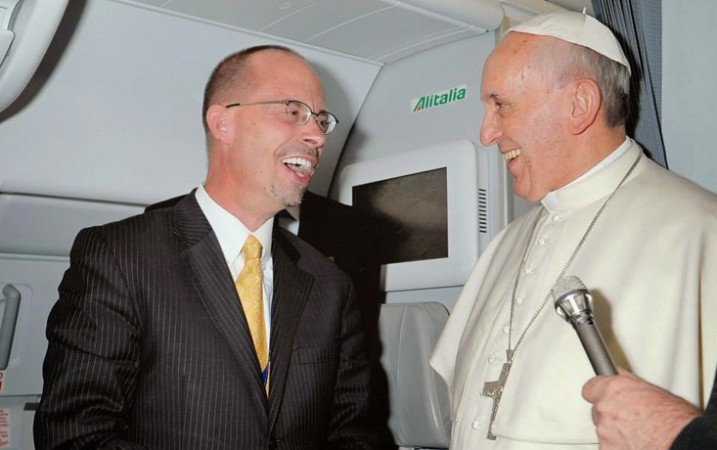
The Vatican is not an organism that thinks only one thought at a time, it’s a bureaucracy. It’s staffed by human beings, each of whom has his or her own wants, fears, intentions, visions, hopes and dreams. There’s far less internal coordination than the mythology would suggest, meaning that often, diversity – at times, even border-line chaos – is the order of the day.

For every official inside the system who embodies whatever one thinks “the Vatican” said or did today, there are probably routinely a half-dozen who aren’t on the same page.

There are at least three reasons why: Structural, cultural and political.

Structurally, Vatican systems are set up in some ways to minimize interaction among different departments. There’s a strong emphasis on respecting the juridical “competence” of each, so that cardinals and their lower-level aides are often hesitant to intervene outside their area of authority.

Documents and policy decisions can be in the works in one department for months, in some cases years, before anyone else knows about them.

Although the atmosphere has loosened up somewhat, I recall distinctly when I first began covering the Vatican twenty years ago, if I were to go out to dinner with two officials from different offices and ask each what was bubbling in his shop, they’d get nervous – not so much about discussing it in front of me, but someone from a different outfit inside the system.

The bottom line is that there simply is no Vatican “war room” where officials hammer out a master plan on much of anything.

Culturally, the Vatican is an international milieu, home to people from a staggering variety of geographical points on the compass. What seems natural or obvious to one official in one office, therefore, will often seem puzzling, even objectionable, to others.

It’s almost always a mistake to assume, for instance, that if an American official in the Vatican says “x,” that view would be shared in precisely the same way by, say, the Italians, or the French. Similarly, if a Latin American head of a department makes a statement on some news story, one can’t presume that his German or Polish colleagues would see it the same way.

Politically, popes often like to appoint officials to Vatican jobs who don’t exactly see eye-to-eye, on the theory that what results can be a sort of “creative tension.”

During the John Paul II years, it was well known that Chilean Cardinal Jorge Medina, the Vatican’s top official for liturgy, and Archbishop Piero Marini, who organized the pope’s own liturgical celebrations, were on completely different planets – Medina a staunch conservative, Marini an ardent reformer.

Insiders knew not to take much of what either man might say on liturgical matters as a corporate Vatican line, but rather as part of an ongoing internal debate, until the pope officially pronounced one way or the other.

When will Bryan and the Jasons tell the truth that John Allen tells while actually covering real-life church officials in the Eternal City?

The First President to be Pried from His Bath

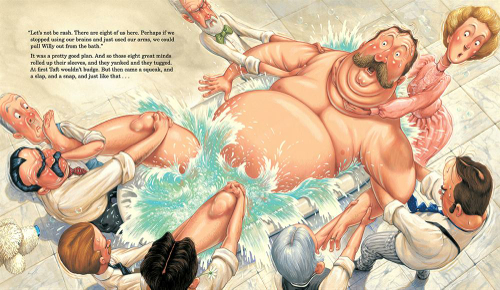
I heard this morning on Sports Talk radio of all things that on this day in history President William Taft, a man of gargantuan proportions, became stuck in his bath tub:

What most people associated with Taft, however, was his enormous size, and the image of his 300 plus pounds of presidential flesh offended some people and amused many others. When he became stuck in the presidential bath tub, requiring six men to pull him free, the nation’s press had a field day. His size made him the subject of countless jokes: “Taft was the most polite man in Washington. One day he gave up his seat on a streetcar to three women.” Within the capital’s social circle, Taft frequently embarrassed his family and associates by falling asleep at concerts, during presidential briefing sessions, and while presiding over his cabinet. At ease with his uncontrolled appetite and his need for sleep after eating or after exerting himself, Taft simply refused to be embarrassed by his weight or his behavior. He accepted his size and so did most of the American public in time.

What many Americans don’t know is that President Millard Filmore was the first to take a bath in the White House. Here is H. L. Mencken’s account:

But it was the example of President Millard Fillmore that, even more than the grudging medical approval, gave the bathtub recognition and respectability in the United States. While he was still Vice-President, in March, 1850, he visited Cincinnati on a stumping tour, and inspected the original Thompson tub. Thompson himself was now dead, but his bathroom was preserved by the gentlemen who had bought his house from the estate. Fillmore was entertained in this house and, according to Chamberlain, his biographer, took a bath in the tub. Experiencing no ill effects, he became an ardent advocate of the new invention, and on succeeding to the Presidency at Taylor’s death, July 9, 1850, he instructed his secretary of war, Gen. Charles M. Conrad, to invite tenders for the construction of a bathtub in the White House.

This action, for a moment, revived the old controversy, and its opponents made much of the fact that there was no bathtub at Mount Vernon, or at Monticello, and that all the Presidents and other magnificoes of the past had got along without any such monarchical luxuries. The elder Bennett, in the New York Herald, charged that Fillmore really aspired to buy and install in the White House a porphyry and alabaster bath that had been used by Louis Philippe at Versailles. But Conrad, disregarding all this clamor, duly called for bids, and the contract was presently awarded to Harper & Gillespie, a firm of Philadelphia engineers, who proposed to furnish a tub of thin cast iron, capable of floating the largest man.

This was installed early in 1851, and remained in service in the White House until the first Cleveland administration, when the present enameled tub was substituted. (“A Neglected Anniversary,” New York Evening Mail, 1917)

Whether presidents have been clean ever since is a separate question.

Sixty Hours I’ll Never Recover

But at least no naked actresses.

That is the general reaction in the Hart household to the completion of Mad Men, a tv series perhaps a tad better than Breaking Bad, but miles behind — wait for it — The Wire. (The atmospherics of Mad Men inch the series just barely ahead of Breaking Bad.) I had to go through 90 episodes to see Don practicing transcendental meditation, Peggy finding love, Joan being torn between love and career, Roger finding love appropriate to his age, and Pete landing in Witchita? Yes, it was uncomfortable to see Betty get sick, but not so much that you see a different side of her.

The morning after I read Louis Menand (who is emerging as someone worthy of a man-crush) on Charles Duhigg’s book, Smarter Faster Better: The Secrets of Being Productive in Life. Menand can’t quite understand why self-help books for business people sell. They are so obvious:

There is not much to disagree with here, and that is one of the intriguing things about the genre this book belongs to. Not dozens or hundreds but thousands of titles like “Smarter Faster Better” are published every year, and they account for a disproportionate percentage of total book sales. Yet they mainly reiterate common sense.

Does anybody think it’s unwise to be lean, nimble, and innovative? Who needs a book to know that rote behavior and fear of uncertainty are not going to take us very far? It’s not startling to learn that organizations that nurture a “culture of commitment” are more productive than organizations that don’t, or that setting ambitious objectives can jump-start innovation. “People who know how to self-motivate, according to studies, earn more money than their peers, report higher levels of happiness, and say they are more satisfied with their families, jobs, and lives.” I can believe that. “Determined and focused people . . . often have higher paying jobs.” I won’t argue. “An instinct for decisiveness is great—until it’s not.” An impregnable assertion.

In an uncanny way, Menand also explains the logic of Mad Men:

If you owned an advertising agency fifty years ago, on the other hand, you wouldn’t care how much pig iron your workers could carry in an hour. You would want your account executives to have winning personalities, to be able to bond easily with other people, to be likable. You would want them to have manners tailored to attract the patronage and retain the loyalty of your customers. Their task would be to persuade, not to push. You would therefore want them to be able to conceal, maybe even from themselves, the manipulative and possibly mercenary nature of their relationship with clients, and to transform a business transaction into a friendly quid pro quo. You would reward the most successful account executives with lavish expense accounts.

The series never goes beyond this (except when Don is being Don).

Evelyn Waugh Would Have to Re-Write Brideshead

Phil Lawler wonders about the pastoral implications of Pope Francis’ pastoral advice in Amoris Laetitia. Consider the plight of “regular” Roman Catholics:

In any Catholic community there will always be some devout believers who, following the Lord’s advice, “Strive to enter by the narrow door.” They will pray often and ardently, try to attend daily Mass, practice their own private devotions, and seek out spiritual direction from priests who demand a lot of them. For these people—let’s call them “high-octane” Catholics—Gresham’s Law will not apply. They are the equivalent of the folks who demand payment in doubloons.

But most Catholics, in most times and places, are not of the high-octane variety. Most “regular” parishioners will do what the Church demands of them, but will not seek out extra rigors. They will attend Sunday Mass on a regular basis, raise their children in the faith, follow the precepts of the Church as they understand them, contribute to the parish. Faithful if not zealous, they will form the backbone of the Catholic community. Nourished by the sacraments and encouraged by their pastors, they will grow in faith; some will eventually become high-octane Catholics.

Now notice how these “regular” Catholics—who sincerely intend to meet their obligations, without taking on extra burdens—are likely to choose between two hypothetical parishes:

In Parish A, Sunday Mass lasts 90 minutes or more; the liturgy is “high” and solemn; the Gregorian chant is unfamiliar. In Parish B, Mass is out in 40 minutes; the hymns sound like (and sometimes are) snappy show tunes.

In Parish A, religious-education classes are demanding, and students who do not master the basic catechism lessons do not advance. In Parish B, teachers assume that “they’re good kids” and don’t worry about details.

In Parish A, when a young couple comes to discuss marriage, and the pastor notices that they list the same home address on their registration forms, he tells them that they must live separately. In Parish B the pastor “doesn’t notice” the matching addresses, and plans for the wedding can move forward.

In Parish A, priests often preach on controversial topics, driving home the Church’s least popular messages, reminding the parishioners of their sins. In Parish B, the homily is always a gentle reminder that we should be kind to one another, and not too rough on ourselves.

Needless to say, high-octane Catholics will flock to Parish A. Regular Catholics will gravitate toward Parish B. Human nature being what it is, most people will choose the less demanding of two options.

Now notice what happens to priests in these parishes when they meet a couple that has been re-married:

In his apostolic exhortation, Pope Francis sets up the model of a pastor who will meet with these couples, help them to review and assess their lives, to repent their past failings, to bring their lives closer to the Christian ideal, and to do everything that they can in their current circumstances to grow in holiness. Exactly how this process will unfold is unclear, because, as the Pope explains, it is impossible to anticipate all the unique circumstances of any individual case. But clearly the Pope is describing a rigorous process, rather than a quick solution.

But what sort of priest would insist on that rigor in his dealings with a remarried couple? The pastor of Parish A, probably. But that pastor would very likely tell the couple that if they wish to receive the sacraments they must live as brother and sister. And the couple, for that matter, if they were active parishioners in Parish A, would probably have reached that conclusion for themselves already. So Amoris Laetitiae would bring no change in their case.

In Parish B, on the other hand, the pastor—having long ago established the pattern of requiring only the minimum—would be far more likely to tell the couple that they should not worry about details, that they should feel free to receive the Eucharist. In all likelihood he would already have conveyed that message, and they would already be in the Communion line every Sunday. Again, the apostolic exhortation would cause no significant change.

But consider what might happen in the marginal cases, where change is most visible. What will happen to divorced/remarried couples who, after years away from the faith, are inspired by the Pope’s message to return to the fold? If they happen to meet with a priest who expects them to go through a long and difficult process, aren’t they likely to seek a second opinion, and maybe a third, until inevitably, they find a pastor who will welcome them back immediately, with no requirements and no strings attached? Hasn’t that pattern already been clearly established by the young couples who want their wedding scheduled without a demanding marriage-prep program, or want their children confirmed without a rigorous CCD requirement?

This is not exactly the church that was opposed to any trace of modernity for at least 150 years.

Now imagine the real life (fictional couple) of Rex Mottram and Julia Marchmain:

Julia manages to match Sebastian’s dissolute lifestyle through her own acts of intransigence. She eventually plans to marry Rex Mottram, a Protestant Canadian, who has managed to gain a seat in the House of Commons. It is this relationship with Rex that marks Julia’s descent into chronic sin. Julia learns that Rex may be carrying on an affair with a mistress. She thinks that if they become engaged, this can put an end to the affair. When it doesn’t, she then begins to reason that if she is going to keep Rex from being unfaithful, she will have to offer sexual gratification to her fiancé before they are married. Julia justifies this in her own mind and presents the proposition to a priest: “Surely, Father, it can’t be wrong to commit a small sin myself in order to keep him from a much worse one?” The Jesuit responds in the negative and suggests that she make her confession. It is this moment, when Julia does not receive what she wants, that she turns against the faith: “‘No, thank you,’ she said, as though refusing the offer of something in a shop. ‘I don’t think I want to today,’ and walked angrily home. From that moment she shut her mind against her religion.”

During their engagement, Rex agrees to receive instruction so that he can convert to Catholicism. However, matters are exasperated when it is revealed that Rex was previously married and divorced in Canada. Rex does not understand how this can be an impediment to a prospective marriage to Julia and he sees no difference between his divorce and the granting of an annulment. When it is obvious that nothing can be done with only a few weeks before the wedding, Julia and Rex agree to marry in a Protestant ceremony, separating themselves from Catholic society and the Marchmain family. Julia’s intransigence reaches its peak as she voices a modern refusal to recognize objective sin: “I don’t believe these priests know everything. I don’t believe in hell for things like that. I don’t know that I believe in it for anything.”

So which priest would Rex and Julia seek? Parish A or Parish B? This writer thinks Parish B’s priest is closer to Pope Francis’ instruction in his apostolic exhortation:

If they were alive today, would Julia and Charles have had to part ways? Amoris Laetitia offers alternatives: “Because of forms of conditioning and mitigating factors, it is possible that in an objective situation of sin – which may not be subjectively culpable, or fully such – a person can be living in God’s grace, can love and can also grow in the life of grace and charity, while receiving the Church’s help to this end.” Couldn’t Julia and Charles have spoken with Father MacKay in the internal forum for the sake of contributing to the “formation of a correct judgment”?

Even the idea of living as brother and sister seems to be impossible in this modern age. While Julia explains to Charles that she plans to “[j]ust go on – alone” this is not a sad revelation because she is finally able to receive God’s mercy and to return to a right relationship with Him. However Amoris Laetitia makes it seem that “going on alone” or abstaining from sexual intercourse is impossible in 2016. Pope Francis explains that “many people, knowing and accepting the possibility of living ‘as brothers and sisters’ which the Church offers them, point out that if certain expressions of intimacy are lacking, ‘it often happens that faithfulness is endangered and the good of the children suffers.’” In the age of Brideshead, one didn’t die if they abstained from sexual intimacy. Apparently, in this sex-obsessed age, it is impossible for one to live without it.

Some will say that no dogma has changed. And sure the dogma of mortal and venial sins have not changed. But if priests’ pastoral counsel, with a green light from the magisterium, is defective by not warning the flock from sin, if it tolerates sinful practices under the guise of being pastoral, something has changed.

Evelyn Waugh knew that the Church of England had changed (even when dogma hadn’t). Do Roman Catholic apologists think Waugh wouldn’t notice this?