Machen Death Day 2019

I wonder if Timothy Isaiah Cho saw this (or thinks Jewish American who admire Machen are racist):

We’ve spent quite a bit of time in recent years debating who’s a Jew, but we’ve neglected to ask the thornier question: namely, what is Judaism? It’s a question that belongs with theologians, a scholastic class that, in our tradition, is sadly more likely to focus on offering a close reading of some sacred scrap of text than on addressing the fundamental relations between the tenets of faith and the earthly soil in which they’re rooted. It’s a shame—we need this sort of inquiry more than ever now that every social-justice warrior fashions our creed into a banner under which to march into battle.

For inspiration, then, we ought to look to our Christian brothers. In 1923, American Christendom received a master class in doctrinal clarity when a perfervid Presbyterian named John Gresham Machen wrote a short book titled Christianity and Liberalism. Too many of his contemporary faithful, he argued, have come to look at their religion as a blank screen on which to project the values of progressive liberalism. They’ve come to see Christ as a metaphor, not a deity, a gentle reminder to always be good and kind because kindness and goodness were just, you know, right. They read the Bible for affirmation, not for instruction, and they were always ready to ignore its teachings if those clashed, however mildly, with modernity’s latest edicts. Liberals who could not abide by Christianity’s essential truths, Machen argued, were many wonderful things, but they were not Christians. And everyone, the fiery theologian concluded, would be better for it if they stopped pretending that their values corresponded in any but a tangential way with those of the core Christian faith.

You can imagine how well Machen and his ideas were received. Rejected and dejected, Machen quit his perch at Princeton and was soon thereafter altogether defrocked of the ministry for his refusal to compromise his beliefs. He traveled extensively to minister to the few who still supported him, and died on one of those journeys, on New Year’s Day of 1937, in Bismarck, North Dakota. He was 55. On his grave was inscribed, in Greek, the motto that captured him best: “Faithful Unto Death.” In a warm obituary several weeks later, H.L. Mencken advised his readers that the deceased “fell out with the reformers who have been trying, in late years, to convert the Presbyterian Church into a kind of literary and social club, devoted vaguely to good works.”

What fun Machen would have had, then, had he stuck around long enough to witness Judaism today and see it turned, by and large, into just such an enfeebled club. Had he walked into our shuls or read our publications, he would’ve despaired to hear so many of us speak reverentially of Tikkun Olam, the commandment to repair the world, as if it alone stood at the core of our ancient faith, or as if world-repairing, stripped of its specific theological underpinnings, were anything more than the vague sort of general goodwill professed not only by Jews but also by Hindus, Zoroastrians, members of the Kiwanis Club, and practically every other sentient being who ever gazed upon God’s creation and had the fleeting feeling that it ought to be just a touch more perfect. Saying you crave social justice doesn’t make you any more Jewish than saying you crave pizza makes you Italian; it’s a mood, not a belief system, and that so many of us are so frequently unable to tell the difference is dispiriting.

How did we get here? It is, as you might’ve guessed, a complicated question. In part, it has to do with the fluidity of the terms we use when we talk about being Jewish. Ours, we agree, is not only a religion but also an ethnicity, a confluence that can confuse us into assuming Judaism is big enough for whatever multitude we wish it to contain. It’s not. As inviting as our tradition of dissent and divergent interpretations is, at its core, it is impossible to divorce from the concrete theological foundations on which it rests. Like divine election, for example: Whether you consider the Jews followers of a faith, members of a nation, or both, you can hardly ignore the historical and doctrinal truth that they became whatever they may now be one day long ago at the foothills of a mountain far away, when they accepted the strange burden of becoming God’s chosen children. Considered from a modern, cosmopolitan perspective, it’s an inconvenient truth, which is why you likely won’t hear it discussed very often in op-eds or sermons. Wrestling with the bond that ties us to the Creator is hard; preaching some gauzy nicety about embracing the Other is not.

Don’t get me wrong: I take no inherent issue with progressive values, nor do I believe that they’ve positively no place in Judaism. But progressive values—or conservative convictions, or libertarian streaks, or any other variety of ideological sentiments—have no place in religion unless they spring, exclusively and clearly and forcefully, from theology. Otherwise, the City of God and the City of Man become one and the same: a dull and loud place in which no spirit can ever soar.

How To Avoid Christological Heresy this Christmas

It has become a cliche to regard the incarnation as providing an upgrade for humanity and even all of creation. Consider this from Michael Sean Winters:

We Catholics believe that human nature is changed and uplifted precisely because our God chose to don it. Human nature, you might say, was the first “gay apparel” of Yuletide. If the Passion, Death and Resurrection of the Lord relativizes our humanity to his divinity, Christmas celebrates the relativization of his divinity to our humanity. It is because of this twin relativization that Jesus was able to overturn manmade precepts with such determination, to cut away the cultural encrustations and get to the kernel within, to proclaim a new day of favor

Truth be told, divinity does not merge with humanity, not even in Jesus himself. Remember what the bishops affirmed at Chalcedon:

begotten before all ages of the Father according to the Godhead, and in these latter days, for us and for our salvation, born of the Virgin Mary, the Mother of God, according to the Manhood; one and the same Christ, Son, Lord, only begotten, to be acknowledged in two natures, inconfusedly, unchangeably, indivisibly, inseparably; the distinction of natures being by no means taken away by the union, but rather the property of each nature being preserved

The hypostatic union does not blur or merge or combine Christ’s human and divine natures. The Westminster Divines were also explicit about keeping the human and divine distinct even though in one person:

The only mediator of the covenant of grace is the Lord Jesus Christ, who, being the eternal Son of God, of one substance and equal with the Father, in the fullness of time became man, and so was and continues to be God and man, in two entire distinct natures, and one person, forever. (WLC 36)

In which case, if the incarnation did not divinize Christ’s human nature, then how could it Christ’s birth and life conceivably sacralize the rest of humanity and human civilization?

Be careful out there.

Forget the Optics, Try the Acoustics

Why is it when reading Tim Keller you (okay I) get the sense that he is above it all. This interview in 2008 in First Things (Oldlife.org did not begin until 2009) captures Keller’s sense of his own exceptionalism. When asked if Redeemer is a megachurch, well, no, it’s better than that:

I found that if you define megachurch as anything over two thousand people, then yes, then we are. But here’s four ways in which we’re not a megachurch, or we don’t do things people associate with megachurches. One is, we do no advertising or publicity of any sort, except I’m trying to get the book out there so people read it and have their lives changed by it, but Redeemer’s never advertised or publicized. And the reason is, if a person walks in off the street just because they’ve heard about Redeemer through advertising, and they have questions or they want to get involved, there’s almost no way to do it unless you have all kinds of complicated programs, places where they can go. But if they come with a friend who already goes there, their questions are answered naturally, the next steps happen organically, the connections they want to make happen naturally . . . We do not want a crowd of spectators. We want a community.

Secondly, we do almost no technology. We don’t have laser-light shows, we don’t have Jumbotrons, we don’t have overheard projectors, we don’t have screens. We don’t have anything like that. Thirdly, we have a lot of classical music, chamber music¯we are not hip at all. We don’t go out of our way to be hip.

There’s praise music in the evening services.

Yeah, but it’s jazz. It’s toned down. It’s much more New York. It’s certainly not your typical evangelical contemporary music. We actually pound into people that we’re not here to meet your needs but to serve the city. So we pound that into them, that we’re not a consumer place, that we’re not here to meet your needs but to serve the city.

Not an ordinary megachurch, but one with class. No CCM but Jazz. No Jumbotrons but ballet.

And what about being Presbyterian? Again, that’s a tad confining for Redeemer’s grander efforts:

Do you ever see a point at which Redeemer’s mission, which is transdenominational, if not nondenominational, is inhibited by being a member of a specific denomination? Would it be easier to do what you do if you were not connected to the Presbyterian Church in America?

Maybe a little. Because, when you’re part of a denomination, you’ve got to have some constitution, some structure, that you hold with everybody else. The larger a church gets, the more unique it gets, and it would always be a little easier, I suppose, if we didn’t have any¯like, for example, how we do elections. We have to get a quorum of our members. When our constitution was built, no one was thinking about a church that held five services on a Sunday, at three locations. So the problem is to get a quorum of our congregation, we don’t actually have a quorum of our congregation at any one service. So where do we hold an election for our services? And the answer is, we choose the largest one and we just hope people come. So it’s a bit of a struggle to get a quorum, because our constitution is set up for a traditional church in a small town. Its not set up for multi-site churches, it’s not set up for churches that don’t have their own buildings. And if we were an independent church, we’d just do it our own way. But we think it’s very very important to be part of the connection. We think for accountability it’s important, for tradition it’s important. So we just put up with it.

Even though you’re helping to plant non-Presbyterian churches?

Yes, because I don’t believe you can reach New York with the gospel if you only plant Presbyterian churches. There are all kinds of people who’ll never be Presbyterians. It just doesn’t appeal to them. Some people are going to be Pentecostals, some people are going to be Catholics. I mean, I know that sounds¯I’m not talking about that certain cultures reach certain people. It’s much more complicated than that. Even though there’s something to that. We all know that certain cultures seem to have more of an affinity toward a certain kind of Christian tradition than others, but I wouldn’t want to reduce it to that at all. I would just say that I only know that God seems to use all these kinds of churches to reach the whole breadth of humanity, and so that’s why we give money to start churches of other denominations, and give free training to it. And we’ve done about a hundred in the New York area, where we’ve helped people. It’s very important to us.

Presbyterianism is a brand that’s distinct from Baptist and Pentecostal. Then again, Redeemer is a brand unto itself. If I were in the PCA I wouldn’t take much heart from having the NYC congregation in the denomination because it is the Lebron James of contemporary Protestantism.

I wonder if Keller considers how he comes across. It sure sounds like none of the rules, contemporary church, Presbyterianism, celebrity, marketing, apply to Keller and Redeemer. They are bigger and better.

What I Loved about Leo Ribuffo

Bruce Kuklick captures it superbly:

As I grew close to Leo over the years, I saw more and more how much of him was shaped by hostility to social and economic status. He saidabout his own essays: Never underestimate spite as an engine of intellectual achievement. He was infuriated by “the cronyism” of leading figures in the history profession, their self-aggrandizement and careerism dressed up in the fake language of meritocracy. One of Leo’s mantras went: “My Uncle Tony” had a more “nuanced” view of race relations in the United States than all the liberal historians writing on the topic.He wrote a scathing attack on me at one point, claiming that my views about the profession reflected “an educational background and academic career spent entirely at elite universities.” In his last days he talked about organizing a session at the 2019 USIH conference that would get old-fart intellectual historians to talk about the field in the 1970s. He absolutely refused to consider several prominent historians whom he judged as well-to-do and orthodox net-workers. About Washington, D.C., he said many times words to this effect: “I associate with lawyers, assistant secretaries of some agency or other, national security talking-heads, Clinton partisans waiting for work. Many are my friends. But I don’t like the class.” While his kindness and self-knowledge allowed him to value the individual, he forever felt alien from an upper crust.

No nudity or foul words, but being with Leo was as invigorating as watching The Wire.

A Stocking Stuffer?

This book may be too late to order for the date when some western Christians observe, celebrate, or get the day off for Christmas. If so, then be ecumenical and try the Eastern Orthodox Christmas, January 7, one of the few times the old Julian calendar comes in handy. The book is about the Gresham family in Macon and even has the sizzle of War Between the States references. From the publisher’s website:

Invalid teenager Leroy Wiley Gresham left a seven-volume diary spanning the years of secession and the Civil War (1860-1865). He was just 12 when he began and he died at 17, just weeks after the war ended. His remarkable account, recently published as The War Outside My Window: The Civil War Diary of LeRoy Wiley Gresham, 1860-1865, edited by Janet E. Croon (2018), spans the gamut of life events that were of interest to a precocious and well-educated Southern teenager—including military, political, religious, social, and literary matters of the day. This alone ranks it as an important contribution to our understanding of life and times in the Old South. But it is much more than that. Chronic disease and suffering stalk the young writer, who is never told he is dying until just before his death.

Dr. Rasbach, a graduate of Johns Hopkins medical school and a practicing general surgeon with more than three decades of experience, was tasked with solving the mystery of LeRoy’s disease. Like a detective, Dr. Rasbach peels back the layers of mystery by carefully examining the medical-related entries. What were LeRoy’s symptoms? What medicines did doctors prescribe for him? What course did the disease take, month after month, year after year? The author ably explores these and other issues in I Am Perhaps Dying to conclude that the agent responsible for LeRoy’s suffering and demise turns out to be Mycobacterium tuberculosis, a tiny but lethal adversary of humanity since the beginning of recorded time.

In the second half of the nineteenth century, tuberculosis was the deadliest disease in the world, accounting for one-third of all deaths. Even today, a quarter of the world’s population is infected with TB, and the disease remains one of the top ten causes of death, claiming 1.7 million lives annually, mostly in poor and underdeveloped countries.

While the young man was detailing the decline and fall of the Old South, he was also chronicling his own horrific demise from spinal TB. These five years of detailed entries make LeRoy’s diary an exceedingly rare (and perhaps unique) account from a nineteenth century TB patient. LeRoy’s diary offers an inside look at a fateful journey that robbed an energetic and likeable young man of his youth and life. I Am Perhaps Dying adds considerably to the medical literature by increasing our understanding of how tuberculosis attacked a young body over time, how it was treated in the middle nineteenth century, and the effectiveness of those treatments.

#woke beware.

Putting the Loco in Logocentric

Rod Dreher reflects on the ways that even while denominational brands among Protestants are in free fall (and have been, I might add, since the Second Not-So-Good Awakening), the differences between Roman Catholics and Eastern Orthodox abide:

And yet, some borders still matter — as Berger notes — at the popular level. When you’re a Protestant and you walk into a Catholic church, you know that something very different is going on there, and vice versa (though given the postconciliar Protestantization of Catholic church architecture and interior design, this is much less obvious in some places than in others). Visit an Orthodox church, and the contrast is even more vivid — perhaps surprisingly so for Catholics, who might reasonably have thought that given the strong Marian piety of Orthodox Christians, the Orthodox church was closer to their own faith than it actually is.

The vibe in a Protestant (especially confessional) church would be different in part because services feature, in contrast to the Roman and Eastern churches, the Bible read and preached.

So when you read Paul’s instruction to Timothy, Paul being an apostle and all and an author of an infallible set of books in Scripture, are you thinking of the atmosphere in a Roman Catholic, Eastern Orthodox, or Protestant service?

14 But as for you, continue in what you have learned and have firmly believed, knowing from whom you learned it 15 and how from childhood you have been acquainted with the sacred writings, which are able to make you wise for salvation through faith in Christ Jesus. 16 All Scripture is breathed out by God and profitable for teaching, for reproof, for correction, and for training in righteousness, 17 that the man of God may be complete, equipped for every good work.

4 I charge you in the presence of God and of Christ Jesus, who is to judge the living and the dead, and by his appearing and his kingdom: 2 preach the word; be ready in season and out of season; reprove, rebuke, and exhort, with complete patience and teaching. 3 For the time is coming when people will not endure sound teaching, but having itching ears they will accumulate for themselves teachers to suit their own passions, 4 and will turn away from listening to the truth and wander off into myths. 5 As for you, always be sober-minded, endure suffering, do the work of an evangelist, fulfill your ministry.

Don’t let them fool you. The model for Protestant ministry is as old as the church in Ephesus that Jesus founded by way of Paul.

Imagine That, Church as Safe Space

Could the Pretty Good Awokening nurture the spirituality of the church? Some of the speakers at the recent evangelical summit on sexual abuse sure made it sound like the church needs to be a place of respite:

These are all scandals that emerged from within the church. But many speakers at the Wheaton summit focused on how to make the church a safe haven from the perils of the outside world, rather than on rooting out harm coming from its own ranks. Beth Moore, a Bible teacher who has become a prominent voice on misogyny and abuse within Christian circles, described her childhood church as a harbor that contrasted with her “unsafe” home. Still, she said, “I have often wondered what a difference it might have made if that safe harbor had not only been a place to hide but a place to heal. What if I’d heard my pastor or my teachers or any of my leaders address what I was going through, call it what it was, say that I wasn’t to blame and not to be ashamed? … What if I’d known I wasn’t alone? What if I’d known there was help?

A safe harbor was all that Machen asked for as a remedy from the abuse of politicized Christianity:

But meanwhile our souls are tried. We can only try to do our duty in humility and in sole reliance upon the Savior who bought us with His blood. . . . whatever solution there may be, one thing is clear. There must be somewhere groups of redeemed men and women who can gather together humbly in the name of Christ, to give thanks to Him for His unspeakable gift and to worship the Father through Him. Such groups alone can satisfy the needs of the soul. At the present time, there is one longing of the human heart which is often forgotten − it is the deep, pathetic longing of the Christian for fellowship with his brethren. One hears much, it is true, about Christian union and harmony and co-operation. But the union that is meant is often a union with the world against the Lord, or at best a forced union of machinery and tyrannical committees. How different is the true unity of the Spirit in the bond of peace! Sometimes, it is true, the longing for Christian fellowship is satisfied. There are congregations, even in the present age of conflict, that are really gathered around the table of the crucified Lord; there are pastors that are pastors indeed. But such congregations, in many cities, are difficult to find. Weary with the conflicts of the world, one goes into the Church to seek refreshment for the soul. And what does one find? Alas, too often, one finds only the turmoil of the world. The preacher comes forward, not out of a secret place of meditation and power, not with the authority of God’s Word permeating his message, not with human wisdom pushed far into the background by the glory of the Cross, but with human opinions about the social problems of the hour or easy solutions of the vast problem of sin. Such is the sermon. And then perhaps the service is closed by one of those hymns breathing out the angry passions of 1861, which are to be found in the back part of the hymnals. Thus the warfare of the world has entered even into the house of God, and sad indeed is the heart of the man who has come seeking peace. (Christianity and Liberalism)

I hope for the sake of the abused that they find peace and solace in the church, so long as they remember that making the church #woke or prophetic is only to bring the “conflicts of the world” back into the place where souls are looking for comfort.

How We Could Have Avoided Christendom

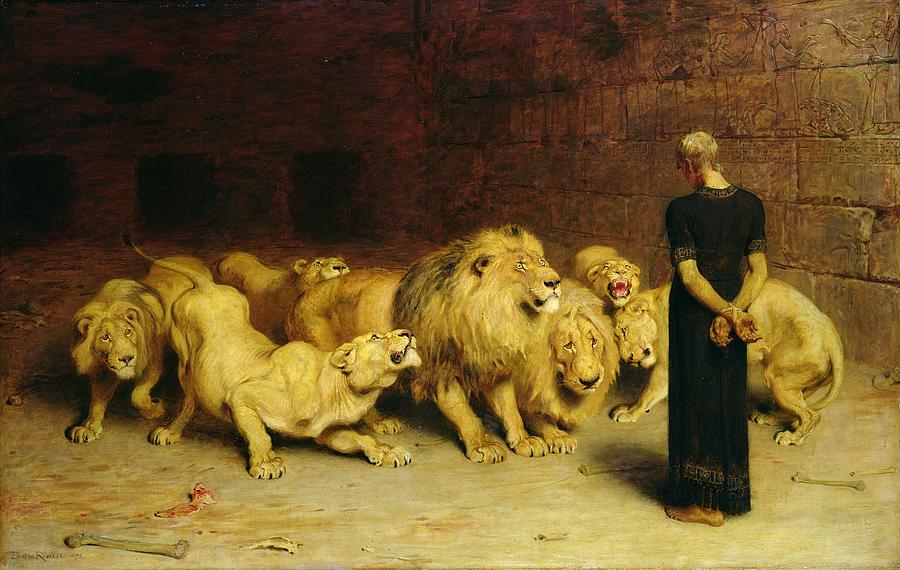
We could have dared to be a Daniel:

Again, Daniel gained the esteem of his irreligious superiors, the Persian king Darius, who determined to make him prime minister of the realm. Members of the Persian royal court were jealous of Daniel, and sought some justification to attack his character—yet none could be found “because he was faithful, and no error or fault was found in him.” Since there was no impugning Daniel’s character, it was again the Jewish religion that became the focal point of the problem. Daniel refused to stop giving thanks to God despite a royal decree that the Persian king must be worshipped. He practiced his religion quietly in the upper chamber of his house to avoid conflict. Still, his detractors discovered him and used his piety as a pretext for destroying him. Despite Darius’s best efforts to reverse his royal edict, Daniel was thrown into the lions’ den. We all know how that turns out.

Thing is, this was not how certain bishops in THE eternal city viewed civil authority:

If princes and magistrates duly elected are filled with the persuasion that they rule, not by their own right, but by the mandate and in the place of the Divine King, they will exercise their authority piously and wisely, and they will make laws and administer them, having in view the common good and also the human dignity of their subjects. The result will be a stable peace and tranquillity, for there will be no longer any cause of discontent. Men will see in their king or in their rulers men like themselves, perhaps unworthy or open to criticism, but they will not on that account refuse obedience if they see reflected in them the authority of Christ God and Man. Peace and harmony, too, will result; for with the spread and the universal extent of the kingdom of Christ men will become more and more conscious of the link that binds them together, and thus many conflicts will be either prevented entirely or at least their bitterness will be diminished.(Pius XI, Quas Primas)

The long history of the papacy up until John XXIII was one of daring to be a prince who could play power politics and maintain Christendom. Work with the Ottomans and dare to be a Daniel? Are you kidding me?

When Will the Gospel Coalition Police Evangelicalism’s Mean Streets?

Justin Taylor wants to parse the numbers of Trump voters to remove the EIGHTY-ONE PERCENT mantra (which is a tired and cliched understanding of the 2016 vote and allows Never Trumpers to have a target). Here‘s how to save evangelicalism from Trump:

Third, we know almost nothing about the 80 percent beyond a religious label they affirm or an experience they claim.

Do they go to church? Are they Protestant? Unless we are willing to say that “an evangelical is anyone who says he or she is an evangelical or says he or she has been ‘born again,’” then we have to admit that we are talking more about a label of self-designation than an actual movement or network, much less a reflection of theological belief or religious practice.

For example, an array of theological traditions outside of the traditional evangelical movement have adherents who say they are “evangelical” or have been “born again,” including:

mainline Protestants (27 percent)
Roman Catholics (22 percent)
Orthodox (18 percent)
Mormons (23 percent)
Jehovah’s Witness (24 percent)
spiritualist Christians (24 percent)

So, evangelical is a plastic word. It doesn’t identify much. Then why does TGC identify as evangelical if the term is so bad, which everyone has known for a while? The problem is that the term is the best for gaining as many followers as you can. If you use Baptist or Presbyterian, you cut down on potential followers, readers, and donors. So you go with the broad term and then qualify TGC further as “broadly” Reformed.

Only now when such breadth looks pretty bad out there in the mainstream media to you object how easy it is to be evangelical. Well, are TGC’s memberships requirements all that demanding?