Send the Confederate Monuments to Canada

After all, as Wilfred Laurier asserted, where else does a nation honor both the victors and the defeated?

Where is the Canadian who, comparing his country with even the freest countries, would not feel proud of the institutions which protect him? Where is the Canadian who, passing through the streets of this old city and reaching the monument raised a few steps from here to the memory of the two brave men who died on the same field of battle while contending for empire in Canada, would not feel proud of his country? In what other country under the sun can you find a similar monument reared to the memory of the conquered as well as of the conqueror? In what other country under the sun will you find the names of the conquered and the conqueror equally honored and occupying the same place in the respect of the population? (The Benefits of British Institutions, 1877)

Laurier, Canada’s first francophone Prime Minister (1896-1911), was referring to the Wolfe-Montcalm Monument that memorialized the two generals who fought on opposite sides and died in the Battle of the Plains of Abraham, a decisive battle in 1759 during the Seven Years War when the British rolled back French colonial presence in North America.

Canada’s capacity to honor both anglophones and francophones in one monument may give provide reasons for thinking of the nation up north as exceptional.

If Lecrae Can Leave, Why Can’t Orthodox Presbyterians Get Out

Some of us have been saying for a while that Reformed Protestants are not evangelical, but the standard scholarship puts conservative Presbyterians squarely in the evangelical camp. Those different assessments of Presbyterian and evangelical relations make the recent discussion of Lecrae’s departure from white evangelicalism seem partial and shortsighted. But they should give confessional Presbyterians sympathy with black Protestants.

For instance, notice what happens if you change words in Raymond Chang’s defense of Lecrae:

We need to be aware of how we bring unconscious biases to our own litmus tests of whether people of color Orthodox Presbyterians are theologically correct enough based on their emphasis on justice doctrinal issues. Often times, people of color are viewed with greater scrutiny simply because of their skin tone dress. We need to be concerned with the ways our political commitments co-opt our faith commitments. The fact that people equate Christians with a particular political party is problematic, especially if we consider how both parties are deeply flawed. We need to redefine our understanding of organizational fit. This means we need to reconsider what it means to be equipped. For example, is someone equipped for the pastorate if they have racist heterodox tendencies or beliefs? And who gets to decide if they do, white people or the people they disparage?

We also need to be mindful of how networks and credibility is established. Consider who is promoted within evangelicalism through publishing deals. If a Christian publisher looks through their catalogues and white people overwhelmingly occupy the authorial space, it is likely because the people they have come across were developed through their white evangelical network. Consider who speaks at conferences like The Gospel Coalition and Together for the Gospel and you’ll see how people who had local or regional platforms, now have national or international ones. Whether you are aware of it or not, we normalize whiteness in evangelicalism by having an overwhelming majority of white speakers and only one or two plenary speakers of color Orthodox Presbyterians. Consider the ways in which people get mentored. There are tremendous barriers to mentorship felt by Christians of color Orthodox Presbyterians who would say they hold the same faith commitments and convictions as evangelicals do, but don’t either know or have an entry point into these networks (I fortunately, had people who helped me navigate in, but I am a part of the exception, not the rule). Consider who is appointed the most senior level leadership roles and how they are found and determined upon. It cannot be true that only white people are “called” to these positions of authority and influence and people of color Orthodox Presbyterians are not.

If white evangelicalism is serious about representing the unity Christ calls us to in this world, this means you cannot find successors who preach like you do, see the world like you do, and share the same skin tonefashion as you. This means Thabiti Anyabwile or Bryan Lorritts (or any of the small handful of others) Carl Trueman cannot be the only black preachers Orthodox Presbyterian in your conferences (despite their his wonderful gifts). This means that conferences need to provide substantial opportunities for Asians and Latinos and Native Americans Presbyterians, Lutherans, and Reformed to speak as well. This means that senior leadership at churches cannot be satisfied with a disproportionate percentage of white pastors/elders to non-white confessional pastors/elders.

Further, we need to look deeply into the reasons why leaders of color Orthodox Presbyterians who occupy the top spots in Christian (evangelical) organizations and churches do not last. This means we need to have the humility to listen, but not just listen, and act upon the problems we see. This also means evangelicalism needs to allow people of color Orthodox Presbyterians to speak for themselves and on their own terms. We also need to create pipelines for evangelicals of color confessional Protestants to grow in leadership opportunities (see what Intervarsity did with the Daniel Project) because we know that leadership matters and that leadership shapes organizations.

Of course, the difference is that Orthodox Presbyterians already have their own institutions and structures. That institutional basis means that OP’s aren’t necessarily jonesing for leadership in TGC. Since that is true, and since the freedom of religion means that all Protestants have the opportunity to form their own structures (which the black church already has), then why is it that Christians of color or some Orthodox Presbyterians aspire to receive the imprimatur of John Piper, D. A. Carson, and Tim Keller?

General Revelation

Why don’t Christians have all the truth? Because non-Christians are smart and attend well to creation. Some highlights of recent revelations from people not explicitly illumined by the Holy Spirit or committed to Reformed Protestant epistemology:

First, a great piece on the films of Whit Stillman which includes this:

Though certainly a contemporary filmmaker and not in any sense a stranded nostalgist, Stillman nevertheless displays qualities that, while once common, are now so rare that they put him in stark relief against nearly all of his contemporaries. Perhaps most pronounced is his distinctive affection for his uniformly well-born characters. If revulsion for bourgeois hypocrisy seems an obligatory quality in American independent filmmaking these days, Stillman will have none of it. He offers instead a gentle satire of his characters’ foibles combined with a frank sympathy for their principles. While quite natural in Austen novels and RKO comedies of the 1930s and ’40s, this is rare today. Thus is it all the more striking that Stillman continues to receive critical acclaim from disparate publications and institutions, from a Vanity Fair photo spread for the 25th anniversary of Metropolitan to a volume of effusive essays from the Intercollegiate Studies Institute.

Second, the short-sightedness of suburban growth:

Since the end of World War II, our cities and towns have experienced growth using three primary mechanisms:

1. Transfer payments between governments: where the federal or state government makes a direct investment in growth at the local level, such as funding a water or sewer system expansion.

2. Transportation spending: where transportation infrastructure is used to improve access to a site that can then be developed.3

3. Public and private-sector debt: where cities, developers, companies, and individuals take on debt as part of the development process, whether during construction or through the assumption of a mortgage.

In each of these mechanisms, the local unit of government benefits from the enhanced revenues associated with new growth. But it also typically assumes the long-term liability for maintaining the new infrastructure. This exchange — a near-term cash advantage for a long-term financial obligation — is one element of a Ponzi scheme.

The other is the realization that the revenue collected does not come near to covering the costs of maintaining the infrastructure. In America, we have a ticking time bomb of unfunded liability for infrastructure maintenance. The American Society of Civil Engineers (ASCE) estimates the cost at $5 trillion — but that’s just for major infrastructure, not the minor streets, curbs, walks, and pipes that serve our homes.

The reason we have this gap is because the public yield from the suburban development pattern — the amount of tax revenue obtained per increment of liability assumed — is ridiculously low.

Last, the folly of an all volunteer military:

When the Gates Commission set up the rationale for the AVF in 1970, it did so at the behest of a president, Richard Nixon, who had come to see the conscript military as a political dagger aimed at his own heart. One could argue that the decision to abolish conscription was a foregone conclusion; the Commission simply provided a rationale for doing it and for volunteerism to replace it.

But whatever we might think of the Commission’s work and Nixon’s motivation, what has happened in the last 16 years—interminable war—was never on the Commission’s radar screen. Like most crises, as Colin Powell used to lament when he was chairman of the Joint Chiefs of Staff, this one was unexpected, not planned for, and begs denial as a first reaction.

That said, after 16 years of war it is plain to all but the most recalcitrant that the U.S. cannot afford the AVF—ethically, morally, or fiscally.

Fiscally, the AVF is going to break the bank. The land forces in particular are still having difficulties fielding adequate numbers—even with lowered standards, substituting women for men (from 1.6 percent of the AVF in 1973 to more than 16 percent today), recruitment and reenlistment bonuses totaling tens of millions of dollars, advertising campaigns costing billions, massive recruitment of non-citizens, use of psychotropic drugs to recycle unfit soldiers and Marines to combat zones, and overall pay and allowances that include free world-class health care and excellent retirement plans that are, for the first time in the military’s history, comparable to or even exceeding civilian rates and offerings.

A glaring case in point is the recent recruitment by the Army of 62,000 men and women, its target for fiscal year 2016. To arrive at that objective, the Army needed 9,000 recruiting staff (equivalent to three combat brigades) working full-time. If one does the math, that equates to each of these recruiters gaining one-point-something recruits every two months—an utterly astounding statistic. Additionally, the Army had to resort to taking a small percentage of recruits in Mental Category IV—the lowest category and one that, post-Vietnam, the Army made a silent promise never to resort to again.

Moreover, the recruiting and retention process and rich pay and allowances are consuming one half of the Army’s entire annual budget slice, precluding any sort of affordable increase in its end strength.

All of these pieces relate to the United States’ growth as a world power and the way we pay (or don’t) for it. Stillman’s movie, Barcelona, is an amusing take on the convergence of economic interest and Cold War policy. And none of it will you (nor should you) find in New Horizons.

Why Pietism and Liberalism Go Hand in Hand

Amy Julia Becker declares her independence from evangelicalism — for at least the reign of President Trump. She seems to think that evangelical stands for something on the conservative side of Christianity’s spectrum. But she now sees how political evangelicalism has become. I’m not sure if she just landed from Mars.

Here is what makes her a pietist:

I am still tempted to categorize my Christian friends with words like “liberal” or “progressive” or “orthodox” or “conservative” or “evangelical.” I am still tempted to judge the faith of other people according to my standards of who and what constitutes Christianity. But when I stop and ask how I see God’s work in their expressions of faith — when I stop and consider the expansive love of God at work in and through countless people, people like me, people who have our theology wrong plenty of the time, people who have our theology right and still behave badly, people who are bumbling around in a world of sin and are still at our core beloved by God and invited to participate in God’s work in the world — when I do that, I start to believe that we are Christians.

Imagine what Ms. Becker would do with Arius. Look at how much he loves God.

Or what about Jacob Arminius? Well, he sure seems serious about the faith.

But such displays of or criteria for genuine faith have little to do with forms. In fact, it’s not just that Christianity revolves around feelings. The people who hurt feelings, the ones who stress right doctrine, the inerrancy of the Bible, or the regulative principle of worship, they are people who care more about forms than feelings. And therefore, such conservatives are inferior kinds of Christians. Tight sphinctered. Machen’s warrior children. They lack charity.

Snowflake Christians beget snowflake nones.

Before Calvin

What would happen if critics of 2k had to think about the relationship between the church and magistrates before emperors got religion (and who knows if they grasped Christianity for the right reasons)?

In the current issue of New Horizons, David VanDrunen explains where 2k reflection on the state starts — not in 1536 but in 33.

The apostolic church lived under civil magistrates who did not confess Christ and sometimes persecuted people who did. Yet New Testament texts such as Romans 13:1–7 and 1 Peter 2:13–17 taught that God had ordained civil magistrates and that believers ought to honor and submit to them.

Following the Roman emperor Constantine’s conversion to Christianity in the early fourth century, the status of Christians in society changed. The contemporary church historian Eusebius, in his Ecclesiastical History, described the Roman Empire under Constantine as the fulfillment of Old Testament texts prophesying that war would cease and the wicked would be cut off: Constantine was realizing Christ’s kingdom on earth. Shortly thereafter, Augustine (354–430) provided a much more modest view. In his City of God, Augustine described Christians as sojourners, on a pilgrimage in this world toward the heavenly city. He acknowledged that Christians should participate in their political communities, but he taught that all earthly rulers and empires are provisional, not to be confused with Christians’ eschatological hope.

In the fifth century, the “Christendom” model emerged. As described by Pope Gelasius I, there are “two powers” that exercise authority under God in this world: the emperor has authority over “temporal affairs” for the sake of “public order,” and the priest controls the sacraments and “spiritual activities,” toward the goal of “eternal life.” Priest and emperor should submit to one another in their proper spheres.

This model was helpful in important respects. It affirmed that civil governments are legitimate, ordained by God. It also taught that their jurisdiction is limited and subject to God’s authority.

But notice the problems:

First, it essentially wed the church to the state in a confessionally unified Christian society. The New Testament, however, never suggests that Christians should expect or seek such a society.

Second, the state was expected to enforce the church’s claims about doctrine and worship by punishing dissenters with the sword. This reality sat uncomfortably beside New Testament teaching that Christ’s gospel and kingdom do not advance by the weapons of this world. Many who sought to reform the church—such as John Hus in the fifteenth century—would meet untimely ends as victims of this church-state alliance.

So long as a Protestant city council supports our guy, John Calvin, we forget about the problems of a religious magistrate? It’s our civil government.

And so long as that Cadillac CTS that only gets 13.8 mpg is a comfortable ride to church, we forget about the price of gas or limits on fossil fuels? It’s our gas guzzler.

Read This and Think Holy Plumbing?

All the benefits of Christ lead plumbers to see their craft in this text?

3 Blessed be the God and Father of our Lord Jesus Christ, who has blessed us in Christ with every spiritual blessing in the heavenly places, 4 even as he chose us in him before the foundation of the world, that we should be holy and blameless before him. In love 5 he predestined us for adoption to himself as sons through Jesus Christ, according to the purpose of his will, 6 to the praise of his glorious grace, with which he has blessed us in the Beloved. 7 In him we have redemption through his blood, the forgiveness of our trespasses, according to the riches of his grace, 8 which he lavished upon us, in all wisdom and insight 9 making known to us the mystery of his will, according to his purpose, which he set forth in Christ 10 as a plan for the fullness of time, to unite all things in him, things in heaven and things on earth. (Eph. 1)

When you work with basin wrenches, everything looks like a mounting nut.

O Canada!

Colonial religion north of the border was no more decent and orderly than it was in the U.S. of A. (though hats off to the Roman Catholics for allowing Presbyterians to use their facility):

For a time after the fall of Montreal to the British in 1760, the Presbyterians were content to worship with the city’s Anglicans. With the arrival in 1786 of John Bethune, a former army chaplain and Church of Scotland minister, they formed a congregation of their own, meeting in a rented room on Notre Dame St. But when Bethune himself moved on to Upper Canada the following year, they moved back with the Anglicans. Hard feelings? None has been recorded.

Then, in 1791, the Presbyterians moved once again to a new foster home, this time to nothing less than a Catholic one. The Recollet fathers invited the Presbyterians to use their handsome chapel in Notre Dame St. for worship once their own Sunday mass was over.

And so they did, for about a year, in front of an altar most unPresbyterian in its embellishment, a hint of incense perhaps lingering in the air. Again, no one seemed to mind.

Like the Presbyterians, the Recollets were used to sharing. They had already lent their chapel to the Anglicans, and in 1809, when the Presbyterians’ church was being reroofed, they would once again welcome the Scots.

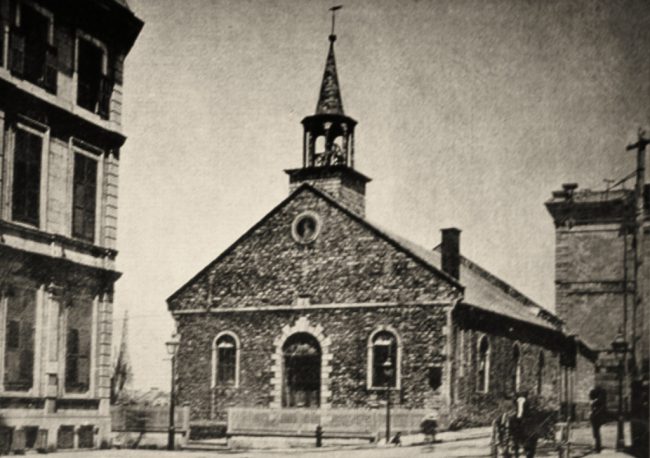
The Scotch Presbyterian Church that opened in the fall of 1792 was a plain fieldstone structure seating more than 500 people. In time, it took its name from the street where it stood, St. Gabriel. The site, which backed onto the Champ de Mars, is now occupied by part of the Old Court House on Notre Dame St.

Many Scots in the city, among them James McGill, Alexander McKenzie and William McGillivray, had grown wealthy in the fur trade, and money for the project was quickly raised to build the church. But as The Gazette noted, the speedy five months in which the work was completed also reflected “great honor on the Gentlemen of the Church of England in this City, by their having liberally contributed to the Undertaking.”At least two Catholics also contributed.

The Glasgow-born McGill was typical of the blurred lines among the various denominations here. Arriving in Montreal in 1766, he worshiped with the Anglicans and continued to rent a pew with them even after leaving with John Bethune’s new congregation. When the St. Gabriel St. Church opened, he rented a pew there as well. In 1796, he was happy to serve as the sole Protestant on a provincial commission charged with repairing and maintaining Catholic churches in Montreal.

The Presbyterians’ first minister, John Young, was an odd man. He was physically imposing – he stood six-foot-six tall, with “an eye in his head like a hawk” – but his character was flawed. Almost certainly, he was an alcoholic and what we would now call a problem gambler.

In 1788, he became pastor of a united congregation in Schenectady and Currie’s Bush, in upstate New York. But two years later, he sought to resign when his flock brought serious charges against him, probably for drunkenness. Chagrined, he made his way to Montreal and, a minister without a congregation, was doubtless pleased to find himself wooed by a congregation without a minister.

In December 1790, he was cleared of the original charge of misconduct. But when the American Presbyterians then censured him for “abruptly leaving his charge, in the sight of the slanderous accusations, and taking a journey into Canada without the knowledge of his people,” he surely concluded he had little future in Schenectady. He briefly returned, before finally throwing in his lot with the Montrealers early in 1791.

He was then about 32 years old, and was soon conducting services for the Presbyterians here. On Sept. 18, in the Recollets’ chapel, he administered the sacrament of the Lord’s Supper “in accordance with the usages of the Church of Scotland.” He took a leading part in the campaign to build a permanent home for his congregation.

Oh, What a Tangled Apologetic We Weave

When we convert to Roman Catholicism and wind up with Pope Francis.

Consider Fr. Dwight Longenecker’s recent explanation for the pope’s failure to answer those cardinals asking for clarification of Amoris Laetitia:

It is, if you like a religion based in an authoritative book, a creed, a catechism, a dogmatic systematic theology and, by extension a defined religious law. Those who favor a propositional faith like certainty and clarity.
Critics of propositional faith believe that, at best, the propositions are simply a framework or structure of belief, and that the real experience is far more complicated, but also far more exciting and real. They criticize those who like a propositional faith as being rigid, legalistic or Pharisaical. The critics of propositional faith like to emphasize the more subjective “encounter with Christ.” They advocate getting away from all the debates about doctrine or canon law, rolling up one’s sleeves and getting busy doing God’s work in the world.

Critics of propositional faith also believe that it is divisive. If “the encounter with Christ” is emphasized rather than propositional formulas of doctrine and morals, we will connect better with non Catholic Christians and people of faith and goodwill who are outside the boundaries of Christian belief. In other words, “doctrine is divisive” but if we focus on religious experience we are more likely to find common ground.

They also feel that a “propositional faith” is, by its nature, bound to the historical and philosophical constructs of the time and culture in which the propositions were asserted. So, the theology of Thomas Aquinas (they would argue) was fine for Europe of the thirteenth century, but it is rather clunky for the fast moving, fast changing global culture of the twenty first century. A faith that is not so propositional is more adaptable and fluid.

In reading the gospel it is difficult not to sympathize with those who criticize “propositional faith.” After all, Jesus’ main opponents were the religious people who were indeed legalistic, judgmental and bound to their laws and man made traditions. Jesus, on the other hand, waded in and “made a mess” to use Francis’ terminology. He defied the legalistic technicalities, met people where they were and brought healing, compassion and forgiveness.

Why does Pope Francis not answer his critics? I believe it is because he is not in favor of “propositional faith”. He wants Catholics to move beyond the technicalities, the details of doctrine and the constrictions of canon law to live out a Catholic life more like Jesus’–allowing for the complications and ambiguities of real life, meeting real people who face difficult decisions and are trying to be close to God while tiptoeing through the legalities and rules of being a Catholic Christian.

In other words, he does not answer his critics because he does not wish to play their game. He does not wish to be drawn into their legalistic arguments, but instead wants to continue to challenge them.

When you read Fr. Longenecker, though, on why he left Anglicanism for Roman Catholicism you start to wonder if he might have remained in the Church of England had he not been so propositional himself. Consider his lament about modernism which is non-propositional to the max:

Women’s ordination was a problem and the authority of Rome was the answer, but there was a deeper, underlying problem with the Anglican Church as I experienced it. The problem is modernism — a philosophical and theological position which is deeply opposed to historic Christianity.

The foundational problem with modernism is that it is anti-supernaturalist. The most foundational difficulty with the anti supernaturalism of the modernist is that he has an anti-Christian conception of God. For the modernist God is either totally immanent. That is He is ‘down here’ and not transcendent, or he is so totally transcendent as to be a sort of deist God who is ‘out there’ and does not intervene. What the modernist theologian cannot believe in is a God who is both immanent and transcendent–a God who is ‘out there’ but who touches this world and ultimately enters this world through the incarnation.. . .

If this is true–if Jesus’ death is no more than symbolic image, then the entire ecclesiological structure and sacramental system is no more than an archaic symbolical structure. It is a historic mythology that, at best, unlocks something within the human subconscious. It is a human construct that helps people to transition through their lives. . . .

So when they said they believed in the Incarnation they actually believed that “Jesus Christ was the most fulfilled human who ever lived. He was so self actualized that he achieved a kind of divine status. He, more than anyone else, was one with the god within.” When they ‘affirmed’ the Virgin Birth they really meant that Mary was an especially pure young woman before she had intercourse with Joseph or a Roman soldier. When they proclaimed from their pulpit on Easter Day, “Christ is Risen! He is risen indeed!” what they meant was, “In some sort of wonderful way I would want to say that Jesus Christ continued to inspire his followers after his tragic death.”

I used to think that his lie was simply being told in the halls of academia, that the rot was really only in the universities, but of course it was not only there. It had been disseminated throughout the Anglican Church through the education of the clergy for the last fifty or sixty years. Of course there were pockets of true belief and there are still. In making this critique of Anglicanism I am not damning all Anglicans.

Now that the pope doesn’t respond to his critics, Fr. Dwight gets non-propositional.

No wonder converts are always winning.

The Small Town and Its Defenders

The missus and I were glad to be in Jackson, Michigan, at the Grand River Brewery, for a set of presentations sponsored by The American Conservative. We heard Bill Kauffman, who is arguably conservatism’s funniest voice. Here’s an excerpt:

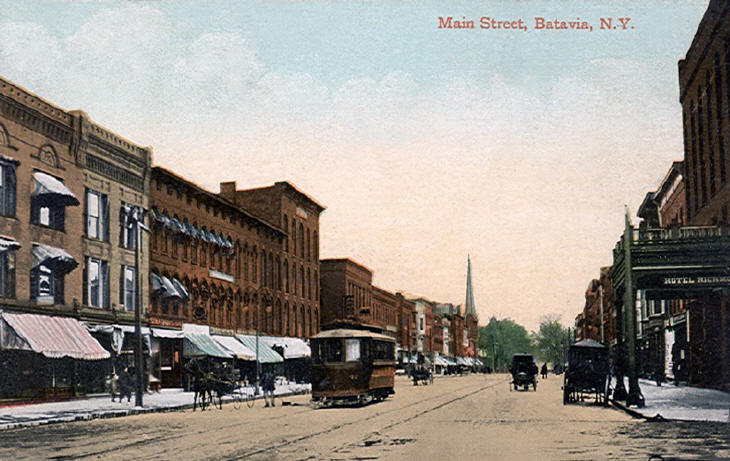
My hometown, Batavia, New York, population 15,500, has had plenty of Bill Baileys and Hughie Cannons over the years. I don’t mean by that shiftless drunks, daydreaming musicians, guys who stay out all night—they’re okay by me—but rather people who leave town, or who refuse to make a home in the place where they live. They reject Booker T. Washington’s wise injunction to cast down your bucket where you are.

In 2003 I published a book called Dispatches From the Muckdog Gazette, which is, megalomaniacally, a memoir about my repatriation to Batavia, but it’s also about the way that Batavia—and by extension all the Batavias from sea to dimming sea—has struggled to maintain a distinct identity, a character, rather than becoming just another formless wattle on the continental blob.

To the world, Batavia is merely Exit 48 on the New York State Thruway, that hideous gray scar across our green and lovely state, that drab version of the Erie Canal dedicated to that drab man Thomas E. Dewey, who fled his fine little hometown of Owosso, Michigan, which was too small to contain a man of his talent, or ego.

I don’t know how much anyone here knows of Batavia—I’m afraid we keep our little light well hidden under the bushel—but I will skip lightly over the first 160 or so years of our history and say only that it is rich, mythopoeic, beguilingly strange, as befits the cradle of the Anti-Masons, the first third party in American history.

Batavia was a prosperous little city, manufactory of combines and tractors and shotguns. English and Scots and Germans were the early settlers, coexisting uneasily with the late 19th-century polyglot influx of Italians and Poles. I’m a mongrel, a mixture of several of these streams—though my beloved late Italian grandmother insisted that we were “northern Italian—almost Swiss.” So in my book I gave myself license to write freely, even raucously, of the ethnic conflicts that once cleaved Batavia—but also gave it a good deal of its spice.

In some ways we were a typical small American city but in other ways we were “Batavia”—our own place. We did not yet bow down before the new American royalty: Burger King and Dairy Queen.

Then, as Joseph Heller would say, something happened. Urban renewal. My old boss Senator Pat Moynihan once said, when driving through Auburn, New York, which was decimated rather as Batavia was—I would do my Moynihan impression but I’m afraid I teetotaled at the reception—“in the 1950s, with a progressive government and newspaper, you got into urban renewal and destroyed everything of value in your town. If you’d had a reactionary newspaper and a grumpy mayor, you might still have it.” (Try to imagine any U.S. senator today saying something one ten-thousandth as perceptive.)

This is Your Society on Antithesis

Damon Linker explains:

Slightly (but just slightly) below the level of national politics, reverberations from news of Harvey Weinstein’s allegedly atrocious behavior with women over a span of several decades continued to radiate outward from the movie producer. Instead of a united front of disgust at the details revealed by the story that brought him down, reaction (of course!) split along partisan lines, with leading liberal and conservative writers denouncing one another for hypocrisy and double-standards (the easiest and laziest forms of moral denunciation). So the right accused the left of going easier on Weinstein than they had on conservatives Roger Ailes and Bill O’Reilly after similar behavior was alleged against them, and the left accused the right of precisely the opposite sin.

Every single event in our public life is now instantly swept up into the centrifugal whirlwind of a political culture in which the center has completely failed to hold. Democrats are increasingly defined by their hatred of Republicans, just as Republicans manage to agree about little besides their loathing of Democrats.

Isn’t this precisely what happens when culture is an outworking of ground motives, and when policy is part of the plan of salvation? Living in God’s two kingdoms sure looks more attractive. But it is not nearly as fulfilling or energizing.