How W-w Liberates

Dan Hitchens objects to an understanding of religion that sees faith as fundamentally opposed to freedom. Here is one version of it:

loads of us long to know our place and stay in it with strict rules and regulations so that we don’t have to be bothered with choice and can just do as the Rees-Moggs and religions tell us: get up, wash, eat, pray, wear and do this and that, before/after doing whatever, don’t eat/drive, carry money, work or speak on this or that day. Do not marry or mingle with a person from this or that class, caste, country, belief. We can have our days, weeks and whole lives planned out and pretend there is some sort of order and justice in the world. It’s so much easier than investigating, making your own mind up, or arguing day in, day out.

Hitchens adds:

This picture of religion—a round-the-clock holiday camp schedule in which scarcely a detail goes undictated or unsupervised—would be unrecognizable to many believers. But it is the picture which occupies the secular mind. Even Damon Linker, formerly a practicing Catholic, describes the 1992 Catechism as “filled with elaborate, absolute rules laying out in minute detail how God wants us to live,” as though it were a kind of technical manual—an impression which could be dispelled by opening the book at random.

Here’s the great thing about w-w: no matter what you do, rules or not, will be faith-based with the correct outlook. All of life becomes religious. Life is round-the-clock religious. No need for a manual. Just take every thought captive.

The Answer John Piper Should Have Given

I wrote yesterday about the odd advice John Piper gave to an inquirer about watching television and movies. Even odder was that Piper did not correct said inquirer for asserting this:

Dear Pastor John, hello! I know that I have begged for Christ to receive my heart and life. My repentance is sincere. I have stopped my willful sinning, and I am doing everything I can to live a holy life. My question is about my desire and satisfaction in spiritual discipline and worship. I prefer entertainment to time with God. That’s the honest truth.

Stopped willful sinning?

Hello.

If Piper doesn’t correct that one with some instruction about ongoing sin, simul justus et peccator and all, hasn’t he missed a great teaching opportunity?

That he failed to challenge this framing of the question may be a tell about the Baptist pastor’s understanding of justification and good works.

Not So Messy

The folks at Witness have abandoned a theological system (Reformed) to rally around a racial (black) identity. Jemar Tisby explained:

Christianity is not some otherworldly religion that is only concerned with our spiritual lives. True faith acknowledges that our souls inhabit bodies and we experience the world in a physical and material way. So Christianity is also concerned with our reality as a people who have been marginalized due to the racial caste system in America.

We are a “black Christian collective” because we are made in the image of God and part of that image includes our melanated skin along with the culture and experiences that go along with it….

As a “black Christian collective,” The Witness has returned to its original mission to serve black people. The move from “African American” to “black” acknowledges this endeavor is international scope. The Witness is for the entire African diaspora. We are also a collective in the sense that a variety of black Christians from different denominations, ages, regions, and experiences all contribute their perspectives. The Witness is not the voice of black Christians; it is the microphone that amplifies those who have often gone unheard.

I was curious, in light of these changes, what The Witness’ perspective or counsel on the shootings in Texas might be. After all, the congregation is white and the shooter was white. So how would black Christians speak to or about Sutherland Springs?

It turns out, they sound like any other U.S. evangelical (white or person of color):

Tragedies like this provoke many discussions and debates around issues such as domestic violence, gun control, and church security protocols. We absolutely need to address these issues and seek concrete solutions, but that is not the focus of this post. Honestly, I don’t feel like I have the proper words at this point. I am tired saints. I have been to war and back and I am tired of violence.

Will you join me in praying that those in Sutherland Springs would be comforted by the God of all comfort? Is it alright if we include Charleston, Las Vegas, Orlando, San Bernardino, Blacksburg, Aurora, and all of those who have been struck by this plague of gun violence?

Let us pray.

Father God, we cry out to you. We thank you that we can approach your throne of grace boldly through the person and work of Jesus Christ. We thank you that you have caused us to be born again by the power of your Spirit who now indwells us and testifies with our spirits that we are the sons and daughters of God.

Father, you are able to do exceeding abundantly above all that we ask or think. We come to you now and we ask that your kingdom would come and that your will would be done on earth as it is in heaven. Lord God, bring healing to the families and communities impacted by these tragedies. We ask that you invade every place of darkness with your glorious light. Let grace abound.

I do wonder about the use of the word “darkness,” but otherwise, kudos to The Witness for showing solidarity with white Baptists.

Beware Medical Missions

Frederick Lugard, a British colonial administrator and Governor at distinct times of Hong Kong and Nigeria, included this estimate of medicine and preaching in his report on the “Rise of our East African Empire” (1893):

I think the most useful missions are the medical and the industrial, in the initial stages of savage development. A combination of the two is, in my opinion, an ideal mission. Such is the work of the Scotch Free Church on Lake Nyasa. The medical missionary begins work with every advantage. Throughout Africa the ideas of the cure of the body and of the soul are closely allied. The “medicine man” is credited not only with a knowledge of the simples and drugs which may avert or cure disease, but owing to the superstitions of the people, he is also supposed to have a knowledge of the charms and dawa which will invoke the aid of the Deity or appease His wrath, and of the witchcraft and magic (ulu) by which success in war, immunity from danger, or a supply of rain may be obtained. As the skill of the European in medicine asserts its superiority over the crude methods of the medicine man, so does he in proportion gain an influence in his teaching of the great truths of Christianity. He teaches the savage where knowledge and art cease, how far natural remedies produce their effects, independent of charms or supernatural agencies, and where divine power overrules all human efforts. Such demonstration from a medicine man, whose skill they cannot fail to recognize as superior to their own, has naturally more weight than any mere preaching. A mere preacher is discounted and his zeal is not understood. The medical missionary, moreover, gains an admission to the houses and homes of the 10 natives by virtue of his art which would not be so readily accorded to another. He becomes their adviser and referee, and his counsels are substituted for the magic and witchcraft which retard development.

Meredith Kline had a point.

The Problem with Cessationism

Cessationists apparently have the reputation of not believing in miracles after the apostolic age:

No issue has been more controversial among Protestants in the past 40 years than the charismatic gifts and the role of miracles in the post-apostolic age. The issue was controversial in previous eras of Protestant history, too, although theological lines were not usually drawn as hard and fast as they are between “cessationists” and “continuationists” today.

In the 1700s and 1800s, suspicion of claimed miracles was connected to anti-Catholicism. Protestant critics saw the Catholic tradition as riddled with fake claims of miracles. Ridiculing the fake miracle claims of Catholics (such as icons bleeding a liquid that turned out to be cherry juice) became a staple of Reformed polemics against the Catholic Church. So when seemingly miraculous events happened in Protestant churches, even sympathetic observers warned against the threat of bogus miracles.

Odd, but the cessationists I know all affirm the ongoing reality of miracles. How could you ever believe in people lost in sin becoming regenerate without resorting to the miraculous work of the Holy Spirit?

The real problem comes with the “gift” of speaking in tongues. Why do we need ongoing revelations from God if scripture is sufficient?

1. Although the light of nature, and the works of creation and providence do so far manifest the goodness, wisdom, and power of God, as to leave men unexcusable; yet are they not sufficient to give that knowledge of God, and of his will, which is necessary unto salvation. Therefore it pleased the Lord, at sundry times, and in divers manners, to reveal himself, and to declare that his will unto his church; and afterwards, for the better preserving and propagating of the truth, and for the more sure establishment and comfort of the church against the corruption of the flesh, and the malice of Satan and of the world, to commit the same wholly unto writing: which maketh the Holy Scripture to be most necessary; those former ways of God’s revealing his will unto his people being now ceased. (CofF 1.1 emphasis added)

6. The whole counsel of God concerning all things necessary for his own glory, man’s salvation, faith and life, is either expressly set down in Scripture, or by good and necessary consequence may be deduced from Scripture: unto which nothing at any time is to be added, whether by new revelations of the Spirit, or traditions of men. (CofF 1.6 emphasis added)

Continuationists who want to defend tongues are in the same predicament as Roman Catholics who defend the continuing infallible teaching of the magisterium and the authority of tradition. Does God’s word have all we need for salvation and godliness? Or do we need ongoing revelations for becoming right with God? If you make an infallible pope or a Spirit-filled Christian the arbiter of Christianity, you deny the sufficiency of Scripture.

Selah.

Evangelicals Need to Take a Page from Roman Catholics (year 501)

Inspired by some minor reflections on personal identity and politics, I present recent findings on Roman Catholics and the 2016 Presidential election.

According to our May 2017 survey, just over three-quarters of American Catholics said that they voted in the November 2016 presidential election. Of those who voted, 43 percent said they voted for Trump while 48 percent said they voted for Clinton. The other nine percent voted for minority candidates. This is fewer Trump voters and more Clinton voters than the percentages among self-identified Catholics as reported in the exit polls, which reported 52 percent voting for Trump, 45 percent voting for Clinton, and 3 percent going to other candidates. But this survey took place six months after the election and some may have been recalling the candidate they wish they had voted for rather than their actual vote.

We began our 2017 survey with a series of questions about the possible role religious beliefs might have played among American Catholics In the 2016 election.

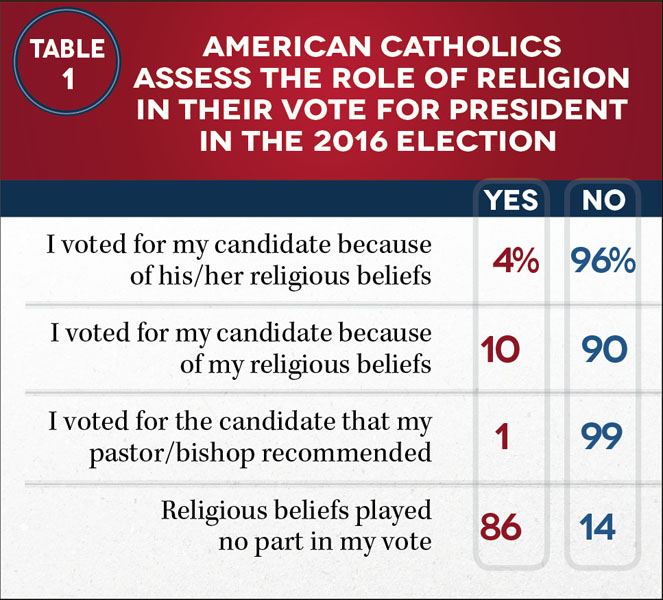
The responses of American Catholics to the questions cited in Table 1 make clear their assertion that their religious beliefs were not relevant to their vote for president in the 2016 election. The great majority (86 percent) said that religious beliefs (their own or that of the candidates) played no role in their vote. Just one in ten said that they voted for their candidate because of their own personal religious beliefs and even fewer — just 4 percent — said that they voted for their candidate because of the candidate’s religious beliefs.

Beliefs and values that are essential

That raised the question whether and to what extent did Catholics who voted for Trump differ in their religious beliefs and practices from Catholics who voted for Clinton. We have a standard block of questions about the beliefs and values that many consider essential to being a “good Catholic” that we have asked, in some form, on every survey since 1987. Table 2 compares the proportion of Trump and Clinton voters who say that each item is “essential to your vision of what it means to be Catholic.”

Catholics who supported Trump and Catholics who supported Clinton generally share very similar beliefs about how essential each of these items is to their vision of what it means to be Catholic. Differences of less than 10 percentage points between the two are not statistically significant. Both types of Catholic voters rank all ten items in virtually the same order.

Belief in the resurrection of Jesus, devotion to Mary as the Mother of God, and the papacy are essential to more than half of Trump voters and Clinton voters. Only about half saw charitable efforts to help the poor as essential and the percentage who saw the celibate male clergy as essential continues to have only a small percentage of support among either Trump or Clinton voters.

In other words, religion had little to do with the vote. That seems precisely what evangelicals should be doing. If you can segregate politics from faith, you don’t have the problem of evangelicals leaving the fold because of the movement’s political significance. Faith is one part of your life. Politics another.

Roman Catholics are doing it. Why can’t evangelicals?

Gospel Coalition Haiku

Why does a complementarian organization promote a congregation that belongs to a communion that ordains women?

Here‘s an explanation of complementarianism’s importance from TGC poobahs:

Probably all of us who share The Gospel Coalition’s vision to renew our faith in the gospel of Christ and to reform our ministry practices to conform fully to the Scriptures have been asked, “So why is TGC complementarian? Are you saying only those who uphold male leadership in the home and church believe the gospel?”

If you’ve ever wondered and asked the question yourself, we hope you’ll watch this video featuring TGC founders Don Carson, Tim Keller, and John Piper. Keller opens with a hermeneutical argument about what sometimes happens when we apply arguments in favor of egalitarianism to biblical passages that relate directly to the gospel. He also explains why TGC’s confessional statement and theological vision for ministry go beyond basic gospel doctrines to include such issues as gender roles. As Piper explains, TGC wants to say things that protect the gospel, display the gospel, and release the gospel for human flourishing. And our current age demands that believers model and argue the biblical case for Christ-like headship.

“We live in a culture where for the last 30 or 40 years, the collapse of the meaning of biblical masculinity has not produced a beautiful egalitarian society,” Piper observes. “It has produced a brutal masculine society.”

Here‘s a profile of puff piece on Hope Church, the largest Presbyterian Church in the nation (even larger than Redeemer NYC) that avoids questions about gender by featuring the topics of race and ethnicity:

The principles were solid: Churches should reflect their neighborhoods, and relationships are a good way to show God’s love to the unchurched. But the results were decidedly monoethnic congregations.

Within 20 years, Hope was the largest church in Memphis, regularly drawing 7,000 worshipers each weekend. But in a city that was nearly 60 percent black, less than 1 percent of them were African American.

At first, Hope reflected its neighborhood. The city to Hope’s south—Germantown—was 93 percent white in 2000, and 90 percent white in 2010. But its county—Shelby—fell from 47 percent white in 2000 to 41 percent white in 2010. And Cordova, the small suburb where Hope sits, dropped from nearly all white in 1988 to 68 percent white in 2010.

So Strickland and Morris set out to do what had never successfully been done before—to convert a white megachurch into a multiracial congregation.

They’re doing it.

Today, one out of five people who attends Hope is black. Of the 106 staff, 18 are nonwhite—including the senior pastor. The congregation sings hymns, contemporary Christian, and black gospel. Members work in predominately black, underresourced neighborhoods in north Memphis together through Hope’s community development corporation. They attend biannual three-day urban plunges and regularly spend eight weeks eating dinner with someone of another ethnicity.

Here’s the Evangelical Presbyterian Church’s statement on women’s ordination (Position Paper, 1984):

Thus, while some churches may ordain women and some may decline to do so, neither position is essential to the existence of the church. Since people of good faith who equally love the Lord and hold to the infallibility of Scripture differ on this issue, and since uniformity of view and practice is not essential to the existence of the visible church, the Evangelical Presbyterian Church has chosen to leave this decision to the Spirit-guided consciences of particular congregations concerning the ordination of women as elders and deacons, and to the presbyteries concerning the ordination of women as ministers.

It is in this context that the Evangelical Presbyterian Church states in its Book of Govern-ment, Chapter 6, titled “Rights Reserved to a Local Church” that “The local church has the right to elect its own officers” (6-2). This right is guaranteed in perpetuity.

Does this mean that race trumps gender?

Ecumenism is Radical (and that’s not good)

If conservatives value variety, why do conservative Roman Catholics insist on church unity? Russell Kirk said that true conservatives actually appreciate difference and pluriformity:

[C]onservatives pay attention to the principle of variety. They feel affection for the proliferating intricacy of long-established social institutions and modes of life, as distinguished from the narrowing uniformity and deadening egalitarianism of radical systems. For the preservation of a healthy diversity in any civilization, there must survive orders and classes, differences in material condition, and many sorts of inequality. The only true forms of equality are equality at the Last Judgment and equality before a just court of law; all other attempts at levelling must lead, at best, to social stagnation. Society requires honest and able leadership; and if natural and institutional differences are destroyed, presently some tyrant or host of squalid oligarchs will create new forms of inequality.

Maybe that makes John Turner a conservative who is not going along with the Reformation as tragedy because it divided the church:

First and foremost, there was no good reason for the primacy of the Bishop of Rome in the first place. Jesus bestowed the keys of the kingdom on Peter, but it seems clear from the Book of Acts and the Pauline epistles that Peter hardly exercised anything like papal authority in the early church. The historical evidence for Peter becoming the first bishop of Rome (or even being in the city) is unconvincing to one not already convinced. While Protestants obviously sundered the institutional unity of the Western church, it was a sort of unity unauthorized by scripture and unwarranted by the circumstances of the early church. (It also seems snarky but necessary to mention that Rome bore considerable responsibility for the Great Schism between East and West that preceded the Reformation by a half-millennium).

Second, it is not at all clear to me that Jesus’s prayer for Christian unity means that Jesus wanted his church to have an institutional, hierarchical unity along the lines of either the late-medieval or contemporary Catholic Church. The Book of Acts suggests that the apostles in Jerusalem exercised a measured primacy among early Christians, but for the most part Christianity spread around the Mediterranean world and to the East in a way that fostered local autonomy and diversity. This diversity of theologies and even collections of scripture alarmed many Christians, some of whom identified many strands of Christianity as heresy. By the fourth century, newly tolerated and then established Christianity sought to impose theological order on this chaos. The result was the institutionally useful but not terribly New Testament idea that all Christians had to have essentially the same understanding of Jesus Christ and of the relationship among the members of the Trinity. Getting at least most Christians to assent to the fourth- and fifth-century creeds took a considerable amount of viciousness and sometimes violence.

So it’s the church unitedists who also likely go for the United Nations and the European Union (even while in some parts of the world arguing for a “two-state” solution).

Celebrating a Reformed Church

I saw a story today about the U.S. bishops having to calculate the uprightness of the Republican tax plan:

After Paul Ryan told an audience at Georgetown University that his legislative work conforms to Catholic social teaching “as best I can make of it,” he homed in on the importance of reducing the federal deficit. “The overarching threat to our whole society today is the exploding federal debt,” he said. “The Holy Father, Pope Benedict, has charged that governments, communities, and individuals running up high debt levels are `living at the expense of future generations’ and `living in untruth.’”

That was in 2012—a smart (if incomplete) retort to scholars, bishops, and commentators who argued that Ryan’s budget priorities ran afoul of Catholic social doctrine. But on October 25, House Republicans under the Wisconsin congressman’s leadership approved a budget blueprint that would bring about an alarming increase in federal debt to achieve tax cuts weighted to benefit the rich. Even in the annals of federal budgeting, an additional gap of $1.5 trillion or more over ten years is a lot of money. When the Senate put forth this plan, which the large majority of Ryan’s caucus rubber-stamped, the Congressional Budget Office warned that “the high and rising debt that is projected would have serious negative consequences for the budget and the nation.” . . .

To give Ryan the benefit of the doubt, there is still time to work out a more principled budget. But, like just about every American politician who claims support in Catholic teaching, he needs to go beyond cherry-picking. He’ll need to consider factors beyond the deficit—especially distributive justice, which, as Pope Benedict wrote in his 2009 encyclical Caritas in veritate, the church has highlighted “unceasingly.”

The U.S. Conference of Catholic Bishops highlighted this facet of Catholic teaching in an October 25 letter on “moral criteria to assist Congress during deliberations on possible tax reform.” The letter said that the tax burden should not be shifted from the rich to the poor, and noted that the Republicans’ “Unified Framework for Fixing Our Broken Tax Code” states that a revised tax code “would be at least as progressive as the existing tax code.” . . .

The bishops’ moral criteria also include concern for the poor; strengthening families; “adequate revenue for the sake of the common good”; avoiding cuts to poverty programs to finance tax reform; and encouraging charitable giving.

I don’t know what Ryan would make of this list, which was part of a letter to all members of Congress from Bishop Frank Dewane of Venice, Fla., chairman of the bishops’ Committee on Domestic Justice and Human Development. But these are points the bishops have made time and again as they advance the notion that a budget is a moral document. Before the House vote on October 25, the bishops’ conference took the step of posting a notice online saying that “Christ teaches that we should find Him the `the least of these,’ (Matthew 25). Call on your Representatives to not forget the poor as they debate and vote on the budget resolution.”

On Reformation Day 2017 I’m so thankful for pastors who actually attend to God’s word and leave politics to politicians.

I’m also glad for reformers who created a separate realm for the church so that secular society could be secular.

I’m especially glad that Orthodox Presbyterian pastors and elders, as gifted as they are, don’t feel responsible for explaining tax policy to Congress.

Union with Christ for Experimental Calvinists

According to a pseudonymous author, 1978 was the year Reformed theology changed:

Reformed theology has changed. And there seems to be no going back. It was in the year 1978 that a tectonic shift in the underlying structure of Reformed theology began with the publication of a small book. The changes were not only systematic, but also systemic—affecting all aspects of it. Yet, interestingly, the changes were initially imperceptible until several years later.

Dr. Richard Gaffin, of Westminster Theological Seminary published his first book, The Centrality of the Resurrection, which would later be renamed and mass published under the title Resurrection and Redemption: A Study in Paul’s Soteriology. It was in this fine exegetical work that Dr. Gaffin unpacked the meaning of the Apostle Paul’s salvation vocabulary. Words like justification, sanctification, adoption, etc. would be understood differently in light his research. Dr. Gaffin was building upon historical Reformed theology as well as critiquing it. To do this he was deeply influenced by the work of various theologians across denominational distinctions, and in particular he was shaped by Reformed thinkers such as Herman Ridderbos and John Murray. But in the end, Dr. Gaffin would put together the exegetical conclusions in a way that had never been done before.

A recovery of union with Christ could have led to a higher view of the sacraments, the way it did for John Williamson Nevin, who also stressed union with Christ:

Most people are taught in Reformed churches and seminaries, to think linearly about salvation (e.g. Justification leads to Sanctification which leads to Glorification). A person is first justified (i.e. saved, forgiven) and then comes sanctification (i.e. growth, maturity), and then comes glorification (i.e. dying and rising from the dead at the resurrection). Other words may be added to this order of salvation (e.g. regeneration, adoption, etc.) but the historical way of looking at these words fits them in an unbreakable, linear, “golden” chain. This is called the ordo salutis (Latin term: “order of salvation”). It’s the Reformed way of explaining the application of salvation to a person from beginning to end. Once a person is justified, the other benefits follow in due course. If a person is “truly” justified, the rest will follow.

This is one reason why Reformed theology has always struggled to “fit” the sacraments into any meaningful place in its systematic theology. If the golden chain of salvation can’t break, then it’s difficult to see how baptism is really all that important or why the Lord’s Supper is necessary. While Reformed theology held to the Lord’s Supper as a “means of grace” it was rare to find a Reformed church practice weekly communion or place it on par with preaching. The sacraments were aids to faith–crutches if you will–but not really necessary in the life and practice of Reformed churches considering the logical consequences of the “golden chain.” If you focus on the linear progression of the ordo salutis, the unbreakable chain of salvation, starting with predestination and ending with glorification then, the sacraments have little need in such a theological system, logically and practically speaking.

But that isn’t where Dr. Gaffin wanted union to go:

But if soteriology is eschatology, then doesn’t soteriology also include the restoration and renewal of personal relationships in a new community? If that’s the case, then isn’t soteriology also ecclesiology? This conclusion, in particular, the “New Gaffin” in his By Faith would attempt to avoid in order distance himself from the sacramental and ecclesiological implications. While many scholars and theologians were coming to this particular conclusion, Dr. Gaffin was distancing himself away from the conclusion that soteriology is ecclesiology.

But despite his attempts to ward off the conclusions, there were clear biblical arguments that couldn’t be avoided by many. Baptism engrafts into Jesus Christ. As Dr. Gaffin had originally said, “…if ‘washing’ on which ‘regeneration’ is directly dependent in Titus 3:5, refers to baptism, then what Romans 6:3ff…teaches concerning baptism as a sign and seal of incorporation with the resurrected Christ, and so the implications of that incorporation, will have to be brought to bear here.” The implications were clear to many: All the benefits of salvation are given in baptism because baptism engrafts into Christ. Soteriology didn’t simply have “implications” on ecclesiology; it is ecclesiology. To be baptized into the Christian church is to be baptized into Jesus Christ.

In which case, how revolutionary was the recovery of union with Christ? Did its advocates simply tinker with the ordo salutis or did they seek to apply union to ecclesiology, liturgy and the sacraments? From this seat, it looks like union had a narrow application, chiefly to a discussion of the application of redemption that comes up in questions 29 through 38 in the Shorter Catechism. For union to apply to questions 88 through 97, unionists would need the Federal Visionaries.