Expiration Date Passed

Apparently Ta-Nehisi Coates’ magic has worn off. Several writers have recently taken issue with his ideas about race relations and whiteness (and white superiority). Thomas Chatterton Williams, who was one of the first black authors to take Coates on, returns for another at bat under with the approval of editors at the New York Times (not the New York Post or the Washington Times). This must be serious.

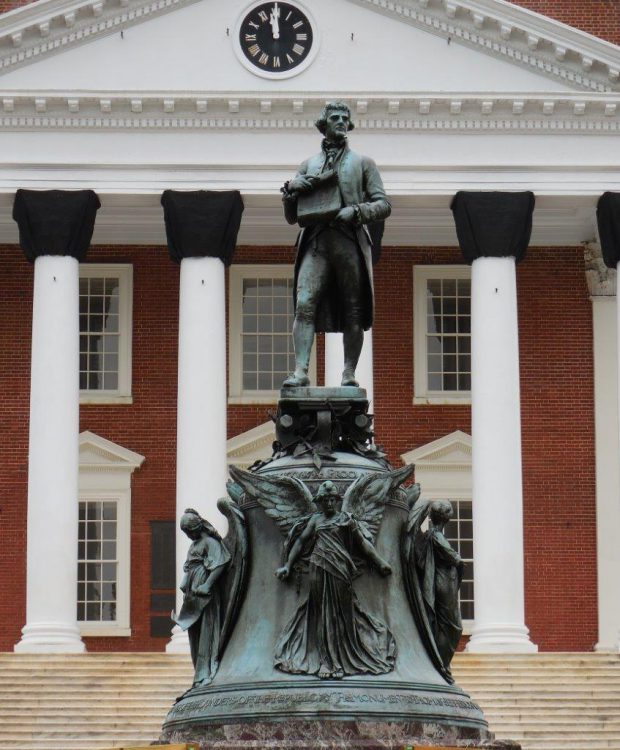
At the Atlantic though, where Coates writes regularly and achieved some of his fame, his editors still think Coates is brilliant and that they bask in the brilliance by publishing and endorsing his ideas. For instance, on a recent podcast about Charlottesville and the Confederate Monuments, Jeffrey Goldberg described President Trump’s reaction, in which he wondered if taking down Robert E. Lee leads to Jefferson and Washington, in cataclysmic terms:

It is an amazing moment when the president of the United States can’t delineate the difference between the Civil War and the Revolutionary War. I think this is a breakpoint in modern American history.

Hasn’t Goldberg read Coates? Someone well before Trump showed a lack of nuance in describing white supremacy in U.S. history:

For the men who needed to believe themselves white, the bodies were the key to ta social club, and the right to break the bodies was the mark of civilization. “The two great division of society are not the rich and poor, but white and black,” said the great South Carolina senator John C. Calhoun. “And all the former, the poor as well as the rich, belong to the upper class, and are respected and treated as equals.” And there it is — the right to break the black body as the meaning of their sacred equality. And that right has always given them meaning, has always meant that there was someone down in the valley because a mountain is not a mountain if there is nothing below.

You and I, my son, are that “below.” That was true in 1776. It is true today. (Coates, Between the World and Me, 104-105).

So what do the editors at the Atlantic think of a staff writer who cannot tell the difference between the Civil War and Revolutionary War?

What’s a Mayor to Think?

This doesn’t sound transformationalizational:

For we know that if the tent that is our earthly home is destroyed, we have a building from God, a house not made with hands, eternal in the heavens. 2 For in this tent we groan, longing to put on our heavenly dwelling, 3 if indeed by putting it on we may not be found naked. 4 For while we are still in this tent, we groan, being burdened—not that we would be unclothed, but that we would be further clothed, so that what is mortal may be swallowed up by life. 5 He who has prepared us for this very thing is God, who has given us the Spirit as a guarantee.

6 So we are always of good courage. We know that while we are at home in the body we are away from the Lord, 7 for we walk by faith, not by sight. 8 Yes, we are of good courage, and we would rather be away from the body and at home with the Lord. 9 So whether we are at home or away, we make it our aim to please him. 10 For we must all appear before the judgment seat of Christ, so that each one may receive what is due for what he has done in the body, whether good or evil. (2 Cor 5)

So is the mayor, or any elected or appointed official, supposed to turn to Abraham (Kuyper) rather than Paul?

What in the World (-w)?

If politicians or voters thought like this, wouldn’t the world be safer for theonomy?

The awareness that God acts in history in ways that we can only know in the context of our culturally determined experience should be central to a Christian understanding of history.

Yet the Christian must not lose sight of the premise that, just as in the Incarnation Christ’s humanity does not compromise his divinity, so the reality of God’s other work in history, going well beyond what we might explain as natural phenomena, is not compromised by the fact that it is culturally defined.

The history of Christianity reveals a perplexing mixture of divine and human factors. As Richard Lovelace has said, this history, when viewed without a proper awareness of the spiritual factors involved, “is as confusing as a football game in which half the players are invisible.”

The present work, an analysis of cultural influences on religious belief, is a study of things visible. As such it must necessarily reflect more than a little sympathy with the modern mode of explanation in terms of natural historical causation.

Yet it would be a mistake to assume that such sympathy is incompatible with, or even antagonistic to, a view of history in which God as revealed in Scripture is the dominant force, and in which other unseen spiritual forces are contending.

I find that a Christian view of history is clarified if one considers reality as more or less like the world portrayed in the works of J. R. R. Tolkien.

We live in the midst of contests between great and mysterious spiritual forces, which we understand only imperfectly and whose true dimensions we only occasionally glimpse.

Yet, frail as we are, we do play a role in this history, on the side either of the powers of light or of the powers of darkness.

It is crucially important then, that, by God’s grace, we keep our wits about us and discern the vast difference between the real forces of good and the powers of darkness disguised as angels of light.

If historians can see the forces of darkness and light in the past, imagine the powers of Christian magistrates and voters in recognizing sin and righteousness in society.

The problem is, I don’t think the Neo-Calvinists really want to go there. But they do need to acknowledge how they made the world safe for theonomists.

When the Fix is Broken

Papal infallibility looks good on paper, but not so much on the Interweb:

These criticisms of Pope Francis put progressive Catholics in an awkward position. Progressives are big fans of Francis, but it would be somewhat hypocritical of them to suddenly become papal absolutists when they clearly had disagreements with Pope John Paul II and Pope Benedict XVI. On the other hand, conservatives who are now critical of Francis accused progressives of being “cafeteria Catholics” when they disagreed with John Paul or Benedict.

All I can say is, “Welcome to the cafeteria.”

The truth is all Catholics are cafeteria Catholics. Conservative Catholics were quite willing to ignore John Paul’s and Benedict’s strong statements on justice and peace, and progressive Catholics are happy to ignore Francis’ opposition to women priests.

Disagreeing with the pope was not welcomed during the papacies of John Paul and Benedict. Bishops, priests, theologians, and Catholic publications were expected to unreservedly cheer any statement that came out of Rome. Priests were silenced, seminary professors were removed, and magazine editors were fired if they strayed from the party line. The open debate that occurred during the Second Vatican Council was closed down. Candidates for the episcopacy were chosen based on loyalty to Rome rather than on intelligence or pastoral abilities.

The atmosphere has changed under Francis. Bishops are being chosen because of their pastoral abilities and identification with the poor. Theologians are free to speak and write what they please. Catholic publications are not subject to censorship. And cardinals and theologians are publicly criticizing the pope, something that would never have been allowed in earlier papacies.

Francis can only blame himself for this. He asked for it. At the beginning of the 2016 synod on the family, he told the bishops to “Speak clearly. Let no one say, ‘This can’t be said, they will think this or that about me.’ Everything we feel must be said, with ‘parrhesia’ (boldness).”

Doesn’t mean that Protestantism is the fix, but for those thinking the other side of the Tiber has the fix, reconsider.

What’s a Plumber to Think?

In which category, flesh or Spirit, fall washers and gaskets?

5 For those who live according to the flesh set their minds on the things of the flesh, but those who live according to the Spirit set their minds on the things of the Spirit. 6 For to set the mind on the flesh is death, but to set the mind on the Spirit is life and peace. 7 For the mind that is set on the flesh is hostile to God, for it does not submit to God’s law; indeed, it cannot. 8 Those who are in the flesh cannot please God.

9 You, however, are not in the flesh but in the Spirit, if in fact the Spirit of God dwells in you. Anyone who does not have the Spirit of Christ does not belong to him. 10 But if Christ is in you, although the body is dead because of sin, the Spirit is life because of righteousness. 11 If the Spirit of him who raised Jesus from the dead dwells in you, he who raised Christ Jesus from the dead will also give life to your mortal bodies through his Spirit who dwells in you.

12 So then, brothers, we are debtors, not to the flesh, to live according to the flesh. 13 For if you live according to the flesh you will die, but if by the Spirit you put to death the deeds of the body, you will live. 14 For all who are led by the Spirit of God are sons of God. 15 For you did not receive the spirit of slavery to fall back into fear, but you have received the Spirit of adoption as sons, by whom we cry, “Abba! Father!” (Romans 8)

Was the NFL the Gateway Drug for Playboy?

I wonder when neurological scientists will study the effects on the brain of watching football on the Lord’s Day. Until then, these conclusions look shaky (even a tad reductionist along materialist lines — but, hey, it’s our reductionism):

We now see the effects of having it “all out there now.” We can see how the constant exposure to pornography is not just eating away at our souls but is quite literally highjacking our brains.

In 2011, Struthers wrote an article for Christian Research Journal that explains the effects of porn on the male brain.

“Because the human brain is the biological anchor of our psychological experience, it is helpful to understand how it operates,” he wrote. “Knowing how it is wired together and where it is sensitive can help us understand why pornography affects people the way it does.”

Here’s a simplified explanation: Sexually explicit material triggers mirror neurons in the brain. These neurons, which are involved with the process for how to mimic a behavior, contain a motor system that correlates to the planning out of a behavior. In the case of pornography, this mirror neuron system triggers the arousal, which leads to sexual tension and a need for an outlet.

“The unfortunate reality is that when he acts out (often by masturbating), this leads to hormonal and neurological consequences, which are designed to bind him to the object he is focusing on,” Struthers wrote. “In God’s plan, this would be his wife, but for many men it is an image on a screen. Pornography thus enslaves the viewer to an image, hijacking the biological response intended to bond a man to his wife and therefore inevitably loosening that bond.” (For more on this see “9 Things You Should Know About Pornography and the Brain.”)

Imagine if neurological scientists tried to measure lust in the heart. And what about those long lasting effects of images of football players kneeling during the National Anthem on a Christian’s loyalty to the God-ordained powers?

The full story has yet to be told.

Speaking of Transformationalizationism

Ken Myers once upon a time took instruction from Meredith Kline about why the idea of Christian culture is wrongheaded:

The experience of human culture in all its diversity is the way we enjoy being human. And enjoy it we must. Being human is the most profound aspect of the creation for which we ought to give thanks. If we can enjoy the beauty of all else in creation, how foolish to resent or ignore the image of the Creator, the pinnacle of creation. It is being human, not being saved — it is the image of God in us, not regeneration — that established the capacity to recognize the distinctions between the beautiful and the ubly, between order and chaos, between the creative and the stultifying.

We were created beings before we were redeemed beings. God’s benediction on creation has not been entirely erased by the Fall. Jesus Himself is not only divine, He is human. Does he enjoy it, or simply endure it? Until our bodies are made new, like the body Jesus now enjoys, our calling is not to escape fleshly existence, nor to sanctify culture (since it is “common,” shared by believer and unbeliever, and cannot be made holy), but to so influence our culture as to make it more consistent with the created nature of man, and to sanctify our own lives, because we are also living in the Spirit, with our minds set on the things that are above.

We acknowledge this distinction between the holy and the common each time we partake of the Lord’s Supper. Every meal I eat, I eat to the glory of God, under the Lordship of Christ. But not every meal I heat has the significance and the power to transform that the Lord’s Supper has. It is a holy meal in a way last week’s visit to Burger King is not. Not everyone is allowed to eat this holy meal, but everyone is allowed to eat at Burger King. If there are deficiencies within the culture that have produced Burger King, the deficiencies are not due to the fact that it is not a holy place, but because it violates or compromises aspects of our experience as human beings. If we believe that to be the case, our goal as Christians would not be to sanctify the Whopper, to make it into a sacrament, but to attempt to influence our culture to make it more fitting for human beings bearing the image of God.

While our culture may not be holy, it should not be inhuman. (All God’s Children and Blue Suede Shoes, 50-51)

Transformationalize This

Michael Oakeshott on culture (from Alan Jacobs):

A culture, particularly one such as ours, is a continuity of feelings, perceptions, ideas, engagements, attitudes and so forth, pulling in different directions, often critical of one another and contingently related to one another so as to compose not a doctrine, but what I shall call a conversational encounter. Ours, for example, accommodates not only the lyre of Apollo but also the pipes of Pan, the call of the wild; not only the poet but also the physicist; not only the majestic metropolis of Augustinian theology but also the “greenwood“ of Franciscan Christianity. A culture comprises unfinished intellectual and emotional journeyings, expeditions now abandoned but known to us in the tattered maps left behind by the explorers; it is composed of light-hearted adventures, of relationships invented and explored in exploit or in drama, of myths and stories and poems expressing fragments of human self-understanding, of gods worshipped, of responses to the mutability of the world and of encounters with death. And it reaches us, as it reached generations before ours, neither as long-ago terminated specimens of human adventure, nor as an accumulation of human achievements we are called upon to accept, but as a manifold of invitations to look, to listen and to reflect.

And the holy urbanists actually think they are up to taking every thought captive? They may have bought that bridge in Brooklyn.

Why Did Jesus Even Need to Die?

The incarnation accomplished what can only a cosmic Mack Truck could do:

“The Word became flesh.” By his Incarnation Jesus restored in himself God’s creation of man and woman at the beginning of human history in his own image. Jesus is the perfect image of the Father and thus becomes the source of restoring all of humanity as the image of God. Jesus renews the original dignity of the human being, indeed now raising it to a still higher status. Recall what the priest prays during the Preparation of the Gifts at Mass when he pours a little water into the chalice of wine: “By the mystery of this water and wine may we come to share in the divinity of Christ who humbled himself to share in our humanity.” Humanity is called now to deeper share in the life of God and this intensifies the regard that men and women have for one another. Because of the Incarnation all human beings are connected to Christ and destined to find eternal fulfillment in him. In his Encyclical Letter Redemptoris Missio St. John Paul II wrote: “Jesus came to bring integral salvation, one which embraces the whole person and all mankind, and opens up the wondrous prospect of divine filiation.”

The Church’s defense and protection of all human beings and human rights flows not simply from a philosophical principle, or from the natural law, but even more profoundly from its belief in the connection of all human beings to Christ and their destiny in him because of the Incarnation. This connectedness and destiny of all humanity to and in Christ is also the foundation of the Church’s solidarity with all peoples. Respect for the dignity and rights of others entails more than just the observance of the Ten Commandments. In the Sermon on the Mount Jesus commands the cultivation of virtues which ennoble not only one’s own self but, even more, enhance the well-being of others. Thus, for example, we are commanded not only not to kill another, but also not to be angry at someone or call a person a “fool” (cf. Mt. 5:21-22).

You’d never know that Jesus condemned the Pharisees, wasn’t particularly concerned to see Judas restored, or prophesied doom on Jerusalem. That’s okay. We can find a text in the Bible to support whatever virtue we like.

By the way, those Reformed Protestants inclined to the cosmic significance of the gospel should pay attention and make better arguments.

Red Ribbon

Just removing the cake from the Bundt pan was victory enough for we theologians of the cross. But when the cake entered at the The Most Popular Fair on Earth won second place in the Bundt cake division, the red ribbon was icing on the cake.

Here is the recipe for Mississippi Mud Cake:

Into a bowl sift together 2 cups flour, 1 teaspoon baking soda, and a pinch of salt.

In the top of a double boiler set over simmering water heat 1-3/4 cups coffee and 1/4 cup bourbon for 5 minutes. Add 5 ounces unsweetened chocolate and 2 sticks (1 cup) butter, all cut into pieces, and heat the mixture, stirring, until the chocolate and butter are melted and the mixture is smooth.

Remove the pan from the heat and stir in 2 cups sugar. Let the mixture cool for 3 minutes and transfer it to the bowl of an.electric mixer.

Add the flour mixture to the chocolate mixture, 1/2 cup at a time, beating at medium speed, and continue to beat the mixture for 1 minute.

Add 2 eggs, lightly beaten, and 1 teaspoon vanilla and beat the batter until it is smooth.

Butter a 9-inch tube pan, 3-1/2 inches deep, and dust it with cocoa. Pour in the batter and bake the cake in a pre- heated very slow oven (275° F.) for 1 hour and 30 minutes, or until a cake tester inserted in the cake comes out clean.

Let the cake cool completely in the pan on a rack and turn it out onto a serving plate. Dust the top with powdered sugar or serve with whipped cream.

The recipe comes from a celebrated blue ribbon winner at Wisconsin county fairs who lives in Chicago and has edited and published a couple of my books.

Fine print: the one time I used butter and cocoa on the pan, the results were not great. The better strategy is to use what works best for your Bundt pan.