How Did that Work Out for You?

From the history of Cleveland Presbyterianism (1896):

OF Cleveland Presbyterianism it may be said that it was from the beginning New Englandized, and then recruited from New York rather than from Pennsylvania. In type of theological belief, then, it has always been liberal, but at the same time evangelical and fairly aggressive, as seen in its missionary spirit. The network of churches now numbers seventeen, counting the East Cleveland, Windermere, and Glenville Churches, which are out of the city only by a narrow bound. The aggregate membership of these churches is about 6,500. All the congregations are housed in admirable buildings, and the value of the property is fully $1,000,000. These churches furnish sittings for about 10,000 worshipers, while in the Sunday-schools there are 6,500 scholars.

The 1801 Plan of Union was a killer. It placed Presbyterians on the front lines of United States religious nationalism. They made America great and Presbyterians have not been able to give up their seat at the table ever since.

Tribalism Comes Naturally

Damon Linker explains why Marx and Plato were wrong:

Politics in all times and places involves a bounded community defining itself, and its citizens ruling themselves, in contradistinction to other bounded communities. The community can be a village, tribe, or city-state; a nation-state; or an empire. Certain forms of government are better suited to certain sizes than others. (A small community can work as a pure democracy, for example, but a vast empire never could.) But regardless of the community’s size, it always has limits (a border), and it always draws a distinction between those who are permitted to join the community and those who are not; between who is and who is not a citizen; and between who does and who does not get to enjoy the privileges that come with citizenship, including a say in making such determinations in the future. This may in fact be the most elemental political act of all, the basis of everything else the political community does. To declare that this act is prima facie illegitimate is to declare a foundational political act to be illegitimate. It is to treat politics itself as in some sense morally compromised. . . .

But then again, neither is it possible to justify in universal-rational terms the right to private property or, really, any form of inherited (unearned) wealth or privilege. The more you think about it, politics (very much including liberal politics) is an activity shot through with norms, practices, and beliefs that can be rather easily exposed as “fictions” once subjected to universal-rational scrutiny.

That’s why philosophers as otherwise so profoundly different as Plato and Karl Marx have concluded that the rule of reason and justice demands communism (the abolition of private property). Indeed, Plato went even further than Marx, to suggest that in a perfectly rational and just political system, property communism would need to be combined with communism of families, with children taken from their parents at birth and raised by the community as a whole. After all, isn’t deference to a mother’s love for her own child based on the fiction that she is always automatically best suited by nature to raise him or her?

The most that might be said for our neoliberal almost-open-border advocates is that they think Plato should have gone even farther in subjecting politics to universal-rational scrutiny and advocated a completely communist state that is also boundless in extent, encompassing all people everywhere, without distinction.

In other words, Plato should have advocated the universal, homogenous state — which is precisely what many on the center-left seem to not-so-secretly believe morality demands.

That such a state is neither possible nor desirable (recall what I said about the largest political communities and their incompatibility with democracy) should be obvious. But then what do our universalist liberals hope to accomplish, not by raising perfectly reasonable objections to specific immigration restrictions, but by denying the legitimacy of having any immigration restrictions at all? There are many, many intellectually coherent answers to the two key questions of immigration policy (Who can come here? And how many of them?) — but many on the left seem to think there is only one legitimate answer to each question (Everyone. And all of them). This is ludicrous.

Linker could have added evangelicals and Roman Catholics who think that the parable of the Good Samaritan should inform how American Christians respond to outsiders:

So, as governments oversee matters of security, we will care for the hurting, calling Christians to embrace refugees through their denomination, congregation, or other nonprofits by providing for immediate and long-term needs, such as housing, food, clothing, employment, English-language classes, and schooling for children.

We distinguish that the refugees fleeing this violence are not our enemies; they are victims. We call for Christians to support ministries showing the love of Jesus to the most vulnerable, those in desperate need, and the hurting. This is what Jesus did; he came to the hurting and brought peace to those in despair.

Critical moments like these are opportunities for us to be like Jesus, showing and sharing his love to the hurting and the vulnerable in the midst of this global crisis. Thus we declare that we care, we are responding because our allegiance is to Jesus, and we seek to be more like him, emulating his compassionate care for the most vulnerable.

Granted, aid to refugees is not immigration policy. Nor is Emma Lazarus‘ poem.

But borders matter and Christians who want to assist those who have fled their homelands do so not as residents of planet earth but as citizens whose nations make laws that govern who comes and goes. Just try traveling somewhere outside the U.S. to minister the gospel or provide diaconal assistance without a passport.

Don’t Blame Calvinism

In his daily set of links to items of interest, Michael Sean Winters commits this drive by:

we as a culture used to know money was corrupting, but have forgotten that fact in recent years. There is something to the argument, to be sure, but there was a fascination with the robber barons and the Newport elite longer before “Lifestyles of the Rich and Famous” came along. And Calvinism, the strongest religious influence in our culture, has always had a soft spot for wealth, seeing it as evidence of divine approval, rather than as the devil laying his traps.

Notice the either-or perspective on wealth — either it’s from God or from the devil. And Winters thinks Roman Catholic conservatives are guilty of dualism.

What Winters reveals is that Rome has never caught up to Protestants on vocation and how to understand work in the world (whether you make a lot of money or not). Imagine if Rome had taught about secular work as part of the priesthood of all believers. They might have helped Protestants who tried to hold back the tide of acquisitive (or status seeking) participation in the market.

Consider the way that Rod Liddle in his review of J. D. Vance’s Hillbilly Elegy describes middle-class English Protestantism of a generation or so ago:

I was of J. D.’s mum’s generation, the people who made fecklessness a lifestyle choice, and were somehow encouraged to do so. We jettisoned almost everything our parents believed in and made ourselves much worse off—just as did J. D.’s mother. I tried to make sense of this generational shift in a book—Selfish, Whining Monkeys—which attempted to explain the reasons why my generation had managed, in such a short space of time, to let down their children and their parents. Some of it accords with what Vance has to say, even if he does not spell it out. Gone, for example, was any notion of deferred gratification and work ethic—just one of the many consequences of the diminished importance of religion in our lives.

Protestantism inculcated a simple and perhaps confining moral code: work hard, invest, don’t steal, look after your community, put your family first, wait for reward—always wait for reward. Don’t sleep around, don’t lie, don’t spend more money than you have. For my parents’ generation, divorce was a stigma and vanishingly rare, at that. But recently I stood outside a Middlesbrough job center interviewing one hundred or so people who were seeking work. Every single one of that hundred came from a broken family. Every one. And of those who now had children themselves, every one was no longer with the partner with whom she’d had the child. And this state of affairs had not made them happy; it had wrecked them. They were all J. D.’s mum now.

What’s so bad about that approach to work and economic considerations? Granted, those middle-class virtues are not the sole possession of Protestant creeds and confessions. But it is hardly a recipe for “the lives of the rich and famous.”

And what did Roman Catholics offer as an alternative?

Within the early Christian community through the medieval period, a similar attitude toward work in the world as associated with the body and the lower elements of human nature prevailed. Through the influences especially of neo-Platonic thought, the emphasis was upon a life spent in contemplation, as reflected in these words of Augustine in the 5th century, “the contemplation of God is promised us as the goal of all our actions and the eternal perfection of happiness,” or Aquinas in the 13th century, “the contemplation of divine truth . . . is the goal of the whole of human life.” Work which meets the needs of the body, then, has “no lasting religious significance.” As theologian Ernst Troeltsch notes in his monumental study, The Social Teaching of the Christian Churches, “An ethic which starts from the point of view of an original equality, and which holds that the differences that do exist are due to sin, and which at its best regards the division of labour as a Divine arrangement adapted to the needs of fallen humanity, is inherently unable to see any value in ‘callings’ at all” (Troeltsch, Social Teaching, I, 121).

The monastery or the nunnery, places of withdrawal from worldly activities, exemplified the most valued state of life, and even while bodily work occurred in those settings, the work was a means of purification and the development of virtue, not an activity to be pursued for itself. Furthermore, in the later medieval period as liturgical practices took up more and more of the roles and time of the monks and nuns, they no longer worked to support themselves; many lived off the wealth of the aristocracy through gifts in exchange for prayer. Even the wandering mendicant friars lived off the good will of those whom they met along the way.

In the Catholic understanding, vocation was a response to God’s calling by removing oneself from the cares and concerns of this world. Sociologist Max Weber notes that in Jewish traditions, among the Greek and Roman classics, or in the medieval world of Catholicism, vocation had none of the contemporary meaning of a fulfillment of one’s duties to God by active engagement in the world. Further, in the medieval world someone who engaged in the work of business was certainly suspect; today’s business state of mind “would both in ancient times and in the Middle Ages have been proscribed as the lowest sort of avarice and as an attitude entirely lacking in self-respect.”8 “Business was only possible for those lax in ethical thinking.” According to Aquinas, there is “something shameful about it [commerce], being without any honorable or necessary defining goal” (quoted in Tam).

Instead of blaming Calvinism, Winters may want to look in the mirror. He may also want to think, as Liddle encourages readers, about economists on the left and the right who have no dog in the hunt for the church Jesus founded:

But it’s not just the retreat of religion, or more properly, our retreat from religion, that caused this shift. It was also the rise of two supposedly oppositional doctrines that grew up in the early 1960s. First, the post-Marxist Frankfurt school of sociologists (Habermas, Horkheimer, Marcuse, et al.), which posited the overthrowing of those old, discredited notions of respect for authority, of capitalism, of anything that could be considered bourgeois, in favor of rampant individualism and free expression—sexually, morally, politically—which unpicked the fabric painstakingly woven by our parents and their parents before them. And then the Chicago school of economists (Hayek, Friedman, et al.), which also posited a rapacious individualism at the expense of the larger society. A deregulated economy in which homes were not places in which one lived, but another form of collateral. An imperative to strive to make money and to spend, to consume and consume without the constraints which had previously attended.

An Argument that Bites Off More than It Can Chew

Bishop Robert Barron is traveling in Italy and recently came across the teeth of Ambrose of Milan. They were on display as relics at a basilica in Milan, and led the bishop to make this argument in defense of such sacred material:

[Cardinal Newman] had come to understand such pious gestures as a logical development of the doctrine of the Incarnation. In Jesus Christ, the Word of God truly became flesh. The Second Person of the Blessed Trinity took to himself a human mind and will and imagination, but also feet, hands, internal organs, muscles, veins, and bones. He lived, died, and rose in a real human body. Subsequently, in the mystical body of the Church, the Incarnation is extended through space and time, the Spirit of Jesus coming to dwell in the humanity of all the baptized and in a privileged way in the humanity of the saints. Paul acknowledged this truth when he cried exultantly, “It is no longer I who live but Christ who lives in me.” How wonderful, too, that this Christ-life is placed in the bodies of the faithful through the materiality of the sacraments: water, oil, imposed hands, transfigured bread and wine, etc. And this, Newman realized, is why the Church has, from the beginning, reverenced the bodies of the saints and treasured their relics. She has known that, as Paul put it, our bodies become temples of the Holy Spirit, dwelling places of Christ.

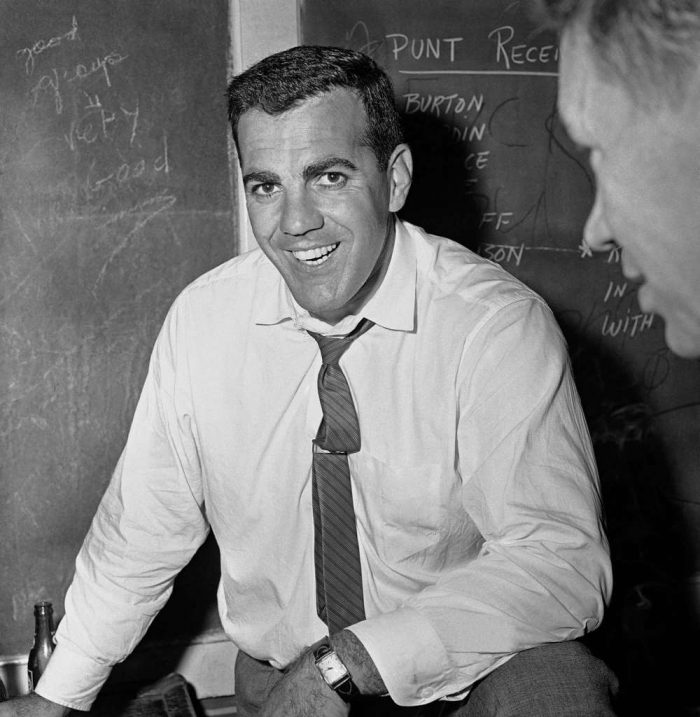
So why not save the remains of all the deceased? Ara Parseghian seemed like a pretty decent man who, even though a Presbyterian, Notre Dame fans revered. Why not preserve his bones and teeth?

The reason is that only some believers in Rome achieve the status of sainthood. Only their remains are holy. The others? The incarnation only goes so far.

Keller and Princeton – Another Perspective

Protoprotestant is a fellow who — I think — once commented here and had some brush with the NAPARC world. He blogs at The Pilgrim Underground and The Pilgrim Path/Proto-Protestantism. I’m not sure I can locate his outlook, but he is usually worth reading. Certainly not predictable.

Recently he commented on the dance performance at Redeemer NYC in ways agreeable to many confessional Presbyterians. But before going there, ProtoProtestant’s memories of and reflections on Princeton Seminary are useful for situating his Presbyterian convictions. After a recent visit to Princeton he reflected on his own spiritual pilgrimage over a twenty-year period after his first visit to the seminary town:

Standing in front of Charles Hodge’s house I couldn’t help but think of his approach to Systematic Theology and his struggles to combat Darwinism. While the latter was indeed admirable and right, his unwitting embrace of Enlightenment categories had all but fettered his own hands. I see him as a tragic figure, trying to hold something together and yet incapable, not even fully understanding what is happening.

When I think of his son AA Hodge I cannot help but recall the rationalist nature of his theology and the great lack of wisdom and insight with regard to society and Christianity. An advocate of what I would identify as imperialist missionary work and the kind of Sacralist doctrine at odds with the New Testament, AA Hodge is a breath of fresh air to Dominionists and the Theonomists who still haunt the halls of American Presbyterianism. At one time his name was hallowed to me. Today, even though a volume or two of his writings remain on my shelf, he is not one that I would esteem.

Of course BB Warfield was the ‘Lion of Princeton’, the great defender of Calvinistic Orthodoxy in the late 19th and early 20th century. An author of many fine works Warfield was nevertheless inept when it came to defending Scripture in the face of Modernism. This statement will astonish many for they view him as ‘the great defender’ of Scripture in the face of Modernism. But they say this failing to understand his capitulation and compromise. Unwittingly, Warfield laid the groundwork for today’s Evangelical laxity with regard to Scripture and the collapse of Biblical authority.

. . . Princeton, so hampered by faulty philosophically dependent Evidentialist Apologetics proved weak and began to collapse in the face of Higher Criticism and the Scientific Revolution. Warfield was himself weak on the question of evolution.

Though not buried there I could not help but think of J Gresham Machen, the founder of Westminster Seminary and the figure most associated with the genesis of the Orthodox Presbyterian Church (OPC). I was once a member of that denomination and would certainly never have anything to do with it again. That said, I cannot but to a certain extent admire Machen and (to a degree) those that went with him. His work on Christianity and Liberalism still holds a place of honour on the shelf. Though authored almost a century ago, the fundamental issues have not changed in the least. It is still a relevant and worthwhile book.

Some merit here, but clearly not an Old Life perspective.

So consider how Tim Keller looks to Protestants like this fellow:

So much for the Regulative Principle….so much for the Sufficiency of Scripture…. these doctrines aren’t even on the horizon for most ‘Reformed’ people anymore. They pay lip service to them but in actuality reject them. Keller, the PCA’s celebrity pastor has led the charge. A Dominionist cut from modern cloth, he’s a man very much at home with the world. When you believe that heaven will look something like Manhattan (investment bankers and all)… then the filth of Broadway, the Theatre District and Lincoln Centre will also be part of it.

In fact Keller’s Church, ‘Redeemer’ PCA is apropos. He believes that all of culture can be redeemed. To put it differently, all of culture can be sanctified and made holy. You must understand this if you wish to grasp why men in tights are dancing around during a worship service. Ballet is being made holy… this is (to Keller) a foretaste of heaven.

Of course this is in addition to the jazz or reggae services they host. It’s a big package. In reality it’s the same worldly gospel of the Prosperity folks but less tacky. It’s for the refined and sophisticated people of the Upper West Side.

Keller is a big deal in Reformed circles and he’s done rather well for himself. I abandoned the Reformed label years ago but even then I realised, if Keller, Piper, Mohler et al. are the Reformed ‘stalwarts’ of the 21st century then the 20th century Calvinist revival will be short lived indeed.

Old Lifers and Old School Presbyterians are not the only ones who see.

The optics!

(more of) Show Me Jesus

To hear some of the recent commentary about Rome’s relationship to modern society, you might wonder about the significance of Jesus. The young journalist, Elizabeth Bruenig, whom Presbyterians baptized, Methodists discipled, and Jews educated (at Brandeis), explained her conversion as finding a refuge from modernity:

Yet the church remains firm, unmoved by this current in modernity. And while it is impossible to speak for all Protestants—and important to note there exists a vast array of opinions on property ownership within the Protestant tradition, some hewing close to the Catholic view—the Catholic Church, at least, bases its position on property in a moral universe far more stable than that which has been constructed since the Reformation. And by the time I neared the end of my time in college, I had become convinced it was the only firm ground from which a Christian could fight back against the domination of the poor by the rich, against poverty, against the destruction of families and communities at the hands of businesses and their political lackeys, against a world stripped of meaning.

I don’t know. To say that the church remains unmoved while failing to mention the about-face involved in the 1864 Syllabus of Errors when Piux IX sneered at the church making any adjustment to modernity (does she really want that?) and the 1962 Second Vatican Council where John XXIII called the church to update its relationship to modern society is quite the claim. You might think a journalist would look a little more carefully at her sources.

Then there is praise from Anthony Annett at Commonweal for the Jesuit article that condemned U.S. evangelicals and Roman Catholics together for an “ecumenism of hate”:

the basic thesis is certainly correct—that a small but vocal and influential segment of American Catholicism is now far more comfortable with the world of right-wing political evangelicalism than with global Catholicism. (Commonweal’s editors commented on it here, and contributing editor Massimo Faggioli wrote on it here.) This world is a Calvinist world, manifesting politically in the twin ideas that the United States is God’s chosen country with a unique destiny in the world’s history, which gives rise to a dualistic outlook, and that God bestows material rewards on his favored, which leads to a full-throttled embrace of capitalism. This latter pathology comes in different levels, of course, the nadir being the appalling “prosperity gospel.”

Annett too fails to mention how a church that so resolutely opposes modernity (according to Bruenig) is so susceptible to its members doing back flips to join Calvinists in the public square. If you have all that history, authority, and tradition, what happened?

For example, at the church frequented by my in-laws in New Jersey, I’ve heard homilies glorifying the military, calling for higher military spending, criticizing Muslim immigrants, and comparing the hill of Calvary with the hill of Iwo Jima. Seriously. This is horrific, but the overwhelmingly white middle-class Mass-goers seem to lap it up. It’s no wonder that they find no contradiction between Catholicism and Trumpism. It’s no wonder that Donald Trump enjoys their support while the rest of the Catholic world views with him with askance and horror.

Clearly, episcopacy has some bugs that not even papal infallibility (determined just on the heels of the Syllabus of Errors) cannot fix.

In fact, as much as Annett and Bruenig believe that real Roman Catholicism is on the side of left-of-center politics, Matthew Schmitz agrees but also notices how out of step Rome’s liberalism is with Rome’s history. The ultramontanism that sustained Pius IX’s quest for papal infallibility also supported integralism, a form of church-state relations that conservatives and liberals in the United States might find a tad overwrought:

Integralism was the system in which church and state collaborated to secure man’s peace on this world and salvation in the next. Joseph de Maistre defended it with a formula binding pope to king: “No public morals nor national character without religion, no European religion without Christianity, no true Christianity without Catholicism, no Catholicism without the Pope, no Pope without the supremacy that belongs to him.” Essential to this arrangement was the idea that the state must be subordinate to the Church.

With Francis has come a different kind of integralism:

Today a new kind of integralism operates, in which the Church is subordinated to the state as the two conspire to uphold liberal values. If one were to update de Maistre’s syllogism, it would go something like: No cheap consumer goods or avoidance of genocide without liberalism, no liberalism without true Christianity, no true Christianity without an undogmatic Church, no undogmatic Church without a liberalising Pope, no liberalising Pope without accountability to the age and freedom from tradition.

It is in this context that one must understand the Vatican’s recent sally against America in the unofficial papal organ La Civiltà Cattolica. Written by Fr Spadaro and Marcelo Figueroa, another papal confidant, the article is not merely an expression of anti-American spite or an attack on ecclesial enemies. It is an attempt to defend the liberal order against what is perceived, rightly or wrongly, as an existential threat.

Sorry, but I’m just not seeing the unity or the authority that wow converts. Plus, did you notice that all of these opinions come from the laity. What would make Roman Catholicism from Protestantism is if lay members kept quiet and deferred to their ecclesiastical superiors. I wonder what that kind of pre-modern ecclesiastical order would do to those converts who find in Rome a horse that rides even higher than the Bible or the Holy Spirit.

Meanwhile, do Roman Catholics actually worry about personal sins, God’s judgment, and whether they are going to purgatory?

A Common Complaint from W-wers

Carlton Wynne objects to natural law and its influence among Reformed Protestants:

I believe this aspect of the Natural Law theory in view–that people can reason their way to actionable truths apart from God’s special revelation–is too optimistic about the powers of unaided reason after the fall. The general revelation of God in nature and beneath conscience must be “carefully distinguished from the reaction that sinful man makes to this revelation” (Van Til). The apostle Paul says that unbelievers “suppress the truth” that they know (including the truth of their moral obligation to God), that they are, at root, “hostile to God” (Rom 8:7); that they have become “futile in their thinking” (Rom 1:21). They are, Paul says elsewhere, “darkened in their understanding, alienated from the life of God because of the ignorance that is in them, due to their hardness of heart” (Eph 4:18).

These are hard words, no doubt. But they point to one side of what has been called the “antithesis” between belief and unbelief, a moral and spiritual conflict of basic commitments that touch all that Christians and non-Christians think about and discuss. According to this Scriptural principle, fallen man is slavishly committed to his own moral autonomy, while Christians are to view all things under the Lordship of Christ and the light of His Word. This means that, at the deepest level, there is no mutually acknowledged common ground between Christian and non-Christian. And this, it seems to me, leaves NL proponents calling for peace when there is no peace.

Fine.

If true, do you then only go to Christian physicians?

And if true, why would you ever let non-Christians into positions of political authority? If you assert the antithesis you wind up theonomic.

Will “common grace” really explain why you, a person who believes in the anti-thesis, choose a non-Christian physician or politician over Christian ones?

Presbyterians Who Don’t Want to Be

David Robertson gives away his tell when he responds to criticism for dedicating children. He thinks that critics strain at gnats while swallowing camels — the camel being a market model of ministry:

At the risk of overgeneralization it seems to me that there is a Scottish/UK version of Presbyterianism that seeks (but does not often practice) visible church unity and does not accept the ‘market place’ mentality that Paul mentions. On the other hand in the US, the land of 1,000 denominations, there is a much greater market place mentality with the pros (greater initiatives, freedom etc.) and cons (disunity, less church discipline etc.). It seems sad to me that even as the number of Christians in the US declines, the number of Presbyterian denominations will probably increase – all owning allegiance to a Confession of Faith which was set up to prevent that happening!

In England there are hardly any Presbyterians and yet we have at least two denominations committed to the WCF. In Scotland the situation is embarrassingly worse. I feel bad that the Free Church has to exist. Because of the apostasy of the Church of Scotland, I think we do have to, but I would much prefer that we didn’t. At one point I was even part of a delegation from the Free Church that met with the C of S and looked at whether and how we could reunite. But it is even more shameful to me that after a lifetime devoted to evangelism in a declining church in a decaying culture, instead of the churches which adhere to the WCF uniting together we have further divided. In my time in ministry in Scotland we have even seen four new Presbyterian denominations, all adhering to the WCF, come into being. The Associated Presbyterians, the Free Church Continuing, International Presbyterian Church and Covenant Fellowship. We talk about church unity but actions speak louder than words. My hope and prayer is that one day the Free Church will cease to exist (that will certainly come true in heaven!). I would be even more radical than that – I would prefer to work in organizational unity with Baptists and others – not just networking but pooling resources and genuinely being the one Church of Jesus Christ.

Notice that he wishes the Free Church did not exist and that he would prefer to minister with Baptists. There’s nothing inherently wrong with that. Scotland, I suppose, like the United States is a free country (Free Church in a Free Country). But I’m not sure how confessional or Presbyterian that attitude is. It does explain Robertson’s attachment to Tim Keller. It also suggests a certain kind of naivete. Does Robertson really think that TKNY is not part of a market model, or that Keller has not become a brand? Either way, why be a Presbyterian when you could just as easily minister with Baptists?

Robertson may also explain why Keller appeals to pastors in small, out of the way, denominations (perhaps unintentionally):

When evangelicals in the Church of Scotland decided that enough was enough and began to leave – they of course looked for a Confessional Presbyterian Church that was faithful to the Bible. For doctrinal and practical reasons most could not join the Reformed Presbyterians, the APC, the Free Church Continuing or the Free Presbyterians – amongst other reasons they were exclusive psalmody. That basically left the Free Church. Now there may be theological reasons why some ex C of S ministers and congregations could not join the Free Church (e.g. those who had women elders and wanted to retain them), but what of those who subscribe to the WCF, are complementarian and Presbyterian? Many have joined but an equal number haven’t – why? Some of it may be the Free Churches own fault – not being welcoming enough etc., but is that the real or adequate reason?

I think that it is the religious market place that Paul so rightly complains about which kicks in here. The reasons are not doctrinal and theological but social, personal and historical. Some had an aversion to the Free Church because of past experience (love remembers no wrongs?), image or misunderstandings about our positions. I have heard others though express things in terms of what I could only call social and class snobbery. We are perceived as not sophisticated enough, too Highland, too working class. I recall a C of S man having what I can only describe as a ‘coming out’ dinner in his home – where he invited his middle class friends to a dinner at which he introduced myself and a couple of others from the church and then announced he was attending the Free Church. It was as though he had announced he was gay! In fact he probably would have got a more favourable response! That attitude may be extreme but in a more modified form it is still there. Is not wanting to be called ‘Wee Free’ a sufficient reason for setting up yet another denomination?

This part of Robertson’s post was intriguing if only because in the United States, conservatives in the PCA seem to have a similar aversion to the OPC — not sophisticated, too tacky, ugly buildings on the wrong side of the beltway. But instead of identifying with communions of like faith, practice, and awkwardness, Robertson instead regards Keller as the right kind of American Presbyterian.

This may make sense since with all of the writing for newspapers and speaking in public that Robertson does, he may regard himself as a kind of public intellectual after the fashion of Keller. He is certainly akin to Keller in the way in which denominational attachments rest lightly on his ministerial shoulders:

The parish and pastoral approach is one that I prefer. We are not engaging in the religious market place (ironically those who take the purist/polemical approach are much more likely to do that), but we are seeking to reach out to every one in the community where we are based. (I realize of course that most of us would claim that is what we are doing and I should also point out that I think that is what Paul’s church is doing in Ealing – I’m talking about the wider issue here – not having a subtle dig – I don’t do subtle!). This means that our primary identity is not that we are a Free Church, or a Reformed church, or the church with the best preaching in Dundee, or David Robertson’s church or any other claim we might foolishly want to make. We are a church of Jesus Christ.

This is the way of pietists, to claim the high ground and act as if denominational particularities are inconsequential in comparison to vision, mission, or devotion. What happens, though, when Robertson or Keller need to explain why another church, say the Church of Scotland or the PCUSA or the Methodists are not quite up to the status of “the church of Jesus Christ”? At that point, don’t arguments about purity and polemics and doctrine kick in?

And what happens when Robertson or Keller receive funds from Presbyterian sources that were given precisely to uphold Free Church and Reformed convictions? Don’t you have to explain the way you are going to use the funds? You will use them for generic Christian purposes, not for Presbyterian ones only?

That is the sort of equivocation that captured the Church of Scotland and the Presbyterian Church in the U.S. before the Free Church and the PCA formed separate communions. Such a separate status is not everyone’s cup of tea. That’s why we have evangelicals. But evangelicals presenting as Presbyterian? That’s why we have The Gospel Coalition.

All Political Sermons are Bad

In the spirit of J. Gresham Machen, remember that if you don’t mix religion and politics, you don’t have to perform the contortions that allow you to affirm Civil Rights legislation (as a work of God) and oppose Prohibition (not as a work of God even though Protestants did think it was a work of God). Just keep politics out of the church.

But that’s not what Christians do.

And American Presbyterians have been guilty for a long time before liberal Protestants went all in on the Social Gospel. Mark Tooley reminds:

This week I studied at the Army War College at Carlisle Barracks in Pennsylvania, a fort dating to the 1700s, when President George Washington led an army there in route to suppress the Whiskey Rebellion. Farmers in western Pennsylvania had revolted against the authority of the new republic to tax the whiskey they distilled from grain otherwise expensive to ship from their remote frontier.

Quickly realizing this threat to the new nation’s cohesion, Washington in 1794 summoned the militias from Pennsylvania and nearby states into an army of 13,000 that he personally led against the rebellion. At an evening celebration of greeting for the President and his army, the town of Carlisle illumined a special proclamation simply declaring: “The Reign of the Laws.”

Such a poignant and wonderful exclamation: “The Reign of the Laws.” The people saluted Washington, but they, like he, did not place their faith in his personal rule but in impartial law as the antidote to anarchy.

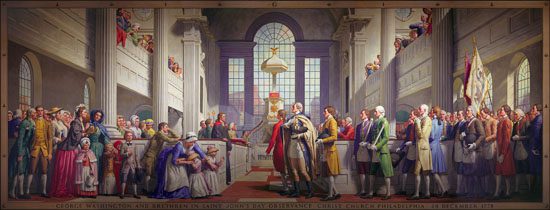
While in Carlisle Washington worshiped at the stone Presbyterian church, which I visited, and where he heard Dr. Robert Davidson preach “A Sermon on the Freedom and Happiness of the United States of America.” Washington described it in his diary: “Went to the Presbyterian meeting and heard Dr. Davidson preach a political sermon, recommendations of order and good government and the excellence of that of the United States.”

Washington’s summary was fair and succinct, but the sermon merits elaboration, both for illustrating how Christians in early America viewed God’s purposes for their nation, and for modeling, at least in part, how we today might view government, justice and nationhood providentially.

The sermon is based on King David’s question in 2 Samuel 7:23: “And what one nation in the earth is like Thy people, even like Israel?” Pastor Davidson warned against being “carried away by the spirit of the times, to substitute mere political harangues in the place of the Gospel of Christ,” recalling, per Proverbs 27:34, that “righteousness exalteth a nation; but sin is a reproach to any people.” And he noted the “duties of citizens are not to be considered as topics foreign to the Gospel” as the “Gospel views man in every condition in which man can be placed.”

Davidson heralded the “great goodness of God to our own state and nation in particular; our high and many privileges, the gratitude due from us to God for them; and the wise improvement which we ought to make of them.” As a national comparison, Davidson recalled:

The history of the Jewish nation, if read with suitable views, and especially in order to gain an acquaintance with the ways of God to men, would be one of the most instructive that could merit our attention. …We see how much superior, in point of privileges, the Jewish nation was, to all the other nations around them.

As God had showed unmerited and unprecedented favor to the Hebrew nation, Davidson urged considering the “great goodness of the Divine Being to our state and nation in particular; – our high privileges; the gratitude which we owe to God for them…” And he recalled:

This part of the New World presented itself as a place of refuge for those who wished to enjoy religious and civil freedom, unmolested, and to the greatest extent. They hoped that here they could worship God according to their consciences, and would be at a secure distance from all the insults of tyranny.

After reciting the British oppressions precipitating the American Revolution, Davidson declared the new independent nation had the “freest and best form of civil government, which could be learned from the wisdom and experience of ages,” and that with “all the imperfections” still “is one of the most free and excellent under the sun.”

Of the American republic, Davidson further rhapsodized:

This is a government, which all the real friends of freedom in the old world appear to admire; and under the wings of which the oppressed of every nation would wish to take refuge. Here is liberty and equality, according to the just acceptation of those favorite terms; liberty, civil and religious to the utmost extent that they can be, where there is any government at all; and an equality of rights, or provision made for the equal protection of the lives and properties of all. That all men should be equal, as to abilities, station, authority, and wealth, is absolutely, in the present state of things, impossible. But where every citizen has a voice in making the laws, or in choosing those who make them, and is equally under their protection, – there is equality.

I for one (why not five) am convinced that modernism did not begin with adapting Christianity to biology, higher criticism, or immigration reform. It began when Christians, like Pastor Davidson, started to adapt Christianity to modern nations like the United States. Once you start making the Bible say things it doesn’t, it’s hard to stop.

Machen Day 2017

One of the very greatest evils of present-day religious life, it seems to me, is the reception into the Church of persons who merely repeat a form of words such as “I accept Christ as my personal Saviour,” without giving the slightest evidence to show that they know what such words mean. As a consequence of this practice, hosts of persons are being received into the Church on the basis, as has been well said, of nothing more than a vague admiration for the moral character of Jesus, or else on the basis of a vague purpose of engaging in humanitarian work. One such person within the Church does more harm to the cause of Christ, I for my part believe, than ten such persons outside; and the whole practice ought to be radically changed. The truth is that the ecclesiastical currency in our day has been sadly debased; Church membership, as well as Church office, no longer means what it ought to mean. In view of such a situation, we ought, I think, to have reality at least; instead of comforting ourselves with columns of church statistics, we ought to face the facts; we ought to recall this paper currency and get back to a standard of gold.

To that end, it should, I think, be made much harder than it now is to enter the Church: the confession of faith that is required should be a credible confession; and if it becomes evident upon examination that a candidate has no notion of what he is doing, he should be advised to enter upon a course of instruction before he becomes a member of the Church. Such a course of instruction, moreover, should be conducted not by comparatively untrained laymen, but ordinarily by the ministers; the excellent institution of the catechetical class should be generally revived. Those churches, like the Lutheran bodies in America, which have maintained that institution, have profited enormously by its employment; and their example deserves to be generally followed. (What is Faith? 156-57)