Even Patriotic Good Works May Be Tainted

The overwhelming case against Confederate Monuments is that either those memorialized or their patrons stood for an evil cause — slavery.

But what if Union Monuments — those memorialized or their patrons — don’t stand for a righteous cause — anti-slavery? What if Union Monuments were designed, like the war itself, to preserve the — get this — Union?

Frederick Douglass pointed out that Abraham Lincoln’s motives in the war were not pure, and that those who came to celebrate the 16th POTUS at the unveiling of the Freedmen’s Memorial Monument, also had mixed motives in the war:

It must be admitted, truth compels me to admit, even here in the presence of the monument we have erected to his memory, Abraham Lincoln was not, in the fullest sense of the word, either our man or our model. In his interests, in his associations, in his habits of thought, and in his prejudices, he was a white man

He was preeminently the white man’s President, entirely devoted to the welfare of white men. He was ready and willing at any time during the first years of his administration to deny, postpone, and sacrifice the rights of humanity in the colored people to promote the welfare of the white people of this country. In all his education and feeling he was an American of the Americans. He came into the Presidential chair upon one principle alone, namely, opposition to the extension of slavery.

His arguments in furtherance of this policy had their motive and mainspring in his patriotic devotion to the interests of his own race. To protect, defend, and perpetuate slavery in the states where it existed Abraham Lincoln was not less ready than any other President to draw the sword of the nation. He was ready to execute all the supposed guarantees of the United States Constitution in favor of the slave system anywhere inside the slave states. He was willing to pursue, recapture, and send back the fugitive slave to his master, and to suppress a slave rising for liberty, though his guilty master were already in arms against the Government. The race to which we belong were not the special objects of his consideration.

Knowing this, I concede to you, my white fellow-citizens, a preeminence in this worship at once full and supreme. First, midst, and last, you and yours were the objects of his deepest affection and his most earnest solicitude. You are the children of Abraham Lincoln. We are at best only his stepchildren; children by adoption, children by forces of circumstances and necessity. To you it especially belongs to sound his praises, to preserve and perpetuate his memory, to multiply his statues, to hang his pictures high upon your walls, and commend his example, for to you he was a great and glorious friend and benefactor.

Having said all that, Douglass was willing to honor Lincoln:

Instead of supplanting you at his altar, we would exhort you to build high his monuments; let them be of the most costly material, of the most cunning workmanship; let their forms be symmetrical, beautiful, and perfect; let their bases be upon solid rocks, and their summits lean against the unchanging blue, overhanging sky, and let them endure forever! But while in the abundance of your wealth, and in the fullness of your just and patriotic devotion, you do all this, we entreat you to despise not the humble offering we this day unveil to view; for while Abraham Lincoln saved for you a country, he delivered us from a bondage, according to Jefferson, one hour of which was worse than ages of the oppression your fathers rose in rebellion to oppose.

If Politics is Downstream from Culture

Is political iconoclasm downstream from recreational drugs?

Here’s why the question makes sense. If more people drank wine at lunch, would be they be less moralistic? Which is related to how much marijuana have neo-Nazis and antifa smoked to reach their adult years?

The apparent popularity of the idea that drinking at lunchtime is unacceptable tells us two things about Britain today – one is about attitudes to drinking, the other is about the way we assess or evaluate things. The first is straightforward: drinking at lunchtime is becoming more unpopular partly because of changing working habits – people work too hard, essentially – and partly because of concerns about the effects of alcohol on health and the fashionability of the healthy lifestyle.

That is not how things used to be. An academic friend of mine from Switzerland, recently retired, told me he had a glass of wine (or two) every day at lunchtime during his productive and satisfying thirty-five-year career. It’s hard to imagine any of today’s academics telling such a story in twenty or thirty years’ time. But fashions change, and maybe today’s will change too.

The second thing, though, is more insidious: the growing tendency to assess all human activity in moral terms: in terms of obligations, duties and the ideas of right and wrong, acceptable and unacceptable, fair or unfair.

Politics is one area of life that has become deeply moralized. Most political decision-making in peaceful well-functioning democracies concerns practical questions about the allocation of resources, and the structure of social organizations. These decisions are for the most part not moral decisions, nothing to do with obligations and rights and wrongs, but the result of compromises based on what is desirable, practical and efficient. Yet people find it so attractive to think of politics – even in this plonking, practical, reliable sense – in moral terms.

In other words, can’t a cigar just be a cigar? Or an Asian-American sportscaster just a guy with a good voice and telegenic demeanor?

It should be emphasized that things in our lives can be evaluated in ways that have very little to do with morality – for example, whether things are pleasant or disgusting, delicious or bland, funny or boring, gauche or stylish, awkward or harmonious, sensible or silly – and in many ways these evaluations come more easily and naturally to us than the abstract judgements of today’s moralists. Yet the preaching tone of the moralist lurks in the speeches of politicians, on the Left and the Right – whether it is about climate change, what we eat, what art or music we enjoy, how we bring up our children, what kind of gender we identify with, etc. My point is not that these are unimportant questions – but that it is not obvious that they are moral questions. Nonetheless, our current political leaders in the UK find it alarmingly easy to adopt moralizing personae, from the honest and pure teetotal bearded vegetarian, to the stern yet fair authoritarian who knows best. Wouldn’t it be a refreshing change to have politicians who were not preaching to us?

Imagine if U.K. politicians had to live statues of people who executed heretics.

(thanks to one of our Southern correspondents who assures me he is not a neo-Confederate)

The Attack on Public Art

With all the attention to Confederate Monuments, I was wondering about what the recent hostilities in Charlottesville might say about the state of public art in the United States.

For instance, Nicole Martinez wrote positively about public art displays as recently as May:

If you walked past one of the Garment District plazas in New York City last fall, you may have noticed those giant, vibrantly colored animal sculptures towering over sidewalk diners at café tables. Or perhaps you were running to catch a plane at Miami International Airport, and you glanced up to see an intricate web of etched glass on the roof of the bustling transportation center. If you’re an artist, you might be wondering how you might land an opportunity to showcase your work in a public space and land a public art commission – and while the process can be long and arduous, there are a variety of opportunities to participate in public art programs across the country.

Public art programs were first launched in the United States in the 1930s, when President Roosevelt’s New Deal spurred the idea that Americans should take pride in their cultural treasures. The New Deal program Art-in-Architecture (A-i-A) developed percent for art programs, a structure for funding public art still utilized today. This program gave one half of one percent of total construction costs of all government buildings to purchase contemporary American art for that structure. Today, acquisitions also include specially commissioned art projects for public art spaces, and the percentage allocated from a new construction project typically varies from one-half to two percent.

You might think that public art is a positive aspect of American society.

The Association for Public Art admits that some pieces might receive support from the entire community but that should not stop funding and recognition:

In a diverse society, all art cannot appeal to all people, nor should it be expected to do so. Art attracts attention; that is what it is supposed to do. Is it any wonder, then, that public art causes controversy? Varied popular opinion is inevitable, and it is a healthy sign that the public environment is acknowledged rather than ignored. To some degree, every public art project is an interactive process involving artists, architects, design professionals, community residents, civic leaders, politicians, approval agencies, funding agencies, and construction teams. The challenge of this communal process is to enhance rather than limit the artist’s involvement.

For that reason, Martinez advises caution to artists:

Ultimately, artists interested in landing public art commissions should pay close attention to government agency websites in an effort to keep track of open calls for public art commissions. If you choose to apply, consider crafting a proposal that directly addresses the architectural components of the space, bearing in mind the agency’s budget constraints and your own ability to stick to the budget you’ve laid out. And while its true that a public art project may not be the most lucrative commission of your artistic career, its lasting influence will likely impact it for years to come.

Obviously, she wasn’t thinking about changing historical awareness.

Consequently, to keep up with the times, Americans for the Arts decided to create distance between their support for public art and the kinds of public displays that have drawn ire recently:

“For nearly 60 years, Americans for the Arts, with its member organizations, has been a fierce advocate for public art and how it can help transform, inspire, and educate communities. Americans for the Arts stands with community members who are coming together to have civil and just dialogues, and to meaningfully and honestly assess the value of their existing public art pieces, monuments, and memorials in telling the narratives that their communities desire and deserve today. Americans for the Arts stands in opposition to any form of violence, intimidation, or illegal activity that cuts short such community dialogue.

“We support ongoing community dialogue around truth, reconciliation, and removal and replacement of the various artistic and cultural vestiges of white supremacy and racism in the United States, and the installation of monuments commemorating narratives of emancipation, shared strength, and equity. We recommend that local arts agencies and other arts institutions join these dialogues in concert with affected communities.

“Americans for the Arts strongly supports diversity, equity, and inclusion, and stands against racism, bigotry, and hatred. To support a full creative life for all, we commit to championing policies and practices of cultural equity that empower a just, inclusive, equitable nation.”

Sixty years for public arts. Four days against white supremacy and racism. You do the math.

American Exceptionalism Perfectionist Style

Forget the meme that has Roman Catholics winning. The big winner of late is Charles Finney, that evangelist who insisted that Christians renounce all sin in their lives and taught a generation of Protestants that compromise with sin in politics was — wait for it — sin.

Evidence of the prevalence of such perfectionism comes in Theon Hill’s piece on Charlottesville. Surprising is his acknowledgement that black Civil Rights advocates were far from pure:

The practice of accommodating white supremacy is not unique to white America. People of color have often deployed accommodation strategically, hoping that it will lead to greater acceptance by whites. Booker T. Washington, in his famous Atlanta Exposition Address, embraced the logics of “separate but equal,” expecting blacks to experience upward mobility as they demonstrated their worth to white America. W. E. B. DuBois called on blacks to avoid racial activism during the First World War, believing that loyalty to the nation during this difficult moment would produce greater acceptance during the post-war period. Even my personal hero Dr. King hesitated to oppose racists in the Democratic Party in 1964, believing that accommodation would produce greater gains for blacks in the long term.

Isn’t that the nature of politics? Don’t you take certain gains while recognizing you don’t get everything? Since politics is about maintaining order and equity in a world that consists of sinners, and since you can’t eradicate sin in this life and don’t want to live in a society where government (who uses force legitimately) is looking into everything you do and think, maybe you live with a little compromise? Maybe you fight another day for another round of proximate goods.

Not so when you apply the standards of perfectionist Christianity:

Scripture and history repeatedly warn that accommodating sin never produces greater holiness.

That is certainly true for the believer and even the church — oh, by the way has anyone asked how pure the mainline churches are in their efforts to combat the alt-right? But monuments and social protests are not about personal righteousness. They are about what we share as people inhabiting the same national borders and government by the same civil authorities.

When did people ever start expecting a nation to be holy?

Oh, that’s right. Mr. Finney.

Theology of the Cross or Glory?

Where do you put a guide to domestic duties?

A few years ago, 2013, a gift was received from Mrs. Robert (Renata) Voeltz — a 1951 “Your Household Guide” sponsored by the Ladies Aid Society of Our Saviors Lutheran Church. This book contained 1,001 helpful household hints selected from several hundred home recipe books of Walsworth Bros., located in Marceline, Missouri, distributed throughout the nation…. It was a wealth of information. For instance, baking, birthstones and flowers, canning, children’s section, cooking, business laws, federal old age benefits. Then, freezing, gardening, health and accident, holidays, insects and kitchen measures. Going on…laundry, paints, picnics, postal rates, presidents of the U.S., sewing, state capitals, time savers and wedding anniversaries.

These were only “hints:” For even consistency when making a pie crust, add water with a clothes sprinkler.” (Clothes sprinkler?? Perhaps a thing of the past.) To see whether old yeast was still good, put it in warm water with a teaspoon of sugar, stir. If it foams in 10 minutes, use it right away. Place an egg in a pan of water — if fresh, it will turn on its side; a few days old, it will tilt upwards; if stale it will stand on end; if very old it will float! Rub scissors with butter to cut up marshmallows. Sprinkle talcum powder into new shoes, they will seem much more comfortable when new. Onions will not make your eyes water if scalding water is poured over them before they are peeled. Boil potato or carrot peelings in the teakettle to remove lime. When scalding a chicken, add one cup soda to the boiling water — the feathers will come off easier and the flesh will be clean and white.

Postal rates? First Class – 3 cents for each ounce. Postal cards – 1 cent each. Second Class – newspapers – 1 cent per two ounces. Third Class – 2 cents for each two ounces; Fourth Class – Parcel Post – must weigh eight ounces.

Sponsors of the book? Full pages: Home Federal Savings & Loan, three offices, savings accounts insured up to $10,000, home loans, convenient monthly payments. Distel & Co.: Furniture, funeral services, ambulance; service within the reach of all, day and night phones. Rendahl & Highum: Feed, seed, grain. Burgess & Sons, Inc.: Lumber, building materials, Clech quality coal, paint and hardware, big enough to accommodate, small enough to appreciate.

Half pages: Kvale’s IGA Store; Kehrberg’s Our Own Hardware, Sears Roebuck & Co. “Shop at Sears & Save.” Biel Implement Co. – Oliver and Minnesota machinery and repairs. One third page: Nash Cafe, Valley Dry Cleaners, Stickan’s Ben Franklin, Webster & Kohn N.J.C. Pure Foods; McConnell Electric; Sward-Kemp Drug; Sande’s Implement – Allis Chalmers and New Idea farm equipment and Studebaker cars; Root River Oil Station – Shell gas and oil; Art’s Husky Station – Goodyear tires; Clifford Walker’s D-X Station – home and auto supplies; Denny’s Cafe – home baked pastries.

As cultural Christianity goes, this seems harmless, even appealing. I’m still not seeing much gospel or cross.

Does this Apply to Parks Departments and Historical Commissions?

13 Submit yourselves for the Lord’s sake to every human authority: whether to the emperor, as the supreme authority, 14 or to governors, who are sent by him to punish those who do wrong and to commend those who do right. 15 For it is God’s will that by doing good you should silence the ignorant talk of foolish people. 16 Live as free people, but do not use your freedom as a cover-up for evil; live as God’s slaves. 17 Show proper respect to everyone, love the family of believers, fear God, honor the emperor. (1 Pet 2)

Or is it better for Christians to be known for their protest love?

Perhaps most difficult of all, I believe victory will come through our obedience to the Lord who commanded us to love our enemies. We cannot live in the disobedience of ignoring the sin of racism and using the terminology “love your enemies” to justify the protection of prejudiced practices. This is not the example of Jesus.

Jesus taught us that telling the truth – and acting accordingly – is integral to godliness. As the Word of God and the Son of Man, he confronted the oppressive actions of church leaders. He challenged bigotry, judgmental attitudes, and injustice. He exposed the prejudices that his enemies loved. He knew exactly who his enemies were, and he took every opportunity to speak directly about the wickedness they shielded. The love of Jesus for his enemies was not a cover-up; it was rooted in revelation. This is the example we must follow. This is the work of love that the church has inherited.

But we have shunned the revealing, revolutionary acts of love because they are too difficult. We have invalidated our own message. The reason that the Church has not been able to rightly dismantle white supremacist notions is because the Church is guilty of undermining racial justice.

Odd What Big Cities Do To Church Life

Is Tim Keller getting cold feet about “the city”? He bears his apparent burden to the other coolest guy in the Reformedish room, Jamie Smith:

JS: As a pastor, and now increasingly a theological educator, where do you most see a need for renewal and intentionality? If you could heal churches, what would you heal in them? What do you wish was stronger, deeper, healthier, more functional in local congregations?

TK: One challenge is pastoral care, primarily because of transience. There is an indication—though it’s hard to prove—that, say, thirty years ago, the average member probably came to church four out of five weeks or five out of six weeks. Now it’s like one out of two. People are travelling more; their attention is divided. Also costs are such that it’s very expensive to have a full-time staff. Frankly, it’s seductive to have a larger church with fewer pastors where people are basically consumers. They’re not really being watched or cared for. There’s pastoral triage, which means that when your life’s falling apart the good churches will be there. They’ll be at the hospital, they’ll be at the funeral parlour, they’ll be in the counselling office. They can do triage. But when it comes to the ordinary kind of positive, proactive pastoral care and intervention where you are actually examining people, only in a nice way—How are you doing? Where are you going? How much do you know about the Christianity? Where could you grow?—that’s just not happening at all.

Keller also seems to pine for a small church. But elders? Not so much:

JS: How much is that the weakening of the priesthood of all believers, do you think? Your point makes me think of a line from Klaas Schilder, a minor twentieth-century Dutch theologian who said something like, “Don’t underestimate the significance of the wise ward elder. He is a cultural force.” By attending to families, doing household visits, the elder is a culture-shaping force because he or she is forming people. I wonder how much what’s missing is not just a lack of pastoral staff but a failure to equip lay elders to do this care.

Several years ago, I was at Whitworth University, and they do a summer program for pastoral professional development—the Whitworth Institute of Ministry. But then alongside it, they do this elder leadership initiative where pastors bring some elders with them and they dive into theology and pastoral resources. I just thought, as go elders, so go the church. What are you seeing in terms of people’s capacity to be elders?

TK: I do think there’s a breakdown. In fact, I get where you’re going and I absolutely agree. The right thing to do is to have a layer of lay leaders; maybe there is an elite group that you can call your elders, but by and large you probably have more like 10 or 15 percent of your people who are mature enough and willing enough and maybe even have the time to be regularly trained by the pastors to do every-member ministry, every-member pastoral care—including evangelism, by the way. Those are the people who bring their friends to church and reach out. But there are also people who are out there just caring for people and then letting you know. They’re your radar system; they let the pastors know.

In a small church where you have maybe eighty people coming to church, then you need about eight or ten of those folks, and you should be meeting with them at least every month. So you’re catechizing them and you’re reading great books together and that makes them feel two things: (1) It makes them feel confident to pry a little bit into people’s lives and have conversations, otherwise they’d be afraid. Most of these folks are afraid to be asked a question they can’t answer. That’s the reason they don’t reach out both in evangelism and in instructing and caring.

So you have to give them (1); but then (2) they have to know that they can get right back to you. If I’m talking to somebody and they ask me a question I can’t answer, I need to be able to get right to you and know that you will get right back to me. So if you have eighty people in your church and you’re a full-time pastor and you have, say, eight or nine people like that and maybe two or three elders as part of that group—you’re going to be fine. Nobody’s going to fall through the cracks, people will lead probably proactively, the minister will visit people and see them, and they’ll also be getting other touches from the church, not just the minister.

So the priesthood of all believers is absolutely crucial. You know, by the way, in Geneva, what Calvin did—at least I’m pretty sure; you know the experts are going to tell me I’m wrong, but I’m almost sure I remember [laughter]. In Geneva the elders were responsible for wards, and when it looked like there was somebody that needed pastoral exhortation, they were brought before the consistory, which met every Thursday, and it was Calvin and the elders. Evidently, like ninety-five times out of one hundred, there was no real discipline. There was exhortation. So people were exhorted to come to church or to love their wife better and so on.

In a small church? If you have 80 people in your church? What is Keller talking about? Why not include observations about Redeemer?

The optics!

The reticence!

What Kind of Christian is John Fea?

John Fea responds to my post that wondered about his ongoing criticism of David Barton, Donald Trump, and the evangelicals who support the POTUS. As convenient as social media is (are?) for carrying on discussions, this one may be bordering on excess.

The nub of the disagreement seems to be the degree to which Christianity should inform judgments about secular politics (I sure hope John agrees that the U.S. is a secular government — it sure isn’t Throne and Altar Christendom). But even behind this question is one about Christianity itself. What kind of religion is Christianity and what are its political aspects?

John’s own religious convictions seem to veer. In one case, he objects to my raising the question of virtue signaling, that by opposing the “right” kinds of bad things, he shows he is not that “kind” of evangelical.

Hart implies that my convictions are not really convictions, but a clever ploy to show people that I am “not that kind of evangelical.” I will try not to be offended. And yes, Hart is correct. Indeed, some of my evangelical readers do understand the difference between Messiah College and Liberty University or David Barton U. I also think that many of my non-evangelical readers and non-Christian readers who may not have understood the difference between these schools have learned from reading The Way of Improvement Leads Home that the world of evangelical higher education is more diverse than they originally assumed. But I also get new readers every day. If my experience is any indication, many folks out there still don’t understand the difference between Messiah College and Liberty University or David Barton University. I hope my blog will teach people that evangelicals are not all the same when it comes to their approach to higher education or politics.

If John has to try not to be offended, I must have offended. My bad. But don’t Christians generally worry about posturing, pride, self-righteousness? Not much these days. And that could be a problem with a certain kind of Christianity, no matter how right in its public interventions, that comes across and being more moral than others. Jesus warned about public piety in the Sermon on the Mount. As a self-acknowledged Christian, should not John be thankful for someone who warns him about the dangers of moral preening?

But John retaliates kind of by locating me in the religious backwaters of Reformed Protestantism:

I should also add that The Way of Improvement Leads Home is not a Reformed Christian blog, a paleo-conservative blog, or a denominational (Orthodox Presbyterian Church) blog. In this sense, it is different than Old Life.

He is broad while Old Life is narrow. But then, even though I am narrowly Reformed (agreed), he faults me also for being secular.

I realize that the kind of approach to government I am espousing here is different from the kind of secularism Hart has written about in his book A Secular Faith: Christianity Favors the Separation of Church and State. According to one synopsis of the book, Hart believes that “the only role of government is to ensure that the laws do not injure faith and its practices.” (This, I might add, is the same kind of thinking put forth by court evangelicals such as Robert Jeffress).

In the end, I think Hart’s warning about mixing church and state is important. You should read A Secular Faith. I read it, enjoyed it, and learned much from it. I also agreed with much of it. I just don’t go as far as Hart in my secularism. This apparently makes me a Christian nationalist.

John does not try to make sense of being narrowly Reformed in church life and broadly secular in politics. His Christianity simply faults me for either being too narrow on religion or too secular on politics. This makes me wonder if John has thought much about two-kingdom theology, whether from Lutheran, Reformed, or Roman Catholic sources. If he had 2k in his tool kit, he might understand that his own evangelical approach to national politics very much follows the play book of neo-evangelical leaders from the 1940s, who followed the national politics (though with revivals thrown in) of the mainline churches. In both cases, ecumenicity, not being narrow in religion, was a way to build coalitions across denominations that would preserve or build (depending on the timing) a Christian America. Now of course, America is a good thing. But to look at the church or Christianity through the lens of its capacity to help the nation is one more instance of immanentizing the eschaton. In other words, you make Christianity (a global faith) narrow on nationalist grounds.

By the way, John’s quote of the synopsis of A Secular Faith — “the only role of government is to ensure that the laws do not injure faith and its practices” — is actually off. The summary of the book from Booklist included this: “That is Augustine’s distinction of the holy city of God from the secular city of man. Christians are perforce citizens of both, but their only specifically Christian obligation concerning secular citizenship is to ensure that the laws do not injure faith and its practices.” John’s quote of the synopsis does allow him to link me to Jeffress. But again, if he knew 2k, he’d be scratching his head over that comparison. Still this tie typifies the way many evangelicals read 2k: if you aren’t with them, you’re on the fringes, either sectarian or secular.

When John moves beyond tit-for-tat, he explains his understanding of government and Christianity’s place in America:

I believe that government has a responsibility to promote the common good. It should, among other things, protect the dignity of human life, encourage families, promote justice, care for the poor, and protect its citizens and their human rights. I also believe in something akin to the Catholic view of subsidiarity. This means that many of these moral responsibilities are best handled locally. This is why I am very sympathetic to “place”-based thinking and find the arguments put forth by James Davison Hunter in his book To Change the World to be compelling.

But when morality fails at the local level, such moral failures must be dealt with by higher governmental authorities. For example, I believe that the intervention of the federal government in the integration of schools during the era of the Civil Rights Movement was absolutely necessary. Local governments and white churches in the South failed on this front. Moral intervention was necessary. I use the term “sin” to explain understand what was going on in these racist Southern communities. Others may not use such theological language and prefer to call it “unAmerican” or simply “immoral.” But whatever we call it, I think we can still agree on the fact that what was happening in the Jim Crow South was morally problematic and the federal government needed to act. I hope Hart feels the same way. If he does, I wonder what set of ideas informs his views on this.

Here John identifies Christianity with morality. Not good. Christianity does point out sin through the moral law. But Christianity actually provides a remedy. Without the remedy, Jesus and the atonement, the moral law is just one big pain in the neck (for the lost, at least). A policy that enacts something that seems like Christian morality is not itself Christian without also including the gospel. This may be the biggest disagreement between John and me. He is willing apparently to regard mere morality as Christian. That means taking to the lost all the imperatives to be righteous without any way to do so. Christian morality, without the gospel, scares the bejeebers out of me (and I don’t think I’m lost), which is another reason for being wary of seeming self-righteous. Who can stand in that great day by appealing to Christian morality? What good is Christianity for America if it doesn’t lead to faith in Christ?

Another larger problem goes with looking to Christianity for moral authority or certainty. This is an old theme at Old Life, but how do you follow the second table of the Ten Commandments — many of which encourage the policies that John thinks government should pursue — without also taking into account those about idolatry, blasphemy, and keeping the Lord’s Day holy. I don’t see how you set yourself up as a follower of Christ while disregarding some of your Lord’s directives?

The kicker is that John admits he could support a president quoting Muslim sources to uphold American ideas:

I think much of what Obama celebrates in Pope Francis’s ideas is compatible with American values. If Obama quoted a Muslim thinker who spoke in a way compatible with American values I would say the same thing.

So is America the norm? Is it Christianity? Or is it John Fea’s moral compass?

John concludes by admitting:

I am opposed to Trump for both Christian and non-Christian reasons and sometimes those reasons converge.

I appreciate the candor but I wonder why John doesn’t see that he here identifies with every other evangelical — from Barton to Jeffress — who merge their political and religions convictions to support a specific political candidate or to argue for their favorite era of U.S. history. Because John converges them in a superior way to Barton and Jeffress, is that what makes his views on politics more Christian, more scholarly, more American?

John is willing to live with the label of Christian nationalist if it preserves him from the greater error of secularism. What I think he should consider is that converging religion and politics is how we got Barton and Jeffress. If John wants to stop that kind of Christian nationalism, he should preferably embrace two-kingdom theology. If not that, at least explain why his version of convergence is better than the court evangelicals, or why he is a better Christian.

I Finally Understand Objections to Lutheranism

Lutherans are pink:

Religious and cultural Lutheran values have shaped Nordic societies for centuries. But instead of encouraging capitalism as in Calvinist Europe, Lutheranism promoted a social-democratic welfare state in the Nordic world.

As this year marks the 500th anniversary of the Reformation, this issue is highly topical.

Robert H. Nelson, professor of economics at the University of Maryland, develops these arguments in Lutheranism and the Nordic Spirit of Social Democracy: A Different Protestant Ethic. He probes the large role a Lutheran ethic played in the development of the Nordic welfare state and the Nordic social-democratic political and economic system during its golden years from the 1930s to the 1980s.

Nelson sees this Lutheran ethic as parallel to the Calvinist ethic famously examined by the German sociologist Max Weber In his book the Protestant Ethic and the Spirit of Capitalism. Nelson also compares the American and Nordic ideas of the welfare state in a novel way, discussing the greater influence of Calvinism in the United States as compared with Lutheranism in the Nordic countries.

According to Nelson, fundamental Nordic values, such as a strong work ethic, complete equality between men and women, and others manifested in social democracy are all derived from Lutheran teachings as embodied in the Lutheran ethic.

The Lutheran ethic emphasized The Golden Rule, “Do unto others as you would have them do unto you,” in the pursuit of an individual calling. This has been the foundation of the concept of 20th century Nordic social solidarity, in particular, states Nelson.

The upside? U.S. is not simply Christian but a Calvinist nation.

Woot!

Except, the Puritans were not exactly capitalists. If you read John Winthrop’s Model of Christian Charity, you would think he’s a socialist.

Does Cultural Christianity Advance the Gospel?

Missionaries tell us no. Convincing indigenous peoples that they don’t need to become western or American in order to trust Christ has been a chief insight of modern missions at least since 1900. But for some of the younger Calvinistically inclined folks, the push back against liberalism also now includes a defense of cultural Christianity.

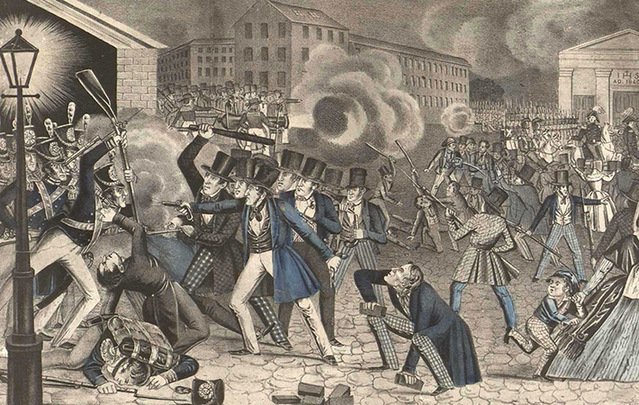
Picking your spots for such a faith surely requires discretion since the riots in Philadelphia between nativist Protestants and Irish Roman Catholics had all the earmarks of cultural Christianity. Protestants expected the public schools to use the Bible to reinforce republican norms but Roman Catholics objected that the Protestant Bible was not neutral — it was not even the right one — the Douay version. Those riots were far more about politics and culture, but defenses of cultural Christianity tread gingerly around such episodes.

What is especially perplexing about Stephen Wolfe’s defense of cultural Christianity is not simply how he might make sense of its darker moments in the past, but even how it measures up to the New Testament. For instance, he starts with this assumption:

We should first acknowledge that the civil recognition, establishment, and privileging of Christianity was the received and standard view for most of Christian history, amongst most major Christian traditions, including many Protestants, and only recently has it been rejected by a majority of western Christians.

That may be true after 350 AD, but imagine Peter and Paul thinking the privileging of Christianity was the air they breathed when they were receiving inspired and infallible revelations from the Holy Spirit.

Wolfe later asserts in a way that would have left Paul scratching his head:

Put differently, the civil and ecclesiastical are the twin species of the same genus, Christian communion. The people of God submit to these mutually supporting, separate and independent administrations because Christ is both the Creator and Ruler of creation and the Mediator of eternal life. The Christian communion is not coterminous with ecclesiastical membership, but is rather the same people submitted to both the civil and ecclesiastical.

Again, that might describe Christendom at some point, but how does it make sense of the apostle’s warning to Corinthians against going to court:

If any of you has a dispute with another, do you dare to take it before the ungodly for judgment instead of before the Lord’s people? 2 Or do you not know that the Lord’s people will judge the world? And if you are to judge the world, are you not competent to judge trivial cases? 3 Do you not know that we will judge angels? How much more the things of this life! 4 Therefore, if you have disputes about such matters, do you ask for a ruling from those whose way of life is scorned in the church? 5 I say this to shame you. Is it possible that there is nobody among you wise enough to judge a dispute between believers? 6 But instead, one brother takes another to court—and this in front of unbelievers! 7 The very fact that you have lawsuits among you means you have been completely defeated already. (1 Cor. 6)

If the civil and ecclesiastical are mutually supporting, why is Paul so incensed with the Corinthians for going to court? Might it be that Paul and the early church had no idea about the state reinforcing Christian norms? That’s what persecution means, I believe.

Calvin’s commentary on this epistle also suggests that he, even though living at a time before 1789 when expectations for Christendom were still in place for all Christians except the Anabaptists, was not as convinced of the easy harmony between church and state. The reason is that the magistrate is an avenger and the church is an instrument of God’s love and mercy:

Those who aim at greater clearness in their statements tell us that we must distinguish between public and private revenge; for while the magistrate’s vengeance is appointed by God, those who have recourse to it do not rashly take vengeance at their own hand, but have recourse to God as an Avenger. This, it is true, is said judiciously and appropriately; but we must go a step farther; for if it be not allowable even to desire vengeance from God, then, on the same principle, it were not allowable to have recourse to the magistrate for vengeance.

I acknowledge, then, that a Christian man is altogether prohibited from revenge, so that he must not exercise it, either by himself, or by means of the magistrate, nor even desire it. If, therefore, a Christian man wishes to prosecute his rights at law, so as not to offend God, he must, above all things, take heed that he does not bring into court any desire of revenge, any corrupt affection of the mind, or anger, or, in fine, any other poison. In this matter love will be the best regulator.

Of course, Calvin is no Anabaptist. He knows the legitimacy of the magistrate and even the competency of unbelieving civil authorities. But he also senses in ways that critics of modern secular liberalism do not seem to that the purposes of church and state are distinct. One implication is that they are not necessarily harmonious. Especially if upholding the Christian ideal of love.

Perhaps cultural Christianity aspires to such an ideal. But chances are what Christian societies produce when the church is established is more on the order of manners or politeness than the spiritual fruit that comes with sanctification.