For Those Without Ears to Hear

Justin Taylor revives Billy Sunday’s career by collecting comments on what the evangelist sounded like and even a few clips of the preacher himself. Taylor leaves out arguably the most insightful observer of Sunday, H. L. Mencken, whose critique extends as much to evangelicalism as to the baseball-player-turned-evangelist himself:

As for his extraordinary success in drawing crowds and in performing the hollow magic commonly called conversion, it should be easily explicable to anyone who has seen him in action. His impressiveness, to the vegetal mind, lies in two things, the first being the sheer clatter and ferocity of his style and the second being his utter lack of those transparent pretensions to intellectual superiority and other worldliness which mark the average evangelical divine. In other words, he does not preach down at his flock from the heights of an assumed moral superiority — i.e. inexperience of the common sorrows and temptations of the world — but discharges his message as man to man, reaching easily for buttonholes, jogging in the ribs, slapping on the back. The difference here noted is abysmal. Whatever the average man’s respect for the cloth, he cannot rid himself of the feeling that the holy man in the pulpit is, in many important respects, a man unlike himself . . . .; his aura is a sort of psychic monastery; his advice is not that of a practical man, with the scars of combat on him, but that of a dreamer wrapped in aseptic cotton.

Even setting aside [Sunday’s] painstaking avoidance of anything suggesting clerical garb and his indulgence in obviously unclerical gyration on his sacred stump, he comes down so palpably to the level of his audience, both in the matter and the manner of his discourse, that he quickly disarms the old suspicion of the holy clerk and gets the discussion going on the familiar and easy terms of a debate in a barroom. The raciness of his slang is not the whole story by any means; his attitude of mind lies behind it, and is more important. . . . It is marked, above all, by a contemptuous disregard of the theoretical and mystifying; an angry casting aside of what may be called the ecclesiastical mask, an eagerness to reduce all the abstrusities of Christian theology to a few and simple and (to the ingenuous) self-evident propositions, a violent determination to make of religion a practical, an imminent, an everyday concern.

Sunday School as Open Forum?

Scott, Aimee and (here I tread in rake territory) Todd try to sort out the differences between Sunday school teaching and authoritative church instruction. I tend to sympathize with the point made (I hear) by Carl and Aimee that women can do whatever non-ordained men do (except of course when it comes to reproduction). And I think Scott’s points about the flimsy origins of Sunday school as a church institution should make all Christians re-think the mechanisms by which churches instruct the faithful. Need I remind folks of the fun that even H. L. Mencken had at Sunday school (even though the Christian religion didn’t really take hold):

The one thing I really remember about that Sunday-school is the agreeable heartiness of the singing. It is, of course, the thing that all children enjoy most in Sunday-schools, for there they are urged to whoop their loudest in praise of God, and that license is an immense relief from the shushing they are always hearing at home. . . .

My favorite then, as now, was “Are You Ready for the Judgment Day?” — a gay and even rollicking tune with a saving hint of brimstone in the words. . . . We grouped it, in fact, with such dolce but unexhilarating things as “In the Sweet By-and-By” and “God Be With You Till We Meet Again” – pretty stuff, to be sure, but sadly lacking in bite and zowie. The runner up for “Are You Ready?” was “I Went Down the Rock to Hide My Face,” another hymn with a very lively swing to it, and after “the Rock” come “Stand Up, Stand Up for Jesus,” “Throw Out the Lifeline,” “At the Cross,” “Draw Me Nearer, Nearer, Nearer, Blessed Lord,” “What A Friend We Have in Jesus,” “Where Shall We Spend in Eternity?” . . . and “Hallelujah, Hallelujah, Revive Us Again.” . . . It was not until I transferred to another Sunday-school that I came to know such lugubrious horrors as “There Is A Fountain Filled with Blood.” The Methodists avoided everything of that kind. They surely did not neglect Hell in their preaching, but when they lifted up their voices in song they liked to pretend that they were booked to escape it. (Happy Days, 178-79)

Not sure Sunday school is the best method of delivery for passing on the faith.

The problem however goes beyond the qualifications posed. What session wants to deal with questions and complaints that arise from non-ordained teachers providing instruction on subjects revealed in Holy Writ? It’s one thing for a woman or non-ordained man to teach math, plumbing, banking or baking. But what about a Christian view of math, plumbing, banking, or baking? Doesn’t the Christian character of the instruction indicate some kind of normative (hence authoritative) instruction? I mean, if I offer a Christian view of history, should Christians not feel a certain pull in the direction of considering this is THE way believers should think about history? Or are Christian views of subjects simply optional for Christians (that’s accepting the premises of w-w thinking).

How much more is instruction seemingly normative if a woman or non-ordained man is teaching the Bible or confession related material? Do such teachers come with a disclaimer — what you are about to hear is just one person’s opinion? If advertised that way, what church members would come (if not for having to find a place to wait while children are in Sunday school)? And if Sunday school is just a place for Christians to opine, is that a good way to prepare for worship (if services follow Sunday school)? Can I really get another member’s objectionable opinions out of my head simply because the pastor invokes God’s presence?

So the issue isn’t one of office, ordination, or even the history of Sunday school as an institution. The issue is the content of the instruction. If that content includes material that comes from the church’s standards — Bible and confession — then the setting involves some version of binding address. At that point, a session will likely want the teaching to reflect the norms of the communion. And at that point we are in the ballpark of having officers who have been vetted and approved for teaching up front behind the podium for — wait for it — Sunday school.

Kant, Mencken, and Locke Walk Into a Bar

And the politicians come out poorer:

Locke has first dibs:

In advocating tax dodging you forget the Social Contract. Is it decent for a citizen to evade his fair obligations to other citizens? Suppose everyone did as you recommend? What would become of the State?

That’s a problem for Kant to solve:

An interesting objection–if only because it proves that the corpse of the late Dr. Immanuel Kant is still dancing. But though it may thus dance, it is nevertheless indubitably dead—and with it the crazy doctrine of a universal moral law. There is, of course, no such thing. Nothing is ever moral for all men—at all events, not with equal horsepower—and by the same token nothing is ever immoral. It may be wrong for a rich man, with so much money that he doesn’t know what to do with it, to dodge his taxes, but it is certainly not wrong in the case of a man whose family must suffer if he pays them. An individual’s first and paramount duty is to himself and his second duty is to his children. Then, in order, come his duties to his wife, his parents, his friends. his brothers and sisters, his creditors, his nieces and nephews, his uncles and aunts, his cousins, his second cousins, his third cousins and so on. Finally come his duties to his enemies, his wife’s relatives and the community in general.

Mencken tries to get the last word:

If the Social Contract were really a free contract, made in cold blood by autonomous principals, then it would lay upon every man a plain duty to pay his taxes in full. But it is really nothing of the sort. On the contrary, it is a contract forced upon him without his leave, and one which he couldn’t evade if he would, and what is more, its terms are grossly unfair and extortionate. The State, in brief, is a professional swindler. Its incessant effort is to make every taxpayer pay $2 or $3 or even $10, for something worth but $1. Theoretically, it collects only enough money each year to pay the actual expenses of government—not a cent more. But actually it collects enough in addition to pay a handsome profit to thousands of men—men who are theoretically servants of the State, but in sober truth are private individuals engaged in the universal human business of getting as much money as possible for as little work as possible.

Certainly, it is no crime for a taxpayer to refuse to submit to this brigandage, and to oppose it with whatever means are at hand. The members of the so-called Government, it is obvious, enter the contest with all of the advantages on their side. Not only have they the police power of the State behind them, to enforce their extortionate demands, but they are also supported by the indifference and superstition of the vast majority of taxpayers, some or whom are too lazy or too ignorant to protect themselves, and others of whom think it would be wrong to try. Therefore, it is perfectly moral, in warring upon such unfair assaults, for the intelligent taxpayer to use devices which, in themselves, may be frowned upon by his private code. In brief, it is moral for him to meet brute force with guile, with chicanery, with downright mendacity—to lie like an anti-vivisectionist whenever the truth would expose him to indefensible and ruinous robbery.

Kant won’t let Mencken have it:

But hark! the corpse of old Immanuel rises to ask a question, to wit: What would happen if every taxpayer swore off most of his takes? How could the State exist? A silly question—like most of those asked (and answered) by that cadaver—for it must be obvious that the majority of taxpayers are so poisoned by moral ptomaines that they will never get the courage to save themselves. The average man is, and always will be, a born sucker. What with his stupidity on the one hand and his morality on the other, he is paralyzed from birth, and so he goes through life a chronic victim. The temptation to rob him is irresistible. Even his wife, his pastor and the policeman on the beat can’t keep their hands off him. He almost begs the world to take his money.

But Mencken persists:

But, supposing the question to be intelligible, it may be answered quickly. And here is the answer: If every taxpayer refused to pay more than, say, 50 per cent. of his taxes, the efficiency of government would not only suffer no diminution, but would probably be vastly augmented. Economy, which is now a mere abstraction, would then become a reality, a necessity. And in the business of cutting down expenses, thus suddenly made the chief concern of the State, nonessentials would go first. If, by any unyielding stupidity of the heads of the State, they didn’t go first—if essentials were thrown overboard to protect supernumeraries and grafters—then the people would rise against the Government and take things into their own hands, and for the first time in the history of the Republic the State would be run as honestly and as economically as the average coal yard, or newspaper, or building association.

The curse of our present scheme of government lies in the fact that it puts no limitation upon taxation. The men who run the State are able to rob us as they will. Naturally enough—since their one aim is to get all they can for themselves and their friends—they lay on all the traffic will bear. The present tax rate on realty in Baltimore, counting in direct and indirect taxes, is fully $3 on the $100—a rate wholly indecent and proposterous. In the absence of legislation reducing it to $1—which rate, if constantly maintained, would be ample to pay all the legitimate expenses of the government—it is the supreme duty of every self-respecting taxpayer to reduce his own bill himself, and in that endeavor he is justified in employing any means, however “immoral,” that may achieve the desired end. Every time he pays a cent more he hands over his good money to meet the costs of pediculine debauchery.

And Mencken wrote this before the states ratified the sixteenth amendment.

The Problem with U.S.

H. L. Mencken explains:

. . . here in this great republic we have the materials for the most superb victualry the world has ever seen, and our people have the money to pay for it. Even the poorest Americano, indeed, eats relatively expensive food. His wife knows nothing of the hard pinching that entertains her French sister. He has meat in abundance and in considerable variety, and a great wealth of fruits and vegetables. Yet he eats badly, gets very little enjoyment out of his meals, and is constantly taking pills. The hot dog is the reductio ad absurdum of American eating. The Sicilian in the ditch, though he can never be President, knows better: he puts a slice of onion between his slabs of bread, not a cartridge filled with the sweepings of the abattoirs.

The national taste for bad food seems all the more remarkable when one recalls that the United States, more than any other country of the modern world, has been enriched by immigrant cuisines. Every fresh wave of newcomers has brought in new dishes, and many of them have been of the highest merit. But very few of them have been adopted by the natives, and the few have been mainly inferior. From the Italians, for example, we have got only spaghetti; it is now so American that it is to be had in cans. But spaghetti is to the Italian cuisine simply what eggs are to the Spanish: a raw material. We eat it as only those Italians eat it who are on the verge of ceasing to eat at all. Of the multitudinous ways in which it can be cooked and garnished we have learned but one, and that one is undoubtedly the worst.

So with the German sauerkraut — a superb victual when properly prepared for the table. But how often, in America, is it properly prepared? Perhaps once in 100,000 times. Even the Germans, coming here, lose the art of handling it as it deserves. It becomes in their hands, as in the hands of American cooks, simply a sort of stewed hay, with overtones of the dishpan. To encounter a decent dish of it in an American eating house would be as startling as to encounter a decent soup.

***

What ails our victualry, principally, is the depressing standardization that ails everything else American. There was a time when every American eating house had its specialties, and many of them were excellent. One did not expect to find the same things everywhere. One went to one place for roast goose, and to another for broiled soft crabs, and to another for oysters, and to yet another for mutton chops. Rolls made the old Parker House in Boston famous, and terrapin a la Maryland did the same for Barnum’s and Guy’s hotels in Baltimore. . . .

in America the public cooks have all abandoned specialization and everyone of them seems bent upon cooking as nearly as possible like all the rest. The American hotel meal is as rigidly standardized as the parts of a flivver, and so is the American restaurant meal. The local dishes, in all eating houses pretending to any tone, are banned as low. So one hunts in vain in Boston for a decent plate of beans, and in Baltimore for a decent mess of steamed hard crabs, and in St. Louis for a decent rasher of catfish. They are obtainable, perhaps, but only along the wharves. One must take a squad of police along to enjoy them in safety. (“Victualry as Fine Art,” 1926)

The Problem with England

H. L. Mencken explains:

The badness of English cooking is proverbial all over the world, but no one seems to have investigated its causes. I suggest that it may be due, at least in part, to two things, the first being that the English have a Puritan distrust of whatever is bodily pleasant, and the second that it is practically impossible to grow good food in their country. The first point needs no laboring. Every American who has been in England in winter knows who the whole population shivers and freezes. The simple device of putting in adequate stoves has apparently never occurred to anyone — or, if it has, it has been rejected as unmanly. The English prefer to be uncomfortable, and think of their preferences as heroic.

So at the table. Most Englishmen have been abroad, and know very well what good victuals taste like. But when they are at home they take a gloomy, stubborn, idiotic delight in eating badly. To say that they have a diseased taste and actually enjoy their flabby flavorless, badly cooked dishes, — this is to go beyond plain facts. It takes only a glance to see that they suffer almost as much as visitors to their country. But they can’t get rid of the feeling that it is virtuous to suffer — that eating better stuff would be frenchified, wicked, and against God. So they remain faithful to a cuisine which Nietzsche long ago described as next door to cannibalism.

I have hinted that the native victuals of the English are all bad. An exception, of course should be made of their incomparable mutton, and another, perhaps, of their sole, but beyond that the judgment holds. Their beef, for all their touching veneration of it, is distinctly inferior to ours, as anyone may discover by eating in the form of steaks. Their pork, at best, is only so-so, and their veal is not better. They seldom eat lamb at all. Of the stuff they get out of the sea, not much is really good. Their oysters are vile, and their turbot is flabby and almost tasteless. Their salmon is better, but it is surely not to be mentioned in the same breath with our mackerel, blue-fish and shad. That leaves their excellent sole — usually ruined in the cooking. . . .

What saves England from complete culinary darkness is the mutton. At its best, it is probably the most magnificent red meat to be had in the world. . . . I believe it is one of the great glories of the English people — a greater glory, indeed, than their poetry, their policemen, their hearty complexions, or their gift for moral indignation. It is the product of English grass — unquestionably the best grass on this piebald ball. Ah, that the English nobility and gentry could dine as well as their sheep. (“Note on Victuals,” 1930)

The First President to be Pried from His Bath

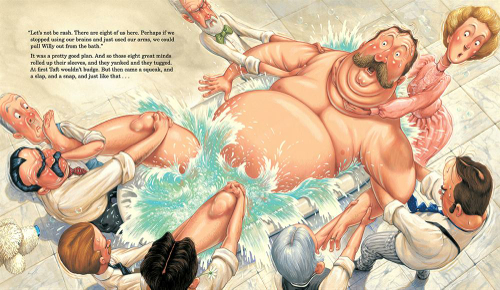
I heard this morning on Sports Talk radio of all things that on this day in history President William Taft, a man of gargantuan proportions, became stuck in his bath tub:

What most people associated with Taft, however, was his enormous size, and the image of his 300 plus pounds of presidential flesh offended some people and amused many others. When he became stuck in the presidential bath tub, requiring six men to pull him free, the nation’s press had a field day. His size made him the subject of countless jokes: “Taft was the most polite man in Washington. One day he gave up his seat on a streetcar to three women.” Within the capital’s social circle, Taft frequently embarrassed his family and associates by falling asleep at concerts, during presidential briefing sessions, and while presiding over his cabinet. At ease with his uncontrolled appetite and his need for sleep after eating or after exerting himself, Taft simply refused to be embarrassed by his weight or his behavior. He accepted his size and so did most of the American public in time.

What many Americans don’t know is that President Millard Filmore was the first to take a bath in the White House. Here is H. L. Mencken’s account:

But it was the example of President Millard Fillmore that, even more than the grudging medical approval, gave the bathtub recognition and respectability in the United States. While he was still Vice-President, in March, 1850, he visited Cincinnati on a stumping tour, and inspected the original Thompson tub. Thompson himself was now dead, but his bathroom was preserved by the gentlemen who had bought his house from the estate. Fillmore was entertained in this house and, according to Chamberlain, his biographer, took a bath in the tub. Experiencing no ill effects, he became an ardent advocate of the new invention, and on succeeding to the Presidency at Taylor’s death, July 9, 1850, he instructed his secretary of war, Gen. Charles M. Conrad, to invite tenders for the construction of a bathtub in the White House.

This action, for a moment, revived the old controversy, and its opponents made much of the fact that there was no bathtub at Mount Vernon, or at Monticello, and that all the Presidents and other magnificoes of the past had got along without any such monarchical luxuries. The elder Bennett, in the New York Herald, charged that Fillmore really aspired to buy and install in the White House a porphyry and alabaster bath that had been used by Louis Philippe at Versailles. But Conrad, disregarding all this clamor, duly called for bids, and the contract was presently awarded to Harper & Gillespie, a firm of Philadelphia engineers, who proposed to furnish a tub of thin cast iron, capable of floating the largest man.

This was installed early in 1851, and remained in service in the White House until the first Cleveland administration, when the present enameled tub was substituted. (“A Neglected Anniversary,” New York Evening Mail, 1917)

Whether presidents have been clean ever since is a separate question.

If God Laughs, Why Can’t I?

1 Why do the nations rage
and the peoples plot in vain?
2 The kings of the earth set themselves,
and the rulers take counsel together,
against the Lord and against his Anointed, saying,
3 “Let us burst their bonds apart
and cast away their cords from us.”
4 He who sits in the heavens laughs;
the Lord holds them in derision.
5 Then he will speak to them in his wrath,
and terrify them in his fury, saying,
6 “As for me, I have set my King
on Zion, my holy hill.” (Ps. 2)

P. J. O’Rourke helps me laugh. He has long alerted me (along with H. L. Mencken) to the pretensions and folly of uplifters, politicians, and do-gooders.

But when the world needs fixing, some find O’Rourke less funny:

That Mr. O’Rourke’s talents lay in finding and exposing hypocrisy and self-serving fantasy rather than making constructive arguments or proposals was no bar to enjoying his work. Nor was the fact that his was a libertarian rather than a conservative viewpoint. The drugs, the booze, and the womanizing pretty clearly indicated his cultural viewpoint and limitations. Still, for those like me who were young and stupid, he seemed a kind of swashbuckling privateer, taking down the enemy’s ships in a manner often fun to watch, if less than ennobling to anyone concerned. There was an immature “cool” to P.J. O’Rourke, the self-described “Republican Party Reptile,” which even his too often lazy approach to book-writing and his childish antics seemed not to erase.

Then some of us grew up. We began to recognize that Mr. O’Rourke’s ridicule was doing nothing to embarrass let alone stymie its targets, who lack any capacity for serious examination of conscience for the simple reason that they have assigned their consciences to the abstract principles of their ideology. In addition, we—especially those of us who were conservative from the start, but also those who simply grew into it—began to lead lives that left little room for childish antics. We found good women to marry, had children, and began raising them. Having begun the lives for which we are intended, we also soon recognized that the antics, entertainments, and even the politics of the college student are inappropriate for enjoyment or use in the home, even as they lack the power or even intent to protect that home.

Bruce Frohnen might have a point if he also pointed out that our politicians and policy analysts also think and talk a lot like children. That is, they continue to act and talk and look for votes and solicit funding on the basis of telling taxpayers and foundations and government officials that they can truly change the world.

But if the world can’t be changed, if sin and misery are par for this earthly course, then we need all the more those pundits who cut through the thin veneer of civilization and notice how pretentious are many of the fig leaves we use to cover our feeble and frail estate. Even better are those opinion writers who apply their skepticism to themselves, as O’Rourke does:

I thought there was a Republican Establishment who was supposed to keep things like Trump or, for that matter, Cruz from happening, and then I realized, no, they’re all dead. I’m the Republican Establishment now.

H. L. Mencken Wasn't Roman Catholic and He Could Write

First Christian presidents and now Peter Leithart explores Christian writers. Why do Christians feel the need to describe human activities in the context of sanctification? Isn’t that a tad provincial?

Leithart’s argument is that because Roman Catholics rely more on sacraments than Protestants who treat them as merely symbols, Roman Catholicism produces better writers:

Marburg is important not so much for what it achieved but as a symbol of what it failed to achieve. It provides a symbolic marker not only for the parting of the ways between Lutheran and Zwinglian, but also, for Zwinglians, the final parting of the ways between symbol and reality. J. P. Singh Uberoi claimed that “Spirit, word and sign had finally parted company at Marburg in 1529. For centuries, Christian sacramental theology had held symbol and reality together in an unsteady tension, but that alliance was ruptured by the Zwinglian view of the real presence. For Zwingli, “myth or ritual . . . was no longer literally and symbolically real and true.” In short, “Zwingli was the chief architect of the new schism and . . . Europe and the world followed Zwingli in the event.”

For many post-Marburg Protestants, literal truth is over here, while symbols drift off in another direction. At best, they live in adjoining rooms; at worst, in widely separated neighborhoods, and they definitely inhabit different academic departments.

Here is a thesis, which I offer in a gleeful fit of reductionism: Modern Protestants can’t write because we have no sacramental theology. Protestants will learn to write when we have reckoned with the tragic results of Marburg, and have exorcised the ghost of Zwingli from our poetics. Protestants need not give up our Protestantism to do this, as there are abundant sacramental resources within our own tradition. But contemporary Protestants do need to give up the instinctive anti-sacramentalism that infects so much of Protestantism, especially American Protestantism.

And Reformed Protestantism is particularly lacking:

Many Protestant churches (often the didactic ones) celebrate the Eucharist infrequently; many are deliberately, self-consciously anti-sacramental. Their worship consists of teaching but not doing, word but not sign. When they do celebrate the Supper, many Protestant churches are informed that it is a sign rather than a reality.

This is a simplification of what goes on in many Protestant churches. It is not, I think, a caricature.

The argument, based on the assumption and the assertion, comes in several stages: Churches whose worship focuses on didactic, doctrinal teaching are going to shape minds, imaginations, and hearts in a particular way. Churches with infrequent communion, and churches that treat communion as “mere sign” are also shaping the imaginative lives of their members.

Churches with didactic preaching and unsacramental worship, I submit, do not produce poets.

A poetic imagination is cultivated in churches where the beauty of Scripture is as important as its truth. Poetic imagination is cultivated in churches that celebrate Eucharist regularly. Every week, their worship climaxes with a great sacramental metaphor, a metaphor that is more than metaphor, a metaphor that also states (in some fashion) what is the case: “This is my body. This is my blood.”

By this argument, some forms of Protestantism – Anglicans with their prayer books and Eucharistic piety, Lutherans with their ins-withs-unders – are more conducive to cultivating poetic imagination than others.

What Leithart doesn’t consider apparently is that the logocentric quality of Protestantism, attention to the meaning of Greek and Hebrew involved in the study of Scripture, consideration of different biblical genres, or even the oratory involved in preaching — all of these could fire the imagination and fascinate young boys and girls with words in a way that could create good writing every bit as much as looking at statues, paintings, a wafer, and a chalice from which you’re never served.

At the same time, what does Leithart do with all those good writers who have no dog in the hunt of Christianity, like H. L. Mencken, who somehow learned to write even without going to church:

. . . the people of New York do even worse; they eat Chesapeake soft crabs fried in batter! What is cannibalism after that? I’d as lief eat a stewed archdeacon. Think of immersing a delicate and sensitive soft crab, the noblest of decapods, in a foul mess of batter, drenching it and blinding it, defacing it and smothering it — and then frying it in a pan like some ignoble piece of Pennsylvania scrapple. As well boil a cocktail, or a smelt, or a canvasback duck.

There is, of course, but one civilized way to prepare soft crabs for the human esophagus, and it goes without saying that it is the one way never heard of by the Greek bootblacks who pass as chefs in New York. It is, like all the major processes of the bozart, quite simple in its essence. One rids the crab of its seaweed, removes the devil, and then spears it with a long, steel fork upon the prongs of which a piece of country bacon, perhaps three inches long, has already made fast. Then one holds the combination over a brazier of glowing charcoal or a fire of hickory . . ., say three or four minutes.

What happens belongs to the very elements of cookery. The bacon, melted by the heat, runs down over the crab, greasing it and salting it, and the crab, thus heated, greased and salted, takes on an almost indescribable crispness and flavor. Nothing imaginable by the mind of man could be more delicious. It is a flavor with body, delicacy and character. Slap the crab upon a square of hot toast and then have at it. (“Callinectes Hastatus,” from The Impossible Mencken, 449)

The man could write and eat.

If It's Obvious It Can't Be True

So what is up with the Trumpophobia? This post made me think about posting about Donald Trump. Lots of people are trying to figure out how serious Christians who self-identify as evangelical could support a politician as raucous, impolitic, and self-important as Trump. I too sometimes wonder about it.

But when you connect Trump to Calvinism you’ve gone a bridge too far:

In the mind of the populist Calvinist, then, Trump is one of God’s “elect,” a billionaire because he is one of God’s great men on earth.

You’ll find echoes of this idea in the theology of the group known as “The Family” or “The Fellowship,” which sponsors the annual National Prayer Breakfast, and supports some of the most corrupt dictators on the planet. (Jeff Sharlet’s outstanding reporting exposed the group’s influence on Capitol Hill.)

For the record, let me say that the Pentecostal tradition to which Palin belongs is antithetical in many ways to traditional Calvinism. Yet, through the influence of the philosophy of Christian Reconstructionism (which theologized both capitalism and segregation along Calvinist thought lines) throughout the religious right, it’s fair to say that Calvin’s big-man theory of redemption holds sway in that religious universe.

Add to that the veneration of patriarchy and the strains of authoritarianism that characterize the religious right, and it begins to dawn on one just why Trump so appeals to the self-appointed guardians of the so-called “real America.”

Since when did American politics become so all darned polite, virtuous, and civil? Maybe it should be those things. But ever since we went down the road of partisanship (read two parties), politicians have splattered a lot of mud. Don’t forget that democracy itself is no picnic.

Democracy is that system of government under which people, having 60,000,000 native-born adults to choose from, including thousands who are handsome and many who are wise, pick out a Coolidge to be head of state. It is as if a hungry man, set before a banquet prepared by master cooks and covering a table an acre in area, should turn his back upon the feast and stay his stomach by catching and eating flies. (H. L. Mencken)

It’s as if everyone following politics has turned into classical music snobs and considers Trump the equivalent of Sinatra compared to Pavarotti or Enrico Caruso when in fact we are all used to casting our votes for Jay Z or Lil Wayne. Just yesterday I heard a quotation from Hillary Clinton where she described the options for the United States as among going backward, maintaining the status quo, and moving forward. Guess which one she is. Seriously?

I’m not opposed to making arguments against Trump. I have some myself. I simply wish that all the opposition didn’t begin with “yuck.” That so reminds me of the girls from junior high.

A Platitude Pusher

I’ve been questioning for some time Tim Challies daily posting of pious aphorisms, which seem to undermine Bible memorization (for starters). Then I read Alan Jacobs on Platitude-Pushers and I think of the sentimental maxims that Tim posts (complete with — wait for it — graphics).

First Jacobs:

Platitude-pushers seem to do especially well on Twitter: if you want to get yourself tens of thousands of followers, just utter banal words of exhortation, challenge, or encouragement with an air of profundity (and, of course, in fewer than 140 characters).

Then Tim’s pious thought for the day:

Everybody thinks sanctification looks like strength. Really what it looks like is weakness. —Ed Welch

Finally, the aphorisms of a real craftsman, H. L. Mencken. Not so pious, but oh so provocative.

Democracy is the theory that the common people know what they want and deserve to get it good and hard.

Love: The delusion that one woman differs from another.

Misogynist: A man who hates women as much as women hate one another.