Certainly Not Calvinist But Not Even Baptist

How do you explain selectivity (cafeteria Protestantism) about — wait for it — the Ten Commandments? But the Allies have their ways of satisfying itching ears. Here’s the latest — positive thoughts about Nativity Scenes:

I’ve changed my views because our culture has changed. As society becomes increasingly secular, it seems to me that just about anything that ties Christmas back to the historical account of Jesus’s birth provides an important point of connection. These small displays are an opportunity for engagement and conversation between those in our communities who celebrate nothing more than Santa and those who love the message of the Jesus’s incarnation.

In fact, I’m always intrigued when someone is offended by the presence of a nativity scene. It’s quite fascinating that people can be offended by a collection of miniature ecclesiastical characters. Why do people get upset? Perhaps it’s because they recognize that what’s being said in that small scene is challenging and even personal: “This happened, this is history, there is a Jesus, and you have to deal with him one way or another.” The person who gets annoyed by public nativity scenes is someone I want to have a conversation with.

Actually, it may be that the people who most often miss the message of the nativity scene are Christians. How easy it is to rush through the whole Christmas experience—the music in the mall, the services in your church, the presents in your house—and be left with sweet sentiments but no real worship in your heart. How easy it is to sing along to “Once in Royal David’s City”—

He came down to earth from heaven,
Who is God and Lord of all.

—and feel neither awe nor offense, but simply nothing much at all.

My point is that it’s not only non-Christians who trivialize Christmas. It’s us. The claims the Bible makes about the first Christmas are either fact or fiction, so they’re either awesome or offensive. They should move us to worship or to resistance. But so often Christians seem to be pursuing a pristine Christmas experience that more reflects the store-bought nativity scene than the costly and messy account of the Bible.

Calvinists did not celebrate Christmas. They avoided also any representation of any member of the Trinity. The same goes for Baptists. Until the twentieth century, non-Episcopalian and non-Lutheran Protestants didn’t do Christmas or display its wares. They only way to get around the second and fourth commandments (for the fourth, one day in seven is holy, not Jesus’ birthday) is if you so elevate feelings or evangelism and argue that rules don’t matter (sometimes). That’s more Whitefield than Edwards. In which case, the Allies can’t even honor properly their “homeboy.”

Just to keep score: justification is supposed to result in sanctification.

Good works constitute indispensable evidence of saving grace. Living as salt in a world that is decaying and light in a world that is dark, believers should neither withdraw into seclusion from the world, nor become indistinguishable from it: rather, we are to do good to the city, for all the glory and honor of the nations is to be offered up to the living God. Recognizing whose created order this is, and because we are citizens of God’s kingdom, we are to love our neighbors as ourselves, doing good to all, especially to those who belong to the household of God. The kingdom of God, already present but not fully realized, is the exercise of God’s sovereignty in the world toward the eventual redemption of all creation. The kingdom of God is an invasive power that plunders Satan’s dark kingdom and regenerates and renovates through repentance and faith the lives of individuals rescued from that kingdom. It therefore inevitably establishes a new community of human life together under God.

Maybe the Allies problem with the Decalogue is that they think of obedience too much in the context of the city and not being ye separate. Don’t want to take God’s word too far.

Human Bodies Waste Away But Cities Abide (psshaw)

One of yesterday’s sermons has me thinking: when will the neo-Calvinists ever do justice to the physical-spiritual dualism that legitimately arises in Paul’s teaching?

For we know that if the tent that is our earthly home is destroyed, we have a building from God, a house not made with hands, eternal in the heavens. For in this tent we groan, longing to put on our heavenly dwelling, if indeed by putting it on we may not be found naked. For while we are still in this tent, we groan, being burdened—not that we would be unclothed, but that we would be further clothed, so that what is mortal may be swallowed up by life. He who has prepared us for this very thing is God, who has given us the Spirit as a guarantee.

So we are always of good courage. We know that while we are at home in the body we are away from the Lord, for we walk by faith, not by sight. Yes, we are of good courage, and we would rather be away from the body and at home with the Lord. So whether we are at home or away, we make it our aim to please him. For we must all appear before the judgment seat of Christ, so that each one may receive what is due for what he has done in the body, whether good or evil. (2 Corinthians 5:1-10 ESV)

You can’t simply point at “all things” passages and make Paul’s understanding of life in this world go away:

He is the image of the invisible God, the firstborn of all creation. For by him all things were created, in heaven and on earth, visible and invisible, whether thrones or dominions or rulers or authorities—all things were created through him and for him. And he is before all things, and in him all things hold together. And he is the head of the body, the church. He is the beginning, the firstborn from the dead, that in everything he might be preeminent. For in him all the fullness of God was pleased to dwell, and through him to reconcile to himself all things, whether on earth or in heaven, making peace by the blood of his cross. (Colossians 1:15-20 ESV)

You can affirm both. Christ is preeminent and we are not at home until we are with Christ. But to use the Lordship of Christ as the basis for transforming cities or redeeming movies and rejecting the dualism between fallen bodies and redeemed souls as fundamentalist is not Pauline. Heck, it’s not even Calvinist:

The wicked, too, groan, because they are not contented with their present condition; but afterwards an opposite disposition prevails, that is, a clinging to life, so that they view death with horror, and do not feel the long continuance of this mortal life to be a burden. The groaning of believers, on the other hand, arises from this — that they know, that they are here in a state of exile from their native land, and that they know, that they are here shut up in the body as in a prison. Hence they feel this life to be a burden, because in it they cannot enjoy true and perfect blessedness, because they cannot escape from the bondage of sin otherwise than by death, and hence they aspire to be elsewhere.

As, however, it is natural for all animals to desire existence, how can it be, that believers are willing to cease to exist? The Apostle solves this question, when he says, that believers do not desire death for the sake of losing any thing, but as having regard to a better life. At the same time, the words express more than this. For he admits, that we have naturally an aversion to the quitting of this life, considered in itself, as no one willingly allows himself to be striped of his garments. Afterwards, however, he adds, that the natural horror of death is overcome by confidence; 515 as an individual will, without any reluctance, throw away a coarse, dirty, threadbare, and, in one word, tattered garment, with the view of his being arrayed in an elegant, handsome, new, and durable one.

Farther, he explains the metaphor by saying — that what is mortal may be destroyed 516 by life. For as flesh and blood cannot inherit the kingdom of God, (1 Corinthians 15:50,) it is necessary, that what is corruptible in our nature should perish, in order that we may be thoroughly renewed, and restored to a state of perfection. On this account, our body is called a prison, in which we are confined.

Fundamentalist Controversy Redux

John Allen explains how Roman Catholicism has come along side Protestantism. The Left and Right aren’t even on the same page of what constitutes truth:

… at this point most defenders of Pope Francis haven’t accused critics of being dissenters, nor have they suggested that people who uphold contrary positions on the substantive positions associated with the pontiff, such as opening Communion to divorced and civilly remarried Catholics, are thereby committing heresy.

The implication seems to be that fans of the pope are more generous, less vicious, and less inclined to question people’s bona fides as Catholics. There is, in other words, often a presumption of moral superiority in the observation that “we don’t talk that way.”

Simply as a descriptive matter, that proposition seems a bit disingenuous. Many in the pro-Francis camp don’t invoke concepts such as “heresy” and “dissent,” because frankly, it’s not the worst insult they can think of with which to slur an opponent.

Instead, they use terms that Francis himself also regards as abhorrent, such as “rigid,” “inflexible,” “legalistic,” “clerical,” and, of course, worst of all, “anti-Vatican II.”

In effect, what’s on display here is one of the defining differences between the Catholic left and the Catholic right over the last fifty years.

For the right, “heresy” and “dissent” are about the worst things imaginable, so when they want to say “x is terrible,” that’s the language that comes naturally. For the left, the equivalent horror is “rolling back the clock” on the Second Vatican Council, so when they want to call something or someone awful, that tends to be the verbal packaging in which the complaint comes wrapped.

Someone trying to remain objective about today’s debates would probably have a hard time concluding that either side has a claim on the moral high ground, since both are charging the other with virtually the vilest crime in their respective vocabularies.

At the same time, gatekeepers like John Allen don’t see when modernism is part of the warp and woof of church life:

Despite challenges intolerance brings, Camilleri stressed that religion, Christianity included, has an endless capacity for good, not only for individuals and communities, but for society as a whole.

The Church, he said, “does not pretend…to substitute for politics. Nor does the Church claim to offer technical solutions to the world’s problems since the responsibility of doing that belongs elsewhere.”

What religion does, then, is offer specific guidelines to both the community of believers, and to society as a whole.

Religion by its nature “is open to a larger reality and thus it can lead people and institutions toward a more universal vision” and a “horizon of fraternity” capable of enriching humanity, Camilleri said.

The Holy See, then, “is convinced that for both individuals and communities the dimension of belief can foster respect for fundamental freedoms and human rights, support democracy and rule of law and contribute to the quest for truth and justice.”

Dialogue and partnerships between religions and with religions, he said, “are an important means to promote confidence, trust, reconciliation, mutual respect and understanding as well as to foster peace.”

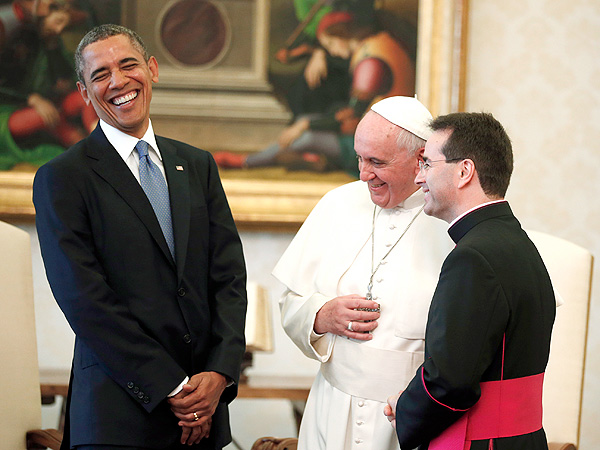
If religion did all that, I’m sure President Obama would have gotten on board. Wait. He did:

Holy Father, your visit not only allows us, in some small way, to reciprocate the extraordinary hospitality that you extended to me at the Vatican last year. It also reveals how much all Americans, from every background and every faith, value the role that the Catholic Church plays in strengthening America. (Applause.) From my time working in impoverished neighborhoods with the Catholic Church in Chicago, to my travels as President, I’ve seen firsthand how, every single day, Catholic communities, priests, nuns, laity are feeding the hungry, healing the sick, sheltering the homeless, educating our children, and fortifying the faith that sustains so many.

And what is true in America is true around the world. From the busy streets of Buenos Aires to the remote villages in Kenya, Catholic organizations serve the poor, minister to prisoners, build schools, build homes, operate orphanages and hospitals. And just as the Church has stood with those struggling to break the chains of poverty, the Church so often has given voice and hope to those seeking to break the chains of violence and oppression.

And yet, I believe the excitement around your visit, Holy Father, must be attributed not only to your role as Pope, but to your unique qualities as a person. (Applause.) In your humility, your embrace of simplicity, in the gentleness of your words and the generosity of your spirit, we see a living example of Jesus’ teachings, a leader whose moral authority comes not just through words but also through deeds. (Applause.)

You call on all of us, Catholic and non-Catholic alike, to put the “least of these” at the center of our concerns. You remind us that in the eyes of God our measure as individuals, and our measure as a society, is not determined by wealth or power or station or celebrity, but by how well we hew to Scripture’s call to lift up the poor and the marginalized — (applause) — to stand up for justice and against inequality, and to ensure that every human being is able to live in dignity –- because we are all made in the image of God. (Applause.)

You remind us that “the Lord’s most powerful message” is mercy. And that means welcoming the stranger with empathy and a truly open heart –- (applause) — from the refugee who flees war-torn lands to the immigrant who leaves home in search of a better life. (Applause.) It means showing compassion and love for the marginalized and the outcast, to those who have suffered, and those who have caused suffering and seek redemption. You remind us of the costs of war, particularly on the powerless and defenseless, and urge us toward the imperative of peace. (Applause.)

Holy Father, we are grateful for your invaluable support of our new beginning with the Cuban people — (applause) — which holds out the promise of better relations between our countries, greater cooperation across our hemisphere, and a better life for the Cuban people. We thank you for your passionate voice against the deadly conflicts that ravage the lives of so many men, women and children, and your call for nations to resist the sirens of war and resolve disputes through diplomacy.

You remind us that people are only truly free when they can practice their faith freely. (Applause.) Here in the United States, we cherish religious liberty. It was the basis for so much of what brought us together. And here in the United States, we cherish our religious liberty, but around the world, at this very moment, children of God, including Christians, are targeted and even killed because of their faith. Believers are prevented from gathering at their places of worship. The faithful are imprisoned, and churches are destroyed. So we stand with you in defense of religious freedom and interfaith dialogue, knowing that people everywhere must be able to live out their faith free from fear and free from intimidation. (Applause.)

And, Holy Father, you remind us that we have a sacred obligation to protect our planet, God’s magnificent gift to us. (Applause.) We support your call to all world leaders to support the communities most vulnerable to changing climate, and to come together to preserve our precious world for future generations. (Applause.)

Your Holiness, in your words and deeds, you set a profound moral example. And in these gentle but firm reminders of our obligations to God and to one another, you are shaking us out of complacency. All of us may, at times, experience discomfort when we contemplate the distance between how we lead our daily lives and what we know to be true, what we know to be right. But I believe such discomfort is a blessing, for it points to something better. You shake our conscience from slumber; you call on us to rejoice in Good News, and give us confidence that we can come together in humility and service, and pursue a world that is more loving, more just, and more free. Here at home and around the world, may our generation heed your call to “never remain on the sidelines of this march of living hope.”

For that great gift of hope, Holy Father, we thank you, and welcome you, with joy and gratitude, to the United States of America. (Applause.)

It’s Fascist When You Exclude the Universities?

Michael Kinsley thinks Donald Trump qualifies technically as a fascist:

The game has several names: “Corporate statism” is one. In Europe, they call it “dirigisme.” Those two other words for it — “Nazism” and “fascism” — are now beyond all respectability. It means, roughly, combining the power of the state with the power of corporations. At its mildest, it is intrusive regulations on business about parental leave and such. At its most toxic, it is concentration camps. In the 1930s, a few Americans (including a few liberals) bought into it. Pearl Harbor ended that argument. Even for Trump, “fascism” itself now is a dirty word, not just a policy choice. Even Trump would not use it — least of all about himself.

Did Kinsley worry about combining the power of the state with the power and prestige (we’re the smartest people in the world) of universities? It’s not as if nothing could go wrong (beware the negatives):

Indeed, illiberal progressive elitism has only become more pervasive as the gap between the “educated and the ignorant” has widened.

With the rise of think tanks, research universities, and advocacy foundations and nonprofits—the vast, interlocking, insulated complex we’ve constructed to formulate, advocate, and execute public policy—we have only reinforced the barrier between the everyday voter and governance. In order to understand, much less engage in, today’s abstract, detached, and data-saturated discourse of public policy, participants require ever more specialized academic expertise. If a problem can’t be expressed in a statistical formula—with the obliteration of nuance, detail, and local variability this entails—then the problem simply doesn’t exist.

What we now call the “rise of the meritocracy” may have begun well over a century ago. But as it accelerates today, its costs are becoming more apparent. The meritocrats sort themselves out not only socially, but geographically as well, into coastal and university enclaves. There, in a contemporary bow to positive eugenics, they engage in assortative mating. Their children then follow the sheltered path from university day school to Princeton to a career in social entrepreneurship, convinced that they can “change the world,” as the slogan goes, without ever touching down in that vast swath of cultural desolation unhappily separating Nassau Hall from Palo Alto. The distance between the “educated and ignorant” grows ever larger, both literally and figuratively.

You could also call this “corporate statism” since the biggest and smartest universities in the U.S. are corporations whose assets tax collectors cannot touch.

Imagine if They Had Worried about Syria

Sean Trende (via Rod) on recent U.S. political history:

Democrats and liberals have: booed the inclusion of God in their platform at the 2012 convention (this is disputed, but it is the perception); endorsed a regulation that would allow transgendered students to use the bathroom and locker room corresponding to their identity; attempted to force small businesses to cover drugs they believe induce abortions; attempted to force nuns to provide contraceptive coverage; forced Brendan Eich to step down as chief executive officer of Mozilla due to his opposition to marriage equality; fined a small Christian bakery over $140,000 for refusing to bake a cake for a same-sex wedding; vigorously opposed a law in Indiana that would provide protections against similar regulations – despite having overwhelmingly supported similar laws when they protected Native American religious rights – and then scoured the Indiana countryside trying to find a business that would be affected by the law before settling upon a small pizza place in the middle of nowhere and harassing the owners. In 2015, the United States solicitor general suggested that churches might lose their tax exempt status if they refused to perform same-sex marriages. In 2016, the Democratic nominee endorsed repealing the Hyde Amendment, thereby endorsing federal funding for elective abortions.

All the power of a global hegemon and we use it like this?

Real or Fake Spin

Sarah Pulliam Bailey reports that hipster-urban church planting may be responsible for Donald Trump:

In recent decades, white evangelical leaders made the American city their mission field. If you wanted to change hearts and minds, you had to go to cultural centers of power, such as New York City or Washington, where the population was growing. Now some evangelicals are wondering if that shift has caused them to overlook the needs and concerns of their counterparts in rural America.

Donald Trump’s victory put the spotlight on white, rural voters, many of them evangelicals, who were drawn to his “Make America Great Again” message. Even as exit polls suggested that 80 percent of white evangelicals voted for Trump, some evangelicals in urban and suburban areas said they didn’t personally know other evangelicals who vocally supported the president-elect. Although three-quarters of evangelicals are white and lean heavily Republican, they are a huge and diverse group, accounting for a close to a quarter of all Americans, with Latinos making up the fastest-growing segment.

Trump carried nearly 93 percent of rural, mostly white evangelical counties, according to political scientist Ryan Burge.

So does she interview the guru of The City Company of Pastors, aka Tim Keller? You bet:

Ahead of the election, Keller, who leads Redeemer Presbyterian Church in New York, said that, aside from best-selling author Eric Metaxas, he did not know one evangelical openly supporting Trump.

Keller made his own shift from a rural church to eventually lead one in the country’s largest city and a global church-planting network called City to City.

“Cities have a cool factor, a starry-eyed cool factor,” he said. “Young evangelicals are not motivated to go to places that are not very desirable places to live.”

Keller said young pastors could learn quite a bit by starting at a small-town church in rural America. Pastors at larger churches in big cities tend to specialize in areas such as ministries to women or children, while rural pastors usually do a little bit of everything, he said.

So now Keller has even more credibility because he started as a country pastor? Why are religion reporters so naive?

Why are readers more discerning that religion reporters?

I like Keller, but his thoughts in this are completely self-serving. How is the church failing rural parts of America? Simple: millennials.

No mention that he has spent the better part of a decade saying that we need to focus on cities, that cities are where you change the world, that cities are the fulcrums of culture, that cities are where you find the most people and get the best harvest, that God wants you to love cities, that God is asking, ‘Why aren’t you moving there?’

Does Ms. Bailey think Keller won’t return her calls if she writes a critical story? Surely, a pastor would not be that vindictive. Or perhaps sanctified celebrity carries the same afflictions as unredeemed celebrity.

Where Will Converts Send Their Children to College?

It probably won’t be Providence College where the conservative Roman Catholic professor, Anthony Esolen, is down for the count:

… when Prof. Esolen authored an article arguing, in his own inimitable style with his usual exuberant and evocative prose, that his institution had adopted a wrong-headed attitude toward “diversity,” one might have hoped that anyone who disagreed with his position would respond in a way worthy of the deepest traditions of any academic community: a thoughtful written response, laying out evidence, supplying facts, adducing arguments, contesting premises, disputing inferences, or perhaps merely appealing for a different set of perspectives.

Instead, Esolen’s argument was greeted with the academic equivalent of a loud, disapproving grunt, expressed in its commonest contemporary form: the planned creation by a faculty member of a “totally spontaneous” mob to march across campus, disrupting classes with chants and a bullhorn, until they reached the president’s office where they ceremoniously presented “their demands.” I say “ceremoniously” because representatives of this group had met with the president the night before to discuss their grievances, so he was quite clear on their wishes already. The march to present “demands” was simply a bit of planned political theater to make noise during classes the next day.

Why doesn’t the vaunted intellectual tradition of the western church prevent episodes like this? After all, lots of Roman Catholic intellectuals have rallied to Esolen’s side:

George, himself a faithful Catholic who writes from an orthodox perspective, contrasted Esolen’s treatment at Providence with Princeton hiring him, granting him tenure, installing him in one of its most celebrated endowed chairs and allowing him to create the James Madison Program in American Ideals and Institutions.

Wrote George, “If Princeton University — a secular institution the vast majority of whose faculty and administrators and many of whose students are ideologically on the left — can welcome the contributions of someone whose convictions are in line with the moral teachings of the Catholic Church (even when those teachings fly in the face of left-liberal orthodoxies) why can’t Providence College — a Catholic institution — welcome the contributions of an exceptional Catholic scholar such as Anthony Esolen?”

Meanwhile, Notre Dame professors Francesca Aran Murphy and Patrick J. Deneen have written a letter to Father Shanley, calling upon him to reframe the discussion of diversity in such a way that Esolen’s individuality as a scholar is respected and honored.

“Professor Esolen’s attempt to open a dialogue about the meaning of diversity and of its place within a Catholic and Dominican college has been greeted with a formal defense of his academic freedom, but a deeper implicit repudiation of the legitimacy of the questions he has raised,” wrote Murphy and Deneen, who added that they found it “alarming” that Esolen had been treated “in a dismissive manner by the administration.”

The letter has been signed by more than 100 scholars and observers across the country, including Ambassador Mary Ann Glendon of Harvard Law School; R.R. Reno, editor of First Things; and Ryan T. Anderson, the William E. Simon Senior Research Fellow at the Heritage Foundation.

Situations like this make a lot more sense if you conclude that the church’s institutions have accommodated themselves to modern academic standards (read modernism) and fail to uphold church teaching. This is what happens after the Land of Lakes Statement and university officials (some of them bishops) don’t pay attention to papal directives. What doesn’t make sense is all the hype of Bryan and the Jasons. Why don’t the converts reflect on the parallels between Roman Catholic and mainline Protestant higher education in the United States the way James Burtchaell did?

Christianity Framed Mencken

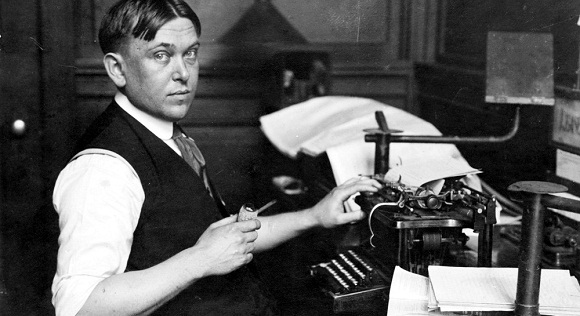
Andrew Ferguson wonders why Eerdmans would include an entry in its American religious biography series on H. L. Mencken:

The co-editor of the series, the church historian Mark A. Noll, raises the question in his foreword: “Whatever could have led Darryl Hart, himself the author of several worthy books patiently explaining the virtues of historical Calvinism, to think that any one at all could be interested in a religious biography of H.L. Mencken?”

A few pages later, the author himself wonders the same thing. After ticking off Mencken’s many admirable qualities—his productivity as a journalist, his fearlessness as a magazine editor, his unfailing humor, his tough-mindedness—Mr. Hart asks: “What does any of this have to do with religion? Why should Mencken qualify for entry in a series of religious biographies?”

I would like to report that the answer Mr. Hart gives to this question is an irrefutable and bold assertion about . . . something or other. But I can’t. For all the book’s virtues—it is charmingly written and comprehensive of its subject—the author struggles to explain why it should have been written at all.

But, for what is Mencken best remembered? The Scopes Trial. What about his attack on Puritanism (“the haunting idea, that someone, somewhere, may be happy”)? And what about his confrontation with the nation’s Protestant-inspired decency laws? Also, what to make of his withering critique of the moral idealism that Woodrow Wilson used to rally the United States to enter a war “to end all wars?”

The point is not that Christianity defined Mencken and that he ironically owed a debt to the believers who bemused him. Instead, taking account of his life makes little sense without noticing how his literary battles with Puritanism, his columns against Prohibition, his pointed coverage of the Scopes Trial, his protracted legal contest with Boston’s Watch and Ward Society, or the book he considered his most important, Treatise, set Mencken apart from his contemporaries, gave him a lot to say along with a large readership that wanted to listen. Christianity and its dominant position in American society was not responsible for producing Mencken. But it was a sufficiently large part of his experience and thought to justify a religious biography. (Damning Words, 4)

If Mencken is best remembered for his opposition to Christianity in its political, cultural, and moral dimensions, then isn’t religion a big part of his life even if he didn’t believe? Christianity framed Mencken. He would not be the man or writer he was without having been surrounded by and pondered Christianity. That makes a religious biography plausible.

Fake News and Phantom Legs

Lots of folks are talking about fake news and how to discern the difference between real and not-so-true reports. Amid all the discussion I can’t stop thinking about Bill Genevose. He is the brother of the deceased Kitty Genovese, the woman whose murder in 1964 turned into a parable of urban life and crime:

Before we had the Internet to blame for everything, news of the brutal murder of 28-year-old bar manager Kitty Genovese went wide as a parable of urban indifference. Genovese was far from the only New Yorker to die on the street in 1964. Nor was she the only woman Winston Moseley, a married father of two, admitted killing. By his own chilling account, Moseley drew no distinction between murder and the routine burglary by which he supplemented his income. The other victims languished in obscurity, while 50 years on, the meaning of Genovese’s murder still fuels a gallery of books, movies and television shows, up to and including a recent episode of Girls. All this — according to a new documentary by Kitty’s younger brother Bill Genovese with filmmaker James Solomon — because of an influential article in the New York Times that attributed her late-night death on a quiet street in Queens to the inaction of 38 witnesses who heard her screams twice (Moseley returned to stab her a second time) and allegedly failed to call the police or rush to her rescue.

The NPR story about Genovese’s death goes on to make the astute point that all news comes with spin that takes truth in the direction of fake:

“We tell ourselves stories in order to live,” Joan Didion famously wrote. Genovese likens his sister’s death to a Rorschach test, and at its sharpest, The Witness is a careful inquiry into the tricks memory plays, and into how ambiguous events get reshaped into narratives that fit individual and collective needs. Almost everyone Genovese interviewed — from surviving witnesses and their children, the prosecutor and judge in the case, police, journalists, and A.M. Rosenthal, the Times editor who handled the story in 1964 and wrote the book Thirty-Eight Witnesses about the case — has, however unconsciously, polished their own version of the truth. Some of the testimonies are sober and corrective, some defensive, others wacky or poignant or both. One witness’ son argues that most of the neighbors were Holocaust survivors and “therefore” would be reluctant to contact authorities. Moseley himself, who died in prison in March of this year, would not allow Genovese to visit him in prison, but wrote him a rambling, outlandish account. The film shows commendable compassion for Moseley’s anguished son, the Rev. Steven Moseley, whose pitifully bizarre contextualization of the murder shows that the damage it did went far beyond Kitty and her family.

The documentary that Bill Genovese made about his sister complicates the legend that this murder created. The mainstream media had a narrative and they kept telling it. It became so convincing about the indifference of Americans to crime that Bill Genovese himself volunteered to serve in Vietnam. He wasn’t going to be guilty of the sort of social character than abandoned his sister. And what happened? On a patrol Bill stepped on a mine and lost both his legs.

Which brings us to Bill Genovese, who as executive producer and narrator is both the film’s subject and its chief interpreter. Having lost both his legs in Vietnam, the handsome Italian-American is a visually dramatic figure, a sleuth in a wheelchair as he follows leads. Kitty’s death moved him, he says, to enlist in the Marines, and his continuing obsession with her murder (his siblings appear briefly, cooperative but baffled by a mystery they no longer seek to solve) stems from a desire to know that he “didn’t lose [his] legs for nothing.” There’s little reason to doubt their brother’s sincerity, yet his declared motives and his quest for “closure” — a glib buzzword that’s overdue for retirement — seem at once too tidy and a causal stretch.

Fake news or not, you should always take even the real news with a grain or two of salt.

How to Redeem Christmas

Let Protestants have it.

Thomas (nee Tommy) Kidd’s review of Christmas in the Crosshairs notices that not until Protestants took up the cause of December 25, the holiday became safe for the women and children.

Before 1800:

In the medieval era, Christmas became a fixture of Catholic festive culture, which sometimes featured drunken celebrations and “social inversions” such as the “Feast of Fools” and “Feast of the Ass” (that is, the donkey that carried Mary). These rites made Christmas a prime target for many Reformers, who viewed them as an unbiblical “popish” riot. In the 1640s, the Puritan-dominated English Parliament banned Christmas and “all other festival days commonly called ‘Holy-days.’ ” A century and a half later, radical French revolutionaries renamed December 25 “dog day,” viewing citizens who stayed home from work as potential enemies of the secular regime.

Then English-speaking novelists saw an opening:

By 1800, Christmas was in bad shape, associated largely with working-class drunkenness and violence. But in the early 19th century, Christmas “revivalists” like Washington Irving and Charles Dickens began recasting it as a generically religious, culturally wholesome, and family-centered holiday. Clement Clarke Moore made perhaps the most significant contribution with his 1822 “Account of a Visit from St. Nicholas,” better known as “ ‘Twas the Night Before Christmas.” A friendly Santa Claus supplanted St. Nicholas’s traditional threats of wrath against disobedient children. Other menacing nocturnal visitors who had been fixtures of medieval Christmases, such as central Europe’s “Perchta the Disemboweller,” soon vanished before Santa’s kindly image. The gift-giving Santa also transformed Christmas into the merchants’ holiday par excellence.

As for me and my house, we’ll stick with Thanksgiving as the best holiday. Rule Americania!