America Is Not America (part one)

Ross Douthat wrote a very good piece on the two U.S. narratives that have vied with each other for the last thirty-five years.

The liberal narrative (with President Obama functioning as story-teller in chief) runs like this:

“That’s not who we are.” So said President Obama, again and again throughout his administration, in speeches urging Americans to side with him against the various outrages perpetrated by Republicans. And now so say countless liberals, urging their fellow Americans to reject the exclusionary policies and America-first posturing of President Donald Trump.

The problem with this rhetorical line is that it implicitly undercuts itself. If close to half of America voted for Republicans in the Obama years and support Trump today, then clearly something besides the pieties of cosmopolitan liberalism is very much a part of who we are.

. . . In this narrative, which has surged to the fore in response to Trump’s refugee and visa policies, we are a propositional nation bound together by ideas rather than any specific cultural traditions — a nation of immigrants drawn to Ellis Island, a nation of minorities claiming rights too long denied, a universal nation destined to welcome foreigners and defend liberty abroad.

Given this story’s premises, saying that’s not who we are is a way of saying that all more particularist understandings of Americanism, all non-universalist forms of patriotic memory, need to be transcended. Thus our national religion isn’t anything specific, but we know it’s not-Protestant and not-Judeo-Christian. Our national culture is not-Anglo-Saxon, not-European; the prototypical American is not-white, not-male, not-heterosexual. We don’t know what the American future is, but we know it’s not-the-past.

Then there’s the conservative narrative (with Trump adding Jacksonian democratic accents):

But the real American past was particularist as well as universalist. Our founders built a new order atop specifically European intellectual traditions. Our immigrants joined a settler culture, Anglo-Saxon and Protestant, that demanded assimilation to its norms. Our crisis of the house divided was a Christian civil war. Our great national drama was a westward expansion that conquered a native population rather than coexisting with it.

As late as the 1960s, liberalism as well as conservatism identified with these particularisms, and with a national narrative that honored and included them. The exhortations of civil rights activists assumed a Christian moral consensus. Liberal intellectuals linked the New Deal and the Great Society to Thomas Jefferson and Andrew Jackson. Pop-culture utopians projected “Wagon Train” into the future as “Star Trek.”. . .

But meanwhile for a great many Americans the older narrative still feels like the real history. They still see themselves more as settlers than as immigrants, identifying with the Pilgrims and the Founders, with Lewis and Clark and Davy Crockett and Laura Ingalls Wilder. They still embrace the Iliadic mythos that grew up around the Civil War, prefer the melting pot to multiculturalism, assume a Judeo-Christian civil religion rather the “spiritual but not religious” version.

Douthat wonders if one narrative is any longer possible.

But any leader who wants to bury Trumpism (as opposed to just beating Trump) would need to reach for one — for a story about who we are and were, not just what we’re not, that the people who still believe in yesterday’s American story can recognize as their own.

What he observes though is a truth about liberal progressive narratives that we also see in mainline Protestantism — historical denial (read fake history). The PCUSA can’t talk about the days it opposed Arminianism, refused to ordain women, and possessed Princeton Theological Seminary as its chief intellectual jewel. No mainline Presbyterian today recognizes the names of William Adams Brown, Robert Speer, or Harry Emerson Fosdick. Why? Because they were not who contemporary Presbyterians are. They don’t measure up to the present.

The same goes for political progressives. They have no useful past in the actual institutions of national life because old Americans are not contemporary Americans. It is what it is becomes we are who we are. We have no capacity to say “we are who we were” even in part.

If that’s so, let’s not simply ban the confederate flag. Let’s burn the U.S. flag — what a racist, misogynist, heterosexist, capitalist country. How dare President Obama wear a flag lapel pin.

Even better — let’s move to Mars where we can reboot the human race.

More of Those (were the) Days

James Madison in “Federalist” 45:

The powers delegated by the proposed Constitution to the federal government are few and defined. Those which are to remain in the State governments are numerous and indefinite. The former will be exercised principally on external objects, as war, peace, negotiation, and foreign commerce…The powers reserved to the several States will extend to all the objects which, in the ordinary course of affairs, concern the lives, liberties, and properties of the people, and the internal order, improvement, and prosperity of the State.

So how did we go from 2 to 15 seats in POTUS’ Cabinet?

The President’s Cabinet
Department of Agriculture
Established: 1862

Department of Commerce
Established: 1903

Department of Defense
Established:1947

Department of Education
Established: 1979

Department of Energy
Established: Aug. 1977

Department of Health and Human Services
Established: 1953

Department of Homeland Security
Established: 2003

Department of Housing and Urban Development
Established: 1965

Department of the Interior
Established: 1849

Department of Justice
Established: 1870

Department of Labor
Established: 1913

Department of State
Established: 1789

Department of Transportation
Established: 1966

Dressing Like a King is Not Unobtrusive

Hello.

Father Dwight again challenges reason:

The priest’s robes are a ceremonial vesture—a uniform of their sacred office. They are meant to effectively obliterate the priest’s personality. They are also, by the way, meant to be unobtrusive. They should not be creative or clever or call attention to the smart vestment designer or the wonderful seamstress. They are simply to dignify the office of the priest and dignify and beautify the celebration of Mass.

If the Mass is the Royal Marriage Feast of the Lamb, then the priest should dress up for his entrance into the royal court. The robes should therefore be regal in their dignity, their simplicity and their style. As much as possible their beauty should be shown, not by cleverness of design or ornamentation, but through quality materials and fine workmanship.

Why should the priest dress like a king? Because he reminds the whole people of God that they serve Christ the King, and the priest is in persona Christi. Furthermore, they remind the people of God that they too are a chosen people, and a royal priesthood. The priest focuses in his own person and ministry the royal priesthood of the people of God.

The question is why priests still dress in a medieval manner when the church has opened the windows to and come alongside the modern world. Not even Queen Elizabeth dresses like a priest.

Neo-Calvinists Made This Possible

How to be a Calvinist without subscribing the Three Forms of Unity (especially the Canons of Dort), Trevin Wax uses the same logic that allowed USA Presbyterians to be Presbyterian without subscribing the Confession of Faith:

I do wonder how David defines the contours of the Reformed heritage. At times, I get the impression that he is speaking of the Reformed tradition in its distinctively Calvinistic soteriological position. Certainly, one can speak of the “Reformed” in this way, but I suppose I come at this definition by considering the broader framework of the Reformation tradition.

For example, I don’t think of Os Guinness or Charles Colson as “Calvinists,” but as thinkers who have adopted and adapted the Kuyperian worldview and its distinctive approach to creation, fall, redemption, and restoration. Perhaps my concern with proper definition says more about my own placement in this tradition, as one who doesn’t line up exactly with Calvinist soteriology and yet appreciates the worldview emphasis one finds within this tradition. I would include John Wesley under the Reformed moniker, even though he was an Arminian with his own Wesleyan twist on the doctrines of salvation.

Interestingly, when David lifts up contemporary treatments of the atonement from N. T. Wright and Fleming Rutledge as preferable to the classical Reformed tradition, he is lifting up heirs to that broader tradition. That’s not to say there aren’t differences between Wright, Rutledge, and the classically Reformed. Still, these writers operate within the basic Reformed worldview and outlook. So, when David differentiates his perspective from the “Reformed,” he does so by appealing to one wing of the Reformed tradition over against another.

Wax never knew Machen:

Even if all this were true, even if a creedal Church were an undesirable thing, it would still remain true that as a matter of fact many (indeed in spirit really all) evangelical churches are creedal churches, and that if a man does not accept their creed he has no right to a place in their teaching ministry. The creedal character of the churches is differently expressed in the different evangelical bodies, but the example of the Presbyterian Church in the United States of America may perhaps serve to illustrate what is meant.

It is required of all officers in the Presbyterian Church, including the ministers, that at their ordination they make answer “plainly” to a series of questions which begins with the two following: “Do you believe the Scriptures of the Old and New Testaments to be the Word of God, the only infallible rule of faith and practice?” “Do you sincerely receive and adopt the Confession of Faith of this Church, as containing the system of doctrine taught in the Holy Scriptures?”

If these “constitutional questions” do not fix clearly the creedal basis of the Presbyterian Church, it is difficult to see how any human language could possibly do so. Yet immediately after making such a solemn declaration, immediately after declaring that the Westminster Confession contains the system of doctrine taught in infallible Scriptures, many ministers of the Presbyterian Church will proceed to decry that same Confession and that doctrine of the infallibility of Scripture to which they have just solemnly subscribed! (Christianity and Liberalism)

Neo-Calvinism created this when it stressed culture over salvation, transformationalism over doctrine. Now we have cultural Calvinists, like cultural Jews and cultural Roman Catholics.

Thank YOU!

How to Argue for Christian Day Schools

Timothy Cardinal Dolan gives instruction indirectly to those neo-Calvinists spooked by Betsy DeVos:

These stellar Catholic schools help the community dramatically. Let me just mention one incredible stat: 98% of our high school seniors graduate on time, and 96% of them go on to college! A large part of that high school success is that our Catholic elementary schools do a great job getting students ready to learn and thrive in high school. No wonder we’re so proud of them, and committed to keeping them open!

But these celebrated schools that so help society need help! Although four of these school changes were decided because the school is no longer connected to a local parish church and office, and only two were made due to declining enrollment, it is still a fact that we must always fight for our schools. We often find ourselves in a catch-22: if we raise tuition, fewer parents, already sacrificing so much to meet even our modest tuition, can’t do it, and tearfully withdraw their children; if we don’t increase fees, well, we don’t have enough funds.

That’s why we’re so grateful to our benefactors, of all faiths or none, who are especially generous to our Inner City Catholic School Scholarship Fund, and to our own Catholic people, who dig deep each year to help keep them strong.

Notice that Dolan thinks by going private you help the public. The neo-Calvinist critics of DeVos seem to think education is a zero sum game — either pro-public or pro-private. If that’s the dynamic, why are neo-Calvinists still advocating private schools? (Thus, another way that Protestants shoot themselves in the foot on public education.)

Numbers that Go Crunch in the Night

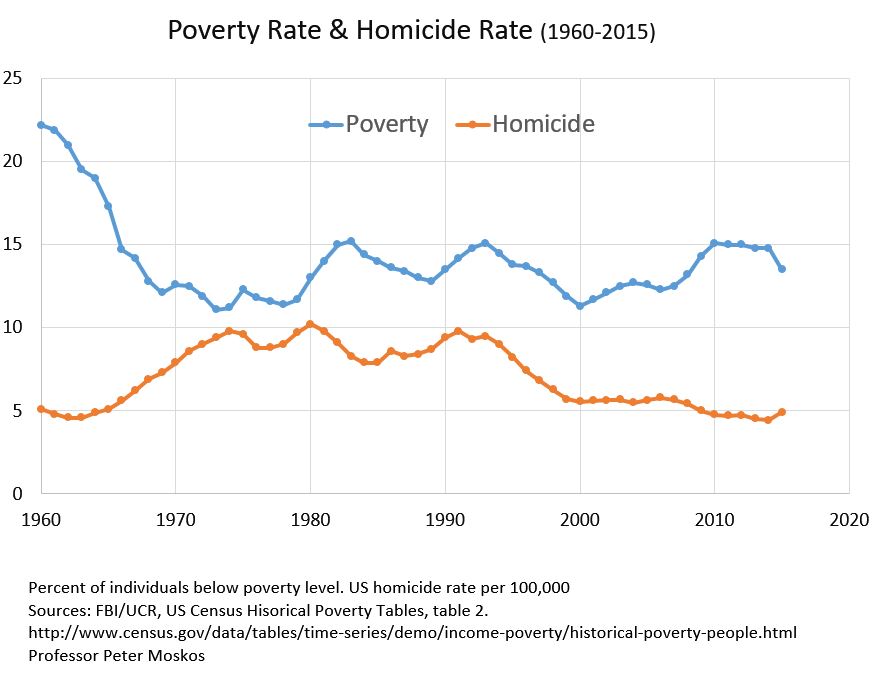
Cop in the Hood explains that crime statistics and poverty are inversely proportional and thus pops the social structure bubble:

When I’m charming people at a cocktail parties with talk of rising crime and the role of police, the good people I talk to, rather than even considering the possibility that police matter and post-Ferguson protests might matter (in a negative way), inevitably try and shift the discussion to greater social issues: poverty, racism, and inequality, the so called “root cause” of crime.

The “root causes” position has long annoyed me. I care about those poverty, racism, and inequality, but in terms of effective crime-preventing policing today, the “root causes” are nothing but a distraction. It’s basically a defeatist way to say we can’t lower crime until we fix society. I’m all for fixing society, but I’m not willing to hold my breath till it happens. Also, the idea that the only way to impact crime is to address structural issues is consistently and demonstrably false.

Last year poverty went down and murder went up. In 2008, the economy tanked, and criminals barely noticed. Between 1965 and 1975, poverty is the US was way down; violent crime way up. In the 1990s, during New York’s great crime decline, the number of New Yorkers living in poverty increased 21 percent. Inflation adjusted household and family income declined. Unemployment approached 10 percent.

Don’t let news get in the way of narrative.

When Every Square Inch is not Literally Every Square Inch

On the day that Betsy DeVos wins Senate confirmation as Secretary of Education (when will women advance beyond the secretariat?), we need to remember that neo-Calvinism has its better and worse forms.

As the recent editorial in Calvin College’s Chimes observed, private Christian day school education does not mean public education is bad (imagine saying that in W. Michigan in 1857):

Many of us entered Calvin College directly from Christian high schools and spent our entire elementary and secondary school years in these institutions, as did Mrs. DeVos. While we appreciate the opportunity to thrive and learn that is provided by these educational systems, we recognize that the vast majority of K–12 students are educated in the public school system. Because of this, we believe that any individual who is nominated to be Secretary of Education should have a strong commitment to public education, which Mrs. DeVos does not.

So the RCA was right to worry about the CRC’s rejection of public schools?

And when it comes to all that kingdom of God rhetoric, not to mention the Lordship of Christ, take it as meaning Republicans don’t belong to the kingdom (how inclusive):

Growing up in the CRC and attending Calvin College, I heard this kind of language all the time. Calvin does indeed call its students to be “Christ’s agents of renewal in the world.” We are told to “advance God’s kingdom.” Without being inside of that tradition, it can sound, perhaps, like theocracy.

What do these phrases actually mean? Most broadly, they mean a service-oriented vision of vocation. Students are called to serve, and they can serve in many ways. For example, Calvin students are regularly called upon to work in the world for racial reconciliation. Why? Because racial reconciliation advances God’s kingdom. That’s why Calvin College faculty signed a letter to Turning Point U.S.A., asking to be added to its “professor watchlist.” The watchlist targets “radical” professors who teach about systemic racism. Serving as Christ’s agents of renewal, Calvin’s faculty spoke up, asserting together that institutional racism is real and that it must be addressed.

What else advances God’s kingdom? Social justice and care for the poor. Clean water in Flint. An improved education for all children in America. All these things advance God’s kingdom. Strong differences will arise about how to get there, but framing these goals in religious language does not mean we have to fear them. After all, those who pray together “thy kingdom come” in the Lord’s Prayer, across many different Christian faith traditions every day, can still disagree quite powerfully about what exactly that kingdom looks like and how it comes about.

Never mind that folks inside the neo-Calvinist bubble don’t worry about how their rhetoric sounds until the bubble bursts and people see inside. Makes you wonder what Afscheiding folks who didn’t join Abraham Kuyper’s church thought of Kuyper as Prime Minister.

Calculating Vice

H. L. Mencken poked holes in the numbers:

How little dependence is to be put in the tales of vice “experts” was lately shown in New York, when a man employed by young John D. Rockefeller made the astounding statement that there were 26,000 white slaves in the greater city–not merely prostitutes, mind you, but white slaves, women “owned” by definite men and regularly robbed of their earnings by these men. A brief examination is sufficient to show the absurdity of such allegations. Go to the figures yourself. The present population of Greater New York, according to the usually accurate estimate of the New York World, is 5,173,064, but this includes the population of two suburban boroughs, Richmond and Queens, in which no white slave trade is alleged to exist. The population of the other three boroughs, Manhattan Brooklyn and the Bronx, comes to 4,476,098.

How many of these New Yorkers are female? According to the census of 1900, the last for which complete figures are available, the population of New York is almost evenly divided between males and females. This gives us, in the three boroughs, 2,373,049 females. But how many of them are of white-slave age? Let us assume, despite the crusaders’ donkeyish theory that a prostitute lasts but five years, that some of the white slaves are as young as 17 years and that others are as old as 34. This gives us a range of 17 years. How many women between these ages live in New York?

Going again to the census of 1900 we find that women between the ages of 17 and 34, inclusive, make up exactly one-third of the female population of the city. Now divide three into 2,373,049 and we get 791,016, which is the maximum number of possible white slaves in New York, counting in married women, college girls, suffragettes and all other indubitably virtuous women. Now divide 791,016 by 26,000 and we get just 30. What does this mean? It means, in brief, that young John D.’s “expert” alleges that one woman in every 30 in New York city, counting in even respectable women, is a white slave.

But ordinary prostitutes are yet to be considered. According to Young John’s “expert,” they greatly outnumber the actual white slaves. How far they outnumber them he doesn’t say: he will come to that by and by. But meanwhile, his statement that there are “many more” justifies the assumption that he means at least half again as many more, That assumption given us 39,000 as the number of ordinary prostitutes. Now add 39,000 to 26,000 and we get 65,000. What does this mean? It means that one woman in every 12 in New York is a prostitute!

Could absurdity further go? And yet such bogus statistics are accepted with the utmost seriousness and published broadcast. The newspapers print them, moralists weep over them, the public is appalled by them. But it seldom occurs to anybody to question them, just as it seldom occurs to anybody in our own dear Baltimore to question the grotesque overstatements of such ludicrous crusaders as Dr. O. Edward Janney and the Rev. Dr. Kenneth O. Murray.

Perhaps John D. Rockefeller was applying “white slavery” in a Sermon-on-the-Mount way, those women who were “white slaves” in their hearts.

The 2k Middle Way

This should eliminate the “R” from R2K with help from the Gospel Allies. Trevin Wax mentions three matters where New Calvinists (posing as neo-Calvinists) can learn from Anabaptists (hint, it’s not how to build a gospel barn). If Mr. Wax had spent a little more time with 2K, he might have posed these theses better.

First, “What happens in the church matters more than anything that happens in the world.

Reply: what have 2kers been saying but only to hear that Christianity must go beyond the church parking lot? And is it not a tad rich to hear about the importance of the church at a website that puts the RA in parachurch? In other words, a high church Calvinism would help Mr. Wax restore the visible church to its proper significance.

Second, “The church changes the world by being the church.”

Reply: don’t go empire building without referring to your Constantinian playbook. Heck, would the church even have a Trinitarian theology to wind up the complementarians without the emperor calling an ecumenical council? Don’t forget either that the conversion of emperors and kings gave a plausibility to Christianity that made the evangelization of medieval Europe more plausible than it would have been with Christianity as a minority and persecuted faith. Do remember as well that the number of Christians spiked in the first half of the fourth century — from 10% of the population in 300 to 50% in 350 — undoubtedly because Christian politicians made the faith respectable and even remunerative.

Meanwhile, as kind as it is to regard Anabaptists as making a difference, overlooking the enormous influence of magisterial Protestants in so many of the aspects of Christian life we take for granted is unfortunate. Whether you like Vacation Bible School, Sunday school, a Bible in every hotel room, or parachurch foreign missionary enterprises, the evangelicals who read and take heart from the Gospel Allies would have a dry and parched religious landscape if they had had to depend on Anabaptists who went before.

Third, “The church is strongest in its witness when it occupies the margins.”

Reply: another kind and generous assertion, but is anyone going to tell me that the OPC has been incredibly strong — compared to Tim Keller, the Gospel Allies, the hipper portions of the PCA, and the behemoth Southern Baptist Convention — because Orthodox Presbyterians have ministered on the margins? Please.

So before anyone tries to buy a farm next to an Amish family, take Mr. Wax’s recommendation of Anabaptism with a grain of salt. If you’re really Reformed, you can chase it with a shot of Rye.

Not Morality but Decency

What if Christians talked more about decency than morality, about what is normal than about what is righteous or God glorifying? Sure, we have churches to talk about the demands of God’s law and how believers glorify God. But, as 2kers are wont to point out, persuading non-Christians to embrace Christian morality sans regeneration or the means of grace seems to be bass ackward.

Does that leave us without a case for those sexual and family aspects of public policy or social life that so animate religious conservatives? It certainly leaves us without a moral high ground. But it’s not as if that high ground doesn’t look to non-Christians like a moral high horse.

So why not take a page from Joseph Epstein? His first collection of short stories about Jewish life in Chicago included one that revolved around a non-observant Jewish businessman meeting his daughter, who had just had an abortion, for dinner to express his disapproval. Part of dinner conversation went like this:

“Daddy, did you really expect me not to sleep with anyone while I was in college?”

“No,” he said, “I guess I didn’t really expect that, but I wouldn’t have minded if you hadn’t. I would have minded a hell of a lot less than I do about what has happened.”

The waitress set down their food. “Enjoy,” she said.

“You still haven’t told me why this bugs you so much, Daddy. Do you think your daughter is now, somehow, damaged goods?”

“I don’t know as I would put it that way, baby, but maybe I do. But not in the way you might think.”

“How then?”

“I think it’s a goddamned damaging thing for a girl to have had an abortion at nineteen,” he said, more emphatically than he had intended. He looked across the aisle at the two old broads and the expressionless face of the senile old gent, and hoped they hadn’t heard him.

“Look, Deb,” he said, talking more softly now, “if you’ve had an abortion at nineteen, what’ve you got planned for twenty-four, or thirty-one, or forty-two?”

“What do you mean?”

“I mean that, for the first time, as a result of what’s happened, I can imagine a terrible life for you. A life of confusion and sadness and heartbreak. And it terrifies me.”

“Why do you think that?”

“Maybe an abortion is a solution to the problem of a pregnancy, but I suspect that it brings its own problems. It isn’t as tidy as it sounds; I suspect that it takes its toll. Once you undergo something like this, your opinion of yourself changes, maybe in small little ways, but it changes. Maybe, because of something like this, you no longer think so well of yourself. Maybe it becomes easier to do more foolish things.”

“I don’t think that’s true, Daddy.”

“I hope it isn’t, sweetheart, I really do hope it isn’t.”

“But what could I have done?”

“You probably did all that you could do, but I think you may be making a big mistake if you think you got away with it. An abortion, anyhow one of this kind, is a dreary and common and pretty crummy thing.”

“What do you want, Daddy?” She had only been picking at her food, but now she gave up even doing that. Tears were in her eyes. Harry remembered her in braces.

“What I want you can’t give me, Deborah. What I want isn’t even reasonable. I want you back the way you were before this happened.”

“What I am supposed to do?” she asked.

“I don’t know what you’re supposed to do. The world is slipping away, my sweet girl, and there’s evidently not much any of us can do about it. But I don’t have to like it. And I especially don’t have to like my kid becoming a part of it.”

If we can join with all (how many?) those people who think abortion who think not that it is a violation of the sixth commandment but “crummy,” would social standards be higher? Maybe.