On the Inside Looking In

Does becoming part of the elite world of publishing, Hollywood, and the academy mean you have to give up perspective?

We need to connect courageously with the rejection, the fear, the vulnerability that Trump’s victory has inflicted on us, without turning away or numbing ourselves or lapsing into cynicism. We need to bear witness to what we have lost: our safety, our sense of belonging, our vision of our country. We need to mourn all these injuries fully, so that they do not drag us into despair, so repair will be possible…. Because let’s be real: we always knew this shit wasn’t going to be easy. Colonial power, patriarchal power, capitalist power must always and everywhere be battled, because they never, ever quit. We have to keep fighting, because otherwise there will be no future—all will be consumed. Those of us whose ancestors were owned and bred like animals know that future all too well, because it is, in part, our past. And we know that by fighting, against all odds, we who had nothing, not even our real names, transformed the universe. Our ancestors did this with very little, and we who have more must do the same. This is the joyous destiny of our people—to bury the arc of the moral universe so deep in justice that it will never be undone.

Writing for the New Yorker and battling capitalist power. Keeping it unreal.

If More Anglicans Read Machen

Would they avoid the problem that Alan Jacobs describes here (for Anglicans who read Machen see this)?

What should Anglicans do with a gay couple that wants to have their baby baptized? Jacobs thinks the child should be baptized:

[T]o deny people the sacraments is to deny them one of the primary means by which they can receive the enlightening and empowering grace by which they can come to know God and follow Him. For the Anglican with a high sacramental theology, it is to deprive them of the “spiritual food and drink” that should be our regular diet. This strikes me as a massively dangerous thing to do. How can we expect people to think as they should and act as they should if we are denying them access to this empowering grace? If we could think and act as mature Christians without regular access to the sacraments, then what need do we have for those sacraments?

But how has the enlightening power of grace worked out in the lives of this gay couple which Jacobs admits has disregarded church teaching and Scriptural imperatives on marriage and sex? It hasn’t worked well and that is why Jacobs thinks the problem is not really with the sacrament but with the failure of Anglican catechesis (in effect a failure of ministry that includes baptism and catechesis):

It is extremely unlikely that any of the people involved have been well-catechized in the Faith. We all need to face up to the fact that almost no churches in the Anglican tradition, conservative as well as liberal, have taken catechesis seriously for a long time. To deny the sacraments to people the Church has failed to catechize is to make others suffer for the failings of the Church’s leadership.

Almost everyone in our society — with the exception of monastics, the Amish, and a few fundamentalist Protestants — has been deeply and persistently catechized by the mass media into a very different model of sexuality than the Christian and biblical one. We should have the same compassion for them as we would for people who have been raised in a brainwashing cult.

So you continue to do what Anglicans have done for a long time — baptize without catechesis? Or do you admit that for baptism to take, it needs the work of instruction in the faith?

[W]e should remember that the task of re-catechizing the Church is going to take a very long time — decades, perhaps centuries — and in the meantime we must be generous and loving to those who have been brainwashed by the world, and not prevent those who desire it from taking the true spiritual food and drink on which we were meant to live.

Why doesn’t Jacobs see how much his sacramental theology really depends on catechetical theology? Or that the ministry of the sacraments cannot be isolated from a larger understanding of pastoral theology? Is it because he doesn’t want to admit that Puritans had a point about the Elizabethan Church?

Bean Counter, Feed My Sheep

Or should it be, sheep feeder, count our beans?

Dr. Timothy Keller, Chairman of the Board at Redeemer City to City, is pleased to announce the selection of Steve Shackelford as the new CEO of Redeemer City to City (CTC).

Shackelford currently serves as President and CFO with Corporate Capital Trust, a business development company that is co-advised by CNL and KKR. The company currently has assets of approximately $4.3 billion and is one of the largest business development companies in the United States. Shackelford earned his undergraduate degree in accounting and MBA degree at Florida State University and spent ten years at the international accounting firm PricewaterhouseCoopers in Orlando, Paris and New York prior to joining CNL in 1996. The Board’s selection comes after an extensive five-month search conducted by executive search firm CarterBaldwin.

Dr. Keller said, “The goal of CTC is to build gospel movements in global cities. The population in cities is growing at a tremendous rate, and there has never been a greater need for churches to serve the diverse needs of cities. Developing leaders for urban ministry is at the core of our mission at CTC. As we grow in global scope, CTC needs an executive leader to navigate the increasing complexity of this movement around the world. I truly look forward to working with Steve to lead this ministry together.”

Imagine if churches ran themselves this way. Isn’t part of urban life worrying about optics?

It’s Only POTUS

Michael Brendan Dougherty echoes the point that presidential elections are destroying America (and so we should let Congress pick POTUS):

The length of our presidential campaign atrophies self-governance. Instead of citizens governing themselves, Americans increasingly define their political lives by their membership in one tribe, and their support for its candidates. Instead of electing a leader, we pledge fealty as followers.

The bulk of our attention flows to the presidential race. And because there is so much attention there, the process attracts candidates who are merely seeking attention for themselves and not high office. In fact, that may be why the primaries feel more and more like reality television, and produced a reality TV president. Each debate is a new episode, and the political press waits for the latest news about which contestant is eliminated.

Because our mode of engaging with politics feels tribal, and because the process takes two years, many people experience it as a crushing psychological and social blow to be on the losing side. Citizens who identify with the losing presidential candidate feel like they are no longer a part of their country. They experience the transfer of the executive branch from one party to the other as a regime change that threatens them. Remember the red and blue maps of Jesusland and America that appeared during the Bush administration? Back then there was heady talk of Vermont seceding from the union to become a bastion of tolerance. Fast forward a few years, and conservatives were the ones spreading stories about Texas’ secession. This is not healthy. But it’s going to continue if we don’t begin to tame the presidential election itself.

The presidential election increases our sense that all issues are national issues. Even people who say they are addicted to politics often have no idea what is happening in their state or county government.

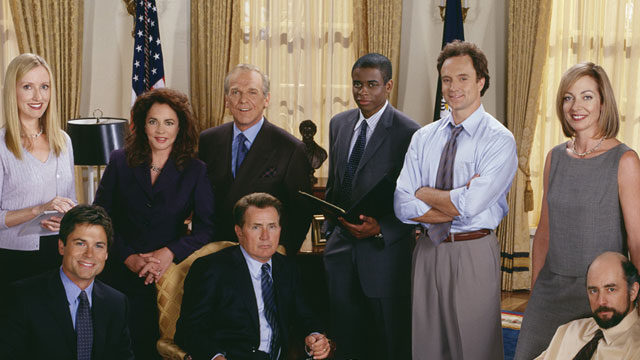
Dougherty adds a point that Aaron Sorkin, the creator of Jed Bartlet, the POTUS on West Wing, should take to heart:

One cause for the gigantism of our presidential election is the gigantism of the executive branch. The federal government employs more than 2 million people in the process of governing us.

Too bad that Sorkin doesn’t seem to recognize the monster that he fed (even if he did not create). His letter to his wife and daughters was typically hysterical (thanks to one of our southern correspondents):

White nationalists. Sexists, racists and buffoons. Angry young white men who think rap music and Cinco de Mayo are a threat to their way of life (or are the reason for their way of life) have been given cause to celebrate. Men who have no right to call themselves that and who think that women who aspire to more than looking hot are shrill, ugly, and otherwise worthy of our scorn rather than our admiration struck a blow for misogynistic s‑‑‑heads everywhere.

But if POTUS were little more than a glorified dog catcher, would the stakes be so high?

The Next Presbyterian Church?

Notice which denominations the Presbyterian Lay(man’s) Committee tries to connect:

CONNECTING WITH OTHER PRESBYTERIANS Presbyterian Denominations:

ECO: A Covenanted Order of Evangelical Presbyterians
EPC: The Evangelical Presbyterian Church
PCA: The Presbyterian Church in America
PCUSA: The Presbyterian Church (USA)

Are the Seceders (Associate Reformed), Covenanters (Reformed Presbyterian), and Orthodox (OPC) chopped liver? The TKNY effect? The legacy of leisure suits?

That Was Then

Here‘s why the church excommunicated Luther almost five centuries ago:

1. Separation of justification from sanctification.
2. Extrinsic, forensic, imputed justification.
3. Fiduciary faith.
4. Private judgment over against ecclesial infallibility.
5. Rejection of seven deuterocanonical books.
6. Denial of venial sin.
7. Denial of merit.
8. Sola Scriptura and radically private judgment: “if we are all priests . . . why should we not also have the power to test and judge what is right or wrong in matters of faith?”
9. Denial that the pope has the right to call a council.
10. Only justified men can do good works.
11. Denial of the sacrament of ordination.
12. Denial of exclusively priestly absolution. Anyone in the Christian community can grant absolution.
13. God has not instituted the office of bishop.
14. God has not instituted the office of the papacy.
15. Priests have no special, indelible character.
16. Temporal authorities have power over the Church; even bishops and popes: “The pope should have no authority over the emperor”.
17. Vows of celibacy are wrong and should be abolished.
18. Denial of papal infallibility.
19. Unrighteous priests or popes lose their authority.
20. The keys of the kingdom were not just given to Peter.
21. Private judgment of every individual to determine matters of faith.
22. Denial that the pope has the right to confirm a council.
23. Denial that the Church has the right to demand celibacy of certain callings.
24. God has not instituted the vocation of monk
25. Feast days should be abolished.
26. Fasts should be strictly optional.
27. Canonization of saints is thoroughly corrupt and should stop.
28. Confirmation is not a sacrament.
29. Indulgences should be abolished.
30. Dispensations should be abolished.
31. Philosophy (Aristotle as prime example) is an unsavory, detrimental influence on Christianity.
32. Transubstantiation is “a monstrous idea.”
33. The Church cannot institute sacraments.
34. Denial that the Mass is a good work.
35. Denial that the Mass is a true sacrifice.
36. Denial of the sacramental notion of ex opere operato.
37. Denial that penance is a sacrament.
38. Assertion that the Catholic Church had “completely abolished” the practice of penance.
39. Claim that the Church had abolished faith as an aspect of penance.
40. Denial of apostolic succession.
41. Any layman who can should call a general council.
42. Penitential works are worthless.
43. The seven sacraments lack any biblical proof.
44. Marriage is not a sacrament.
45. Annulments are a senseless concept and the Church has no right to grant them.
46. Whether divorce is allowable is an open question.
47. Divorced persons should be allowed to remarry.
48. Jesus allowed divorce when one partner committed adultery.
49. The priest’s daily office is “vain repetition.”
50. Extreme unction is not a sacrament (the only two sacraments are baptism and the Eucharist).

What about now?

If Lutheran teachings and practices don’t result in excommunication today, it likely has something to do with situations like this:

“Life is full of ambiguity”, Cardinal Cupich said, but the “important thing is to bring an attitude of discernment to a situation.” He then referred to a “wonderful article” by Professor Rocco Buttiglione in L’Osservatore Romano some months ago, “who situated historically that document in terms of the ongoing development of the teaching of the Church.” (Professor Buttiglione’s essay has since been refuted).

He ended by saying “there are enough voices out there in which the Holy Father doesn’t have to in any way have to defend a teaching document of the Church. It’s up to those who have doubts and questions to have conversion in their lives.”

Controversial passages never passed

But defenders of the Dubia argue that Cardinal Cupich’s comment that the controversial propositions in question were “voted on by two-thirds of the bishops” is especially problematic.

It is often forgotten, they point out, that despite the strenuous efforts by the Synod secretariat and others to manipulate and jostle the synod fathers into accepting the most controversial propositions (allegations detailed in my book The Rigging of a Vatican Synod?), none of the three most controversial propositions managed to obtain a two-thirds majority during the first, Extraordinary Synod on the Family, in October 2014.

One of them was a proposition relating to the “Kasper proposal” of admitting the divorced and remarried to holy Communion after a period of penitence. That failed to pass, and only a proposition calling for “careful reflection and respectful accompaniment” of remarried divorcees made it through.

Under such circumstances, they would normally therefore have been rejected.

In spite of this, the Pope controversially broke with custom, which he can do, and authoritatively insisted that all three rejected proposition be kept in the document, thereby enabling them to be carried over into the working document for the Ordinary Synod on the Family the following year.

Not to worry, the more ambiguity, the more it’s the church Christ founded. If only the consequences for souls dependent on faithful ministers of the gospel and reliable expositors of sacred mysteries were so ambiguous.

The Worse, the Better

It’s an odd argument, but in the Pope Francis era it seems to be more prevalent. It runs something like this:

He’s a lousy husband, angry, selfish, a slob, and abusive, but that makes him the husband God gave me all the more.

He’s a terrible employee — late for meetings, lies to customers, refuses to adhere to company policies, but he’s the co-worker God gave me.

He’s an awful king — he suspended habeus corpus, requires citizens to hostile to hostile and uncivil soldiers, forces us to pay taxes without giving us a voice in tax policy — but he’s the king God gave us.

And so, when it comes to the church, the fact that an institution so bad has existed so long is proof that it is the institution Christ founded.

For instance:

In the satirical writings, dialogues, of the 14th c. Italian author Boccaccio there is story about a Jew who has to go to Rome for something. The local Bishop has been trying to get the Jew to convert the Christianity. Knowing the Jew was about to see the Church at its worst in Rome, the corruption and moral turpitude of many of the clerics and religious, even Popes like the Borgias, the Bishop despaired that the Jew would ever covert on his return. However, once returned from his trip, the Jew went to the Bishop and said, “I’m ready to convert now!” The Bishop, flabbergasted, replied, “You went to Rome and you saw how horrid things were there… and you still want to join this Church?” “Yes”, said the Jew. “I figure that with so many wicked and corrupt people hard at work trying to destroy the Church, it shouldn’t have lasted 14 years, much less 14 centuries. It has to be of divine origin!”

Or again:

It was exhilarating, that moment when it hit me: “I’m going to become Catholic.” But as I experienced more of the modern church, and began RCIA, Patrick Coffin’s greeting to converts, “Come on in! It’s a mess,” started to make sense.

So did the words of Hilaire Belloc, which no longer seemed merely witty:

The Catholic Church is an institution I am bound to hold divine but for unbelievers a proof of its divinity might be found in the fact that no merely human institution conducted with such knavish imbecility would have lasted a fortnight.

Even more:

Worrying about the daily confusion and sorrow Pope Francis introduces into our lives can impede us from working on our first priority—which is living our Catholic life in Christ as fully as we possibly can. With only exceedingly rare exceptions, we are in no position to offer correction to the Holy Father. Therefore, it will do us little good to engage in endless arguments over what is wrong, whose fault it is, and how the problems posed by the current papacy might be resolved. And not only will this do us no good, but it can be a significant source of scandal to others, most of whom will have little or no awareness of the issues at stake.

I’d like to suggest that it is time to turn the corner on Pope Francis. Most of us have no cards to play in the game of improving the papacy. But we do have our own callings, our own God-given talents, our own opportunities to engage in the spiritual and corporal works of mercy, to teach the truth and to foster the good. When we can use something Pope Francis has said or done in our own Catholic service, then we should—all the better! But when we cannot take our inspiration from Pope Francis, we can still reference Our Lord and the Church He founded. We do not need to come up against Francis and grind to a halt. That’s what I mean about turning the corner.

I do not presume to know papal theory well, but am aware that reservations about papal authority were much more substantial in the Middle Ages than they are in the post-Vatican I church where infallibility is now dogma. In fact, important medieval philosophers like Marsilius of Padua and William of Ockham (does that make me Darryl of Hart?) made arguments against the tyranny of the papacy that would seem to be relevant for Roman Catholics today.

But the apologetic that the deficiencies of the church only prove its necessity and durability defy Thomistic logic no matter how tight the syllogisms are under Bryan and the Jasons Kangol cap.

Here’s why: if the church is deficient, how do you then know that its truth claims are not also deficient?

Because the reality remains: She is the bride of Christ, and the Truth is found nowhere but in Her. Conversion to the one true faith remains the greatest, most life-altering decision a person can make—even if things are a bit of a mess.

In point of fact, the truth about conditions in the church come almost entirely from sources external to the magisterium, which sort of pokes a hole in those audacious (warning, Bryan Cross has removed the article about Papal Audacity) claims about the magisterium’s infallible protection of the truth.

Ministry Inside the Bubble

Redeemer NYC has been in existence for almost twenty years and by this point it may be worth asking whether Tim Keller and company have transformed or been transformed by the bubble. Consider, for starters, that Redeemer spawned churches that cover Brooklyn — bubble central — about as well as Verizon. Notice as well that Keller speaks of the dangers of white nationalism the way many in the academy, Hollywood, Washington, and the Times do (though he also worries about secularism).

More substantive than these atmospheric impressions are the way that the Kellers promote the big city and its culture. Does anyone remember how Kathy Keller lauded the benefits of living in the city?

Lifestyle Benefits

simplicity more possible—you collect less stuff in small apartments

immediate family is closer physically, harder for kids to isolate themselves; meals together more likely

apt cleaning/care is easier, less time-consuming than a house

you don’t spend all your free time on house/yard chores

no scraping off your car in icy weather—enjoy walking in the snow instead

no school snow days—the subway is always working

sense of community, bonding, in your immediate neighborhood

for new parents, especially stay-at-home moms, you don’t experience the isolation and despair of being stuck at home all day, unable to go out or even see another adult person—just a trip to the laundry room gives you someone to talk to, and a stroll outside brings you to the world

many large American cities have something like Fresh Direct: order your groceries online and have them delivered the next day, boxed, to your kitchen; great if you are sick or time pressured

fresh fruit and cheap flowers at corner stands rival expensive shops elsewhere

great food in every restaurant—no bad meals . . .

General

airline prices are cheaper to/from larger cities; fewer transfers

closer to ministry opportunities, especially diverse groups, the poor, ethnic communities (instead of traveling many miles to reach a people group); virtually all people groups are in the city, especially Africans, Russians, and South Americans

less expensive for getaways; can travel by subway to a new neighborhood or a cultural enclave for a change of pace; so many unique experiences close at hand

wealthy people in cities are always happy to lend their vacation homes to ministry families for weekends and getaways, as long as you are flexible; since ministry happens on weekends, mid-week getaways don’t generally conflict with the owners’ desire to use it on weekends

easier to reach the suburbs from the city center than to reach the city center from the suburbs

access to the best of the best in: professional sports, cultural interests (museums, lectures), entertainment (theatre, music, improv), educational opportunities/options, shopping, influencers in every field, restaurants, medical care

Don’t get me wrong. I’m a fan of cities for many of these reasons. But Ms. Keller doesn’t seem to understand that urbanism separates her from lots of other Americans, while signalling to urban dwellers that she and her husband’s ministry “get” — nay, love — the city (even if the big steeple PCA churches in the South or the social justice warriors in St. Louis do not: “bless their hearts for being urban, but they don’t know NYC the way we do” – read they aren’t bubblicious). How do you then challenge the bubble when you’re on the same side as the bubble?

Tim Keller himself earlier this year showed that he was not as comfortable with urban artistic life as many might assume given Redeemer’s Faith & Work Center:

Contemporary art is dominated by either critical theory or commercialism. Much art is aimed at transgressing and debunking all social norms in order to liberate the individual. Or it is designed to provoke in such a way that attracts eyeballs and income. It’s possible that gospel-changed Christians in the arts would bring far more hope and less nihilism, and could express visions of community and shared values.

Isn’t that all the more reason to wonder whether Redeemer’s ministry did anything to prepare New Yorkers for what happened on election day. Or, were they part of the constituency that Saturday Night Live mocked?

They pride themselves on being open-minded, but they actually close themselves off to contrary arguments; The Bubble is a “community of like-minded free-thinkers—and no one else.” They think they’re more thoughtful and intellectual, but they’re really just confirming each other’s biases; a “wide array of diverse viewpoints” is two people doing nothing but agreeing with each other. They think they’re well-informed and cultured, but they draw from a very narrow range of trendy lifestyle fads and “only the good websites.” They think of their lifestyle as simple and accessible, but only the well off can afford it. (“Anybody is welcome to join us,” the ad proclaims, but a one-bedroom apartment starts at $1.9 million—not far off from reality in Manhattan or San Francisco.)

They say they are above racial division, but they’re the ones obsessing over it. (“We don’t see color here—but we celebrate it.”) Then there’s the preening, condescending race-consciousness of the privileged white “progressive”—who, in this sketch, ostentatiously points to the “black power” button on his lapel and gets a subtly exasperated roll of the eyes from his black co-star.

Most important: They depend on the support and protection of blue-collar workers who don’t share their values and culture.

Can’t Presbyterians ask what happens to Presbyterian frogs in the New York City kettle? Isn’t that what Presbyterian polity is about? Or are we supposed to be awed by Redeemer exceptionalism?

Inside the Bubble, All White Christians Look the Same

President-elect Trump’s pick for Department of Education, Betsy Devos, has deep ties to the Christian Reformed Church:

She is daughter of Edgar Prince, the founder of Prince Corp., an automobile parts supplier based in Holland, Mich. While her mother, Elsa, and her husband’s parents have supported anti-gay marriage efforts in the past, Betsy Devos has focused primarily on education.

DeVos has been member and an elder at Mars Hill Bible Church in Grand Rapids, which was formerly led by popular author Rob Bell. Former president of Fuller Seminary Rich Mouw said he served on a committee with her to replace Bell, and he said DeVos is heavily influenced by Abraham Kuyper, a Dutch writer and Calvinist theologian.

“I wouldn’t consider her to be right wing,” Mouw said. “She’s a classic free-enterprise conservative. She takes public life, art and politics very seriously.”

Middle-class work ethic – check

Anti-gay marriage – check

Abraham Kuyper – check

Rob Bell – what the bleep?

Thankful for Trump

I rarely see eye-to-eye with Michael Novak, but m(mmmmeeeeEEE)y reaction to the election was similar to his in the sense that I dreaded four more years of progressivism at that center of American life and felt a sense of relief when news came that Hillary Clinton did not win.

But a better expression of my thoughts comes from Damon Linker who recognizes, as few do inside the bubble of progressivism, that the United States includes more than elite institutions and their unofficial establishment:

The urge toward exclusion is a perennial possibility of politics. That’s because politics takes place on two levels. On one level is the back and forth of partisan conflict, involving persuasion, argument, electoral battles, triumphs, and defeats. On this level, pretty much anything goes as long as it abides by the rules of the political game. But there’s also a second, more fundamental level of politics that involves a competition over who gets to set the rules, the boundaries of what is publicly acceptable, in the first place — and precisely where those boundaries will be positioned.

The most obvious example of second-order politics in the American system is the judiciary, and especially the Supreme Court. Until the Obergefell decision in 2015, for example, the American people were engaging in a free-flowing debate about same-sex marriage, with some people in favor of allowing it and others opposed, and public opinion shifting rapidly in the “pro” direction. That was politics conducted on the first level. But then the Supreme Court stepped in to declare gay marriage a constitutional right. That was second-order politics in action: Suddenly the rules were changed, with the “pro” side summarily declared the winner throughout the nation and the “anti” side driven — and permanently excluded — from the political battlefield going forward.

But second-order politics isn’t only found in the formal strictures of a Supreme Court ruling. It comes into play when prominent institutions in civil society (such as mainstream media outlets, universities, corporations, movie studios, and other arms of the entertainment industry) informally unite in deciding that an issue, or a specific position on an issue, is simply unacceptable because it crosses a moral line that leading members of these institutions consider inviolable. Over the past several decades, a range of positions on immigration, crime, gender, and the costs and benefits of some forms of diversity have been relegated to the categories of “racism,” “sexism,” “homophobia,” “white supremacy,” or “white nationalism,” and therefore excluded from first-order political debate.

I’m not going to cry for progressives. They still have elite journalism, Hollywood, the most exclusive colleges and universities, and lots of agencies related directly and indirectly to the federal government. They just don’t have the White House for the next four years. Let’s see Aaron Sorkin make a television show about that.