Engaged or Cohabiting

Thanks to Dustin who challenges the Old Life (okay mmmmeeeEEEE) manner of responding to The Gospel Coalition (aka Gospel Industrial Complex and related outlets) I have the opportunity to clarify this old Calvinist’s attitude to the Calvinist wannabes.

The problem with TGC is that is neither fish nor foul. It tries to do the gospel but it also adds a lot of clutter. So if I wanted to read a theological journal, TGC isn’t the place to go because it doesn’t go deep or academic (though it tries to strike a scholarly tone). And if I want to read about culture — TGC has channels from “Current Events” to “Arts and Culture” — why would I read their take before what I normally read — New Republic, New Yorker, American Conservative, and a host of blogs.

So the issue is that TGC doesn’t really investigate the nooks and crannies of theology and worship. How can it when it is a coalition of people in different communions? TGC accentuates the positive. In my mind that is overwhelmingly dull. TGC feels more like an organization interested in boundary maintenance and creating a feeling of belonging than in thinking challenging thoughts. The inspirational bits, whether from earnest piety or the fame of celebrity pastors, don’t overcome the predictability.

When it comes to arts, culture, current events, TGC seems to want to be neo-Calvinist but the New Calvinists haven’t done the intellectual heavy lifting that neo-Calvinist clearly have. As much as I take issue with the integralist aspirations of neo-Calvinists, they are smart, they know the importance of academic rigro rigor and are generally (in their intellectual demeanor) not interested in inspiring. They are especially proficient in philosophy. I don’t happen to believe that philosophy is the area of study to supply the foundation that gives coherence to all human activity — I don’t think such coherence is possible (hide human flourishing under a bushel? Yes!). But I give the neo-Calvinists credit for doing the hard intellectual labor.

I don’t see that kind of intellectual output — no offense — at TGC. Not to mention that I’m not sure what current events or the arts or food shopping on Sundays has to do with the gospel.

So TGC fails on two counts: they dabble at paleo-Calvinism; and they dabble at neo-Calvinism. If the allies want simply to be evangelical, fine. That is actually what they are — a repristination of the New Evangelicalism of Fuller, Christianity Today, and the National Association of Evangelicals minus the Wesleyans and Pentecostals. I’ve seen this stuff before. Not much to see and certainly nothing to take seriously.

In other words, I don’t engage TGC. I live in a world where TGC also lives. In some sense, we live together. But we don’t relate and we certainly don’t commune (or roll on Shomer Shabbos).

Forgiving a Scapegoat?

Alan Noble raised the bar pretty high — as high as church membership mind you — when he explained why evangelicals should be never Trump:

In response to these profound violations of human decency, he scoffs, changes the subject, denies he even said it, or doubles down. As he has said, he does not ask God for forgiveness, because he doesn’t believe he needs it.

That insight into Trump’s perception of his own soul should tell evangelicals all they need to know about him as a leader. Any man who is so unaware of his own depravity that he cannot recognize his need for forgiveness is incapable of justly leading any country. There simply is no way around this fact for evangelicals.

Has anyone asked Hillary Clinton of her need for forgiveness? At least, Noble should give equal time to both candidates. He might also want to consider the constitutional qualifications for holding the office of POTUS. No religious tests. So does Noble understand how much he sounds like a Jerry Falwell (Sr.)?

At least Roman Catholics are less driven by piety than by policy. Here are the items to worry about in a Clinton presidency (via her appointments to SCOTUS):

Religious Liberty: In the highly-publicized case of Burwell v. Hobby Lobby, the Supreme Court ruled that closely held for-profit companies like Hobby Lobby could be exempt from laws that violate its religious beliefs, in this case Obamacare’s contraception mandate. This was an enormous win for religious liberty, but it was only decided by a slim 5-4 margin. With a liberal majority, you can expect the Court to rule against companies like Hobby Lobby or non-profits like Little Sisters of the Poor. Religious corporations and organizations around the country would be forced to chose between violating their consciences or paying penalties that would likely put them out of business. If liberals have their way, say goodbye to many religious retailers, charities, bookstores, hospitals, medical centers, and so on.

Transgender Bathrooms: Thirteen states are currently suing the Obama administration over its directive to public schools mandating that transgender students be able to use the bathrooms and locker rooms of their choice without having to prove their gender identity. Perhaps no issue more directly impacts the lives of our children than this. A liberal Supreme Court will undoubtedly uphold the Obama administration’s rule and force states to comply. The consequences will be catastrophic. Don’t be so naive as to think boys won’t abuse these policies and force their way into female bathrooms and locker rooms. Parents and teachers won’t be able to stop them. And aside from sexual misconduct and assault, this policy could mean the end of men’s and women’s competitive athletics as we know it.

Second Amendment: Without a doubt, the Second Amendment would become a primary target of a liberal Supreme Court. In recent years, two landmark decisions protecting an individual’s right to own and bear arms – Heller v. District of Columbia and McDonald v. City of Chicago – were each decided by just one vote. (Are you noticing the 5-4 trend yet?) Given the opportunity, a liberal Court wouldn’t hesitate to overturn those decisions. We got a glimpse of this in June, when the notoriously liberal Ninth Circuit Court of Appeals ruled that the Second Amendment does not permit the public to carry concealed firearms. A liberal Supreme Court would certainly uphold this ruling and continue to hack away at the rest of the Second Amendment.

Abortion: It was an activist, liberal Supreme Court in 1973 that decided Roe v. Wade and legalized abortion. A liberal Supreme Court in 2017 will only reinforce and protect that decision. It will likely strike down majority-supported, common sense abortion laws that have been passed in the states, like late term and partial birth abortion restrictions and pain-capable legislation. Just this June, the Supreme Court invalidated the Texas law requiring basic health standards for abortion facilities, a law passed to prevent another Kermit Gosnell house of horrors from occurring.

But the best perspective on Trump and Clinton may come from those without a faith-based dog in the hunt:

But Trump is a monster! Yes, but given the right circumstance, so are you. His ugliness is simply more apparent than that of other managers of the state’s sacred violence. Let’s be frank here: though his speech is scarily vulgar, the violence he promises is already occurring.

Think his call to deport illegally undocumented workers is fascist? The Obama administration, garbed as it is with the shimmering rhetoric of victimhood, has already deported over 2,500,000 human beings—23 percent more than Bush.

How about his pledge to torture suspected terrorists? Clinton-Bush-Obama beat him to it. They just don’t talk about it like he does. And let’s not limit it to foreigners; Obama didn’t bat an eye as elderly tax protester Irwin Schiff died of cancer chained to a prison bed far away from his family for breaking the sacred taboo against being too stingy in sharing his resources with the collective.

How about the time Trump promised to target terrorists’ families? Obama, the great defender of Islam, already trumped that when he murdered people like U.S. citizen Anwar al-Awlaki’s 16-year-old son Abdulrahman, who hadn’t seen his father for two years. This teen and his friends were blown apart by the Nobel prize winner while having a campfire dinner, apparently for the sinful dreams of his father.

Actually, a faith-based perspective makes sense of Never Trump. He’s our Scapegoat:

In today’s Christ-haunted West, we no longer have complete unanimity in our identification of common enemies, but we still seek it in the sub-factions we continually form. Yet Donald Trump’s faction is not going to prevail in any lasting way: his sacred dogma is built on “Winners.” His brand is a throwback to Nietzsche, who was himself a kind of throwback to a still older “golden age,” a time when pagan religion celebrated history’s winners, who were deemed right because of their might.

Trump even viscerally looks the part of the old scapegoat kings who would be ceremonially paraded before being sacrificed: he is often mocked for having small hands and goofy orange hair; he eats profane food like McDonald’s; he loves gaudy decoration in an age of “shabby chic”; he calls himself a winner in a culture where people must offer faux humility to gain status. Trump, who has repeatedly said that were he not her father he would be dating his daughter, is even accused of breaking the age-old taboo against incestual lust.

In the ancient cultic world of our past pagan order, hierarchies of kings, priests, and elites often killed or excluded the odd, weak, infirm, disabled, ethnic minority, or child based on the cultural fact that they were intrinsically inferior and thus deserving of a worse lot in life. But since the crucifixion meme began dominating the West, our modern cultures are increasingly self-critical and haunted by victims. Jesus robbed us of our blindness to the unjust order of “might makes right,” but he didn’t create an alternative ideology to deny us choice. We still have to choose, to a person, to model forgiveness and nonviolence as we seek to heal the victims most vulnerable to exploitation. But we’re stubborn in doing this work, and so we try to create cathartic peace and order through scapegoating—this time in the name of victims.

Labor Day Is a Holiday that Isn’t Holy

Tim Challies shows the classic confusion of redemption and providence by calling everything grace:

It is God’s grace that you can be industrious instead of idle. Flavel says, “Sin brought in sweat, but now not to sweat increases sin. He that lives idly cannot live honestly.” The Bible’s warnings about laziness and idleness are many and stern. So when God puts you into a vocation that is legal and moral, he has done you a great benefit. He has given you the blessing of allowing you to earn your own living. Your hard work allows you to avoid the temptations of idleness and to care for your own needs rather than having to rely upon others. Further, through God’s provision to you, you have enough to provide for those who cannot provide for themselves. It is, after all, more blessed to give than to receive.

But what if I am not as industrious as H. L. Mencken or Woody Allen who seemingly have not lived in a state of grace?

It is God’s grace that you have a job that is lawful before God and men and especially suited to you. There are many people who are employed in jobs that are sinful or even illegal. “They do not only sin in their employments, but their very employments are sinful.” To have a job that dishonors neither God nor men is no small mercy. To have a job suited to your passions and skills is a double mercy. Then, if your job allows you to provide for yourself and others without working you to the bone, without consuming all of your waking hours, you have more reasons still to thank God for what he has given you.

My skills as a historian, such as they are, did not come through the means of grace or conversion. I studied and learned from lots of non-redeemed historians.

It is God’s grace that he has directed you into the kind of job that neither you nor your parents may ever have expected. You may well be involved in a job that your parents did not plan for you to do, and perhaps one that even you did not plan to do. Just like a compass needle turns this way and that before settling on true north, so “a child is designed for this, then for that, but at last settles in that way of employment to which Providence designed him.” Many of us can attest that “Not what we or our parents, but what God designed shall take place.” This is certainly the case with me and I owe God great thanks and praise for his kindness and his wisdom in giving me a passion for writing and then allowing me to do it.

I say it’s providence but it’s also the accident of growing up at a time when college education became wildly available and when graduate schools were opening their doors wide. That kind of economic development is not grace. It is providence.

It is God’s grace that he secures what you have earned. God’s favor toward you is what has allowed you to earn what you have. That same favor is what has allowed you to keep what you have earned.

Let’s not forget civil magistrates and police many of whom are not living in a state of grace. Their non-sanctified labors maintain my security and property.

It is God’s grace that your vocation is sufficient for you. Some people have work, but not enough strength to complete it. Some have strength, but no work to commit it to. Some have both strength and work but even then not sufficient to provide for themselves or others. If God blesses your labors to give you enough or even more than enough to meet your needs, you ought to give him praise and thanks.

If I am content with my vocation — some days — that is partly a function of sanctification. But I know lots of non-believers who seem to have as much job satisfaction as I do.

Tim either needs to get out more or needs to read more on providence (preferably without Petra blaring in the background).

Obedience Girl

Wesleyans aren’t the only ones to promote perfectionism:

Following Jesus is a serious task, and, at the same time, one filled with joy; it takes a certain daring and courage to recognize the divine Master in the poorest of the poor and those who are cast aside, and to give oneself in their service. In order to do so, volunteers, who out of love of Jesus serve the poor and the needy, do not expect any thanks or recompense; rather they renounce all this because they have discovered true love. And each one of us can say: “Just as the Lord has come to meet me and has stooped down to my level in my hour of need, so too do I go to meet him, bending low before those who have lost faith or who live as though God did not exist, before young people without values or ideals, before families in crisis, before the ill and the imprisoned, before refugees and immigrants, before the weak and defenceless in body and spirit, before abandoned children, before the elderly who are on their own. Wherever someone is reaching out, asking for a helping hand in order to get up, this is where our presence – and the presence of the Church which sustains and offers hope – must be”. And I do this, keeping alive the memory of those times when the Lord’s hand reached out to me when I was in need.

Mother Teresa, in all aspects of her life, was a generous dispenser of divine mercy, making herself available for everyone through her welcome and defence of human life, those unborn and those abandoned and discarded. She was committed to defending life, ceaselessly proclaiming that “the unborn are the weakest, the smallest, the most vulnerable”. She bowed down before those who were spent, left to die on the side of the road, seeing in them their God-given dignity; she made her voice heard before the powers of this world, so that they might recognize their guilt for the crime – the crimes! – of poverty they created. For Mother Teresa, mercy was the “salt” which gave flavour to her work, it was the “light” which shone in the darkness of the many who no longer had tears to shed for their poverty and suffering.

But did she trust Jesus as her savior from sin?

Buyer’s Remorse or Remorse over Buyers?

Alan Jacobs warns converts who would be apologists:

Waugh is one of those converts in whom Catholics take great pride. If I were in their position, I would do everything in my power to prevent the world from finding out that he belonged to my communion. If the rightly administered sacraments are presumed to be instruments of grace, it appears that Waugh, at any rate, was invulnerable to their power. I would appreciate it if my Catholic brothers and sisters took the unremitting nastiness of the man more seriously. I have yet to hear one say that when Waugh took the Sacrament he did so unworthily, though I do not believe, given his gleeful and freely expressed hatred of almost everyone he knew, that anyone could reasonably say that he did so worthily.

He believed that by becoming Catholic he had ensured his own salvation, and from that elevated seat taunted his friends who remained Outside: “Awful about your obduracy in schism and heresy,” he wrote to the Anglican John Betjeman. “Hell hell hell. Eternal damnation.” Only some wholly unacquainted with Waugh’s views would think he was joking. Betjeman certainly didn’t.

Winning?

A war that won’t end:

Thus neither side won the Twenty Years’ War. Victory would mean achieving core aims at an acceptable cost relative to the benefits. Al-Qaeda did meet some of its goals: With limited resources, bin Laden gained incredible notoriety and inflicted enormous damage on a great power. In 2003, U.S. troops left Saudi Arabia—the key goal outlined in the 1996 manifesto. In 2004, bin Laden released a video that compared the costs of the 9/11 attacks to al-Qaeda versus the United States: “Al-Qaeda spent $500,000 on the event, while America, in the incident and its aftermath, lost—according to the lowest estimate—more than $500 billion, meaning that every dollar of al-Qaeda defeated a million dollars.”

But in a broader analysis, bin Laden failed. Yes, U.S. forces left Saudi Arabia, but they did so voluntarily, after Saddam was toppled. Crucially, al-Qaeda was unable to mobilize Muslims around a strict Islamist identity that transcended other loyalties. As Charles Kurzman showed in his book The Missing Martyrs, after 9/11, fewer than one in every 100,000 Muslims became jihadist terrorists. The vast majority of Muslims completely reject bin Laden’s ideology. And national, tribal, and other local identities remain profoundly important from the Palestinians to the Pakistanis. From 2003-2011, confidence in bin Laden collapsed in many Muslim-majority countries, falling from 59 percent to 26 percent in Indonesia, and from 56 percent to 13 percent in Jordan. In a 2013 poll taken in 11 Muslim countries, a median of just 13 percent had a favorable view of al-Qaeda, whereas 57 percent had an unfavorable view.

Al-Qaeda’s loss is not U.S. gain:

Let’s turn first to the United States on offense: the invasions of Afghanistan and Iraq. Recounting the costs is numbing: over 7,000 Americans killed, tens of thousands of soldiers seriously wounded, trillions of dollars expended, and over 100,000 civilian deaths in Iraq alone. And there’s the wider impact of spending on America’s debt, of enhanced interrogation and torture on the U.S. global image and ethical standing, and of seemingly endless quagmires on domestic political unity.

In an interview, Zbigniew Brzezinski, the national security advisor to President Jimmy Carter, told me, “The Iraq War was unnecessary, self-damaging, demoralizing, delegitimizing, and governed primarily by simplistic military assumptions that didn’t take into account the regional mosaic in which Iraq operates and the internal mosaic inside Iraq.”

The eclipse of al-Qaeda by ISIS is a loss for al-Qaeda but not a gain for the United States. ISIS is an even more ruthless and capable adversary.

Does idealism hurt the United States (and are believers responsible for imbuing America with too many ideas?)?

But the main combatants in the struggle lost for similar reasons: They were hobbled by ideology. Al-Qaeda’s vision of austere Wahhabi Islam and endless global jihad is profoundly unappealing to the vast majority of Muslims. But ideology also shaped U.S. strategy, sometimes in dangerous ways. American idealism is one of the country’s most attractive qualities, central to its moral standing and “soft power.” But idealism also helped to frame the Twenty Years’ War as a struggle between good and evil, which required grandiose goals to topple regimes and build beacons of freedom in the Middle East. It also encouraged Americans to lump terrorists and rogue states together into a big bucket of bad guys. At the same time, Americans are also hostile to the whole notion of nation-building, often seeing stabilization missions as a kind of big-government welfarism, and not something that the country’s warriors should be doing. In a recent foreign-policy speech, Donald Trump said, “ISIS will be gone if I’m elected president,” but at the same time, the United States will be “getting out of the nation-building business.” This combination of beliefs is as American as apple pie.

As a result, the United States is an impatient crusader: eager to smite tyrants and terrorists but unwilling to invest the time and resources needed to win the peace.

And Here I Thought W-w Was Hard

Turns out, obedience is harder:

In the first place, it seems that Gahl does not consider adequately the role of conscience. Is it sufficient that the confessor enunciates a principle such that it can be assumed that the conscience has been sufficiently enlightened? Perhaps not. Cardinal Newman made an illuminating distinction between a merely notional assent and a real assent of the conscience. It is possible that the penitent does not understand or does not accept the confessor’s admonition and refuses to promise that, in the same situation, he will not act once again in the same manner. The conscience will be enlightened only in the moment in which it has given real assent. What should be done if the penitent does not give real assent to the confessor’s admonition?

Pity the potato farmer who needed to find Denzinger‘s entry on notional assent.

When It Was Unthinkable that the State Would Affirm God

Thanks to his typing skills, Mark Van Der Molen reproduces a remark that Alan Strange made in his discussion at Reformed Forum on the spirituality of the church:

The separation of church and state, the distinction of church and state is something entirely different from the separation of faith from politics, or even God from State. None of those men believed in the separation of God from State. Even in public ways, all of them believed….basically Thornwell argued and so did Robinson, that it is immoral. Any state that is atheistic is immoral. They both argued that. If you read Robinson and Thornwell, and particularly Hodge, I think you will see they have clear points of integration. They have them in any number of ways, they all believed that it was immoral and unthinkable that the State would deny God or Christ in a general way.

(Alan, if you’re reading, I’m not picking on you. I am using your remarks to clarify, in which case disagreement may be beneficial.)

First, I do wonder about the difference between an atheistic and an idolatrous state. If the false gods are no gods, isn’t then every state without the Triune God revealed in Holy Writ an atheistic state. Is Turkey any better than the Soviet Union if the former acknowledges Allah in some way but the Soviets denied God? What about a Jewish state like Israel? Or how about a Mormon state like Utah? If states become immoral by virtue of atheism, aren’t they also immoral by denying the true God?

That puts Alan and Van Der Molen, perhaps, closer to the Puritans and a confessional state than to Robinson and Hodge who seemingly welcomed a secular government like the United States but rejected an atheistic state.

But keep in mind the progression of states that include God in their operations:

Puritans — they admitted only Puritans and excluded Baptists, Quakers, and Lutherans (for starters)

1820s U.S. — was friendly primarily to Protestants though all faiths could worship, which was a decisive break from 1640 Boston and 1550 Geneva

1950s U.S. — American society recognized a tri-faith monotheism informally of Protestants, Roman Catholics, Jews while also putting God on coins and in the Pledge of Allegiance, which was a break from 1820s Protestant dominated America

2010s U.S. — American society apparently has no religious standards and may even give sectarian faiths a hard time, which is a break from 1950s tri-faith America

The trend here is toward greater diversity and toleration. 2kers are trying to stop the bleeding by reconfiguring what God requires. The 2k conclusion, tentatively, is that God does not reveal a definite pattern for politics. The church is one thing, the state another. 2kers also try to learn lessons from the past and how earlier efforts to establish religious standards could not compete with the movement of peoples or the growing authority of the nation-state to regulate its citizens affairs in a way that achieved a measure of social unity.

What critics of 2k need to do is stop showing how 2k departs from the past. We get that. What critics need to do is not foment fear for disagreeing with Calvin or Winthrop — as if Protestants have post-canonical authorities whom we must follow. Critics need to propose an equation for God-and-state that is either required by God’s word (especially the part where Paul recommends submission to Nero) or that does justice to the lives that Christians now lead and somewhat enjoy.

2k is not novel in one sense. It advocates the spirituality of the church which is a part of the Western Christian tradition going back to Augustine, Paul, and Jesus. In another sense it is new — in the novos ordo seclorum way. 2k proposes a re-consideration of political theology in the light of modern social arrangements that is still true to Scripture and Reformed theology.

Is that any more scary than suggesting that the United States ban idolatry?

I’ll See Your 2 Popes and Raise You 5 Presidents

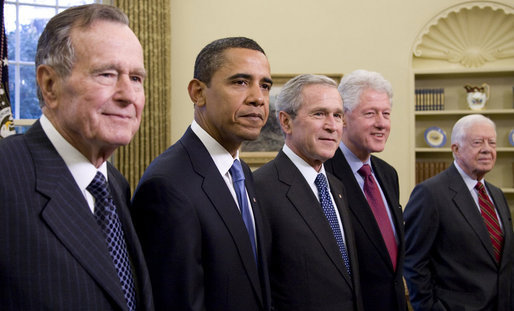
That would be, after the next inauguration, Jimmy Carter, George H.W. Bush, Bill Clinton, George W. Bush, and Barack Obama all improving the world during the reign of Hilary or Donald. I wonder if Michael Sean Winters had President Obama in mind when he wrote:

All politicians should write their memoirs. After that, they should retire from the public stage beyond the occasional speech and whatever work the management of a presidential library entails. It is unhealthy for a democracy if new slots on the stage are not opened with regularity. Stroking the egos of former presidents is redundant. And, creating these personalized, secular and necessarily politicized charities will, beyond doubt, harm the brand of charity over time.

When professional athletes retire, they have a long life ahead of them. But they have precedents. Color commentators. Coaches. Automobile dealerships. Not so with presidents. Where do you go after being the most powerful man in the free world? Even presiding over Harvard seems like slumming.

Winters thinks the Clintons’ problem is moral earnestness:

The real problem here is not so much the foundation itself as the tone deafness of the Clintons to the suspicions of their motives. I have noted before that there is something creepy about the ethics of the Clintons, something commonly found among the do-gooders of the world. It goes like this: I am a good person, and X is not a good thing to do, yet I did it, therefore X must not be such a bad thing after all. It is true that they no doubt mix up their prideful motives with their altruistic ones. Find me the politician who doesn’t? But they take it to a level that is noxious.

I think it has more to do with their former lack of wealth. Hilary had to find a law job after Bill lost the Arkansas governor in 1980. They were supposedly in serious debt. How do you rub shoulders with the rich and famous (and Yale Law alums) if you aren’t rich? Well, you speculate in real estate, you take really really big speaking fees. Once out of the White House, you form a charity like the Gates. That shows you are philanthropic and rich. But it doesn’t play well with the hillbilly/hound dog in Bill, just as Huma’s break with Anthony Weiner doesn’t make Hilary look all that virtuous for standing by her man.

One of the Two Kinds of People is Dead Wrong

Thanks to John Fea for truth:

Think of the left lane as filled with hot coals. If you use it, do so quickly (and get out of the way!).