Punching Above His Weight

Another example of draping yourself in Calvin’s mantle on women but not on heretics:

This misquote actually drives directly at the heart — directly at the heart — of the current discussion of sexuality. When the dust settles on the Trinitarian debates, even if that time is years away, the church will still have to work out her theology of sexuality. In the Reformed world, Calvin’s own view will be one that carries weight.

And, Calvin thought sex meant something in civil society.

Serious Reformed men who differ from this view should be honest that their views are innovations explicitly rejected by our fathers in the faith.

What if our fathers in the faith put us at odds with the Founding Fathers? This weekend is a good time to consider.

A related consideration is recognizing it may be time to walk on our own in civil society and not rely on those Protestants who still held out for Constantinianism. Medieval Europe is not the standard for Christian reflection about civil society. The Bible is. And it’s hard to find Peter or Paul invoking Moses to correct Nero.

(And don’t even go to Calvin’s views on the Trinity. Nothing to see there.)

So Now the Covenanters are the Standard?

At the Shiloh Institute this week I (mmmeeeeEEEEE) played around with the question of center and periphery in conservative Reformed Protestantism in the United States. For some (not at the conference), the PCA is in the mainstream. One explanation is its size — it outflanks all of the other communions that belong to NAPARC. Another is that the PCA has anywhere between six and a dozen celebrity pastors (with none having the star power of TKNY). Another is that New Calvinism is popular and the PCA is in tune with that immature and attention-deficit-disordered (read young and restless) brand of Calvinism. Related is the Gospel Coalition factor. By virtue of encouraging and defending New Calvinism, PCA officers have seats at the table of a website parachurch endeavor that is seemingly big, popular, and influential.

If you want to put the OPC at the center of conservative or confessional Calvinism, you need to ignore the numbers and pay attention to history and language. The OPC has been around longer than the PCA. In 1937 the OPC coughed up a big wing of the PCA — the RPCES portion of the Bible Presbyterian Synod — that in turn equipped the PCA with its educational institutions, Covenant College and Covenant Theological Seminary. The OPC continues to draw upon the Reformed past as it attempts to understand God’s word. The variety of views on creation, the presence of two-kingdom theology, and the recent report on the doctrine of republication all indicate ways in which the OPC keeps alive expressions of Reformed Protestantism older and in many cases more substantial than twentieth-century conservative Presbyterianism.

As for language, English is the OPC’s native tongue, which means the OPC has never had to think of itself explicitly as an ethnic communion. And it is ethnicity in part that hurts the URC’s chances for defining the center and periphery in American Calvinism.

That leaves communions like the RPCNA (Covenanters) and ARPC (Seceders), both of Scottish extraction, on the margins of contemporary American Calvinism. They may be bigger or smaller than the other churches, but their histories are different from the OPC, PCA, and URC. All of the latter communions started in opposition to liberalism within an older denomination. The RPCNA and ARP don’t have the same dynamics and so don’t resonate as well with other NAPARC members.

But having said all that, shut my mouth. Now we hear from a PCA source that the RPCNA is at the center of contemporary Reformed church life:

The reason I know this is because the most Confessional denomination in NAPARC (North American Presbyterian and Reformed Council) is the RPCNA (Reformed Presbyterian Church of North America). The RPCNA is the most historically confessional church in this council (which the PCA is a member), and yet, those who are claiming to be the confessionalists in the PCA, would not join with this, the most confessional denomination. Why? It is because they ordain women to the office of deacon. Yes, that is right. The most confessional of all the denominations in NAPARC ordains women to the office of deacon. They have practiced this since 1888, and have done so because it was studied, and found to be biblical. They have kept their strong confessional nature all this time, while still ordaining woman to be deacons.

Those in the PCA who are claiming the moniker of Confessional, taking it from anyone else who doesn’t agree with them on the issue of women’s roles, should in fact stop being so disingenuous. Instead of confessional they are more closely identified as Old School Southern Presbyterians, which is fine. But, please stop using Confessional like you have something that no one else does. It’s disingenuous and you are making a non-confessional issue, the defining issue.

Speaking of disingenuousness, does Jon Price really want to embrace the National Covenant (1581) to which the RPCNA still swears allegiance, as ground zero of Presbyterian confessionalism? And is he ready to put away the hymnal and the swaybabes?

Hey now.

At least the PCA is not the PCUSA (at least until Michelle Higgins gets her way):

Followers of Jesus Christ know that no person can claim divine favor through personal merit, but only by the grace of God. The Presbyterian Church (U.S.A.) acknowledges that actions we and our members have taken over the years have at times led God’s beloved children who are lesbian, gay, bisexual, transgender, queer, and questioning to feel that they stand outside the grace of God and are unwelcome in the PC(USA). We deeply regret that, due to human failings, any person might find cause to doubt being loved by God. We affirm the God-given dignity and worth of every human being, and renew our commitment to ‘welcome one another, as Christ has welcomed [us], for the glory of God.’ [Romans 15:7]

The Theology of Brexit

Massimo Faggioli reminds that Vatican II and the European Union are part of the same cultural moment:

The simultaneity of the Dublin conference and Brexit made me think about the tight relationship between development of Catholic theology (especially ecclesiology) in the 20th century and the development of Catholicism from multinational to truly internationalist/globalist. Catholic support for the European project after World War II (from Pius XII to the most important politicians of the Christian-Democratic parties governing Europe after 1945) was part of the transition from the nationalist, romantic roots of the theological ressourcement between the mid-19th century and the 1920s and ’30s. At Vatican II, Catholic theology internationalized what had been born as expressions of national movements during the previous century (adoption of the vernacular; the new role of national bishops’ conferences; anti- Curia sentiment; anti-capitalist, anti-democratic, and anti-liberal Catholic social movements, etc.). The internationalist quality of Pacem in terris and Gaudium et spes was a turning point in doctrine concerning the state and government in Catholic theology, and also a response to the most powerful internationalism of the second half of the century, Communism. At Vatican II, Catholicism became an advocate of globalization, which John XXIII had called in the opening speech of the council in 1962 “a new order of human relations.”

The ties between Vatican II and the EU are even closer in the minds of traditionalist Roman Catholics:

Brexit can be seen as a subset of the debate on Vatican II and the post-Vatican II period, at least among Catholics. It’s no secret that Catholics and the Catholic bishops of Britain were deeply divided over Brexit, and that for many conservative Catholics in Britain opposition to the EU and to Vatican II has similar roots. Traditionalist Catholics who today reject “the new order”—in terms of economic and social exclusion, as well as of the dominance of what Francis in Laudato si’ called “the technocratic paradigm”—tend to put Vatican II and the EU together in one category of internationalization and globalization; they choose a traditional, pre-global church and a nation-state (even though this fallback on the nation-state is for them theologically not unproblematic) as opposed to the larger framework of a globalized ecclesial context and a European political union. It is an opposition to a much more complex world, politically and theologically, and to the modern, globalized attitudes toward vulnerable life, marriage, family, subsidiarity, immigration, war, and peace. It is an opposition that puts back into question the Catholic perception of political power, and in particular the church’s perception of the sovereignty of the nation-state and of international/supranational institutions.

Meanwhile, Damon Linker notices aspects of Angela Merkel’s responsibility for the circumstances that led to Brexit that could also be applied to Pope Francis, perhaps the post-Vatican II pope that most embodies Vatican II:

Angela Merkel is the real catalyst behind the outcome of the UK referendum. Not only did the German chancellor insist on admitting well over a million refugees and migrants from the Greater Middle East into the heart of Europe. Supporters of the policy have also made it clear on numerous occasions that they consider racism and xenophobia to be the only possible grounds for opposing her stand.

From the standpoint of progressivism, this makes perfect sense. An open-door policy toward refugees and migrants fleeing unrest in the Levant and North Africa is obviously the only morally acceptable option. It shouldn’t matter whether those immigrants are Muslims, or if they’re Syrians or Libyans, skilled or unskilled, poor or middle class, literate or illiterate, eager to assimilate or convinced of the need to resist it, looking for freedom and pluralism or hoping to build an enclave of Sharia law within the West. And there’s certainly no reason to suspect that any of them might turn toward terrorism, now or a generation from now. They’re just placeless people — human beings in need of aid, comfort, and charity. That’s all that should matter.

Except that many millions of citizens in EU member countries don’t see it this way. It does matter to them, just as it also matters to them whether Turkey is eventually invited to join the union, and they don’t appreciate having their concerns about the ethnic, religious, linguistic, and economic character of their political communities dismissed as moral pathologies.

Nor do they care to have their religious institutions circumscribed by remote bishops and cardinals. Pre- or post-Vatican II, subsidiarity matters.

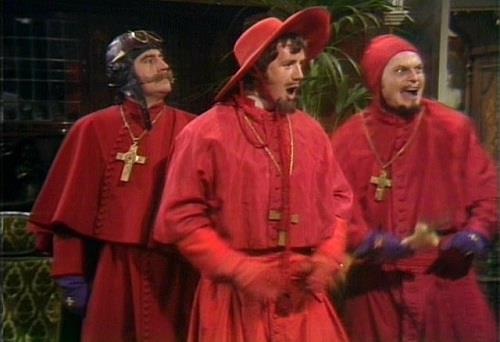
No One Expects the Puritan Witch Hunt

Some contemporary critics are debating whether Christians are experiencing something closer to a witch hunt or an inquisition. Turns out, the inquisition is worse:

By contrast, the purge of traditional Christians and Jews is a heretic hunt, an Inquisition, whose objective is to isolate and punish individuals who actually profess opinions contrary to the prevailing orthodoxy. There can be some overlap between an Inquisition and a witch-hunt, to be sure. But today’s liberal Inquisitors are not searching for individuals secretly in communion with God—yet.

This is a critical distinction. Witch-hunters eventually discover that burning a few old hags does not prevent cows’ milk from souring. Inquisitions, by contrast, usually succeed: The Catholic Church succeeded in stamping out broadly held heresies, as in the Albigensian Crusade of 1220-1229, which destroyed between 200,000 and 1,000,000 inhabitants of Cathar-controlled towns in Southern France. In many cases a town’s entire population was killed, just to make sure. For its part, the Spanish Inquisition eliminated all the Jews, Muslims, and Protestants, although it sometimes drove heretical opinions underground, with baleful consequences for the Catholic faith. (From David P. Goldman via Rod Dreher)

So, converts to Rome want to identify with all of THAT history? And were the glories of Christendom all that glorious?

But if you can defend that part of the church’s history, the recent past is easy peasy.

We’re Supposed to Believe Evangelicals Care about Nicea?

While evangelical leaders and some of their critics debate the complexities of Trintarian theology (thanks, mind you, to prior considerations of the relations between the sexes – ahem), please keep in mind two points.

First, evangelical Protestants never — NEH VEH — cared about Nicea. If they knew about Nicea, they certainly didn’t know the Council of Constantinople of 381 (wasn’t that a Muslim city?). Just look at some evangelical statements on the Trinity:

God has revealed himself to be the living and true God, perfect in love and righteous in all his ways, one in essence, existing eternally in the three persons of the Trinity: Father, Son, and Holy Spirit. (Fuller Seminary, flagship seminary of the neo-evangelical movement)

We believe that there is one God, eternally existent in three persons: Father, Son and Holy Spirit. (National Association of Evangelicals)

By way of comparison:

In the unity of the Godhead there be three persons, of one substance, power, and eternity: God the Father, God the Son, and God the Holy Ghost: the Father is of none, neither begotten, nor proceeding; the Son is eternally begotten of the Father; the Holy Ghost eternally proceeding from the Father and the Son. (OPC Confession of Faith 2.3)

Our Churches, with common consent, do teach that the decree of the Council of Nicaea concerning the Unity of the Divine Essence and concerning the Three Persons, is true and to be believed without any doubting; that is to say, there is one Divine Essence which is called and which is God: eternal, without body, without parts, of infinite power, wisdom, and goodness, the Maker and Preserver of all things, visible and invisible; and yet there are three Persons, of the same essence and power, who also are coeternal, the Father, the Son, and the Holy Ghost. And the term “person” they use as the Fathers have used it, to signify, not a part or quality in another, but that which subsists of itself. (Augsburg Confession)

So when Carl Trueman writes:

In light of the last few weeks, the American conservative evangelical movement as a whole has been exposed as theologically thin in its doctrine and historically eccentric in its priorities. As the war of words dies down, the subsequent peace must bring with it ecumenical consequences. It cannot simply involve papering over the obvious cracks in order to return to gospel business as usual.

Does he really mean to say “the last few weeks”? What about the last century does he not appreciate?

The second point to consider is how parachurch this entire debate is. As Jake Meador observes, evangelicals don’t debate well:

And so we continue to go around the maddening how-evangelicals-debate cul de sac: Dr. Trueman has long complained that evangelicalism is driven more by cultural concerns, like complementarianism, and a celebrity pastor complex than by sincere concern with faithful preaching and ministry. In the way he makes these critiques, he has sometimes been excessively aggressive, thereby making it far less likely that people will hear his real concerns or weigh whether or not there is any truth in them at all. He is, instead, easily dismissed as a crank.

One reason is that the means for conducting debate are parachurch institutions, not church assemblies, committees, reports, and debates.

So while evangelicals debate the Trinity — THE TRINITY!! — Orthodox Presbyterians were discussing the doctrine of republication.

Evangelicals really should join a confessional church. The water is warm.

May Institutions Confess Sins of Persons?

The overture to the PCA General Assembly on racism continues to intrigue if only because this is conceivably a problem just as much for the OPC as for our sister denomination. After all, J. Gresham Machen was no integrationist but held a view of blacks (typical at the time) that anyone today would consider not simply micro but macroracist. So I wonder if the PCA adopts the following overture, will it also petition the OPC to repent for Machen’s sins (for starters):

Therefore be it resolved, that the 44th General Assembly of the Presbyterian Church in America does recognize, confess, condemn and repent of corporate and historical sins, including those committed during the Civil Rights era, and continuing racial sins of ourselves and our fathers such as the segregation of worshipers by race; the exclusion of persons from Church membership on the basis of race; the exclusion of churches, or elders, from membership in the Presbyteries on the basis of race; the teaching that the Bible sanctions racial segregation and discourages inter-racial marriage; the participation in and defense of white supremacist organizations; and the failure to live out the gospel imperative that “love does no wrong to a neighbor” (Romans 13:10) . . .

One of the arguments made in defense of overtures like this one is that as the continuation of the Presbyterian Church US, the PCA is institutionally in continuity with the views on race that afflicted its southern Presbyterian forebears:

why should we confess for the sins of a church that we were not a part of? Frankly, I do not really understand this objection. The PCA is a continuing denomination; we claim to continue the PCUS. We must publicly confess and repent for sins of those whom we share a covenantal relationship with. God holds our covenant community responsible for our actions, even our sins, collectively. That’s how God works. We must confess for our failures as a church during the Civil Rights Movement and wherever we’ve sinned.

If you peel back the onion layers of institutional/covenantal ties, where do you stop? Why for instance do the overtures not include slavery since the PCUS and the PCUSA both had church members that owned slaves?

In fact, when it comes to institutional continuity, one could argue that PCA is good since the PCUS adopted measures to condemn segregation and approve integration. In his book on the origins of the PCA, Sean Lucas observes:

In 1954, the PCUS General Assembly adopted a report that affirmed “that enforced segregation of the races is discrimination which is out of harmony with Christian theology and ethics” and that urged southern Presbyterian colleges, campgrounds, and churches to be open to all, regardless of race. (For A Continuing Church, 121)

Of course, resolutions like this prompted conservatives in the PCUS who also eventually led in forming the PCA, to oppose the centralization of church power and ecumenism. Some of the opposition also came from sessions and presbyteries. But as for institutional succession, PCA officers could regard themselves as standing in line with the PCUS’s disapproval of racism and segregation.

In fact, throughout Sean Lucas’ five-part series on race and the roots of the PCA, the overwhelming examples of questionable views about race come not from the institutional church but from persons or periodicals. Here is how Lucas describes G. Aiken Taylor:

He told Nelson Bell, “I don’t like agitation on the social question from either side. I am not an integrationist, neither am I a segregationist. My position on this issue is that a view point of whatever kind should not be made the criterion for determining the place or the worth of a man…or a church paper.” In reply, Bell assured him that there was a range of opinions on segregation among the board of directors for the magazine and that he would not be required to hold to a particular party line. That said, the older man also counseled him not to push his more moderate racial views either: “I feel you would be utterly foolish to come to the Journal as editor and make race an issue–certainly at this juncture. There are so many more important things which need to be faced.” As it would happen, Taylor’s position on race, as evidenced in his writing and editorial practice, would largely harmonize with Bell’s own racial views: downplaying forced segregation, dismayed by outside agitators who stirred up the racial issue, and concerned not to let racial politics divert attention from the largely doctrinal and social issues of the day.

Sometimes presbyteries might weigh in but in one case the condemnation concerned rioting not integration:

In 1961, East Alabama Presbytery declared itself against the mob violence that engulfed the Freedom Riders in Birmingham and Montgomery: “We express our deep regret and emphatic disapproval of mob violence for whatever cause.”

Even then, only four years later the PCUS took action that would seem to give its Presbyterian successor cover from charges of racism:

When the 1965 PCUS General Assembly endorsed a range of Civil Rights activities, including peaceful demonstrations and sit-ins, over sixty commissioners filed a dissent. Nelson Bell presented it to the assembly, arguing that “some of the methods sanctioned in the document are ‘contrary to or go beyond the jurisdiction of the Church.'” Even if the church desired to support “worthy goals” like racial justice, Aiken Taylor noted, that did not mean that it could do so through “radical measures” or “extremism or vindictiveness.” Later in 1965, Bell worried again that peaceful demonstrations were a small step from civil disobedience and “the step from civil disobedience to riots and violence is even shorter.” Willfully breaking laws, even for a worthy goal, is wrong: “No nation should permit injustice and discrimination to be a part of its accepted way of life. But no nation can survive which placidly allows people to make of themselves prosecutors, jurors, and executioners–and this applies to all citizens.” Means do not justify the end: breaking the law, whether to support segregation or integration, was never right.

Yet, interesting to see is that opposition to General Assembly resolve was not premised on race but on the value of civil disobedience. Yet, when church bodies did engage in explicit forms of racial bigotry, the response of the PCUS and many conservatives (who went into the PCA) was to object:

Second Presbyterian Church, Memphis, Tennessee, drew national attention for its refusal to admit mixed-race groups to corporate worship services. One of several Memphis churches targeted in early 1964 by the local chapter of the National Association for the Advancement of Colored People (NAACP) for its “kneel-ins,” Second Church reacted the most negatively. The groups were refused admittance and church officers patrolled the narthex and the front of the church looking for those who would seek to “integrate” the services. The Second Church kneel-ins drew media attention not only because of their racial component, but also because the congregation was scheduled to host the PCUS General Assembly in 1965. As a result, several presbyteries and synods, along with the liberal Presbyterian Outlook, protested allowing the Memphis church to host the assembly; by February 1965, the assembly’s moderator, Felix Gear, a former pastor of Second Church, made the decision to move the coming meeting to the denomination’s assembly grounds in Montreat.

Lucas’ conclusion may be correct that the founding fathers of the PCA sinned, though his book and series show a lot more complications than simply the yes-no question of white supremacy (or not). But the theological question of institutional responsibility for personal sins is a theological question begged rather than answered. Lucas invokes the example of Daniel confessing Israel’s sins:

But his confession is strange–because he doesn’t confess his own private sins, but the sins of Israel and Judah that led to the judgment of the exile: “We have sinned and done wrong and acted wickedly and rebelled, turning aside from your commandments and rules. We have not listed to your servants the prophets, who spoke in you r name to our kings, our princes, and our fathers, and to all the people of the land. To you, O Lord, belongs righteousness, but us open shame” (Dan 9:5-7).

This wasn’t simply lip synching or going through the motions. Rather, Daniel recognized his own covenantal complicity in what his fathers and forefathers had done and in bringing about the exile. And he confessed those sins and repented: “We have sinned, we have done wickedly” (Dan 9:15).

By that same exegesis, isn’t the PCA righteous for the way its parent body, the PCUS, condemned racism and segregation?


The Gastronomicity of the Church

Where the BenOp meets episcopal flourishing:

Regardless of our religious backgrounds or belief systems, we tend to take note not only of what the pope says and does, but what he wears, what kind of -mobile he’s driven around in — and what he eats. Thus “The Vatican Cookbook,” published in April by the Sophia Institute in Nashua, N.H., which has the compelling subtitle of “500 Years of Classic Recipes, Papal Tributes and Exclusive Images of Life and Art at the Vatican.” But this is as much a practical cookbook as it is a coffee-table book for the devout. There are more than 80 recipes, including favorites of the current pope, as well as his two most recent predecessors. Thus, there are dishes from Argentina (Pope Francis), Bavaria (Pope Benedict XVI) and Poland (Pope John Paul II).

So: pierogi and dulce de leche, homey recipes for Christmas cookies and minestrone, and bistro favorites such as a Parisian beefsteak and chocolate amaretto cake. Threaded through these recipes are glossy photographs of patron saints, the Pietà, the pasta stations, and sections devoted to the recent popes and the Pontifical Swiss Guard, the uniformed men who pledge to serve and protect the pope and who “present” the cookbook (today, we’re told, there are 110 of them). The book was written not by the Polish nuns who do the majority of cooking at the Vatican, but by David Geisser (a former chef who published two cookbooks before joining the guard), Erwin Niederberger and Daniel Anrig, all current or former members of the guard. There are a few “table prayers” here, but they’re included at the end, after a section devoted to “basic recipes” that includes pasta dough, pizza dough, polenta — and truffle risotto. Because, in Vatican City, truffle risotto is a basic recipe. In other words, it’s all kind of lovely, whether your devotion extends to God or to tiramisu, or maybe to both.

If Only the Orthodox Presbyterian Church Would Join

This Day in Presbyterian History has the remarks of Richard Gray in 1965 at the merger of the Evangelical Presbyterian Church and the Reformed Presbyterian Church General Synod which became Reformed Presbyterian Church Evangelical Synod (the tree that bore the fruit of TKNY). Several themes stand out.

First, the trauma of 1937 was not the death of J. Gresham Machen:

I sat on that day in June in the New Century Club in Philadelphia with a group of people known as the Presbyterian Constitutional Covenant Union. There the constituting act for the Presbyterian Church of America was adopted. There stepped to the platform the young professor of philosophy from the University of Pennsylvania, Gordon H. Clark, and in “Clarkian” style he took from his pocket two 8 1/2 x 11 pages and delivered a terse but brilliant nominating speech which made J. Gresham Machen moderator of the First General Assembly of the Presbyterian Church of America.

It was like standing upon a tower. There was a great vista before us. I felt as though I was a part of church history and in my bones were some of the great convictions of the Reformers and of the early Christians. But within one year I was to know something of the disillusionment and the discouragement that causes the Psalmist to cry out in the first three verses of Psalm 60. This initial group split and each side tagged the other with labels which it has taken about 25 years to wash off.

Second, Dutch-American Calvinists did not own w-w rhetoric:

I believe we are still in the warfare and we still have the same banner. The banner raised in the cause of truth was raised for the turth against compromise inecclesiastical matters. We were standing for the purity of the visible church. We felt that the organized church had been instituted by our Lord Jesus Christ and it was not simply an association of convenience, or an organization that one joined because he wanted to get ahead, or even merely to give one the opportunity of preaching the gospel.

Also the banner of truth was raised against compromise culturally. We believed that Christianity was not only a fire escape from hell, so to speak, but it was a life-and-world view. We still believe this. We held this against the encroaching secularism of the day, against the deadening formalism of the church, and against the contaminating worldliness with which the church had become tainted.

Third, the OPC needed to join the RPCES to add forces to the culture war:

“There is a great need on the American scene for a sturdy, conservative Presbyterian denomination. The union of the EPC and the RPC is an important step in achieving this. If next the OPC can be brought to join forces, a truly impressive denomination would resutl. Numerically they would form a pretty good network of churches across the country. Separatist movements usually carry in themselves the seeds of further division as shown again in the days of 1936. The new denomination has learned these lessons it may be hoped.

“If the OPC should come along, too, there would be adequate number of experienced men with balanced judgment to keep the denomination on a sound course, one to encourage steady growth by local progress in attracting to the new church our Presbyterian groups seeking a happy spiritual home.

“To assist” (and I think this is a very important paragraph) “this last suggested development to occur the new denomination should follow a statesman-like policy toward the USA and the Southern church. They might well feel that their role in the south should be to testify without derogating. Criticisms that have to be made in faithfulness to Scripture could be offered in an evident spirit of loving concern, in sorrow not condemnation. It might be indicated that the line of separation that sometimes has to be drawn is often very difficult to decide upon, one man’s conscience not having received the same education as another’s, and Biblical interpretation on the issue of separation not standing out sharply and obviously clearly.”

The OPC is still on the outside looking in. Will the PCA show the same respect for conscience among “southerners” as Gray mentioned?

The Berny Option

Human flourishing Bernard of Cluny style:

Jerusalem the golden, with milk and honey blest,
Beneath thy contemplation sink heart and voice oppressed.
I know not, O I know not, what joys await us there,
What radiancy of glory, what bliss beyond compare.

They stand, those halls of Zion, all jubilant with song,
And bright with many an angel, and all the martyr throng;
The Prince is ever in them, the daylight is serene.
The pastures of the blessèd are decked in glorious sheen.

There is the throne of David, and there, from care released,
The shout of them that triumph, the song of them that feast;
And they, who with their Leader, have conquered in the fight,
Forever and forever are clad in robes of white.

O sweet and blessèd country, the home of God’s elect!
O sweet and blessèd country, that eager hearts expect!
Jesus, in mercy bring us to that dear land of rest,
Who art, with God the Father, and Spirit, ever blessed.

Brief life is here our portion, brief sorrow, short lived care;
The life that knows no ending, the tearless life, is there.
O happy retribution! Short toil, eternal rest;
For mortals and for sinners, a mansion with the blest.

That we should look, poor wanderers, to have our home on high!
That worms should seek for dwellings beyond the starry sky!
And now we fight the battle, but then shall wear the crown
Of full and everlasting, and passionless renown.

And how we watch and struggle, and now we live in hope,
And Zion in her anguish with Babylon must cope;
But he whom now we trust in shall then be seen and known,
And they that know and see Him shall have Him for their own.

For thee, O dear, dear country, mine eyes their vigils keep;
For very love, beholding, thy happy name, they weep:
The mention of thy glory is unction to the breast,
And medicine in sickness, and love, and life, and rest.

O one, O only mansion! O paradise of joy!
Where tears are ever banished, and smiles have no alloy;
The cross is all thy splendor, the Crucified thy praise,
His laud and benediction thy ransomed people raise.

Jerusalem the glorious! Glory of the elect!
O dear and future vision that eager hearts expect!
Even now by faith I see thee, even here thy walls discern;
To thee my thoughts are kindled, and strive, and pant, and yearn.
(Jerusalem the Golden, 1146)

Y B O P C

I have already raised the question about whether belonging to a denomination like the OPC is a good thing. Now as I sit through a prolonged and valuable procedural debate at General Assembly, I wonder again why pastors who want big, contemporary congregations that appeal to Protestants without great biblical or theological discernment and who prefer up-tempo Christian songs led by praise bands (without brass instruments, mind you) — why do these officers endure the deliberations that consume sessions’, presbyteries’, and assemblies’ time and talents. What do you gain by being a minister in a Presbyterian communion like the OPC? It is not as if the OPC is a brand that attracts visitors and new members. You don’t put the OPC logo on your church signs to watch the parking lot fill. So why put up with the often baroque dealings of church courts and committee reports when you are not so particular about worship, the fine points of the confession, and the rigor of Reformed piety (e.g. Sabbath observance)?

I have come up with three reasons for people who come into the OPC and stay there.

1) Tribalism: Someone whose father or grandfather left the PCUSA in 1936 with Machen. The notion would be something like, “this is the church where my family has worshiped for three generations and so out of loyalty to my kin and I remain a true blue Orthodox Presbyterian.” Other Reformed communions, those with ethnic identities, like the CRC (Dutch-American) or RPCNA (Scots-American) have ethnic attachments that generally elude the OPC. But in some cases, you do see how family keeps some Orthodox Presbyterians Orthodox Presbyterian. (Of course, the nature of covenant nurture itself is a form of tribalism since a child baptized and nurtured in an OP family and congregation, who remains OP, does so in part as part of generational succession.)

2) The Cause: People who identify with Machen and the battle against liberalism in the church and who defend the authority of Scripture come to the OPC and stay there because the denomination is the embodiment of that cause that J. Gresham Machen led throughout the 1920s and 1930s. This was a big factor in my own joining the OPC and continuing to serve. This understanding of OPC identity has sometimes run up against a view of the OPC as a church committed to the Great Commission in which polemics and debate distract from evangelism and edification. The problem with this view is that you wouldn’t have the OPC without polemics and debate. So seeing the very pieces of the church’s DNA as antithetical to evangelism and mission is to be in denial about the denomination’s origins. For these OP’s, evangelism and edification occur in the context of polemics and debate.

3) The Reformed Faith is Pretty Good Great: Another way to identify with the OPC is to look at the central dynamics of the Reformed branch of Protestantism and try to find them in existing communions where you live. Then find and join the one that is most interested in a ministry reformed according to the word of God. Any number of communions could qualify as following in the larger footprints of the Reformation, but judging which one is most reformed according to the word determines which one you join. (Since having to think about the global history of Reformed Protestantism, I have come to regard and identify with the OPC on these grounds.)

I’m willing to lengthen my list.