Imagine if the PCA were Big Enough

Then you wouldn’t need the Gospel Coalition.

So why don’t the leaders of neo-neo-evangelicalism acknowledge that a parachurch organization with a public profile generated largely by the world-wide interweb used by celebrity pastors who sometimes go to conferences and meet with ordinary neo-neo-evangelicals is a capitulation to contemporary culture? Where is all the discernment that comes from reading sociology, history, and cultural and art criticism?

What if limiting your ministry to the confines of a communion is counter-cultural? Is being counter-cultural simply a pose or does it also require subtraction — rejecting (at least some aspects of) culture?

Then, these reflections might lose some of their pietistic earnestness (sorry for the redundancy):

“If they are not controlled by Scripture and confessionalism, then of course [evangelicals] are going to fit into the grid of the broader and more secular culture,” Carson said. “By and large, these cultural evangelicals work out their cultural bondage in more conservative ways than their agnostic counterparts, but it is difficult to believe that racism is less evil than sexual promiscuity.”

Exactly. And if pastors let confessions and church polity control their ministry, they might put their own communion, the one in which they vowed to minister God’s word and the holy sacraments, ahead of all other extra-denominational activities. In other words, can you really act like you are being counter cultural when the rest of the culture is turning from denominational Christianity to none (denominational) Christianity?

“I see TGC as occupying the same space that evangelicalism’s founding fathers—like Carl Henry, Harold Ockenga, John Stott, J. I. Packer, and Billy Graham—occupied,” Keller said. They wanted to be evangelicals, not fundamentalists; to engage with non believers and with society, and not just to withdraw, Keller said.

“We don’t want to be pietists, but we don’t want to be captive to the spirit of the age either,” Keller said. “But that is actually a hard place to be. It’s a lot easier to retreat to your fortress or to just go along with the crowd. But TGC, from the very beginning, wanted to avoid going in either direction. We wanted to be prophetic from the center, as Don [Carson] says.”

What would really be counter-cultural would be commitment to word-and-sacrament ministry when the spirit of the age, thanks to Henry, Ockenga et al, is to overlook considerations like baptism, the Lord’s supper, ordination, and the sufficiency of Scripture (which would limit pastors from dabbling in sociology and cultural criticism).

In point of fact, creating a brand though social media, the way the gospel allies do, is about as beholden to the zeitgeist as someone could imagine. When I think of being counter-cultural, I don’t think of the Gospel Coalition. I think of the Amish.

Post-script: notice that evangelicalism didn’t start with Luther, the Puritans, Edwards, or Finney. It began in the 1940s. What I’m saying.

Is the PCA Big Enough?

The death of R. C. Sproul and the occasion of The New Yorker publishing Tim Keller provide the opportunity for further reflections on ecclesiology and parachurch agencies. For instance, Keller’s article in The New Yorker includes this byline:

Timothy Keller is the founder and Pastor Emeritus of the Redeemer Presbyterian Churches of New York City.

And here is how Christianity Today began its death notice for Sproul:

Late PCA leader influenced generations of Christians by filling the gap “between Sunday school and seminary.”

Both men belong/belonged to the PCA. But no one identified either man in his professional life with the PCA. Keller is his own church-planting guru with Redeemer City-to-City as the vehicle for funding church start ups in big cities around the world. Sproul made Ligonier Ministries his brand. Both are hugely successful authors who are/were known more for books than denominational affiliation. Neither man found it possible to work within the confines of denominational mechanisms. Could Keller have somehow made his church planting operation part of the PCA’s Mission to the World? (And what if Keller decided to put Crossway Publishing on his back and allow them to publish his New York Times bestsellers? Or, what if Keller became the face of the Gospel Coalition and transferred his energies from Redeemer’s many operations into the Gospel Coalition’s many operations?) Imagine what that might do for the PCA’s name recognition. Or could Sproul have operated Ligonier as an arm of the PCA’s Discipleship Ministries (the equivalent of the OPC’s Committee on Christian Education)? The answer is yes. But that affirmative would have changed significantly the shape of what Keller and Sproul accomplished as expositors of God’s word and teachers of doctrine.

This is not meant as a criticism of either man. The intention here is simply to note the real limitations of denominations. Everyone faces them. Denominations are clunky, procedural, deliberative, slow. Presbyterian denominations even more so. So to take a non-profit and move it under the umbrella of another non-profit is a dicey institutional maneuver. At the same time, becoming the head of a denomination’s church planting operations or its Christian education agency is to give up space for personal initiative and take a back seat to supervising committees and denominational procedures.

And yet, not everyone conducts work that duplicates that of a denominational agency or committee. In the case of a church historian, for instance, a denominational committee may publish books that cover institutional or theological history but they don’t produce books on the arts and sciences. In which case, an academic historian needs to find other publishing outlets for non-denominational writing. At the same time, writers and authors constantly face the temptation to create their own media company. Think Rush Limbaugh. Then imagine Rush having to cooperate and even submit to the guidance of the Republican Party. Not gonna happen. But when Rush wants to achieve a higher profile, does he work with his own website and editorial services or does he seek a trade press that knows the ropes of getting books into bookstores and handles distribution and invoices?

Which comes around then to a question bigger than celebrity, namely, entrepreneurialism. To what degree should pastors and theologians be in the business not only of creating ideas and arguments that encourage the faithful but also the start of organizations for promoting their own initiatives? The related question is whether denominations or church government is compatible with entrepreneurial pastors. Communions like the PCA, from the outside, look fairly capacious. If the OPC has the reputation for helicopter Presbyterianism — which is so far from reality — then the PCA is a Presbyterian version of a confederation of congregations like the URC or the SBC. It would seem to be a perfect place to allow for energetic and industrious pastors to work out their gifts and callings.

But the examples of Sproul and Ligonier, and Keller and Redeemer suggest otherwise. Not even as vigorous, missional, and hands-off a denomination as the PCA is capable of employing the talents of men like Sproul and Keller.

So either denominations have run their course of usefulness, or gifted ministers need to turn down their talents to settings conducive to a communion’s normal operations.

Selah.

Morality Divides, Coalitions Unite

That is, as some may tell, an riff on the old line used during the fundamentalist controversy to counter conservatives — “theology divides, ministry unites.”

Our friend, Chortles Weakly explains how officers in NAPARC communions who also hold official positions in The Gospel Coalition — can anyone identify the Allies? — are looking the other way when it comes to the Second Commandment, the bedrock of the Regulative Principle:

As the cultural exegetes must surely agree, an organization’s use of images, technology, and messaging strategies is fair game for critics. What follows is my attempt to critique some of the ways TGC uses images and innovates. The standard will not be something I learned in business school, the standard will be the confessions of the Reformed churches.

My concern here is not really with Reformed churches as such (which cannot actually align with TGC) or with members (who are free to consume as they will). It is with the officers (elders and pastors) of confessionally Reformed churches who participate in TGC leadership, given the fact that TGC’s content so strongly influences the one culture that really matters, the one culture that truly ought to be ordered according to the Bible – the household of faith, the church of God.

My concern is that the officers of confessionally Reformed churches (basically those from denominations affiliated with the North American Presbyterian & Reformed Council – NAPARC) who sit on the TGC council are giving their stamp of approval to some things that are specifically forbidden by the Bible, the Reformed confessions, and the historic practice of the Reformed churches.

The TGC web page over the recent Thanksgiving weekend provided a notable example of TGC-endorsed aberrant practices. The front page of the site used an image of a nativity scene (with the second person of the Trinity supposedly represented) in support of an article on “8 New Resources for Advent”. This is not an isolated instance. Pictures of Jesus and commendations of movies and materials depicting him are nothing new at the TGC web site.

What specifically is wrong with images of Jesus? Well, simple logic tells us that any image of Christ is necessarily a lie – the Bible is not a picture book. No image of Christ can be accurate. Can inaccurate images be a help to those who view them? Some will argue that serve an essential pedagogical use when it comes to children. Some, as were heard at the last General Assembly of the Presbyterian Church in America, will argue that we cannot appreciate the humanity of Jesus without images.

The Westminster Larger Catechism, to which the presbyterian ministers on the TGC council have taken vows of subscription, would seem to speak both to images of Christ and things like Advent in question 109:
Picture

Q. 109. What sins are forbidden in the second commandment?

A. The sins forbidden in the second commandment are, all devising, counseling, commanding, using, and any wise approving, any religious worship not instituted by God himself; the making any representation of God, of all or of any of the three persons, either inwardly in our mind, or outwardly in any kind of image or likeness of any creature whatsoever; all worshiping of it, or God in it or by it; the making of any representation of feigned deities, and all worship of them, or service belonging to them; all superstitious devices, corrupting the worship of God, adding to it, or taking from it, whether invented and taken up of ourselves, or received by tradition from others, though under the title of antiquity, custom, devotion, good intent, or any other pretense whatsoever; simony; sacrilege; all neglect, contempt, hindering, and opposing the worship and ordinances which God hath appointed. (http://opc.org/lc.html)

Now, I am aware that there are officers who take exceptions (where allowed) to portions of this section, especially concerning mental images. I am aware that some presbyterian bodies have in the last few decades allowed loose or “system” subscription to confessional documents. Still the question must be raised: Should a NAPARC church officer sit on a quasi-ecclesial body’s board when that that body condones and promotes violations of the second commandment as defined by the confessional standards of the officers’ own denominations?

At a time when America is leading the crusade for obedience to God’s law, do Gospel Allies really want to be caught on the sidelines?

Rod Reading Tim

Rod Dreher doesn’t detect much daylight between the Benedict Option and Tim Keller even though I’ve tried to describe it. Here’s Keller (from Rod) on the West:

The crazy Christian gospel, so sneered at by the cultural elites that day, eventually showed forth its spiritual power to change lives and its cultural power to shape societies. Christianity met the populace’s needs and answered their questions. The dominant culture could not. And so the gospel multiplied.

Do we have Paul’s courage, wisdom, skill, balance, and love to do the same thing today in the face of many sneering cultural leaders? It won’t be the same journey, because we live in a post-Christian Western society that has smuggled in many values gotten from the Bible but now unacknowledged as such. Late modern culture is not nearly as brutal as pagan culture. So the challenges are different, but we must still, I think, plunge into the agora as Paul did.

Here’s Rod’s rendering:

Does it surprise you that I agree with this? I’m still looking for ways in which Tim Keller and I substantively disagree on cultural engagement. If you know of any, please let me know — I’m serious about that. What I emphasize in The Benedict Option is that if we Christians are going to do that in a hostile, post-Christian public square, we have no choice but to take a step back from the public square to deepen our knowledge of the faith, our prayer lives, and our moral and spiritual discipline.

One difference right off the bat is that Keller is not pessimistic about the contemporary world, the way Rod is. That’s why it had to come as a surprise when Princeton Seminary thought Keller was too conservative and should not receive the Kuyper Prize.

Yet, Keller has other readers. Rod quotes one:

I’m somewhat favorably disposed to Tim Keller’s ministry, and even attended his church for a season. But that movement is likely to head off in its own direction. The current alliances that make up evangelicalism were forged in an era before liquid modernity. There is no reason why we should expect those alliances to continue to make sense in the very different social context that we face today. And we have to avoid the trap of conflating Christian orthodoxy with practical Christian wisdom. Families raising kids need something very different from a church community than what I need, as a 30-something professional who travels 50% of the time, usually in Asia….

Liquid modernity poses a certain challenge to Western rules-based cultures. Things change faster than our ability to develop rules to address certain situations. And that places a degree of stress on existing institutions, requiring them to be thicker than they were in the past. But it’s hard for institutions to be both thick and broad. For thickness to work, there has to be a high degree of overlap in people’s life situations. Demographic differences matter more.

I’m actually an advocate of an evangelical break-up. I believe that the Benedict Option is necessary. But the Benedict Option is going to look very different for different people. My fear is that evangelicalism ends up targeting the largest market, middle-class white suburbanites with kids, and castigated everyone else as a sinner. One need not look to hard for criticisms of Tim Keller’s efforts to reach out to people like me. And it disappoints me that Keller is largely silent in the face of those criticisms. If Christianity is to survive in an age of liquid modernity, it’s going to take more than suburban mega-churches.

Another difference then is that Rod thinks modernity is a force that hurts Christianity while Keller, like Pope Francis, tries to come along side moderns.

Still one more reader of Keller that Rod should enter into his Redeemer NYC spreadsheet:

Over the past decade or so, evangelical millennials like myself and my peers (and possibly even you), could be found across the country, repenting of our former fundamentalist ways.

We’ve put away our moralistic understanding of Christianity. We’ve reclaimed what is essential: Jesus, and his gospel. We’ve tossed aside our simplistic, and less than nuanced answers to those who criticize our faith and worldview.

Aided by an Internet-powered, Information Age, we have set out to re-engage culture in a fresh new way, following Tim Keller and Russell Moore on one end of the spectrum, or Rob Bell and Rachel Held Evans on the other.

As those who will soon lead the church, we are convinced that we are called to a new vision of cultural engagement and mission. . . .

Therefore, we’ve raised our sensitivity to xenophobic nationalism, misogyny, gay-bashing, microaggressions, and anti-intellectualism. For us, being uninformed and un-’woke’ is shameful and most harmful to our Christian witness.

Instead, we have taken up the mission to winsomely engage the brightest of thinkers in order that they might believe, and to prophetically rebuke the most narrow-minded of evangelicals in order that they might think.

We see far too little cultural influencers operating out of a biblical framework. And we’ve seen too many of our friends leave the faith due to overly simplistic, unsatisfying, and stale apologetic answers to their genuine contemporary questions.

We want to articulate, in a Keller-esque fashion, an attractive “third way,” between the liberals and the conservatives, between the irreligious and the religious. And in doing so, we hope to find a better place to stand, where we are neither apostates nor anti-intellectuals, neither prodigals nor older brothers.

So we continue to study Scripture and affirm its absolute authority, while still paying close attention to contemporary culture, the media, and the academy, seeking common grace insights from them, and wrestling with how to interpret and make sense of their findings.

We heed Peter’s exhortation that we be prepared to make a defense to all, while reminding ourselves of James’ admonition to be quick to listen, and slow to speak, even when it comes to a secular culture such as ours.

We don’t settle for just being Christians, but we seek to be informed, knowledgeable, and sensitive Christians. And by God’s grace, we sometimes do find a way forward, a third way, in which we actually become “believers who think,” equipped to interact with “thinkers” who don’t believe.

And discovering a “third way” feels good. It’s the rewarding feeling of progress, and confidence — confidence in the fact that we’ve found more thoughtful and persuasive answers than the ones our Sunday School teachers gave us 20 years ago. But it’s also the feeling of transcendence, and if we’re not careful, arrogant superiority.

Thinking Christians engaged with the world. That may not have been Paul’s advice to Timothy but it’s a page right out of Harry Emerson Fosdick:

Already all of us must have heard about the people who call themselves the Fundamentalists. Their apparent intention is to drive out of the evangelical churches men and women of liberal opinions. I speak of them the more freely because there are no two denominations more affected by them than the Baptist and the Presbyterian. We should not identify the Fundamentalists with the conservatives. All Fundamentalists are conservatives, but not all conservatives are Fundamentalists. The best conservatives can often give lessons to the liberals in true liberality of spirit, but the Fundamentalist program is essentially illiberal and intolerant.

The Fundamentalists see, and they see truly, that in this last generation there have been strange new movements in Christian thought. A great mass of new knowledge has come into man’s possession—new knowledge about the physical universe, its origin, its forces, its laws; new knowledge about human history and in particular about the ways in which the ancient peoples used to think in matters of religion and the methods by which they phrased and explained their spiritual experiences; and new knowledge, also, about other religions and the strangely similar ways in which men’s faiths and religious practices have developed everywhere. . . .

Now, there are multitudes of reverent Christians who have been unable to keep this new knowledge in one compartment of their minds and the Christian faith in another. They have been sure that all truth comes from the one God and is His revelation. Not, therefore, from irreverence or caprice or destructive zeal but for the sake of intellectual and spiritual integrity, that they might really love the Lord their God, not only with all their heart and soul and strength but with all their mind, they have been trying to see this new knowledge in terms of the Christian faith and to see the Christian faith in terms of this new knowledge.

For anyone who detects an example of the genetic fallacy, please write a note to Pastor Tim and ask him to explain how he avoids the errors that modernists like Fosdick committed.


Gospel Coalition Haiku

Why does a complementarian organization promote a congregation that belongs to a communion that ordains women?

Here‘s an explanation of complementarianism’s importance from TGC poobahs:

Probably all of us who share The Gospel Coalition’s vision to renew our faith in the gospel of Christ and to reform our ministry practices to conform fully to the Scriptures have been asked, “So why is TGC complementarian? Are you saying only those who uphold male leadership in the home and church believe the gospel?”

If you’ve ever wondered and asked the question yourself, we hope you’ll watch this video featuring TGC founders Don Carson, Tim Keller, and John Piper. Keller opens with a hermeneutical argument about what sometimes happens when we apply arguments in favor of egalitarianism to biblical passages that relate directly to the gospel. He also explains why TGC’s confessional statement and theological vision for ministry go beyond basic gospel doctrines to include such issues as gender roles. As Piper explains, TGC wants to say things that protect the gospel, display the gospel, and release the gospel for human flourishing. And our current age demands that believers model and argue the biblical case for Christ-like headship.

“We live in a culture where for the last 30 or 40 years, the collapse of the meaning of biblical masculinity has not produced a beautiful egalitarian society,” Piper observes. “It has produced a brutal masculine society.”

Here‘s a profile of puff piece on Hope Church, the largest Presbyterian Church in the nation (even larger than Redeemer NYC) that avoids questions about gender by featuring the topics of race and ethnicity:

The principles were solid: Churches should reflect their neighborhoods, and relationships are a good way to show God’s love to the unchurched. But the results were decidedly monoethnic congregations.

Within 20 years, Hope was the largest church in Memphis, regularly drawing 7,000 worshipers each weekend. But in a city that was nearly 60 percent black, less than 1 percent of them were African American.

At first, Hope reflected its neighborhood. The city to Hope’s south—Germantown—was 93 percent white in 2000, and 90 percent white in 2010. But its county—Shelby—fell from 47 percent white in 2000 to 41 percent white in 2010. And Cordova, the small suburb where Hope sits, dropped from nearly all white in 1988 to 68 percent white in 2010.

So Strickland and Morris set out to do what had never successfully been done before—to convert a white megachurch into a multiracial congregation.

They’re doing it.

Today, one out of five people who attends Hope is black. Of the 106 staff, 18 are nonwhite—including the senior pastor. The congregation sings hymns, contemporary Christian, and black gospel. Members work in predominately black, underresourced neighborhoods in north Memphis together through Hope’s community development corporation. They attend biannual three-day urban plunges and regularly spend eight weeks eating dinner with someone of another ethnicity.

Here’s the Evangelical Presbyterian Church’s statement on women’s ordination (Position Paper, 1984):

Thus, while some churches may ordain women and some may decline to do so, neither position is essential to the existence of the church. Since people of good faith who equally love the Lord and hold to the infallibility of Scripture differ on this issue, and since uniformity of view and practice is not essential to the existence of the visible church, the Evangelical Presbyterian Church has chosen to leave this decision to the Spirit-guided consciences of particular congregations concerning the ordination of women as elders and deacons, and to the presbyteries concerning the ordination of women as ministers.

It is in this context that the Evangelical Presbyterian Church states in its Book of Govern-ment, Chapter 6, titled “Rights Reserved to a Local Church” that “The local church has the right to elect its own officers” (6-2). This right is guaranteed in perpetuity.

Does this mean that race trumps gender?

O Canada!

Colonial religion north of the border was no more decent and orderly than it was in the U.S. of A. (though hats off to the Roman Catholics for allowing Presbyterians to use their facility):

For a time after the fall of Montreal to the British in 1760, the Presbyterians were content to worship with the city’s Anglicans. With the arrival in 1786 of John Bethune, a former army chaplain and Church of Scotland minister, they formed a congregation of their own, meeting in a rented room on Notre Dame St. But when Bethune himself moved on to Upper Canada the following year, they moved back with the Anglicans. Hard feelings? None has been recorded.

Then, in 1791, the Presbyterians moved once again to a new foster home, this time to nothing less than a Catholic one. The Recollet fathers invited the Presbyterians to use their handsome chapel in Notre Dame St. for worship once their own Sunday mass was over.

And so they did, for about a year, in front of an altar most unPresbyterian in its embellishment, a hint of incense perhaps lingering in the air. Again, no one seemed to mind.

Like the Presbyterians, the Recollets were used to sharing. They had already lent their chapel to the Anglicans, and in 1809, when the Presbyterians’ church was being reroofed, they would once again welcome the Scots.

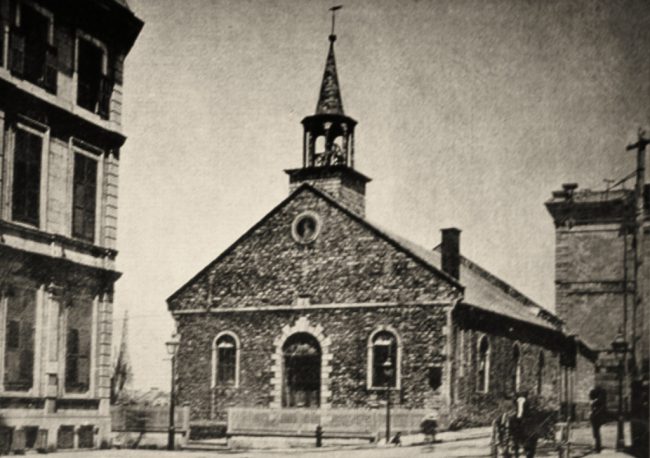
The Scotch Presbyterian Church that opened in the fall of 1792 was a plain fieldstone structure seating more than 500 people. In time, it took its name from the street where it stood, St. Gabriel. The site, which backed onto the Champ de Mars, is now occupied by part of the Old Court House on Notre Dame St.

Many Scots in the city, among them James McGill, Alexander McKenzie and William McGillivray, had grown wealthy in the fur trade, and money for the project was quickly raised to build the church. But as The Gazette noted, the speedy five months in which the work was completed also reflected “great honor on the Gentlemen of the Church of England in this City, by their having liberally contributed to the Undertaking.”At least two Catholics also contributed.

The Glasgow-born McGill was typical of the blurred lines among the various denominations here. Arriving in Montreal in 1766, he worshiped with the Anglicans and continued to rent a pew with them even after leaving with John Bethune’s new congregation. When the St. Gabriel St. Church opened, he rented a pew there as well. In 1796, he was happy to serve as the sole Protestant on a provincial commission charged with repairing and maintaining Catholic churches in Montreal.

The Presbyterians’ first minister, John Young, was an odd man. He was physically imposing – he stood six-foot-six tall, with “an eye in his head like a hawk” – but his character was flawed. Almost certainly, he was an alcoholic and what we would now call a problem gambler.

In 1788, he became pastor of a united congregation in Schenectady and Currie’s Bush, in upstate New York. But two years later, he sought to resign when his flock brought serious charges against him, probably for drunkenness. Chagrined, he made his way to Montreal and, a minister without a congregation, was doubtless pleased to find himself wooed by a congregation without a minister.

In December 1790, he was cleared of the original charge of misconduct. But when the American Presbyterians then censured him for “abruptly leaving his charge, in the sight of the slanderous accusations, and taking a journey into Canada without the knowledge of his people,” he surely concluded he had little future in Schenectady. He briefly returned, before finally throwing in his lot with the Montrealers early in 1791.

He was then about 32 years old, and was soon conducting services for the Presbyterians here. On Sept. 18, in the Recollets’ chapel, he administered the sacrament of the Lord’s Supper “in accordance with the usages of the Church of Scotland.” He took a leading part in the campaign to build a permanent home for his congregation.

See What Keller Did Now?

Tim Keller has made the history of Presbyterianism obsolete. Look at the way Jake Meador describes the challenges facing young pastors in the PCA:

… young Presbyterian pastors, many of whom are on university campuses with RUF or working in gentrifying urban neighborhoods, face enormous class-based pressure to conform to certain progressive cultural norms. These pressures make themselves felt in a variety of ways.

First, there is a strong and classic American pull toward being dismissive of the past, toward what is established, and to embrace what is new. This temptation exerts an even stronger pull than normal on many young PCA pastors because many younger pastors and RUF guys have strong entrepreneurial tendencies. While this is often a very good thing—indeed, it’s what makes it possible for them to succeed as church planters and RUF pastors—this same trait can make them naturally inclined to be dismissive toward established norms, policies, and beliefs, especially when they are surrounded by other young people with the same entrepreneurial sensibilities. It is probably not a coincidence, in other words, that the most famous “Kellerite” to go progressive is pastoring in San Francisco, the capital of Silicon Valley.

In addition to the disregard for things that are older, established, etc. there is also strong cultural pressure to embrace a kind of bourgeois bohemian lifestyle—buy a cute house in the gentrifying neighborhood, embrace the careerism, food and exercise regimen, lifestyle trends, and broadly progressive ethos of your neighbors. You can even say you’re just being outreach-focused as you do it. While none of these things are bad in isolation, taken together they’re all steps that involve embracing the norms of a younger bobo sub-culture. And if you’re embracing those norms out of a desire to be liked rather than a pure desire to make the Gospel sensible, it will be disastrous.

But, of course, it is all very complicated: Essentially, these are young pastors being handed different cultural scripts and asked to choose which ones to follow. But these clashing scripts cannot be simplistically labeled “good” and “bad” such that we can tell young pastors to follow the “good” script and avoid the “bad.” It is more complicated than that.

This is similar to the point that Ron Belgau made in his response to Rod Dreher earlier this week: It’s not that we have a legacy PCA script that is unambiguously good that we need to cling to. That script has problems—it’s awful on race issues, for starters. So figuring out the cultural scripts question in the PCA is challenging: The young white bobo script you’re pushed toward culturally and according to class is bad, but then you don’t necessarily have a good alternative script, particularly if you’re trying to plant a church or RUF in a more hostile environment. There simply aren’t good evangelical templates for how to do that because we have for the most part been really bad at it.

In such a situation, the draw toward Keller and the ham-handed attempts to mimic him are quite understandable. What other models do these pastors have? Driscollism? Straight-up progressive Episcopalianism?

Certainly, you can argue that there actually are other models out there—Calvin basically turned Geneva into a booming intellectual hub. Someone like Richard Sibbes was a very successful preacher in Cambridge at the university in the 17th century. Richard Baxter could be helpful in that we know more about his routines as a pastor than any other minister of his era. Bucer and his colleagues in Strasbourg did good and faithful work in a major intellectual, cultural, and scholastic hub. But these examples are all either from radically different cultural contexts, much more obscure, or both.

It isn’t unreasonable that these pastors would look to Keller and, being young and failing to understand their context, fail to mimic him well. But that isn’t Keller’s fault and it isn’t entirely the young pastor’s fault either. It’s a predictable outcome given all the factors I have mentioned already.

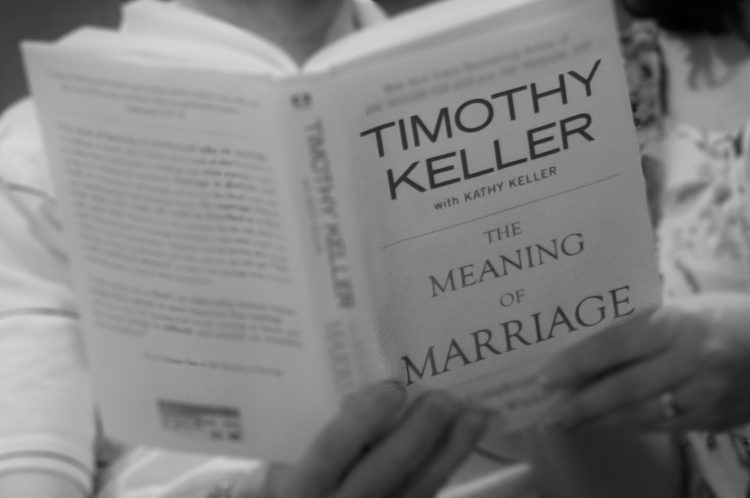
Whatever happened to vanilla Presbyterianism? A pastor ministers the word, administers the sacraments, catechizes the youth, shepherds the flock, and goes to presbytery. What does all this worry about culture have to do with it? Meador doesn’t think Keller is responsible for leading the PCA down a misguided path of Kellerism. That is mostly true. What happened it seems to meeeeEEEE, is that Keller fulfilled the aspirations of some PCA leaders who wanted to “engage” the culture — marriage is still up for grabs.

What is happening in the PCA is what always happens to denominations that Americanize and try to adapt to the culture. The Presbyterian version of this is not whether to be Baptist or Episcopalian — though why don’t the boho’s seem to notice that Keller’s urban ways draw him to Baptists at TGC and other urban pastors like John Piper and Mark Dever? The Presbyterian version of assimilation is New School and New Life. In the 19th century, those who wanted to Christianize the culture were the New Schoolers (Lyman Beecher and Charles Finney), and their opponents were Old School Presbyterians who tried to maintain creedal theology and presbyterian governance. In the twentieth century (let’s leave aside the modernists for now), the assimilationists were New Lifers (in the OPC mind you) who wanted Orthodox Presbyterians to join with the wider evangelical world and also reach the young people with long hair. In case no one noticed, Tim Keller’s origins are in the New Life wing of the OPC, with Harvie Conn supplying a theology of the city, and Jack Miller providing a relaxed Presbyterianism that could adjust to the culture (Miller’s tastes ran less to ballet and more to Jesus people. Keller went to New Life Glenside while he taught at WTS, if I am not mistaken.) Not to mention that the Reformed Presbyterian Church, Evangelical Synod (which goes back to the Bible Presbyterians) side of the PCA that gave it Covenant College and Covenant Seminary, is not the same slice southern Presbyterianism that produced Reformed Seminary and the original PCA.

In other words, the history is thick behind Keller and simply looking at the PCA from the perspective of Baptists and Episcopalians doesn’t take you very far into the weeds.

Yet, when you apply the categories of Baptist and Episcopalian, you wind up rendering Old School (or vanilla) Presbyterianism as a couple clicks away from strange:

During times when progressivism is ascendant, as it certainly is in our day, there is a natural temptation amongst conservatives to want to double down on their most strident rhetoric, add purity tests to protect their institutions, and to begin attacking people not only for holding wrong ideas, but for holding ideas which they suspect could lead to wrong ideas (even if they won’t inevitably lead to them).

Is this a plea for Erdmanesque tranquility so that the boat won’t rock? Ministry unites, doctrine divides?

Whether Keller is responsible or no, he has not helped to prepare the PCA for the predicament that Meador thinks the denomination faces:

You’re in this weird denomination that aspires to being the church that can reach secular bobo-types in upwardly mobile neighborhoods but that also aspires to be faithful to theological orthodoxy and even to be theologically evangelical, all the way down to not ordaining women. That is an awkward position to be in from the beginning.

If Keller had left the impression that working through presbyterian channels was not weird but normal, and had achieved his fame not as a pastor with one foot in presbyterianism and another in networked Protestantism but as a regular Presbyterian minister, he might have communicated an important lesson to young pastors, namely, that it’s okay to be simply a pastor. But that is not what he did. And his fellow Presbyterian Church in Americans are sorting out what the Age of Keller means.

Dissecting Signers (cont.)

I wonder why John Fea and other signers of the “Open Letter” about racism and Confederate Monuments did not feel the pinch of Matthew Lee Anderson’s criticism of the Nashville Statement. Anderson wrote again:

While forming God’s people is a thoroughly laudable aim, I wonder: why then the website, the press release, and the signatories? The means of communication are not neutral, after all. They deliberately invite attention not just from evangelicals, but the world. If the form of such statements is part of catechesis, then why were Bible verses left off? And why were reasons for each of the affirmations and denials not given, or definitions of terms not supplied? Such additions would dramatically expand the statement’s length. But what does that matter, if the purpose is catechism and not the culture war?

And why is there not more attention to the pastoral dynamics of how these affirmations and denials are to be worked out in the context of local communities? For a statement signed by a heavy concentration of Baptists, its form and substance have little to do with congregational life. It is a “statement” by an evangelicalism that has left ecclesial communities behind in favor of trans-denominational, parachurch partnerships.

That could equally be said of the Christian scholars who signed the letter opposing Neo-Nazis. What about the means of communication? Where are the biblical citations? Why isn’t the “Open Letter” taking a side in the culture wars? One answer could be that the sins are so obvious. So why isn’t it possible to see the self-evident character of the sins enumerated in the Nashville Statement? Only some evangelical scholars are allowed to pontificate, only the smart ones?

When Fea writes that Anderson is observing what evangelical historians are seeing — “Anderson and Gerhz seem to be in agreement that the Nashville Statement reflects what we (and now many others) have been calling ‘The Age of Trump'” — that avoids partisanship?

You could even argue that Anderson’s diagnosis of the subtext and optics of the Nashville Statement apply across the board, even to celebrity Christian intellectuals, like Rod Dreher who is excited about the release of the French translation of Benedict Option. If the means of communication and the publicity machines are not neutral, if they capitulate to the economic structures, inequalities of late modernity, and the desires of consumers, then why not apply that to individuals as much as statements?

But when it comes to Tim Keller, nothing to see (not even the publicity machine, fundraising, digital networks, and fame trafficking that has attended the New York City star):

it isn’t fair to assign blame to a teacher when students do not live up to his standard, particularly in a case like this one where the “teacher” had virtually no personal contact with most of the students and has instead simply attracted a crowd of admirers via publications.

Indeed, if anything I think we should commend Keller for his stewarding of his position at Redeemer. They were very selective in what sermons they made freely available online, he waited a long time to start writing books, and he has put a far greater emphasis on church planting in NYC rather than simply growing his brand as a celebrity pastor. Given what has happened to Mark Driscoll and now Darrin Patrick, we should be profoundly grateful for men like Keller (and John Piper) who manage to be in the spotlight for so long and to do so with relatively little scandal.

I thought Anderson said that publications, lack of personal contact, and crowds of followers were not “neutral.”

The lesson is that the means of production behind the Nashville Statement are flawed. But the means of production behind Keller — well, he arrived ex nihilo.

Odd What Big Cities Do To Church Life

Is Tim Keller getting cold feet about “the city”? He bears his apparent burden to the other coolest guy in the Reformedish room, Jamie Smith:

JS: As a pastor, and now increasingly a theological educator, where do you most see a need for renewal and intentionality? If you could heal churches, what would you heal in them? What do you wish was stronger, deeper, healthier, more functional in local congregations?

TK: One challenge is pastoral care, primarily because of transience. There is an indication—though it’s hard to prove—that, say, thirty years ago, the average member probably came to church four out of five weeks or five out of six weeks. Now it’s like one out of two. People are travelling more; their attention is divided. Also costs are such that it’s very expensive to have a full-time staff. Frankly, it’s seductive to have a larger church with fewer pastors where people are basically consumers. They’re not really being watched or cared for. There’s pastoral triage, which means that when your life’s falling apart the good churches will be there. They’ll be at the hospital, they’ll be at the funeral parlour, they’ll be in the counselling office. They can do triage. But when it comes to the ordinary kind of positive, proactive pastoral care and intervention where you are actually examining people, only in a nice way—How are you doing? Where are you going? How much do you know about the Christianity? Where could you grow?—that’s just not happening at all.

Keller also seems to pine for a small church. But elders? Not so much:

JS: How much is that the weakening of the priesthood of all believers, do you think? Your point makes me think of a line from Klaas Schilder, a minor twentieth-century Dutch theologian who said something like, “Don’t underestimate the significance of the wise ward elder. He is a cultural force.” By attending to families, doing household visits, the elder is a culture-shaping force because he or she is forming people. I wonder how much what’s missing is not just a lack of pastoral staff but a failure to equip lay elders to do this care.

Several years ago, I was at Whitworth University, and they do a summer program for pastoral professional development—the Whitworth Institute of Ministry. But then alongside it, they do this elder leadership initiative where pastors bring some elders with them and they dive into theology and pastoral resources. I just thought, as go elders, so go the church. What are you seeing in terms of people’s capacity to be elders?

TK: I do think there’s a breakdown. In fact, I get where you’re going and I absolutely agree. The right thing to do is to have a layer of lay leaders; maybe there is an elite group that you can call your elders, but by and large you probably have more like 10 or 15 percent of your people who are mature enough and willing enough and maybe even have the time to be regularly trained by the pastors to do every-member ministry, every-member pastoral care—including evangelism, by the way. Those are the people who bring their friends to church and reach out. But there are also people who are out there just caring for people and then letting you know. They’re your radar system; they let the pastors know.

In a small church where you have maybe eighty people coming to church, then you need about eight or ten of those folks, and you should be meeting with them at least every month. So you’re catechizing them and you’re reading great books together and that makes them feel two things: (1) It makes them feel confident to pry a little bit into people’s lives and have conversations, otherwise they’d be afraid. Most of these folks are afraid to be asked a question they can’t answer. That’s the reason they don’t reach out both in evangelism and in instructing and caring.

So you have to give them (1); but then (2) they have to know that they can get right back to you. If I’m talking to somebody and they ask me a question I can’t answer, I need to be able to get right to you and know that you will get right back to me. So if you have eighty people in your church and you’re a full-time pastor and you have, say, eight or nine people like that and maybe two or three elders as part of that group—you’re going to be fine. Nobody’s going to fall through the cracks, people will lead probably proactively, the minister will visit people and see them, and they’ll also be getting other touches from the church, not just the minister.

So the priesthood of all believers is absolutely crucial. You know, by the way, in Geneva, what Calvin did—at least I’m pretty sure; you know the experts are going to tell me I’m wrong, but I’m almost sure I remember [laughter]. In Geneva the elders were responsible for wards, and when it looked like there was somebody that needed pastoral exhortation, they were brought before the consistory, which met every Thursday, and it was Calvin and the elders. Evidently, like ninety-five times out of one hundred, there was no real discipline. There was exhortation. So people were exhorted to come to church or to love their wife better and so on.

In a small church? If you have 80 people in your church? What is Keller talking about? Why not include observations about Redeemer?

The optics!

The reticence!

How Did that Work Out for You?

From the history of Cleveland Presbyterianism (1896):

OF Cleveland Presbyterianism it may be said that it was from the beginning New Englandized, and then recruited from New York rather than from Pennsylvania. In type of theological belief, then, it has always been liberal, but at the same time evangelical and fairly aggressive, as seen in its missionary spirit. The network of churches now numbers seventeen, counting the East Cleveland, Windermere, and Glenville Churches, which are out of the city only by a narrow bound. The aggregate membership of these churches is about 6,500. All the congregations are housed in admirable buildings, and the value of the property is fully $1,000,000. These churches furnish sittings for about 10,000 worshipers, while in the Sunday-schools there are 6,500 scholars.

The 1801 Plan of Union was a killer. It placed Presbyterians on the front lines of United States religious nationalism. They made America great and Presbyterians have not been able to give up their seat at the table ever since.