Sexual Hangups, Reformed or Roman Catholic

Where would you be without “Calvinism” to bail you out? Michael Sean Winters blames Reformed Protestantism for U.S. Roman Catholics’ obsession with sex:

The focus on sexuality as the key indicator of Christian identity has always been one of the odd and remarkable hallmarks of Catholicism in America. Catholic cultures — Italy, Spain, France — are not known for any puritanical dispositions regarding human sexuality. But, in America, the ambient Calvinism of the religious culture combined with the Jansenistic impulses of Irish Catholicism to make a concern for sexual purity an obsession. The three Democrats discussing their faith are right to insist that any fair reading of the Gospels reveals that the Lord Jesus spent far more time urging his disciples to be generous to the poor, welcoming to the stranger, and treat people with dignity than he did discussing any sexual issues.

This is rich coming from a member of a communion which makes a common union (marriage) a sacrament, has authoritative teaching that minutely regulates legitimate sex, requires ordained officers to live celibate lives, and has bishops who need to cover up for priests who do not practice what the church preaches (actually only homilies).

The really rich aspect of Winter’s gripe with Calvinism’s mores is that Rome’s double-mindedness about sex goes way, way back, as Charlotte Allen explains:

In Peter Damian’s definition—a common one during the Middle Ages—the sin of “sodomy” encompassed “four classes of unnatural vice,” each described by him with startling explicitness and deemed more serious than the last, starting with masturbation and culminating with anal intercourse, the worst offense of all. All were forms of male homosexual activity (the other two consisted of the carnal touching of others’ private parts and intercourse between the thighs of someone of one’s own sex). Peter Damian was outraged, particularly because the superiors of clerics who committed such sins were, in effect, giving them a pass: exacting penances for monks and priests found to have committed the first three offenses but expelling from holy orders only those who had engaged in the fourth, anal intercourse.

Some of the offenders, Peter ­Damian said, had even chosen fellow homosexual offenders as their confessors so as to obtain slap-on-the-wrist treatment. “Listen, you do-nothing superiors of clerics and priests. Listen, and even though you feel sure of yourselves, tremble at the thought that you are partners in the guilt of others; those, I mean, who wink at the sins of their subjects that need correction and who by ill-considered silence allow them license to sin.” He reserved his harshest condemnation for bishops who abused their underlings by engaging in homosexual acts with them: “What a vile deed, deserving a flood of bitter tears! If they who approve of these evildoers deserve to die, what condign punishment can be imagined for those who commit these absolutely damnable acts with their spiritual sons?” Damian was not without pity for those sinners, however, begging them to throw themselves onto God’s mercy and reform their ways, but he asked Leo to expel from holy orders those who had committed any of the four categories of sodomy.

Scholars have debated whether homosexual activity among clerics was quite such a widespread “festering disease” during the eleventh century. It is indisputable, however, that the tenth and eleventh centuries were the most scandal-plagued that the Western Church had endured, and that the moral and sexual integrity of the clergy was at the heart of the issue. Hildebrand, the Tuscan Benedictine monk who became Pope Gregory VII in 1073, had to institute the “­Gregorian Reform” movement attacking simony (the buying and selling of holy offices), lay investiture (the control of bishoprics by powerful secular lords), and gross violations of the Western Church’s longtime requirement of priestly celibacy. That rule had been in place since at least the early fourth century, but by the eleventh, priests and even bishops all over Western Europe were living openly with wives and children, often passing down their churches by inheritance to their priest-sons. Some took concubines.

How does that saying go? Those in glass houses dot dot dot
Was Calvin’s Return to Geneva in 1541 a Miracle?

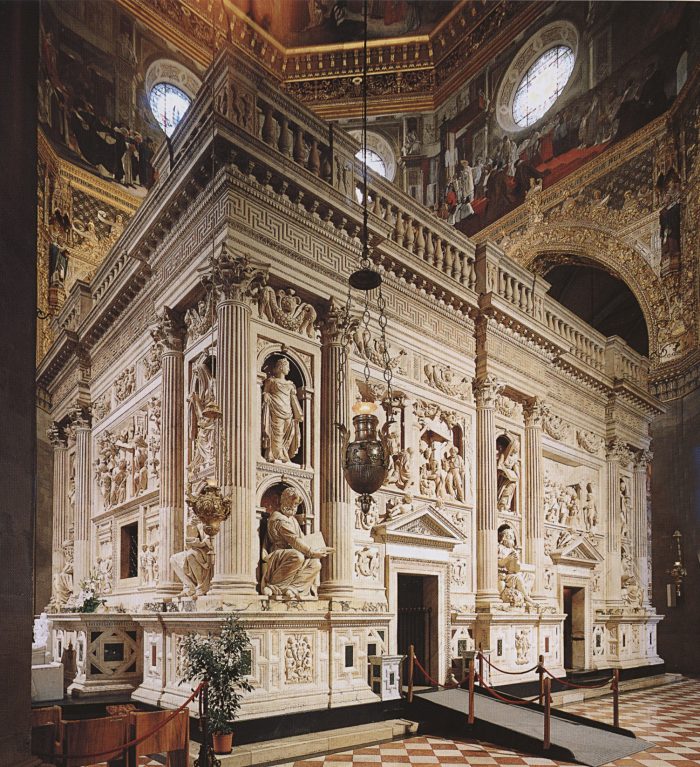
How much do Protestants associate the greatest hits of their churches’ history with anything like what Roman Catholics sometimes teach and believe about the House of Loreto. According to the Catholic Encyclopedia:

Since the fifteenth century, and possibly even earlier, the “Holy House” of Loreto has been numbered among the most famous shrines of Italy. Loreto is a small town a few miles south of Ancona and near the sea. … this building is honoured by Christians as the veritable cottage at Nazareth in which the Holy Family lived, and the Word became incarnate. … Angels conveyed this House from Palestine to the town Tersato in Illyria in the year of salvation 1291 in the pontificate of Nicholas IV. Three years later, in the beginning of the pontificate of Boniface VIII, it was carried again by the ministry of angels and placed in a wood near this hill, in the vicinity of Recanati, in the March of Ancona; where having changed its station thrice in the course of a year, at length, by the will of God, it took up its permanent position on this spot [six] hundred years ago. Ever since that time, both the extraordinary nature of the event having called forth the admiring wonder of the neighbouring people and the fame of the miracles wrought in this sanctuary having spread far and wide, this Holy House, whose walls do not rest on any foundation and yet remain solid and uninjured after so many centuries, has been held in reverence by all nations.”

Got that? The house where Mary and Joseph lived in Nazareth is now in Italy. No construction company performed the move. No, angels did. They moved the house not once but three — COUNT ‘EM THREE!! — times (or is it four?).

Are these miracles merely the outworking of local traditions and pious cults in southern Italy? No. Popes have approved these stories as true.

More than forty-seven popes have in various ways rendered honour to the shrine, and an immense number of Bulls and Briefs proclaim without qualification the identity of the Santa Casa di Loreto with the Holy House of Nazareth. As lately as 1894 Leo XIII, in a Brief conceding various spiritual favours for the sixth centenary of the translation of the Santa Casa to Loreto, summed up its history in these words: “The happy House of Nazareth is justly regarded and honoured as one of the most sacred monuments of the Christian Faith; and this is made clear by the many diplomas and acts, gifts and privileges accorded by Our predecessors. No sooner was it, as the annals of the Church bear witness, miraculously translated to Italy and exposed to the veneration of the faithful on the hills of Loreto than it drew to itself the fervent devotion and pious aspiration of all, and as the ages rolled on, it maintained this devotion ever ardent.”

Then the Catholic Encyclopedia’s authors go on to list the reasons for the authenticity of these miracles:

(1) The reiterated approval of the tradition by many different popes from Julius II in 1511 down to the present day. This approval was emphasized liturgically by an insertion in the Roman Martyrologium in 1669 and the concession of a proper Office and Mass in 1699, and it has been ratified by the deep veneration paid to the shrine by such holy men as St. Charles Borromeo, St. Francis de Sales, St. Ignatius Loyola, St. Alphonsus Liguori, and many other servants of God.

(2) Loreto has been for centuries the scene of numerous miraculous cures. Even the skeptical Montaigne in 1582 professed himself a believer in the reality of these (Waters, “Journal of Montaigne’s Travels”, II, 197-207).

(3) The stone on which the original walls of the Santa Casa are built and the mortar used in their construction are not such as are known in the neighbourhood of Loreto. But both stone and mortar are, it is alleged, chemically identical with the materials most commonly found in Nazareth.

(4) The Santa Casa does not rest and has never rested upon foundations sunk into the earth where it now stands. The point was formally investigated in 1751 under Benedict XIV. What was then found is therefore fully in accord with the tradition of a building transferred bodily from some more primitive site.

To their credit, the authors also acknowledge that this historical whopper of a story has not held up to scrutiny even from Roman Catholic historians:

It must be acknowledged, however, that recent historical criticism has shown that in other directions the Lauretan tradition is beset with difficulties of the gravest kind. These have been skilfully presented in the much-discussed work of Canon Chevalier, “Notre Dame de Lorette” (Paris, 1906). …The general contention of the work may be summarized under five heads: (1) From the accounts left by pilgrims and others it appears that before the time of the first translation (1291) there was no little cottage venerated at Nazareth which could correspond in any satisfactory way with the present Santa Casa at Loreto. … (2) Oriental chronicles and similar accounts of pilgrims are absolutely silent as to any change which took place in 1291. There is no word of the disappearance at Nazareth of a shrine formerly held in veneration there. … (3) There are charters and other contemporary documents which prove that a church dedicated to the Blessed Virgin already existed at Loreto in the twelfth and thirteenth centuries, that is to say, before the epoch of the supposed translation. (4) When we eliminate certain documents commonly appealed to as early testimonies to the tradition, but demonstrably spurious, we find that no writer can be shown to have heard of the miraculous translation of the Holy House before 1472, i.e., 180 years after the event is supposed to have taken place. … (5) If the papal confirmations of the Loreto tradition are more closely scrutinized it will be perceived that not only are they relatively late (the first Bull mentioning the translation is that of Julius II in 1507), but that they are at first very guarded in expression, for Julius introduces the clause “ut pie creditur et fama est”, while they are obviously dependent upon the extravagant leaflet compiled about 1472 by Teramano.

It is clearly impossible to review here at any length the discussions to which Canon Chevalier’s book has given rise….the balance of recent Catholic opinion, as represented by the more learned Catholic periodicals, is strongly in his favour.

And yet, over one hundred years later, popes still use the site of the house to inspire the faithful and stories from journalists include explanations like this:

The Basilica of the Holy House in Loreto contains the walls of what tradition holds to be the house in which the Virgin Mary lived when the Angel Gabriel announced that she was to give birth to Jesus.

Which of course raises several questions:

1) Isn’t belief in the virgin birth hard enough? Why add a unit of angels with “Wide Load” banners attached below their wings?

2) If Popes can lead the laity astray on historical details like this, are they all that trustworthy on wayward priests, at the low end, or on what Jesus said (by way of oral tradition), at the high end?

3) But let’s not blame the hierarchy entirely. Why are Roman Catholic laity so willing to go along with such myths, legends, and fabrications?

Instances like this make plausible lines like the following from Lyman Beecher, a (trigger warning) New School Presbyterian who was not sure how Roman Catholics would do in a republic:

If [Roman Catholics] could read the Bible, and might and did, their darkened intellect would brighten, and their bowed down mind would rise. If they dared to think for themselves, the contrast of protestant independence with their thralldom, would awaken the desire of equal privileges, and put an end to an arbitrary clerical dominion over trembling superstitious minds. If the pope and potentates of Europe held no dominion over ecclesiastics here, we might trust to time and circumstances to mitigate their ascendance and produce assimilation. But for conscience sake and patronage, the are dependent on the powers that be across the deep, by whom they are sustained and nurtured; and receive and organize all who come, and retain all who are born, while by argument, and a Catholic education, they beguile the children of credulous unsuspecting protestants into their own communion. (Lyman Beecher, Plea for the West, 1834)

If Not Imprecatory Psalms, What About the Lord’s Prayer?

Even Psalms that don’t register on the list of imprecatory ones can be a challenge to use if only because of their depiction of the death of God’s enemies. Some advise against their use and this was one of the reasons for not producing, as the OPC and URC did, a complete Psalter:

The psalmist was praying against those who persecuted him. The theocracy, God’s reign in Israel from the time of Moses to the time of Christ, was a shadow of future events (Heb. 10:1). One of those events is the final judgment of God. The destruction of the Canaanites in the days of Joshua was a shadow of the final judgment and not, therefore, normative for how we are to deal with our neighbors who do not believe in Jesus. The imprecations against the wicked in the book of Psalms were also shadows of the final judgment—appropriate for the era of the theocracy, but not for this present age. The gospel era is one of kindness, tolerance, and patience—intended to bring people to repentance and faith (Rom. 2:4). This is the day of salvation (2 Cor. 6:2). And this is why Jesus taught us to love our enemies and to pray for them, not against them. This is why Paul taught us to pray that God would bless our enemies (Rom. 12:14; 1 Cor. 4:12). Like the psalmist we leave vengeance to God, but unlike the psalmist we pray that God would bless those who bring pain into our lives. (Cornerstone Biblical Commentary, Psalms and Proverbs, pp. 348–49)

Others, though, notice that Christians still pray for God’s judgment upon his enemies even in the New Testament:

We need to be very conscious of trying—that part of what we’re called to be as the light of the world is people who love our enemies. Paul talks about how loving your enemies will further increase their punishment. So setting love of enemy radically over against judgment is not biblical.

I think it is not illegitimate to use the imprecations of the psalter to pray for judgment on God’s enemies. Every time we pray, “Come quickly Lord Jesus,” we’re praying an imprecation on God’s enemies. When Jesus comes again, there will be judgment for God’s enemies.

In other words, when Jesus taught his disciples to pray, he included the petition, “Thy kingdom come,” which as the Larger Catechism explains involves praying for the “hastening” of the kingdom of glory:

that Christ would rule in our hearts here, and hasten the time of his second coming, and our reigning with him forever

Not to be missed is the nature of the office that Christ executes as king:

Christ executeth the office of a king, in calling out of the world a people to himself, … restraining and overcoming all their enemies, and powerfully ordering all things for his own glory, and their good; and also in taking vengeance on the rest, who know not God, and obey not the gospel.

In which case, the anti-imprecatory Psalm position implies editing the Lord’s Prayer.

That does not mean that prayers for judgment day are easy to pray. The image of that great separation of the saved and the lost is haunting. At the same time, the thought of the end of the world is never absent from Christian devotion and worship.

On the upside, at least Protestants debate something that Roman Catholics don’t anymore thanks to an effort to manage less than good acts and desires with procedural standards and practices.

Who Sounds Protestant?

Another upgrader to Rome marvels about continuity between the ancient church and contemporary Roman Catholicism (were the church fathers as sexually confused as today?):

I haven’t officially tweeted this yet, but for the last 5-6 months, I’ve been struggling through a very unexpected twist in my Christian life: the Catholic Church. If you knew me before, you would know that this was the farthest thing from my mind for the past 30 years.

I was as anti-Catholic as they come (James White probably had me beat). The problem was, I knew NOTHING about their actually teachings. All I knew came from other anti-Catholic polemicists. Until I started a class on Church History (via a Reformed grad school). I was blown away.

In addition, I started to read the Church Fathers. Not what people say about the Fathers, but their actual letters and writings. This was HUGE in my dealings with the claims of Catholicism. They actually sounded Catholic and not Protestant.

Along with many, many pages of books, debates, and conversion stories, I started to really think that the Catholic Church is the Church that Christ founded 2000+ years ago. Now I am on the path towards full-communion with the Catholic Church. Crazy!

Have people like this never read Paul? What that apostle recommended to Titus does not sound like Roman Catholicism — eh veh:

1 Paul, a servant of God and an apostle of Jesus Christ, for the sake of the faith of God’s elect and their knowledge of the truth, which accords with godliness, 2 in hope of eternal life, which God, who never lies, promised before the ages began 3 and at the proper time manifested in his word through the preaching with which I have been entrusted by the command of God our Savior;

4 To Titus, my true child in a common faith:

Grace and peace from God the Father and Christ Jesus our Savior.

5 This is why I left you in Crete, so that you might put what remained into order, and appoint elders in every town as I directed you— 6 if anyone is above reproach, the husband of one wife, and his children are believers and not open to the charge of debauchery or insubordination. 7 For an overseer, as God’s steward, must be above reproach. He must not be arrogant or quick-tempered or a drunkard or violent or greedy for gain, 8 but hospitable, a lover of good, self-controlled, upright, holy, and disciplined. 9 He must hold firm to the trustworthy word as taught, so that he may be able to give instruction in sound doctrine and also to rebuke those who contradict it.

10 For there are many who are insubordinate, empty talkers and deceivers, especially those of the circumcision party. 11 They must be silenced, since they are upsetting whole families by teaching for shameful gain what they ought not to teach. 12 One of the Cretans, a prophet of their own, said, “Cretans are always liars, evil beasts, lazy gluttons.” 13 This testimony is true. Therefore rebuke them sharply, that they may be sound in the faith, 14 not devoting themselves to Jewish myths and the commands of people who turn away from the truth. 15 To the pure, all things are pure, but to the defiled and unbelieving, nothing is pure; but both their minds and their consciences are defiled. 16 They profess to know God, but they deny him by their works. They are detestable, disobedient, unfit for any good work.

Notice Paul says God reveals himself by preaching. He never mentions the sacraments in his instructions to a man who is planting a church. Odd. Though the shot at Jewish myths might make you want to check what you are doing with an altar and sacrifice in worship.

He also says overseers (bishops or presbyters) should be married to only one wife. So much for clerical celibacy.

In chapter two, Paul goes on to bang the gong for doctrine — the meat and drink of logocentric Protestants.

Then in chapter three, Paul tells Titus to be subject to the ruling authorities and to teach Christians to do the same. Let’s just say that the papacy has had a little trouble thinking such instruction applied to them. Heck, they still have a Vatican jail and mete out temporal justice.

But the church fathers don’t sound Protestant. Whatehveh.

Whatever Happened to Mortal Sin?

Austen Ivereigh is another of those papal interpreters who explain to the rest of the world what the bishops and pope really mean. His advance copy for the upcoming synod of bishops on sexual abuse is the sort of piece Harry Emerson Fosdick could have composed:

The church’s task is not to lament and condemn, but rather to discern and reform.

We’re so used to hearing that Francis is “behind the curve” on the abuse issue. In truth, he is well ahead of it. While most Catholics, not least bishops and religious orders, remain fixated on cleaning up the institution, demonstrating that it is now transparent and accountable and regulated by new measures, the pope has grasped that keeping the focus on the institution in this way is precisely the problem. This is apparent in the texts he addressed to the Chilean bishops and the people of God last year, which in turn draw on his meditations on institutional desolation as a Jesuit back in the 1980s. Both those texts of three decades ago and last year’s letters have been collected and commented on by his Jesuit collaborators in Rome, Fr. Antonio Spadaro and Fr. Diego Fares, in a new book published in Italian and Spanish, Las Cartas de la Tribulación (“The Tribulation Letters”). If the book had come out later, it would doubtless have included Francis’s letter to the U.S. bishops at the start of their retreat at Mundelein seminary.

The heart of the pope’s message is a pithy little sentence that occurs back in his 1980s writings and again in his letters to the bishops of Chile and the United States: “Ideas you discuss, but situations have to be discerned.” Whenever the church faces a time of tribulation, there are various temptations it can succumb to: to recoil into itself, to put up defenses, to blame others, and essentially to argue—with others, and within itself. The church is prone to “ruminating” on its own desolation, lamenting and blaming, and at its worst falls into “victimism,” which, says Francis in his preface to the book, “conceals in its breast the resort to vengeance, which only feeds the evil it pretends to eliminate.”

All these are means of evading the real task, which is to seek the grace that is always on offer in desolation and tribulation: the grace of conversion. By accusing ourselves, not others—in humility, repentance, and self-correction—we open ourselves to that grace. We change. We are converted. We see where we went wrong. And with that new sight comes the chance to change course. The church’s task is not to lament and condemn, but rather to discern and reform.

What is so hard to discern about the sin of sex outside of marriage? Or how tough is it for bishops to tell the truth and be responsible with those under their oversight? It may require a little extra discernment to ponder the sort of sin that proceeds from victims for resenting their abusers or the bishops who covered up the tawdry activity. But do you really need to look to systems and cultures to figure out sinfulness or that the wages of sin is death?

It is breathtaking to see how much Rome has changed since Benedict XVI and John Paul II. It is even more staggering to see people like Ivereigh whitewash popes and bishops’ actions and responsibilities in the current climate. It makes you think the gates of hades are winning.

New Rome

If you were thinking Constantinople you would be wrong. The New Rome is Roman Catholicism after Vatican II.

Here are a couple of data sets. One from Lawrence King and Robert Miller:

When Vatican II promulgated its Declaration on Religious Freedom (Dignitatis humanae), few expected that fifty years later the view that people do not have a right to religious liberty would become popular again. Yet this doctrine—commonly known as integralism—is experiencing a resurgence among some conservative Catholic intellectuals.

Integralism is the doctrine that (ideally, if not always in practice) the state should endorse the Catholic faith and act as the secular arm of the Church, punishing heresy among the baptized and suppressing false religious practices if they threaten Catholicism. This doctrine was taught by several nineteenth-century popes. Then, in 1965, the Second Vatican Council taught that all human beings have a right to religious freedom and that it is wrong for the state or anyone else to use force in matters of religion. . . .

From 1978 to 2013, the conservative position was dominant. Popes John Paul II and Benedict XVI insisted that Vatican II was an incremental development of the Church’s ongoing tradition, not a radical break with the past. The Catechism of the Catholic Church (1992) was an authoritative statement of this position, weaving pre-1962 and post-1962 Catholic teachings into a seamless whole. Conservative theologians deployed two powerful arguments: Against the liberals, they argued that rejecting the Church’s traditional teachings is profoundly un-Catholic. Against the traditionalists, they argued that rejecting the Church’s recent teachings, both of the Council and of the post-conciliar popes, was equally un-Catholic.

Since the election of Pope Francis in 2013, however, this conservative synthesis has been put in serious question. While not formally rejecting any of John Paul II or Benedict XVI’s teachings, Francis has scuttled many of their initiatives, removed their most ardent supporters from office while promoting several of their critics, and has taken positions on certain matters (such as gradualism in moral theology) that appear to be at odds with the views of his predecessors. As a result, some conservative theologians have concluded that Francis may be teaching serious errors.

However, once a Catholic theologian concludes that the current pope is in error, he or she opens the lid of a very deep box. If the pope has been teaching false doctrine regarding moral gradualism since 2013, then isn’t it possible that all the popes since 1965 have been teaching false doctrine regarding religious liberty? The conservatives’ strongest argument against traditionalism—“How can you call yourself Catholic if you reject the authority of the pope?”—is no longer available. As a result, some conservative Catholic thinkers have recently been reevaluating traditionalist claims on a variety of matters, including integralism.

There is a certain irony in this. Integralism extends the religious authority of the pope and bishops into the sphere of civil law, and yet the people who most adamantly defend integralism today are rarely fans of the current pope.

Or this from James Chappel, Catholic Modern:

Whatever we might think of the Church’s activism on these fronts, one thing at least is clear: it has embraced modernity. With few exceptions, Catholic thinkers and leaders take for granted that they are living in a religious plural world, and that their task is to collaborate with others in the name of the common good. They no longer call for church-state fusion or the revocation of religious freedom. They invoke, instead, human rights. They are more likely, too, to agitate for civil rights and pursue Christian-Jewish dialogue than they are to revive the Church’s long history of anti-Semitism.

Catholics have their own idea of what a just modernity should look like, of course. . . . They do not, in other words, call for an overturning of the secular order and a reinstatement of the Church as the sole guardian of public and private morality. These aspects of Catholic engagement are so familiar to us that we can sometimes forget how recent they are. A devout Catholic in 1900, anywhere in the world, would have been shocked to learn that the Church would one day support values like these. Sometime between 1900 and the present, the Church became modern. (1-2)

This is a much more serious problem than Protestants with 33,000 denominations or EIGHTY-ONE PERCENT of evangelicals voting for Trump. It means that the church, the hierarchy, the infallible magisterium, was wrong about the world, sin, and the devil for much of medieval and modern history. Roman Catholicism was not simply about grace and spiritual matters. It claimed to be the source of order in society and truth about the way humans should order their earthly affairs.

It’s like saying the Bible teaches a judgment day when the saved and lost will be separated and then realizing that Scripture teaches universal salvation. Protestants may disagree about what the Bible means, but they still regard it (the ones who believe it) to be true. Modern Roman Catholics, even before the revelations of sexual scandals for the past two decades, do not believe that popes before John XXIII were telling the truth about the church and its function in the world. And once you question the church’s function in the world, you question implicitly its teaching about salvation.

Mainline Protestantism’s Elder Brother

Boniface takes the temperature of Roman Catholicism in the light of Governor Cuomo and Archbishop Dolan:

the purpose of excommunication is not merely for the good of the sinner’s soul; it is also for the edification and protection of the community. “Do you not know that a little leaven leavens the whole lump? Cleanse out the old leaven that you may be a new lump.” St. Paul teaches that excommunication helps purge the body of “leaven”, and that without this purging such leaven will cause a rot throughout the body. When the offender is singled out and has judgment pronounced upon him, the faithful at least see that such behavior is proscripted. St. Paul is not only worried about the sinner, but about the boasting of the congregation, that is, their attitude about the sinner. By excommunicating him, St. Paul judges not only the sinner, but the broader attitude that allows sin to flourish unchecked.

To bring this back to Governor Cuomo: from the biblical perspective, whether Cuomo will repent or not, whether he respects the authority of the Church or not, whether the Church can claim any socio-political leverage in these matters, is not ultimately the main concern. The fact is, the good of the Catholic Church in America demands that this man be thrown out. At least make an attempt to purify the lump of its leaven. If we don’t, we are celebrating with the old leaven. It’s about the integrity of the community as much as it is about the sinner.

* * * * * *

There have often been times in Church history where discipline has been lost or seriously eroded. We can think of various monastic reforms throughout the centuries. Or the era of the Counter Reform and the Council of Trent when the Church had to fight an uphill battle to transform the episcopacy from a class of political courtiers into something more in line with what Christ intended. Countless regional synods from the first millennium and the era of the barbarian invasions attest to the Church’s commitment to maintaining or restoring discipline in an age of chaos when order seemed to be falling apart everywhere.

…And that’s the sad truth here. Cardinal Tobin, Dolan and the like don’t care what the optics are here. They don’t care whether the House of the Lord is an eye sore, an abomination to the people. “God’s name is blasphemed among the Gentiles because of you” (Rom. 2:24); but they don’t care. If discipline has been lost, then the common sense approach is to restore it. You restore it by making examples of people and actually asserting your will to enforce discipline. If you can’t do that or refuse to, it simply means you don’t even want discipline restored. You’re happy with the status quo. This is the inescapable conclusion: Cuomo will not face excommunication because the princes of the Church are content with the current situation.

So why convert? Protestants are supposed to think this is the church founded no matter how much it resembles mainline Protestantism? When the successors to the apostles are so far from following the apostles, we’re supposed to see nothing and come back to mother church?

Changes on the Left and the Right

Not even development of doctrine can keep up with the flips and flops, the yings and yangs, of English-speaking Roman Catholics. Massimo Faggioli provides a bird-watchers guide:

There is, for example, a new wave of ultramontanism that looks to an idealized conception of Rome for its points of reference. There is also a related resurgence of “integralism,” inspiring conferences at the University of Notre Dame and Harvard. The new integralism takes a step beyond the more tentative Catholic post-liberalism, or the simple proclamation of the crisis of liberal Catholicism. Integralism is the attempt to imagine for the Catholic Church—but also for the world in which the church lives—a future that rejects the “liberal” separation between temporal and spiritual power, and subordinates the former to the latter.

According to Sacramentum Mundi (first published between 1968 and 1970, and now available online—its general editor was Karl Rahner, SJ) integralism is

the tendency, more or less explicit, to apply standards and directives drawn from the faith to all the activity of the Church and its members in the world. It springs from the conviction that the basic and exclusive authority to direct the relationship between the world and the Church, between immanence and transcendence, is the doctrinal and pastoral authority of the Church.

Here one can detect a subtle difference between the classic definition of integralism and its twenty-first-century variety. This new strain is focused almost exclusively on the political realm. In fact, what it resembles most is another phenomenon of nineteenth-century Catholic culture: intransigentism—the belief that any concession to, or accommodation with, the modern world endangers the faith. Unlike mere conservatism, which values elements of the past and seeks to preserve them, intransigentism rejects the modern outright and preemptively. This has consequences for the theological thinking of Catholics who today call themselves integralists, traditionalists, and ultramontanists. For these Catholics, the past sixty years—and especially Vatican II—either do not matter at all or matter only if they can be interpreted as a confirmation of the church’s past teaching.

Roman Catholic liberals also are hardly steady:

It is interesting how different the liberal Catholicism of the nineteenth century is from the liberal Catholicism of today, and how similar the Catholic intransigentism of the nineteenth century is to the intransigentism of today. Liberal Catholicism today is much more accepting of individualistic, bourgeois society than it was in the nineteenth century, when it had a more prophetic edge. But intransigentism hasn’t really changed much in the past 150 years, especially when it comes to the question of the confessional state—a question on which the church’s official teaching has changed during this period. It would be interesting to ask the proponents of this kind of Catholicism what they make of the plight of Catholics who have to live as minorities under integralistic non-Christian confessional regimes, and why those Catholics do not seem to be so afraid of liberalism.

Faggioli may regard himself as closer to the mainstream of Roman Catholic thought thanks to his regard for Pope Francis and his Italian background. But when you ponder all the changes in Roman Catholic teaching about various aspects of modern society since Vatican II, you hardly see the sort of continuity to which the Villanova University professor aspires. Roman Catholics in the U.S. certainly have their moments. But it is not as if the bishops, the Vatican, or the papacy has stayed on track. Roman Catholics can pick their favorite pope after World War II — John XXIII, Paul VI, John Paul II, Benedict XVI, or Francis — according to their reading of the tradition, the modern world, and personal preference.

It’s almost as chaotic as Protestants reading the Bible.

If You Worry about Pompeo, Why Not Pope Francis?

The Guardian has a story that should trouble 2kers. It’s about the influence of evangelicals, holding office, mind you, and responsible for foreign policy in the Middle East:

In his speech at the American University in Cairo, Pompeo said that in his state department office: “I keep a Bible open on my desk to remind me of God and his word, and the truth.”

The secretary of state’s primary message in Cairo was that the US was ready once more to embrace conservative Middle Eastern regimes, no matter how repressive, if they made common cause against Iran.

His second message was religious. In his visit to Egypt, he came across as much as a preacher as a diplomat. He talked about “America’s innate goodness” and marveled at a newly built cathedral as “a stunning testament to the Lord’s hand”.

The desire to erase Barack Obama’s legacy, Donald Trump’s instinctive embrace of autocrats, and the private interests of the Trump Organisation have all been analysed as driving forces behind the administration’s foreign policy.

The gravitational pull of white evangelicals has been less visible. But it could have far-reaching policy consequences. Vice President Mike Pence and Pompeo both cite evangelical theology as a powerful motivating force.

Just as he did in Cairo, Pompeo called on the congregation of a Kansan megachurch three years ago to join a fight of good against evil.

“We will continue to fight these battles,” the then congressman said at the Summit church in Wichita. “It is a never-ending struggle … until the rapture. Be part of it. Be in the fight.”

This is not good on two counts. First, it mixes the church and the state. Second, it uses bad theology for one of the mix’s ingredients. Good for Julian Borger to catch this.

But what about when the Vatican does the same thing (but without the Word of God)?

Though the week between Christmas and New Year’s is traditionally a fairly slow period on the Vatican beat, this is the Pope Francis era, when tradition and a Euro will buy you a cup of cappuccino in a Roman café.

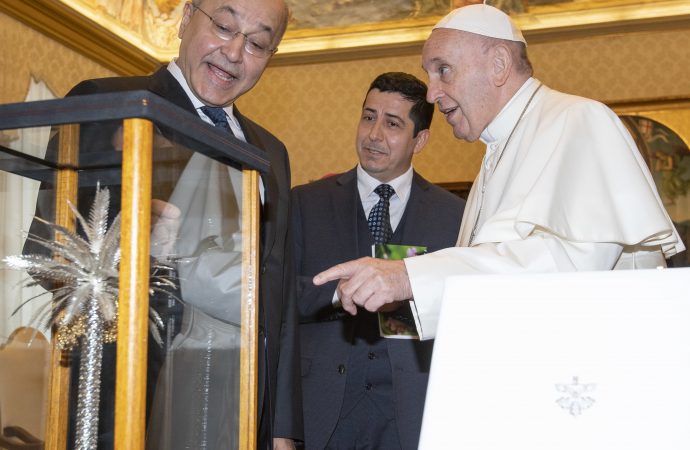
Thus it’s entirely fitting that arguably one of the Vatican’s most important diplomatic encounters of 2018 came the day after Christmas, when Italian Cardinal Pietro Parolin, the Secretary of State, met Iraqi President Barham Salih in Baghdad.

During the meeting, Salih extended an invitation to Pope Francis to visit the Iraqi city of Ur, the Biblical city of Abraham, for an interreligious summit. It’s a trip that St. John Paul II desperately wanted to make in 2000, during a jubilee year pilgrimage to sites associated with salvation history, but the security situation at the time made such a trip impossible.

There was no immediate word from the Vatican whether Francis intends to accept the invitation, although there has been some media buzz about an outing coming as early as February. Doing so would be entirely consistent with his penchant for visiting both the peripheries of the world and also conflict zones.

Parolin was accompanied in the Dec. 26 meeting by the Patriarch of the Chaldean Catholic Church in Iraq, the largest of the Eastern churches in communion with Rome in the country, Cardinal Louis Raphael Sako. That was an important signal, in part underlining that the Vatican isn’t interested in pursuing a parallel diplomatic track with Baghdad that doesn’t prioritize the concerns of the local church.

(That’s a real concern, given the fact that critics insist the Vatican has done precisely the opposite in some other parts of the world, including China and Russia.)

According to a statement afterwards from the Iraqi president’s office, Salih and Parolin discussed the importance of different religions working together to combat extremist ideology “that does not reflect the beliefs and values of our divine messages and social norms.”

The statement also said the two leaders discussed the situation facing Christians in Iraq, talking “a great deal” about how to maintain their presence in the country and to assist in rebuilding their homes, businesses and places of worship in the wake of devastation caused by ISIS and other extremist Islamic forces.

Is it because the Vatican has been engaged in foreign policy for a millennium, compared to evangelicals who have only been at it maybe 30 years tops, that allows reporters to take Bishops’ influence on temporal rulers for granted?

Or are evangelicals scarier because with the executive branch of the U.S. federal government they have more power than the pope?

If so, that’s true audacity.

How To Avoid Christological Heresy this Christmas

It has become a cliche to regard the incarnation as providing an upgrade for humanity and even all of creation. Consider this from Michael Sean Winters:

We Catholics believe that human nature is changed and uplifted precisely because our God chose to don it. Human nature, you might say, was the first “gay apparel” of Yuletide. If the Passion, Death and Resurrection of the Lord relativizes our humanity to his divinity, Christmas celebrates the relativization of his divinity to our humanity. It is because of this twin relativization that Jesus was able to overturn manmade precepts with such determination, to cut away the cultural encrustations and get to the kernel within, to proclaim a new day of favor

Truth be told, divinity does not merge with humanity, not even in Jesus himself. Remember what the bishops affirmed at Chalcedon:

begotten before all ages of the Father according to the Godhead, and in these latter days, for us and for our salvation, born of the Virgin Mary, the Mother of God, according to the Manhood; one and the same Christ, Son, Lord, only begotten, to be acknowledged in two natures, inconfusedly, unchangeably, indivisibly, inseparably; the distinction of natures being by no means taken away by the union, but rather the property of each nature being preserved

The hypostatic union does not blur or merge or combine Christ’s human and divine natures. The Westminster Divines were also explicit about keeping the human and divine distinct even though in one person:

The only mediator of the covenant of grace is the Lord Jesus Christ, who, being the eternal Son of God, of one substance and equal with the Father, in the fullness of time became man, and so was and continues to be God and man, in two entire distinct natures, and one person, forever. (WLC 36)

In which case, if the incarnation did not divinize Christ’s human nature, then how could it Christ’s birth and life conceivably sacralize the rest of humanity and human civilization?

Be careful out there.