You Don’t Need an Education to be Outraged

Molly Worthen wrote a good piece at the New York Times about the way that conservatives take ideas seriously (and by implication, liberals not so much):

The syllabuses and faculty range from say, the secular Jewish milieu of Hertog to the libertarian Cato Institute to the Christian traditionalism of the John Jay Institute. But all these programs seek to correct the defects they see in mainstream higher education by stressing principles over pluralism, immersing students in the wisdom of old books and encouraging them to apply that wisdom to contemporary politics.

Liberals have their own activist workshops and reading groups, but these rarely instruct students in an intellectual tradition, a centuries-long canon of political philosophy. Why have philosophical summer schools become a vibrant subculture on the right, but only a feeble presence on the left? The disparity underscores a divide between conservatives and liberals over the best way to teach young people — and, among liberals, a certain squeamishness about the history of ideas.

Liberals, however, can’t afford to dismiss Great Books as tools of white supremacy, or to disdain ideological training as the sort of unsavory thing that only conservatives and communists do. These are powerful tools for preparing the next generation of activists to succeed in the bewildering ideological landscape of the country that just elected Mr. Trump.

One reason that liberals and progressives don’t study the past or its leading voices is that so many of the authors fail so quickly on the left’s moral grid of identity righteousness/victimhood (race, class, gender, sexual orientation). If John Stuart Mill was on the wrong side of women’s liberation or Immanuel Kant wasn’t a proponent of civil rights for blacks — a bit anachronistic, mind you — then what could they possibly teach about the plight of trannies in search of a public bathroom? It worked the same way in the world of mainline churches. Who reads Henry Sloane Coffin, William Adams Brown or their evangelical enablers like Robert Speer? These modernists or doctrinal indifferentists were on the cutting edge of reducing the conservative orientation of the PCUSA. But by the 1960s when sex, Civil Rights, and Vietnam were the topics of debate, the old contests of the 1920s had no value.

In point of fact, activism needs no serious reflection if you listen to interviews with contemporary Ivy League students like this. Sure, the Princeton University editor is respectful and intelligent in some respects. But he has no clue about the impropriety of going to college to learn while also saying that faculty need to be re-educated about race and safe spaces. If this student is representative, today’s college students, the really smart ones, can’t tell the difference between being policed in Ferguson, MO or by campus police at Princeton University. Heck, they even think that the oppression African-Americans have confronted historically is on a par with what women, gays, and trannies face.

Meanwhile, the therapeutic quality of contemporary activism should never be discounted. The idea of not hurting students’ sense of empowerment is prominent in discussions of critical race theory like Henry Louis Gates, Jr.’s in Speaking of Race, Speaking of Sex. Where that leads was the subject of Judith Shulevitz’s New York Times piece on safe spaces discussed here.

With all the smart people running the world for the last 8 years, you might think that colleges and universities would themselves provide the sort of intellectual training for which Worthen calls. Why do you need supplemental education when you are in a four-year accredited and, in some cases, prestigious university? The reason is that universities, even the good ones, treat students like this:

But the fixation on diversity in our schools and in the press has produced a generation of liberals and progressives narcissistically unaware of conditions outside their self-defined groups, and indifferent to the task of reaching out to Americans in every walk of life. At a very young age our children are being encouraged to talk about their individual identities, even before they have them. By the time they reach college many assume that diversity discourse exhausts political discourse, and have shockingly little to say about such perennial questions as class, war, the economy and the common good. In large part this is because of high school history curriculums, which anachronistically project the identity politics of today back onto the past, creating a distorted picture of the major forces and individuals that shaped our country. (The achievements of women’s rights movements, for instance, were real and important, but you cannot understand them if you do not first understand the founding fathers’ achievement in establishing a system of government based on the guarantee of rights.)

When young people arrive at college they are encouraged to keep this focus on themselves by student groups, faculty members and also administrators whose full-time job is to deal with — and heighten the significance of — “diversity issues.” Fox News and other conservative media outlets make great sport of mocking the “campus craziness” that surrounds such issues, and more often than not they are right to. Which only plays into the hands of populist demagogues who want to delegitimize learning in the eyes of those who have never set foot on a campus. How to explain to the average voter the supposed moral urgency of giving college students the right to choose the designated gender pronouns to be used when addressing them? How not to laugh along with those voters at the story of a University of Michigan prankster who wrote in “His Majesty”?

Imagine that: a good novel, historical investigation, and even philosophical deliberation might lift a person out of their own set of ideas and consider those of other people. They might even experience empathy with hillbillies (or they can simply deconstruct and carry on impervious to others).

Yes, there are lots of good faculty, serious students, and great classes across the board in U.S. colleges and universities. But the limits of smarts are well on display. Can U.S. higher education self-correct? Can the Vatican? You do the math and set the odds.
It

Jeremy Young explains what he explored in his book on the charisma of politicians between the Civil War and World War II:

One of the central questions I had to answer in researching my book on turn-of-the-century charisma was how to determine whether a given leader was actually charismatic. Charisma is an enigmatic quality, both ineffable and deeply subjective; who was I to say that Theodore Roosevelt was more or less charismatic than, say, Woodrow Wilson? Ultimately, I realized that I was asking the wrong question; charisma was not a characteristic of leaders, but a relationship between them and their followers. By observing how Americans described their leaders, then, I could let followers do the work of identifying charisma.

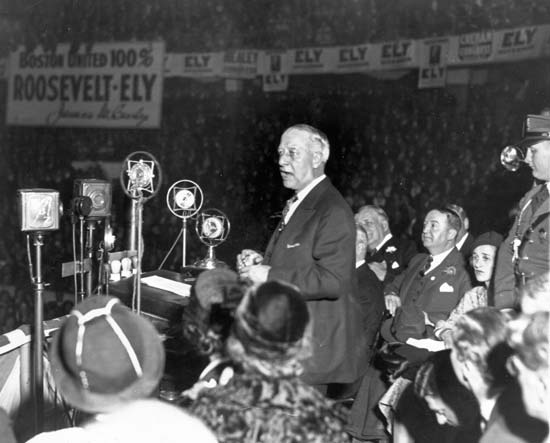
H. L. Mencken had another theory. It was whether or not a politician had “it.” Mencken thought Al Smith did.

There is something about Al’s aspect that the plain people like, not kowing why, and they seem to like it almost as well where cops are curiosities as where cows are curiosities. I have watched them at a dozen country railway stations, crowding up to the observation platform. Maybe the stop is for but two or three minutes; sometimes there is no more than a slowing down. They crane their necks expectantly, waiting for they know not what. Suddenly Al is on view, waving the brown derby, reaching out to shake hands, hauling in the bouquets brought for Mrs. Smith and joshing the local worthies. They regard him quizzically for a moment, and even with a certain hostility, but then, of a sudden, he has landed them, and as the train rolls on they are howling. . . .

The plain fact is that Al’s points are mainly infra-red and ultra-violet. It is impossible to chart or label them. He simply has the thing that the movie folk call IT — and the movie folks discovered long ago that it could not be described with any precision. There are grand and gaudy beauties who lack it altogether, and there are shabby little girls who radiate it at a pressure of a million volts. Al has it as no American politician has had it since Roosevelt. Has more of it, indeed, than Roosevelt, for the popularity of Roosevelt was largely logical: the plain people admired him because he had waded in blood and saved American womanhood from the Spanish Hun. But they know very little about Al, and what little they know, at least in these back reaches of the land, is mainly unfavorable. I don’t think it would be exact to say that they admire him, even after they have seen him. But it is as plain as day that they delight in him. He somehow thrills them and makes them happy. When he casts his magic over them it penetrates to their gizzards. (“Smith Has ‘It'” – 1928)

I suspect that Hillary didn’t have it but Trump did.

Postscript: Machen voted for Al.

It’s Fascist When You Exclude the Universities?

Michael Kinsley thinks Donald Trump qualifies technically as a fascist:

The game has several names: “Corporate statism” is one. In Europe, they call it “dirigisme.” Those two other words for it — “Nazism” and “fascism” — are now beyond all respectability. It means, roughly, combining the power of the state with the power of corporations. At its mildest, it is intrusive regulations on business about parental leave and such. At its most toxic, it is concentration camps. In the 1930s, a few Americans (including a few liberals) bought into it. Pearl Harbor ended that argument. Even for Trump, “fascism” itself now is a dirty word, not just a policy choice. Even Trump would not use it — least of all about himself.

Did Kinsley worry about combining the power of the state with the power and prestige (we’re the smartest people in the world) of universities? It’s not as if nothing could go wrong (beware the negatives):

Indeed, illiberal progressive elitism has only become more pervasive as the gap between the “educated and the ignorant” has widened.

With the rise of think tanks, research universities, and advocacy foundations and nonprofits—the vast, interlocking, insulated complex we’ve constructed to formulate, advocate, and execute public policy—we have only reinforced the barrier between the everyday voter and governance. In order to understand, much less engage in, today’s abstract, detached, and data-saturated discourse of public policy, participants require ever more specialized academic expertise. If a problem can’t be expressed in a statistical formula—with the obliteration of nuance, detail, and local variability this entails—then the problem simply doesn’t exist.

What we now call the “rise of the meritocracy” may have begun well over a century ago. But as it accelerates today, its costs are becoming more apparent. The meritocrats sort themselves out not only socially, but geographically as well, into coastal and university enclaves. There, in a contemporary bow to positive eugenics, they engage in assortative mating. Their children then follow the sheltered path from university day school to Princeton to a career in social entrepreneurship, convinced that they can “change the world,” as the slogan goes, without ever touching down in that vast swath of cultural desolation unhappily separating Nassau Hall from Palo Alto. The distance between the “educated and ignorant” grows ever larger, both literally and figuratively.

You could also call this “corporate statism” since the biggest and smartest universities in the U.S. are corporations whose assets tax collectors cannot touch.

Imagine if They Had Worried about Syria

Sean Trende (via Rod) on recent U.S. political history:

Democrats and liberals have: booed the inclusion of God in their platform at the 2012 convention (this is disputed, but it is the perception); endorsed a regulation that would allow transgendered students to use the bathroom and locker room corresponding to their identity; attempted to force small businesses to cover drugs they believe induce abortions; attempted to force nuns to provide contraceptive coverage; forced Brendan Eich to step down as chief executive officer of Mozilla due to his opposition to marriage equality; fined a small Christian bakery over $140,000 for refusing to bake a cake for a same-sex wedding; vigorously opposed a law in Indiana that would provide protections against similar regulations – despite having overwhelmingly supported similar laws when they protected Native American religious rights – and then scoured the Indiana countryside trying to find a business that would be affected by the law before settling upon a small pizza place in the middle of nowhere and harassing the owners. In 2015, the United States solicitor general suggested that churches might lose their tax exempt status if they refused to perform same-sex marriages. In 2016, the Democratic nominee endorsed repealing the Hyde Amendment, thereby endorsing federal funding for elective abortions.

All the power of a global hegemon and we use it like this?

Fake News and Phantom Legs

Lots of folks are talking about fake news and how to discern the difference between real and not-so-true reports. Amid all the discussion I can’t stop thinking about Bill Genevose. He is the brother of the deceased Kitty Genovese, the woman whose murder in 1964 turned into a parable of urban life and crime:

Before we had the Internet to blame for everything, news of the brutal murder of 28-year-old bar manager Kitty Genovese went wide as a parable of urban indifference. Genovese was far from the only New Yorker to die on the street in 1964. Nor was she the only woman Winston Moseley, a married father of two, admitted killing. By his own chilling account, Moseley drew no distinction between murder and the routine burglary by which he supplemented his income. The other victims languished in obscurity, while 50 years on, the meaning of Genovese’s murder still fuels a gallery of books, movies and television shows, up to and including a recent episode of Girls. All this — according to a new documentary by Kitty’s younger brother Bill Genovese with filmmaker James Solomon — because of an influential article in the New York Times that attributed her late-night death on a quiet street in Queens to the inaction of 38 witnesses who heard her screams twice (Moseley returned to stab her a second time) and allegedly failed to call the police or rush to her rescue.

The NPR story about Genovese’s death goes on to make the astute point that all news comes with spin that takes truth in the direction of fake:

“We tell ourselves stories in order to live,” Joan Didion famously wrote. Genovese likens his sister’s death to a Rorschach test, and at its sharpest, The Witness is a careful inquiry into the tricks memory plays, and into how ambiguous events get reshaped into narratives that fit individual and collective needs. Almost everyone Genovese interviewed — from surviving witnesses and their children, the prosecutor and judge in the case, police, journalists, and A.M. Rosenthal, the Times editor who handled the story in 1964 and wrote the book Thirty-Eight Witnesses about the case — has, however unconsciously, polished their own version of the truth. Some of the testimonies are sober and corrective, some defensive, others wacky or poignant or both. One witness’ son argues that most of the neighbors were Holocaust survivors and “therefore” would be reluctant to contact authorities. Moseley himself, who died in prison in March of this year, would not allow Genovese to visit him in prison, but wrote him a rambling, outlandish account. The film shows commendable compassion for Moseley’s anguished son, the Rev. Steven Moseley, whose pitifully bizarre contextualization of the murder shows that the damage it did went far beyond Kitty and her family.

The documentary that Bill Genovese made about his sister complicates the legend that this murder created. The mainstream media had a narrative and they kept telling it. It became so convincing about the indifference of Americans to crime that Bill Genovese himself volunteered to serve in Vietnam. He wasn’t going to be guilty of the sort of social character than abandoned his sister. And what happened? On a patrol Bill stepped on a mine and lost both his legs.

Which brings us to Bill Genovese, who as executive producer and narrator is both the film’s subject and its chief interpreter. Having lost both his legs in Vietnam, the handsome Italian-American is a visually dramatic figure, a sleuth in a wheelchair as he follows leads. Kitty’s death moved him, he says, to enlist in the Marines, and his continuing obsession with her murder (his siblings appear briefly, cooperative but baffled by a mystery they no longer seek to solve) stems from a desire to know that he “didn’t lose [his] legs for nothing.” There’s little reason to doubt their brother’s sincerity, yet his declared motives and his quest for “closure” — a glib buzzword that’s overdue for retirement — seem at once too tidy and a causal stretch.

Fake news or not, you should always take even the real news with a grain or two of salt.

Aren’t We Glad to Have Subdued the South So the U.S. Can Avoid This?

Crawford Gribben, who does a pretty good impersonation of a political commentator even though he knows far more about Puritanism than most Protestant academics, explains the dilemmas that union — both British and European — pose to European English speakers:

So, while no one knows what will happen next, here is one possible scenario. The High Court decision will be upheld, and Parliament will have the final say on Brexit. But this reversion to representative democracy will make no real difference to the process: Labour MPs, recognizing that seven in ten of their constituencies voted in support of the government’s action, will be unable to mount any effective resistance. The British government will then invoke Article 50 and begin the process of exiting the European Union before the Scottish government can table a second independence referendum or make sufficient advances in negotiations with EU member states and institutions to have them recognize its legal capacity to “inherit” UK membership. Against the wishes of its devolved government, Scotland is pulled out of the European Union along with the rest of the UK. Its independence referendum comes as too little, too late. . . .

The federal solution could prove successful. Towards the end of her second government, and with a constitutional dexterity that has not been characteristic of many 20th-century Westminster governments, Theresa May could propose a federal relationship between England, Wales, and Northern Ireland, facilitate the return of the Scots, who would retain a nominal independence, and cement a special relationship with the Republic. With the Irish and Scottish land borders becoming effectively meaningless, there could re-emerge a polity that embraces the geography of the old United Kingdom of Great Britain and Ireland without its problematic centralization. Or, in a more likely scenario, economic realities will prevail. English elections continue to signal a rightward drift, and the economy continues its gradual improvement. Welsh voters don’t like it, but combine their sentimental nationalism with a hard-headed recognition of the uncertain prospects of small nations in a sometimes unfriendly European Union, and prefer the devil they know. The pragmatism is familiar: After all, the Brexit results in both countries cut across party political lines. In Northern Ireland, an ambiguous settlement continues to link the province to England and Wales for as long as Stormont politicians can turn crises into dividends, even as north-south economic and cultural connections make the border increasingly irrelevant.

If only the United States were so constitutionally dexterous. But thanks to two world wars fighting on the United Kingdom’s side (not to mention a certain imbroglio with a Republican as commander-in chief), Americans remain stuck perpetually seeking a more perfect union.

On the Inside Looking In

Does becoming part of the elite world of publishing, Hollywood, and the academy mean you have to give up perspective?

We need to connect courageously with the rejection, the fear, the vulnerability that Trump’s victory has inflicted on us, without turning away or numbing ourselves or lapsing into cynicism. We need to bear witness to what we have lost: our safety, our sense of belonging, our vision of our country. We need to mourn all these injuries fully, so that they do not drag us into despair, so repair will be possible…. Because let’s be real: we always knew this shit wasn’t going to be easy. Colonial power, patriarchal power, capitalist power must always and everywhere be battled, because they never, ever quit. We have to keep fighting, because otherwise there will be no future—all will be consumed. Those of us whose ancestors were owned and bred like animals know that future all too well, because it is, in part, our past. And we know that by fighting, against all odds, we who had nothing, not even our real names, transformed the universe. Our ancestors did this with very little, and we who have more must do the same. This is the joyous destiny of our people—to bury the arc of the moral universe so deep in justice that it will never be undone.

Writing for the New Yorker and battling capitalist power. Keeping it unreal.

It’s Only POTUS

Michael Brendan Dougherty echoes the point that presidential elections are destroying America (and so we should let Congress pick POTUS):

The length of our presidential campaign atrophies self-governance. Instead of citizens governing themselves, Americans increasingly define their political lives by their membership in one tribe, and their support for its candidates. Instead of electing a leader, we pledge fealty as followers.

The bulk of our attention flows to the presidential race. And because there is so much attention there, the process attracts candidates who are merely seeking attention for themselves and not high office. In fact, that may be why the primaries feel more and more like reality television, and produced a reality TV president. Each debate is a new episode, and the political press waits for the latest news about which contestant is eliminated.

Because our mode of engaging with politics feels tribal, and because the process takes two years, many people experience it as a crushing psychological and social blow to be on the losing side. Citizens who identify with the losing presidential candidate feel like they are no longer a part of their country. They experience the transfer of the executive branch from one party to the other as a regime change that threatens them. Remember the red and blue maps of Jesusland and America that appeared during the Bush administration? Back then there was heady talk of Vermont seceding from the union to become a bastion of tolerance. Fast forward a few years, and conservatives were the ones spreading stories about Texas’ secession. This is not healthy. But it’s going to continue if we don’t begin to tame the presidential election itself.

The presidential election increases our sense that all issues are national issues. Even people who say they are addicted to politics often have no idea what is happening in their state or county government.

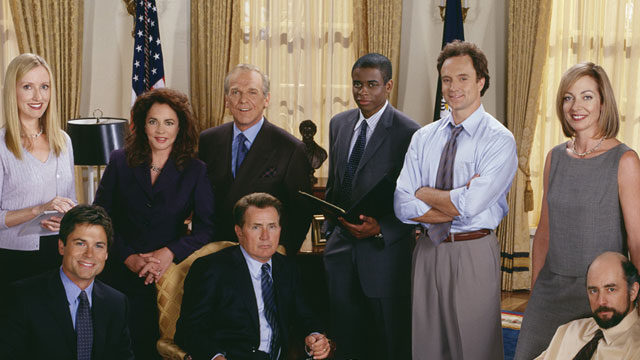
Dougherty adds a point that Aaron Sorkin, the creator of Jed Bartlet, the POTUS on West Wing, should take to heart:

One cause for the gigantism of our presidential election is the gigantism of the executive branch. The federal government employs more than 2 million people in the process of governing us.

Too bad that Sorkin doesn’t seem to recognize the monster that he fed (even if he did not create). His letter to his wife and daughters was typically hysterical (thanks to one of our southern correspondents):

White nationalists. Sexists, racists and buffoons. Angry young white men who think rap music and Cinco de Mayo are a threat to their way of life (or are the reason for their way of life) have been given cause to celebrate. Men who have no right to call themselves that and who think that women who aspire to more than looking hot are shrill, ugly, and otherwise worthy of our scorn rather than our admiration struck a blow for misogynistic s‑‑‑heads everywhere.

But if POTUS were little more than a glorified dog catcher, would the stakes be so high?

Thankful for Trump

I rarely see eye-to-eye with Michael Novak, but m(mmmmeeeeEEE)y reaction to the election was similar to his in the sense that I dreaded four more years of progressivism at that center of American life and felt a sense of relief when news came that Hillary Clinton did not win.

But a better expression of my thoughts comes from Damon Linker who recognizes, as few do inside the bubble of progressivism, that the United States includes more than elite institutions and their unofficial establishment:

The urge toward exclusion is a perennial possibility of politics. That’s because politics takes place on two levels. On one level is the back and forth of partisan conflict, involving persuasion, argument, electoral battles, triumphs, and defeats. On this level, pretty much anything goes as long as it abides by the rules of the political game. But there’s also a second, more fundamental level of politics that involves a competition over who gets to set the rules, the boundaries of what is publicly acceptable, in the first place — and precisely where those boundaries will be positioned.

The most obvious example of second-order politics in the American system is the judiciary, and especially the Supreme Court. Until the Obergefell decision in 2015, for example, the American people were engaging in a free-flowing debate about same-sex marriage, with some people in favor of allowing it and others opposed, and public opinion shifting rapidly in the “pro” direction. That was politics conducted on the first level. But then the Supreme Court stepped in to declare gay marriage a constitutional right. That was second-order politics in action: Suddenly the rules were changed, with the “pro” side summarily declared the winner throughout the nation and the “anti” side driven — and permanently excluded — from the political battlefield going forward.

But second-order politics isn’t only found in the formal strictures of a Supreme Court ruling. It comes into play when prominent institutions in civil society (such as mainstream media outlets, universities, corporations, movie studios, and other arms of the entertainment industry) informally unite in deciding that an issue, or a specific position on an issue, is simply unacceptable because it crosses a moral line that leading members of these institutions consider inviolable. Over the past several decades, a range of positions on immigration, crime, gender, and the costs and benefits of some forms of diversity have been relegated to the categories of “racism,” “sexism,” “homophobia,” “white supremacy,” or “white nationalism,” and therefore excluded from first-order political debate.

I’m not going to cry for progressives. They still have elite journalism, Hollywood, the most exclusive colleges and universities, and lots of agencies related directly and indirectly to the federal government. They just don’t have the White House for the next four years. Let’s see Aaron Sorkin make a television show about that.

But We Don’t Want to Live in Lena Dunham’s World

We only want to watch it (sometimes).

That’s one thought that came to me when reading this (thanks to another of our southern correspondents):

During the eight years of the Obama administration, white evangelical Christians, who make up one-quarter of the U.S. population, felt that culture moving away from them. They watched gay marriage become the law of the land and Christians come under fire for saying they didn’t want to provide pizzas or cakes or photographs for those weddings. They heard college students demand “safe spaces” and “trigger warnings”; they heard “Black Lives Matter” and didn’t understand when they were demonized for responding “All Lives Matter.” Their president disparaged people like them who “cling to guns or religion,” and then said that religious employers should subsidize their workers’ birth control and anyone should use any bathroom they like.

But if evangelical Christians are like me, they watch a lot of television and should know that the rest of America doesn’t live as evangelical Christians do.

Even so, television is one thing, society is another.

And let’s think about what drove that whitelash. This kind of thing often happens when groups and identities feel under threat. We know this from history. And it mirrors developments in Europe, especially in the face of globalization and an influx of culturally-distinct immigrants.

Evangelicals and other Americans may have sensed that television shows were becoming the reality. When the President approves of rainbow lights on the White House after SCOTUS legalizes gay marriage, and then he sends letters that micromanage states’ bathroom policies, you begin to worry that you have entered Girls — get this — without your consent.