An End Run

Imagine you are a Reformedish Protestant around the time of George W. Bush’s election. You have entered the world of Reformed Protestantism by way of the biblical theology (which leaned Federal) of Peter Leithart and James Jordan, you agree with a number of Doug Wilson’s critiques of modern America, and you became acquainted with the West and the Great Books again through Wilson’s Recovering the Lost Tools of Learning. Say you want a Reformed or Presbyterian church with a narrative that inspires, that connects with the sort of intellectual creativity that Leithart displays, that shows little of the wear and tear that afflicts most denominations in the United States whether sideline or mainline, and that connects with the larger history of the West, from Plato to Erasmus.

Where do you turn?

The OPC is too small and too theologically sectarian. The PCA suffers from similar problems among the TRs (Truly Reformed) and is blithely naive about modernity and urbanity on its progressive side. The ARP and the CRC are too ethnic and suffer from a measure of parochialism within their Scottish and Dutch traditions respectively. The same goes for the RPCNA which is even smaller than the OPC. The CREC might work but in 2000 that communion is only two years old, not the strongest case for a church with roots.

To your credit, you were enough of a Protestant not to find Roman Catholicism as a viable alternative.

What then? Why not turn to Elizabethan Anglicanism, like this?

The early English church, despite all the misconstruals of it by Anglo-Catholics, was Protestant and Reformed. The history of the 19th Anglo-Catholic attempt to deny this is a painful one for those who prize integrity of inquiry. The work of Peter Nockles and the more recent, and excellent, work of Jean-Louis Quantin, have shown how wrongheaded that 19th century orgy of wishful thinking really was. But this was proved back in the 19th c itself by Nathaniel Dimock, regarding sacramental theology, and regarding ecclesiology, by the American Bishop Charles McIlwaine, in his Roman, Oxford, and Anglican Divinity Compared.

The English Church of Elizabeth, James, and Charles is, in some ways, a model of importance for own time. Reformed churches, their common mind constricted by familiarity only with Scots and English Presbyterianism, miss the riches of Reformed thought available in Richard Hooker, or Richard Field, or Lancelot Andrewes (just as they miss the riches available in the thought of German and French Reformed). Anglo-Catholic attempts to prove that the established church was somehow not really Protestant are attempts to deprive modern Protestants of useful heritage.

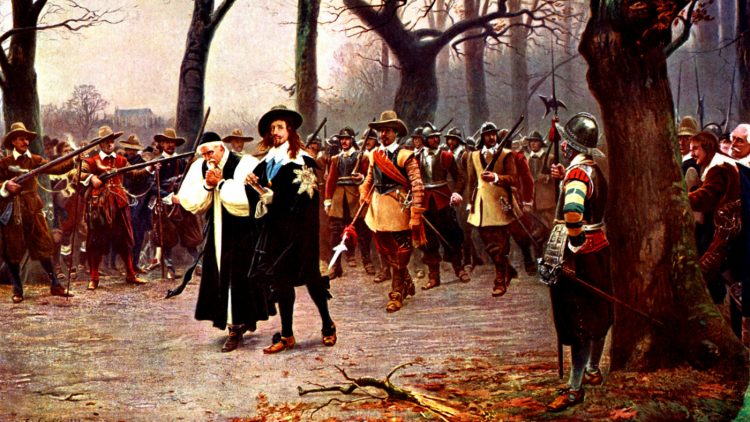
What is important to notice about this way of being Reformed is that it allowed you to occupy the catholic and moderate middle while also regarding the regulative principle as too Puritan and biblicist (and sectarian) and two-kingdom theology as a betrayal of the godly monarch (which allegedly made the English church tick until those rowdy Presbyterians and Puritans conspired to take down Charles I).

What is also striking about this line of argument about the American church scene at the beginning of the 21st century was that it was precisely the way priests and bishops who were part of the Anglican establishment saw Christianity in England:

The great innovation of Elizabeth’s reign was what we might term the internalization of anti-sectarian rhetoric, as anti-puritanism. In Edward’s reign that language had been used to associate the English church with the foreign reformed churches in the common defence of an emergent reformed orthodoxy. Now it was introjected, to precisely opposite effect, into the conduct of intra-Protestant debates between defenders of the ecclesiastical status quo and proponents of various styles and modes of further reformation. The central figure here was John Whitgift who, in an extended exchange with the leading presbyterian ideologue of the day, Thomas Cartwright, deployed the Edwardian version of the two extremes used to define the via media of the English church, popery and Anabaptism, to exclude, as he hoped, the likes of Cartwright and his ilk, from the charmed circle of English Protestant respectability. True to the spirit of his Edwardian forebears, Whitgift sought to assimilate Cartwright and his associates both to popery and to Anabaptism, using what he took to be their ultra-scripturalism and populism to associate them with the latter and what he took to be their clericalist opposition to the Royal Supremacy to associate them with the former.

Ostensibly a form of religious polemic, Whitgift’s anti-puritanism was also inherently political. It dealt with issues of governance and jurisdiction and stressed heavily the extent of direct royal authority over ecclesiastical affairs. In so doing it encoded within itself a set of (intensely monarchical) political values, defined against what he took to be the ‘popularity’ inscribed within presbyterian theory and puritan political practice. By popularity Whitgift mean a commitment to theories of government in which the role of the people was expanded. But he also used the term to refer to the political methods used by the supporters of the discipline to put their case to a variety of more or less popular publics through the pulpit and the press, and through the the circulation of manuscripts and of rumours and a variety of petitioning campaigns, some of them aimed at the parliament rather than at the prince. (Peter Lake, “Post-Reformation Politics, or On Not Looking for the Long-Term Causes of the English Civil War,” 28)

When Machen, Witherspoon, and Knox won’t do, turn to Whitgift and Hooker? In the United States, a country that made its name by rejecting Royal Supremacy?

It is an intellectually energetic way to find an alternative to American politics and the Reformed and Presbyterian churches that have persisted in the United States. But it is as arbitrary as thinking that the debates surrounding foreign missions and church government of Machen’s time are the terms by which Presbyterians in Australia ought to operate.

When Congregationalists Were Woke (150 years ago)

Observations about the Boston Council of Congregationalists in 1865:

Even mild and bespectacled Alonzo Quint, who had just returned from service as a Union army chaplain, burst out in protest during a discussion of the civil rights of rebels, declaring them “uncommonly stupid and ignorant” and “unfit to come back and be trusted with a vote.” Quint let fly again at the delegation from Great Britain, who were present at the council. Still deeply angry over British support for the Confederacy, and egged on by hisses from other delegates, he denounced them as “always ready to follow the powerful, and always read to crush the weak,” “robbing in India [and] plundering in Ireland.”

Sometimes bitterness boiled over. A report on evangelization in the South prompted Samuel Pomeroy, who was both a Republican senator from Kansas and president of the Atchison, Topeka, and Santa Fe Railroad, to declare that it would suit him better “if we spoke out a little more plainly about hanging somebody.” When the delegates responded with applause, Pomeroy pressed on: “I am very willing to mingle our justice with mercy to the common people of the South . . . but it does seem to me it is time somebody was hung.” Pausing for yet another round of applause, he further advised that “some wholesome hanging, I think, would have settled this question in the minds of the American people long ago; and I do not believe that a convention, even of this character, composed largely of clergymen, — men who love forgiveness and mercy, — would not be harmed if it adopted a little stiffer resolution on this question.” (Margaret Bendroth, The Last Puritans, 55)

This makes Thabiti Anyabwile look restrained.

On Necessity, Inevitability, and Finding a Basis

The Belgic Confession (Art. 24) says this about good works:

Therefore,
far from making people cold
toward living in a pious and holy way,
this justifying faith,
quite to the contrary,
so works within them that
apart from it
they will never do a thing out of love for God
but only out of love for themselves
and fear of being condemned.

So then, it is impossible
for this holy faith to be unfruitful in a human being,
seeing that we do not speak of an empty faith
but of what Scripture calls
“faith working through love,”
which moves people to do by themselves
the works that God has commanded
in the Word.

Faith makes good works inevitable and in a sense necessary. Without faith, the motivation for works changes.

Faith also affects the way we view good works. It allows Christians to look to Christ’s righteousness as the basis for salvation even while pursuing good works, rather than asking, “have I done enough?”

Moreover,
although we do good works
we do not base our salvation on them;
for we cannot do any work
that is not defiled by our flesh
and also worthy of punishment.
And even if we could point to one,
memory of a single sin is enough
for God to reject that work.

So we would always be in doubt,
tossed back and forth
without any certainty,
and our poor consciences would be tormented constantly
if they did not rest on the merit
of the suffering and death of our Savior.

Even the language of saying works are necessary to, as opposed to for, salvation is to veer in the direction of making works one basis among others for our salvation.

Given the propensity of fallen human nature for self-righteousness, loose talk about good works is like what Mark Noll said about evangelicals and activism: “to urge activist evangelicals to get more active is like pointing an addict toward dope.”

To urge Christians to good works for final salvation, without lots of qualifications, is like encouraging a relapse.

That Sound You Heard Was Paul Blanshard’s Head Exploding

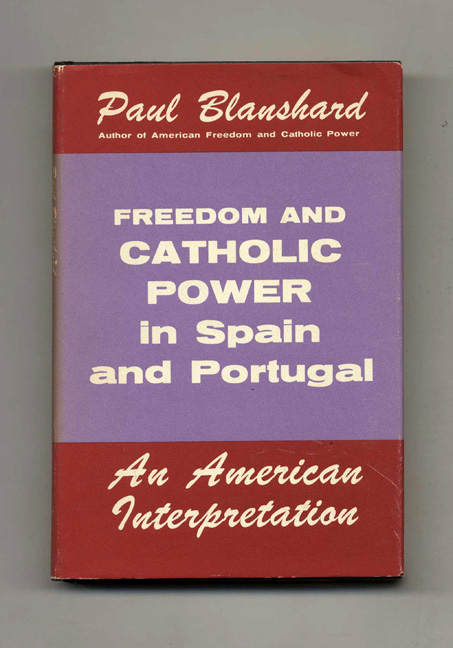
Paul Blanshard, for those born after Richard Nixon defeated George McGovern, was a lapsed Congregationalist (redundant?) who wrote the last best-selling work of anti-Catholicism. American Freedom and Catholic Power was perhaps the last gasp of Protestant bigotry, but it was still sufficiently forceful and plausible into the 1950s that Blanshard did not get cancelled for expressing hurtful thoughts.

That was 15 years before the end of Vatican II (roughly), when Rome still on paper and through political channels was skeptical about the kind of freedoms embodied in American political norms. In 1950 the church still insisted that “error has no rights,” a position that ran into something of a hurdle with the United States’ Bill of Rights which guaranteed rights for all sorts of groups who held erroneous views (even Roman Catholics).

But Vatican II sort of kind of ended all that and Rome changed its mind about freedom for false religions. That explains this post, an argument that assumes Roman Catholicism and freedom go hand in hand. That Americanist position is receiving push back from integralists (among others). So imagine writing advice about liberal democratic institutions with Roman Catholic integralists as the ones defenders of civil liberties need to fear:

I think the recent intra-conservative French-Ahmari debate can be partially resolved by determining the extent to which secular progressives integralists can be trusted to protect robust freedom of religion for religious traditionalists with conservative views about human sexuality.

If secular progressives integralists are trustworthy, at least by and large, then French’s strategy of working within liberal democratic institutions makes sense. Conservatives should hold secular progressives integralists to a constitutional order that they accept in general, but chafe at in certain cases. Secular progressives Integralists cannot always be trusted to uphold robust freedom of religion, but they’re trustworthy enough not to fundamentally undermine Christianity in the United States. They will obey liberal democratic norms on the whole; conservatives just have to fight to keep them honest.*

However, if secular progressives integralists aren’t trustworthy, then Ahmari’s approach starts ceases to make sense. Secular progressives Integralists will tend to undermine robust protections for freedom of religion in a systematic way, and so ignore constitutional constraints whenever they can get away with it. In that case, politics is war regarding freedom of religion, and conservatives may be permitted to respond in kind. Perhaps the liberal legal settlement is therefore unstable because the left cannot be trusted to uphold it, and so the only truly feasible arrangement is cultural and political victory in the fight against the left. There’s no peace and no middle ground because the other side isn’t trustworthy, and so can’t be trusted to keep a liberal democratic peace.

Actually, I’m not sure if more sentences need to be changed to maintain the parallels. Either way, secular progressives are not the only ones about which to worry. They would likely let Presbyterians worship (and other groups). That was not an option in Roman Catholic societies.

The Necessity of Good Works

Are good works “necessary to the attainment of eternal life,” as A. A. Hodge wrote at one point? Is that simply what the Confession of Faith and Catechisms say?

“Necessary” is actually a word infrequently used in the Westminster Standards. It appears six times in the first chapter of the Confession (on Scripture), as in:

All things in Scripture are not alike plain in themselves, nor alike clear unto all:p yet those things which are necessary to be known, believed, and observed for salvation, are so clearly propounded, and opened in some place of Scripture or other, that not only the learned, but the unlearned, in a due use of the ordinary means, may attain unto a sufficient understanding of them. (1.7)

The Divines also use it once in the chapter on vows:

It is not to be made to any creature, but to God alone:n and, that it may be accepted, it is to be made voluntarily, out of faith, and conscience of duty, in way of thankfulness for mercy received, or for the obtaining of what we want, whereby we more strictly bind ourselves to necessary duties; or, to other things, so far and so long as they may fitly conduce thereunto. (22.6)

It comes up once in the 23rd chapter on the civil magistrate, such that wars are sometimes legitimate on “necessary occasion(s).

In chapter 28, baptizing a person by dipping is not “necessary.”

And in chapter 30 church censures are “necessary” for reclaiming unrepentant sinners.

The language of necessity attached to good works’ utility in securing eternal life is not present.

The Shorter Catechism (if my Adobe search capacities are reliable) uses “unnecessary” only once in A. 61 in relation to words, works, and thoughts about worldly employments and recreations, as in those activities that do not qualify for works of “necessity and mercy.”

The Larger Catechism uses “necessary” seven times, all in connection with duties that superiors have to inferiors, the way to pray, or certain implications of the Decalogue.

But for anything close to an assertion that good works are necessary for eternal life or salvation, the Standards say so only by inferences drawn from the mind of the one inferring.

Perhaps the language or “require” will help. But here again, if you look at the Shorter Catechism on the duty God requires, you may wind up backing away from Hodge’s claim.

Of course, Q. & A. 39 state explicitly that God requires all people to obey his law:

Q. 39. What is the duty which God requireth of man?
A. The duty which God requireth of man, is obedience to his revealed will.

That answer introduces a lengthy commentary on the Ten Commandments.

Those reflections end with this:

Q. 82. Is any man able perfectly to keep the commandments of God?
A. No mere man, since the fall, is able in this life perfectly to keep the commandments of God, but doth daily break them in thought, word, and deed.

Conceivably, someone could receive eternal life by good works if that person lived a perfect life. But the fall sort of threw a wrench into that relationship between obedience leading to salvation. The Shorter Catechism puts that reality in a fairly pithy way:

Q. 84. What doth every sin deserve?
A. Every sin deserveth God’s wrath and curse, both in this life, and that which is to come.

Have a nice day.

It’s not a question of how many good works will secure your salvation. It is a problem than one sin condemns you to God’s wrath. Good works aren’t going to make up for that.

So what is the remedy? What does God require for eternal life? Again, the Shorter Catechism is crisp if not clear:

Q. 85. What doth God require of us, that we may escape his wrath and curse, due to us for sin?
A. To escape the wrath and curse of God, due to us for sin, God requireth of us faith in Jesus Christ, repentance unto life, with the diligent use of all the outward means whereby Christ communicateth to us the benefits of redemption.

If someone was looking for an affirmation of the value that good works perform in obtaining eternal life, that would be a good place to find it.

And in case you are thinking that repentance is in the good works ballpark, you might have to find a different stadium since “Repentance Unto Life” is the chapter before “Good Works” in the Confession. Granted, repentance is necessary to perform good works:

By it, a sinner, out of the sight and sense not only of the danger, but also of the filthiness and odiousness of his sins, as contrary to the holy nature, and righteous law of God; and upon the apprehension of his mercy in Christ to such as are penitent, so grieves for, and hates his sins, as to turn from them all unto God, purposing and endeavoring to walk with him in all the ways of his commandments. (15.2)

Repentance is part of the motivation for a good work. But for a work to be good, it must meet three criteria: a heart “purified by faith,” in a manner that conforms to Scripture, and for the end of God’s glory. (16.7)

What to Do with Columbus Day

I wonder if the sovereignty of tribal nations is part of the Democratic Party’s platform. I am curious mainly after looking at presidential proclamations about Columbus Day. In his 2015 speech, President Obama mentioned working harder to establish and protect tribal sovereignty. I had no idea that native American reservations function (or at least ideally) directly in relation to the federal government and not with states. The reason has to do with trying to recognize their existence and history before the founding of the United States. They were nations before, so the creation of the United States should not change that.

Imagine though, if you tried to make an analogy between tribal sovereignty and national sovereignty. There might be something in there for pondering the status of migrants. (Wikipedia haters, beware):

In Iron Crow v. Oglala Sioux Tribe, the United States Supreme Court concluded that two Oglala Sioux defendants convicted of adultery under tribal laws, and another challenging a tax from the tribe, were not exempted from the tribal justice system because they had been granted U.S. citizenship. It found that tribes “still possess their inherent sovereignty excepting only when it has been specifically taken from them by treaty or Congressional Act”. This means American Indians do not have exactly the same rights of citizenship as other American citizens. The court cited case law from a pre-1924 case that said, “when Indians are prepared to exercise the privileges and bear the burdens of” sui iuris, i.e. of one’s own right and not under the power of someone else, “the tribal relation may be dissolved and the national guardianship brought to an end, but it rests with Congress to determine when and how this shall be done, and whether the emancipation shall be complete or only partial” (U.S. v. Nice, 1916). The court further determined, based on the earlier Lone Wolf v. Hitchcock case, that “It is thoroughly established that Congress has plenary authority over Indians.” The court held that, “the granting of citizenship in itself did not destroy … jurisdiction of the Indian tribal courts and … there was no intention on the part of Congress to do so.” The adultery conviction and the power of tribal courts were upheld.

Heck, there might even be some relevance for church power and two kingdoms, not to mention a little push back for Representative Robert O’Rourke and his comments about religious institutions’ tax status.

Columbus Day may even provide perspective on what to do with historical monuments. The celebration of Columbus Day started in part out of a response to the lynching of Italian Americans in New Orleans, one year before the 400th anniversary of Columbus’ discovery of America. Can you try to protect people who suffered discrimination by celebrating someone from that group who it turns out inflicted suffering on a minority group? If the historical context for the creation of a monument is important for assessing a statue, doesn’t that give some protection for Columbus statues and the holiday?

Figuring out what to do with Latinos and Hispanics in all this, since it was the Spanish monarchy that underwrote the Italian explorer, is above my paygrade.

One last wrinkle: is it a form of bigotry to think of the mafia when you consider Italian-American identity? It may be, but organized criminals have inspired some of the greatest moving pictures on earth. Don’t forget, though, that other ethnic groups were involved in organized crime.

For Italian vs. Irish mobsters, with a dash of Jewish crime, see Miller’s Crossing.

For Jewish gangsters, see Liberty Heights.

And for Greek, Polish, and African-American gangsters (and boy were they organized), there is always The Wire.

The Politics of Scholarship on Evangelicalism

John Turner provides relief for those tired of the complaint about evangelical hypocrisy in voting for Donald Trump:

American evangelicals, white and otherwise, are far more interested in charity and evangelism than they are in politics. As Kidd comments, “charitable action is a more constant attribute of evangelicals than Republican political engagement is.” He then concludes, “we should not define evangelicalism by the 81 percent.” Rather, “being an evangelical entails certain beliefs, practices, and spiritual experiences.” For Kidd, voting for Donald Trump is tangential rather than central to the reality of most American evangelicals.

Two thoughts. 81%! Kidd suggests that pundits and scholars are hampered by definitional confusion about the definition of evangelical. Pollsters count many people as evangelical who would not define themselves that way. Still, 81%! I think Fitzgerald is correct. It’s not just that most nominal evangelicals voted Trump. Most committed, church-going white evangelicals did so as well. In fact, the more frequently people attended church, the more likely they were to vote Trump. This is one reason I attend a Presbyterian church. There’s no midweek worship, and you can be in and out in a shade more than an hour on Sundays. This inoculates me against Trump-voting. I won’t spend more time in church until after he leaves office, just in case. Hopefully he’ll be gone by the end of January 2020, and I can safely worship more frequently.

At the same time, I think we as historians err if we define evangelicalism – or our interests in evangelicalism – by that political statistic. Evangelicalism is not a political movement. Most churches that one might reasonably categorize as evangelical are not especially political, let alone hyper-partisan. Rather, those evangelical churches focus on weekly worship, small-group Bible studies, support for missions, and all sorts of other activities that rarely catch the attention of pundits.

Evangelicalism is primarily a phenomenon of religion. That makes sense.

But what did the emergence of the religious right during the Reagan era do to the scholarship on evangelicalism? And would anyone care about evangelicalism (if such a thing exists en mass) if not for politics?

In 1978, when Ernest R. Sandeen and Frederick Hale compiled an annotated bibliography on religious history, American Religion and Philosophy, evangelicalism did not even register an entry in the subject index, and the title index contained only four books or articles. By the early 1990s, when Butler felt he was drowning in a sea of born-again historiography, evangelicalism not only claimed more space in standard reference works but had grown to need its own. In 1990, Joel Carpenter and Edith Blumhofer produced the first bibliography exclusively on evangelicalism, Twentieth-Century Evangelicalism: A Guide to the Sources; and Norris Magnuson enlarged the corpus with American Evangelicalism: An Annotated Bibliography (1990), which he supplemented in 1996 with a second volume, American Evangelicalism II: First Bibliographical Supplement, 1990–1996. Reference works may not be the best guide to a subject’s popularity, but they do help to confirm that, during the last quarter of the twentieth century, evangelical Christianity went from merely a footnote in the fundamentalist controversy to a threat to the preeminence of mainline Protestantism.

The new scholarship on evangelicalism is clearly related to the surge of born-again involvement in electoral politics. Had the Jerry Falwells and Pat Robertsons not emerged throughout the 1980s and 1990s as politically powerful, most non-evangelical academics would have had few reasons to care about the development and legacy of revivals, biblical inerrancy, the second coming of Christ, or the events of the first chapter of Genesis. Christine Heyrman conceded in Southern Cross (1997) that “Evangelicalism’s complex beginnings in the early South would probably claim the curiosity of only a small circle of historians were it not for the fact that this legacy now shapes the character of conservative Protestant churches in every region of the United States.” Despite the boost the Protestant Right gave to students of evangelicalism, born-again historians have remained remarkably silent on politics, let alone evangelicalism’s assumed default political perspective, conservatism.

So as much as I want to agree with Turner, I continue to think that the world of evangelical higher learning and scholarship would not exist if not for a wider public wanting to know something about the politics of those odd people with Jesus in their bosoms.

There is Therefore Now Some Condemnation for Those who Are in Christ Jesus

Feel good moments are not part of the feng shui of Old School Presbyterianism. For that reason, I can empathize with some who viewed the video of Botham Jean’s expression of forgiveness to Amber Guyger as too sentimental and its viral circulation as sappily predictable.

Still, I am having trouble understanding Christians who have argued that Christianity is more than forgiveness because social (read racial) justice is still really important. According to Dorena Williamson:

Listening to the entire Jean family offers us a fuller picture of Christianity. In their words and posture towards Guyger and the criminal justice system, we hear calls for both forgiveness and justice. But if we elevate the words of one family member at the expense of another, we run the risk of distorting the gospel.

That way of putting makes you wonder if what social justice Christians really want is purgatory, a place where you go to burn off your temporal sins even though your spiritual ones are forgiven.

Williamson says people inspired by Botham need to listen to his mother. But what about the apostle Paul? He did write, after all:

31 What then shall we say to these things? If God is for us, who can be against us? 32 He who did not spare his own Son but gave him up for us all, how will he not also with him graciously give us all things? 33 Who shall bring any charge against God’s elect? It is God who justifies. 34 Who is to condemn? Christ Jesus is the one who died—more than that, who was raised—who is at the right hand of God, who indeed is interceding for us. 35 Who shall separate us from the love of Christ? Shall tribulation, or distress, or persecution, or famine, or nakedness, or danger, or sword? 36 As it is written,

“For your sake we are being killed all the day long;
we are regarded as sheep to be slaughtered.”

37 No, in all these things we are more than conquerors through him who loved us. 38 For I am sure that neither death nor life, nor angels nor rulers, nor things present nor things to come, nor powers, 39 nor height nor depth, nor anything else in all creation, will be able to separate us from the love of God in Christ Jesus our Lord.

Is it anachronistic to think that not even racism could separate someone who trusts in Christ from God and redemption through his son? Or is racism the unpardonable sin?

Of course, Paul also wrote about justice. Five chapters later, he made this point:

Let every person be subject to the governing authorities. For there is no authority except from God, and those that exist have been instituted by God. 2 Therefore whoever resists the authorities resists what God has appointed, and those who resist will incur judgment. 3 For rulers are not a terror to good conduct, but to bad. Would you have no fear of the one who is in authority? Then do what is good, and you will receive his approval, 4 for he is God’s servant for your good. But if you do wrong, be afraid, for he does not bear the sword in vain. For he is the servant of God, an avenger who carries out God’s wrath on the wrongdoer.

What Paul does not say is that punishment by the governing authorities can separate Christians from the love of God.

Forgiveness trumps social justice, then. Even the Coen brothers understood this in O Brother, Where Art Thou:

…religion and politics, at least by the light of one strand of Christianity, have different standards and scope. The state’s purpose is justice and, according to any number of New Testament writers, the magistrate is well equipped with physical penalties to accomplish it. The church’s purpose is mercy and is similarly furnished with such means as preaching and the sacraments to pursue its redemptive tasks. To confuse the two is to misconstrue the bad cop (the state) and the good cop (the church). The difference is really not that hard to grasp, except perhaps for those believers who would like the church to have the trappings of the state and for citizens who would like politics to fill some spiritual void. Even run of the mill ex-cons, like Ulysses Everett McGill, the scheming ring-leader of the escaped prisoners in the movie, “O Brother, Where Art Thou?,” could see that his colleagues’ conversions would have no effect on their legal predicament as escaped convicts. When Pete and Delmar both appealed to their baptism in a muddy river as the basis for a general absolution, Everett responded, “That’s not the issue . . . .. Even if it did put you square with the Lord, the State of Mississippi is more hardnosed.” (A Secular Faith, 123)

Presbyterian Sex

Decency and order come to mind but I am not sure you want to create a bumper sticker about how Presbyterians have sex.

Reading Emily Suzanne Johnson’s new book, This is Our Message: Women’s Leadership in the New Christian Right (Oxford University Press), took me to quotations from Marabel Morgan’s Total Woman and Tim and Beverly LaHaye’s Act of Marriage. Morgan wrote in 1973:

For super sex tonight, respond eagerly to your husband’s advances. Don’t just endure. . . . He may enjoy making love even when you’re a limp dishrag, but if you’re eager, and love to make love, watch out! If you seduce him, there will be no words to describe his joy. Loving you will become sheer ecstasy. (75)

That’s not very graphic, but it’s way more explicit than anything that H. L. Mencken printed and that subsequently landed him in a Boston jail under the charge of publishing obscenity.

But the LaHayes discussed the subject in ways that likely forced parents to hide their book, Act of Marriage (1976), from adolescent boys:

The husband who would be a good lover will not advance too quickly but will learn to enjoy loveplay. He will not only wait until his wife is well-lubricated, but reserve his entrance until her inner lips are engorged with blood and swollen at least twice their normal size.

Yowza!

Morgan was some kind of fundamentalist, a graduate from Florida Bible College. The LaHayes were Southern Baptists (Tim is deceased, Beverly is still alive). That kind of discussion of sexual intimacy is not what I learned was fitting in the Baptist fundamentalist home and congregation in which I grew up.

Meanwhile, Tim and Kathy Keller arguably discussed briefly and more openly than I would care to do their sexual history, but the theme is restraint:

Kathy and I were virgins when we were married. Even in our day, that may have been a minority experience, but that meant that on our wedding night we were not in any position to try to entice or impress one another. All we were trying to do was to tenderly express with our bodies the oneness we had first begun feeling as friends and which had then grown stronger and deeper as we fell in love. Frankly, that night I was clumsy and awkward and fell asleep anxious and discouraged. Sex was frustrating at first. It was the frustration of an artist who has in his head a picture or a story but lacks the skills to express it. (Meaning of Marriage, 79-80)

That is still TMI for my own comfort. But it is a very different picture of sexual intimacy than what the fundamentalist Morgan and Baptist LaHayes presented.

Which raises the question: if you can be a Presbyterian in the bedroom, why not in worship?

The Heart is Desperately Wicked, Who Can “Really” Know It?

For Justin Taylor at a webpage the purports to do “history,” this exchange rises to the level of true knowledge about human motivation — in this case, why American Protestants fought for independence:

“Captain Preston,” he asked, “what made you go to the Concord fight?”

“What did I go for?” the old man replied, subtly rephrasing the historian’s question to drain away its determinism.

The interviewer tried again, “. . . Were you oppressed by the Stamp Act?”

“I never saw any stamps,” Preston answered, “and I always understood that none were sold.”

“Well, what about the tea tax?”

“Tea tax? I never drank a drop of the stuff. The boys threw it all overboard.”

“I suppose you had been reading Harrington, Sidney, and Locke about the eternal principle of liberty?”

“I never heard of these men. The only books we had were the Bible, the Catechism, Watts’s Psalms, and hymns and the almanacs.”

“Well, then, what was the matter?”

“Young man, what we meant in going for those Redcoats was this: we always had been free, and we meant to be free always. They didn’t mean we should.”

Taylor adds:

Historical causation is notoriously complex. Yet sometimes we forget that a historical actor’s motivation can be surprisingly simple. As those interested in correctly interpreting the past, we should never stop our investigation with the self-perception or motivation of those involved in the events. But we should often start there.

But if you listen to someone who is trying to make sense of his own life, like Glenn Loury is while writing his memoirs, you might actually wonder if any of us can make sense of our motivations. It is one of the reasons we have friends, spouses, pastors, and even therapists — to learn that sometimes what we thought we were up to was actually done for different reasons. Most of us delude ourselves much of the time. It is part of being a sinner.

I suspect what caught Taylor’s eye was the soldier’s reference to the Bible, and other religious texts and ignorance of English political theory. I wonder, though, why Taylor would not question a devout Christian was so willing to take up arms without political reasons. I remain unconvinced that the Bible teaches rebellion. That’s why you need 2k, to find reasons to do things about which the Bible is silent or not conclusive.