You Gotta Serve Somebody

Will it be the Bible or the magisterium? Massimo Faggioli worries that papal audacialists are turning into magisterial fundamentalists:

Now, four years into the pontificate of Francis, only the traditionalist wing still uses the hermeneutics of “continuity and reform” versus “discontinuity and rupture” in interpreting Vatican II; Francis has never used it. But the damage is done, and not just in Rome or in the Vatican. For while on one side there is the minimizing of the role of critical thinking about Church history, on the other there is the cultural turn to an emphasis on identity studies. Even at those universities where a historical-critical approach to Church institutions and magisterial texts persists, things tend to gravitate around “religious studies” instead of theology.

This poses a problem for history and religious studies as disciplines: trying to understand the past lives of Christians without a theological line of credit open toward the faith of those Christians limits the ability of the historians to understand the lives of those Christians. But it’s an even bigger problem for theology. The historical-critical method is facing some pushback today even when it comes to biblical studies, as seen recently in overblown reactions to what the new general of the Jesuits said about the interpretation of the Gospel a few weeks ago. Paradoxically it seems more acceptable in today’s Catholic Church to bring the historical-critical method to bear on Scripture than to documents of the magisterium; it’s become more acceptable to critique divinely inspired authors of Scripture than a pope writing on sexual morality. A creeping magisterial fundamentalism toward the encyclicals of this last century is part of the “biopolitical” problem of Catholicism. This is clearly visible in the debate over Amoris Laetitia. But it would also be worth exploring how naively and uncritically Leo XIII’s Rerum Novarum is sometimes used (or misused) in the U.S. church to make arguments about Catholic social teaching.

But with a reduced papacy, what separates Roman Catholicism from Anglicanism? And without the audacity of the papacy, how do you argue for Rome’s superiority to Geneva?

Why Would Tim Keller Accept Princeton’s Invitation?

Owen Strachan is at a loss to explain why Princeton Seminary has decided to withdraw the Kuyper Prize from Tim Keller:

How odd that this fracas has happened at Princeton. Princeton Seminary is the ancestral home of Charles Hodge, B. B. Warfield, J. Gresham Machen. For a good long while, Princeton was one of the staunchest defenders of orthodoxy in all its gleaming brilliance, turning out thousands of Bible-loving, gospel-preaching pastors in days past. Princeton has long had ties to Abraham Kuyper, who delivered his famous “every square inch” Stone Lectures at the school in 1898. The Princeton-Kuyper-evangelical connection is alive and thriving at schools like Westminster Seminary, which produced sterling graduates like Harold John Ockenga.

Beyond thriving Westminster, as just one humble example, I will be teaching a July PhD seminar with my colleague John Mark Yeats at Midwestern Seminary on “Biblical Theology and Culture.” We will be discussing Kuyper’s Lectures on Calvinism. Baptists like me are thankful for our brother Abraham and his insights. Over 115 years later, the Kuyperian tree yet blooms, and on numerous campuses, the “Princeton Theology” yet lives.

But mark the irony: today, Kuyper could not receive his own award, as Michael Guyer noted. Nor could Hodge or Warfield or Machen—strong complementarians all—win such an honor, or perhaps even teach at the school they did so much to establish and strengthen.

Does Strachan not see the irony that Machen had to leave Princeton for Old Princeton’s theology to thrive? Doesn’t he understand the irony of the anti-Machen Princeton awarding (the pro-Machen?) Keller with a prize associated with the Calvinist orthodoxy of Abraham Kuyper?

Strachan interprets this episode as another indication of how deep the antithesis goes:

Don’t be confused: this world hates the gospel, hates God, and hates Christ (Romans 8:7). It calls faithful men and women of God to sit down and fall silent. But, in love for fellow sinners, we graciously refuse to do so. We will preach the whole counsel of God, including biblical sexual ethics, which glisten with divine craftmanship. We will rise to praise Tim Keller, a man who received a weighty charge from God, a man entrusted with much, a man who did not drop the baton.

That’s pretty arch for a defender of Keller since that world-hating-Christ meme has never been prominent in Keller’s we-can-redeeem-this approach to the big apple.

But if the world is all that, why would Keller recommend Gotham the way he does? And if the world hates Christ as Strachan says, why would Tim Keller not look at Princeton’s effort to award him as an indication that he may not have been as clear in his communication of Reformed orthodoxy? After all, when E. J. Young received an invitation merely to serve on Christianity Today‘s editorial board, he refused to identity institutionally with the church for whom Princeton Seminary is the theological flagship:

As you well know, Carl [Henry], there was in the Presbyterian Church a great controversy over modernism. That controversy was carried on by Dr. Machen in part. There were many who supported Dr. Machen in his opposition to unbelief. On the other hand there were many who did not support him. When matters came to a showdown and Dr. Machen was put from the church there were those who decided it would be better to remain within and to fight from within. . . . Since that time I have watched eagerly to see what would be done by those who remained in the church. They have done absolutely nothing. Not one voice has been raised so far as I know to get the church to acknowledge its error in 1936 and to invite back into its fold those who felt constrained to leave, or those who were put out of the church. . . . What has greatly troubled me has been the complete silence of the ministers in the church. They simply have not lived up to their ordination vows.

If Keller had been holding out for confessional Presbyterianism, Princeton never would have paid him attention. And if Princeton Seminary had ever checked Keller’s curriculum vitae, they’d have seen Westminster Seminary, the school founded by Machen, and wondered, “what were we thinking?”

If only the New Calvinists paid a little more attention to Old Calvinists, they might know that Calvinism is never sexy. As Mencken said for many mainstream media members, “Calvinism is but little removed in the cabinet of horrors from Cannibalism.” But instead, New Calvinists listened to Keller and thought, if he can make it in New York City, so can we.

Why Isn’t Jamie Smith Alarmed?

Alarm sells more books (and Rod Dreher sells more books than Jamie Smith).

Jamie has a point that Rod Dreher’s Benedict Option traffics in alarmism (does that mean alarm is okay):

And in his much-anticipated book, “The Benedict Option,” blogger Rod Dreher has seen the apocalypse: “There are people alive today who may live to see the effective death of Christianity within our civilization. By God’s mercy, the faith may continue to flourish in the Global South and China, but barring a dramatic reversal of current trends, it will all but disappear entirely from Europe and North America. This may not be the end of the world, but it is the end of a world, and only the willfully blind would deny it.” Note, again: if you’re not alarmed, you’re not seeing things, a circular reasoning to help work yourself into a froth of fear.

But Rod is right that Jamie goes too far and virtue signals to elite journalists in the nation’s capital who may not view Calvin College in high regard these days (think Calvin alum, Betsy De Vos) when Smith trots out the standard Never Trump meme that alarmism is a version of white backlash. Jamie, who promotes charity, really did go here:

But the new alarmism is something different. It is tinged with a bitterness and resentment and sense of loss that carries a whiff of privilege threatened rather than witness compromised. When Dreher, for example, laments the “loss of a world,” several people notice that world tends to be white. And what seems to be lost is a certain default power and privilege. When Dreher imagines “vibrant Christianity,” it is on the other side of the globe. He doesn’t see the explosion of African churches in the heart of New York City or the remarkable growth of Latino Protestantism. The fear seems suspiciously tied to white erosion.

Jamie may work in Dutch-American country, but he’s no provincial.

So Rod feels betrayed:

I cite the research of Notre Dame sociologist Christian Smith, who documents the stark decline of American Christian belief, compared to historical doctrinal norms. I cite the more recent findings, by Pew, by Jean Twenge, and by others, showing the unprecedented falloff of religious identification and practice among Millennials. And I cite the recent study by two eminent sociologists of religion who found that the United States is now on the same secularizing track as Europe (I wrote about that also here, on this blog.)

If you are a believing Christian who is not alarmed by this, you have your head in the sand. On his blog the other day, Alan Jacobs observed that some public critics of the Benedict Option seem to be operating from a position of “motivated reasoning” — that is, that they are reacting less about what’s actually in the book than in how the book’s premises, if true, threaten their own biases and interests. In other words, they may be motivated to react with hostility to it, beyond legitimate criticism. To put it more uncharitably, as the saying goes, it is hard to get a man to see something when his paycheck depends on him not seeing it.

Is that happening here? I don’t know. I can’t read James K.A. Smith’s mind. I do know that I find it awfully strange that he turned so sharply on the Benedict Option, in the time he did. And I find it especially dishonest — and, frankly, morally and intellectually discreditable — that he would impute racist motivations to me when the book I wrote, which he has in hand, makes a very different claim.

As I have indicated many times, what bothers me about the BenOp is that Rod only seems to understand a cultural crisis now when some Christians (the mainstream calls them fundamentalists) saw it at least a century ago. My sense is that Rod grew up fairly comfortable in mainline Protestant America and only when the mainline churches went really flaky did he look for Christian sustenance elsewhere — first Rome, then Constantinople. But he seems to have no awareness that Protestants circa 1900 saw trends in the mainline world that plausibly predicted what would happen to the Protestant mainline in the Angela Davis era.

One of those Protestants from the turn of the twentieth century who saw the crisis of modern society was a man who has inspired many of the faculty and administrators at the college where Jamie Smith teaches. The college is Calvin and the old Protestant is Abraham Kuyper. The Dutch pastor, university founder, politician and theologian knew alarm and encouraged it among his followers. Kuyper put the antithesis this way:

Not faith and science, therefore, but two scientific systems or, if you choose, two scientific elaborations, are opposed to each other, each having its own faith. Nor may it be said that it is here science which opposes theology, for we have to do with two absolute forms of science, both of which claim the whole domain of human knowledge…. [They dispute] with one another the whole domain of life.

Jacob Klapwijk explains that antithetical vision this way:

Throughout human society, in church, state, and community, the believer is called pro Rege, that is, he is called to follow King Jesus. Pro Rege means mobilizing Christian forces for the battle against idolatrous and anti-Christian powers at work in culture. To build science on Christian principles is part of that calling. The other side of the coin is that every form of s science based on, say, humanistic principles is to be opposed; demanded is a thoroughgoing antithetical attitude toward non-Christian thought.

That is part of the rationale that inspires the institution where Jamie Smith works. It’s the reason why parents send their children not to University of Michigan but to Calvin College. For Smith to act like alarmism is only a card that Rod Dreher plays is to be as historically unaware as Rod himself.

Alarmism happens. It’s even biblical:

For we do not wrestle against flesh and blood, but against the rulers, against the authorities, against the cosmic powers over this present darkness, against the spiritual forces of evil in the heavenly places. (Eph. 6:12)

I do wish critics of modernity like Dreher and Smith would remember that the world went south well before Alasdair MacIntyre or Charles Taylor started writing books. It happened when God barred Adam and Eve from Eden.

At Least It Makes You a Curmudgeon

Presbyterianism, that is.

Bill Smith a good on-line friend is kicking up a little dust of late against Reformed Protestantism or Presbyterianism and maybe a tad triumphal about his own communion (Reformed Episcopal Church) which, the last I checked, was where you still needed to kneel in order to receive grape juice – ba dop bop.

It’s time for pushback.

First, he starts with a legitimate complaint about Presbyterian worship and blames the regulative principle:

Across the PCA you can find strict regulative principle worship (few), traditional worship, contemporary worship, black worship, near charismatic worship, blues worship, revivalistic worship complete with the invitation system, gospel-driven worship, and all sorts of blended worship. You can find ministers leading worship in black Geneva gowns, suits with white shirts and ties, blazers and open collar shirts, polo shirts and sandals, khakis or jeans and sports shirts tucked in or out standing behind pulpits, sitting on stools, walking across and an empty stage. You can find pulpits, baptismal fonts, and communion tables prominently displayed, or entirely hidden. You can sing Psalms and historic hymns, gospel hymns, praise and worship songs, accompanied by nothing, organs, pianos, orchestras, acoustic guitars, and rock bands. Depending on your worship principles, preferences, and personality, you can find the worship in a PCA church comfortable, compatible, challenging, relevant, irrelevant, or offensive.

All of this is true. But you can’t fault the regulative principle which only identifies the elements (as opposed to circumstances and forms) of worship. Those are word, sacrament, prayer (song), and offering (never forget to collect the offering). The RPW does not guarantee uniformity in congregations. It should exclude silliness and frivolity. But if you have officers who are willing to tart worship up to make it relevant, convincing them of the RPW won’t solve anything.

Conversely, rule by one (episcopacy) is fairly effective in generating liturgical conformity. But then there’s Rome. Doh!

Second, he moves to the tragic death of Iain and the allegations swirling around it to argue that Presbyterian government doesn’t work very well. I actually wish Bill had not gone here. It’s still fresh and details are uncertain. But there he went. And his point is that harsh forms of discipline is what Presbyterians are good at:

it also set me thinking again, as I often have, about the way discipline of ministers was handled in my former connection. And it impresses me that it was handled in the way a particular kind of father might deal with his son. The son took the family car out on a Friday night without permission. The father becomes aware of what the son did because (1) the son confessed it, (2) someone who witnessed the son with the family car told the father, or (3) the father himself discovered it.

What does this particular type of father do? (1) He takes away the son’s keys and intends to return them (a) never or (b) after observing his son’s repentance for a long time. (2) He beats the hell out of the son. (3) He requires the son to confess his disobedience and avow his repentance at a council of the whole family.

Now the father may cry. He may even cry with the leaders of his church. He may pour out his heart to God about how he has gone wrong in the bringing up of his son. He may ask others to pray for him and his son. He may tell his son he loves him and that his heart is broken. Still, he takes the keys away forever or an indeterminate time. Still he beats the hell out of the kid. Still he requires the son to humiliate himself before his family.

Does Bill think that the threat of draconian measures were what drove pastor Campbell? Perhaps, but the analogy of a son taking out dad’s car without permission is not necessarily on the same order of a man who has taken vows to a wife and — wait for it — a church (can we get a little high church Reformed Episcopalianism here?). And what is Father Bill going to say to the wife of a man who has cheated on her or abused her? Has Bill Smith had to face down Valerie Hobbs?

Finally, Bill goes all in and defends Lent against its Reformed Protestant critics (“war”? On-line?). He notes that Banner of Truth once had to rearrange a conference because the Dutch Calvinist participants needed to hold Ascension services. He concludes:

Those who object to Ash Wednesday and Lent on principial grounds should recognize that that what they object to on principial grounds is the Christian year. For those who do not reject the Christian year, but allow for the observance of some parts of it, the issue of Lent is one of preference and discretion.

No problem. I’ve been arguing against the church calendar for years. The inter-advental liturgical calendar is 52 Sundays a year.

But at least, Bill still has a Presbyterian attitude.

Spiritual Discipline

Notice how devoting yourself to fasting and prayer winds up concentrating your mind on what to eat:

Here are some meatless Friday suggestions:

Cheese Quesadillas. In the unforgettable words of Napoleon Dynamite’s grandmother, “Just fix your self a dang QuesaDILLA.” Our family is all about the quesadilla on Friday. Cheap. Easy. Kids love them. Make big ones and use a pizza cutter to cut them up into slices for everybody. Add some sour cream and hot sauce for the parents, maybe some chips and home-made guacamole. You’ve got a great meal.

Nachos. A variation on quesadillas. My wife Joy gets cookie sheets out, covers them with chips and grated cheese and then puts them in the oven. Bring them out and put them in front of the kids and watch them disappear. Super cheap and kids love it. For adults, add sour cream, salsa, chives, guacamole, etc. You can also add refried beans – but make sure you get the kind without animal fat/lard since this would violate the Friday meatless rule.

Pizza. Cheese pizza for the kiddos. Margarita pizza for the parents. Perfect.

Grilled Cheese Sandwich and Tomato Soup. This is a nice simple meal and surprisingly our kids love it. You dip the grilled cheese in the soup. Comfort food. For parents, add some pesto to your grilled cheese sandwich. Also, adults like mixing up the cheeses – try different kinds.

Pasta and Marina. Fast. Easy. Children love. It costs next to nothing.

Fettuccine Alfredo. Another meatless meal that most people like. Very filling. Lots of energy.

Mac and Cheese. A good option for kids – especially when mom and dad are leaving on a date. Meatless. Inexpensive.

Vegetable Lasagna. This may not be a winner with the kids, but adults like it. It’s a lot of work to prepare, though.

Egg Salad Sandwich. My wife and I really like egg salad sandwiches with tomato and lettuce.

Tuna Salad Sandwich. Honestly, this can get old, but you change it up additions like cucumbers, olives, or even curry powder. You can get tuna sandwiches at Subway on Fridays.

Fish and Chips. My go to Friday meal, especially if at a restaurant.

Salmon. During the year, when we want a nice Friday meal, we go for salmon. Healthy. Lean. Not hard to prepare. I grill it on a cedar plank. Fantastic. This is a nice option if you have friends coming over for dinner on a Friday night, but don’t want to bore them with mac and cheese. You can also mix the grilled salmon with greens, fruits, and nuts for a beautiful salad.

Cheese Enchiladas and Chips and Salsa. This is the number one Marshall Friday meal. Joy makes it and everybody loves it. Very filling. Not very expensive. The hard part is heating all the corn tortillas in oil. It takes a little more time, but it’s worth it. My nine year old twin daughters made this meal one Friday night while my wife was away from start the finish (but I had to wash the dishes!).

Need to eat out on a Friday? My favorite option is a Bento Box lunch at a Sushi restaurant.

My least favorite Friday option? Well, the McFish Sandwich and frozen fish-sticks are my least favorite. The children like fish-sticks, but when I discover that they are for dinner, I inwardly groan. Nothing says “penance” like fish-sticks.

Imagine if you believed that conversion was a life-long process, not just 40 days a year:

Q 88. Of how many parts does the true conversion of man consist?
A: Of two parts; of the mortification of the old, and the quickening of the new man.

Q 89. What is the mortification of the old man?
A: It is a sincere sorrow of heart, that we have provoked God by our sins; and more and more to hate and flee from them.

Q 90. What is the quickening of the new man?
A: It is a sincere joy of heart in God, through Christ, and with love and delight to live according to the will of God in all good works.

Time for Sausage

Martin Luther’s reform began with posting a message — how logocentric. Reformed Protestantism began with eating food. To reinforce Protestant identity while so many manque Protestants are finding their inner penitential selves, here are a couple recipes.

The first is for St. Galler bratwurst:

63.00% veal
32.00% pork jowl
1.50% salt
1.25% milk, dry skim
0.85% sugar
0.42% mustard seed, ground
0.42% lemon zest
0.35% pepper, white, ground
0.10% ginger, powdered
0.06% mace, ground

26mm sheep casings

For those who think that looks hard (I do — who measures like that?), here’s a way to dine on sausage that looks tasty and comforting:

Ingredients 12 SERVINGS
2 tablespoons unsalted butter, plus more
1 medium boule sourdough, cut into 1-inch pieces (9–10 cups), dried out overnight
2 tablespoons olive oil
1 pound sweet or spicy Italian sausage, casings removed
2 large onions, finely chopped
3 celery stalks, chopped
¼ cup finely chopped sage
Kosher salt, freshly ground pepper
1 cup dry white wine
2 large eggs, beaten to blend
1 cup low-sodium chicken broth
2 cups half-and-half
1 pound aged cheddar, grated (about 5 cups), divided

Preparation
Preheat oven to 300°. Butter a shallow 13×9″ baking dish and a large piece of foil. Place 9 cups bread in a large bowl.
Heat oil in a large skillet over medium-high. Cook sausage, stirring occasionally and breaking into small pieces with a wooden spoon, until browned and cooked through, 7–10 minutes. Transfer to bowl with bread.
Place onions, celery, sage, and 2 Tbsp. butter in same skillet; season with salt and pepper. Cook, stirring often, until onions are golden brown and soft, 10–12 minutes. Add wine and cook, stirring occasionally, until almost completely evaporated, about 5 minutes; scrape into bowl with bread and sausage.
Whisk eggs and broth in a medium bowl until smooth, then pour over bread mixture. Pour in half-and-half and add 3 cups cheese; toss to combine. Season with salt and pepper. Transfer to prepared baking dish and cover with foil, buttered side down. Bake until a paring knife inserted into the center comes out hot, 40–50 minutes .
Heat broiler. Uncover stuffing and top with remaining cheese. Broil until top is golden and bubbling, about 4 minutes. Let sit at least 10 minutes and up to 30 before serving.
Do Ahead: Stuffing can be assembled 1 day ahead; cover with foil and chill. Stuffing can be baked (but not broiled) 3 hours ahead. Store tightly wrapped at room temperature until ready to broil.

See Tim Give Away the Covenant

If you are in the business of baptizing children, catechizing those same kids, encouraging parents to nurture their children, and if on top of all that you believe that God uses families (at least in a significant way) to build his church, I’m not sure how you can write this:

In China, Africa, and many other places in the world, Christianity is growing rapidly as those societies are modernizing. Then, as people come to Europe and the United States from Africa, Latin America, and Asia, they plant new churches or strengthen other ones that are growing and reaching those cities. Why? Because, while religion that’s inherited will decline in the modern age, religion that’s chosen will not. The growing Christian churches are evangelical and Pentecostal, and they emphasize the biblical call to “choose for yourselves this day whom you will serve” (Josh. 24:15) and the biblical teaching that we stand or fall on our own faith, not the choices of our family or community (Ezek. 18). These churches teach that vicarious, formal religion isn’t enough; there must be a radical, inward conversion (Deut. 30:6; Jer. 9:25; Rom. 2:29). Christianity that foregrounds these important biblical concepts and lifts up heart-changing personal faith can reach many contemporary people—and it can reach cities.

Why would a Presbyterian minister write this since he has subscribed teachings like these?

2. Marriage was ordained for the mutual help of husband and wife, for the increase of mankind with legitimate issue, and of the church with an holy seed; and for preventing of uncleanness. (Confession of Faith, 24)

2. The visible church, which is also catholic or universal under the gospel (not confined to one nation, as before under the law), consists of all those throughout the world that profess the true religion; and of their children: and is the kingdom of the Lord Jesus Christ, the house and family of God, out of which there is no ordinary possibility of salvation. (Confession of Faith, 25)

Just because you believe that infant baptism, catechesis, and covenant nurture is the way God ordained to advance the kingdom of grace does not mean you don’t evangelize or do missions. But don’t you at least have to tip the cap to the tradition in which you minister? Aren’t you as a Presbyterian supposed to believe in covenant children who, like Isaac, grew up never having known a day that you did not trust Jesus?

But if you read Richard Lovelace more than John Williamson Nevin — who is a lot hipper and accessible to urbanists than Hodge or Warfield — I guess you forget what happens to covenant children who try to convert:

I had come to college, a boy of strongly pious dispositions and exemplary religious habits, never doubting but that I was in some way a Christian, though it had not come with me yet (unfortunately) to what is called a public profession of religion. But now one of the first lessons inculcated on me indirectly by this unchurchly system, was that all this must pass for nothing, and that I must learn to look upon myself as an outcast from the family and kingdom of God, before I could come to be in either in the right way. Such, especially, was the instruction I came under, when a ‘revival of religion,’ as it was called, made its appearance among us, and brought all to a practical point. . . .

It was based throughout on the principle, that regeneration and conversion lay outside of the Church, had nothing to do with baptism and Christian education, required rather a looking away from all this as more a bar than a help to the process, and were to be sought only in the way of magical illapse or stroke from the Spirit of God;. . . An intense subjectivity, in one word — which is something always impotent and poor — took the place of a proper contemplation of the grand and glorious objectivities of the Christian life, in which all the true power of the Gospel at last lies. My own ‘experience’ in this way, at the time here under consideration, was not wholesome, but very morbid rather and weak.

Alas, where was mother, the Church, at the very time I most needed her fostering arms? Where was she, I mean, with her true sacramental sympathy and care? How much better it had been for me, if I had only been properly drawn forth from myself by some right soul-communication with the mysteries of the old Christian Creed. (My Own Life, 1870)

Is Donald Trump Mainstreaming Apostasy?

While Mike Horton zeroes in on the personalities associated with Word of Faith who will be speaking or praying (or speaking in tongues) and the presidential inaugural, not to be missed is the rest of the clergy assembled. Among them, Cardinal Timothy Dolan:

Dolan will be the first Catholic to take part in a presidential inauguration in 40 years, since President Jimmy Carter’s in 1977, the Religion News Service reports. Rabbi Marvin Hier will be the first Jewish clergy involved since Ronald Reagan’s in 1985.

His inclusion “may reflect, in part, homage to the Jewish faith of Trump’s daughter and son-in-law,” Black said. Eldest daughter Ivanka Trump, a convert to Orthodox Judaism, is moving to Washington and expected to serve as a stand-in to the First Lady.

The broad faith representation may also reveal a desire to please the American electorate, more pessimistic about the president-elect than any of his recent predecessors. According to the Pew Research Center, Trump’s overall campaign grade is the lowest among any presidential candidate—winning or losing—since it began collecting data in 1988.

White is the only pastor from Trump’s group of evangelical faith advisors scheduled to speak at the inauguration. The Mormon Tabernacle choir is slated to perform. Trump has downplayed the celebrity factor in his confirmed guest list. So far, Carter is the only former president expected to attend.

Horton puts his objection this way:

Thanks to the First Amendment, Christian orthodoxy has never been a test for public office. But it is striking that Trump has surrounded himself with cadre of prosperity evangelists who cheerfully attack basic Christian doctrines. The focus of this unity is a gospel that is about as diametrically opposed to the biblical one as you can imagine.

But is it fair to say “surrounded”? Kevin Kruse, who teaches at Princeton puts it this way:

“The traditional tasks of an inaugural—bringing the country together and setting an uplifting and unifying agenda for the future—are even more pressing for president-elect Trump,” said Kruse. “And that, I suspect, is why he’s enlisted a much larger lineup of clergy to speak at the inauguration than his predecessors. He knows he needs their help in elevating the tone and, in turn, elevating his presidency as well.”

Either way, a confessional Protestant could object to every religious figure scheduled for the inauguration. Especially in the year that Protestants commemorate the Reformation, shouldn’t Calvinists be up in arms about a Roman Catholic bishop at the event? Why single out Paula White? Looks too much like Megyn Kelly?

Reading about Machen in The Reformed Journal

Reformed Protestants 50 and up may have spent some of their reading hours with The Reformed Journal, a magazine of Dutch-American Calvinist provenance that came into existence as a forum for Christian Reformed Church progressives. I read it from my days as a seminary student until 1990 when it folded. I didn’t always agree with the politics or theology, but it was provocative and thoughtful.

Given the “progressive” character of the magazine, I should not have been surprised that TRJ’s regular contributors were slightly sympathetic but underwhelmed by J. Gresham Machen. That outlook bothered me because the deeper I went into the archives, the more impressed I was by the man who started Westminster Seminary and the OPC (with lots of help from others). In light of yesterday’s post with an excerpt from Machen’s testimony at his trial and with some reflections still fresh from the fall Presbyterian Scholars Conference (where several participants were experiencing the joy of post-PCUSA life but still not on board with Machen’s own version of that experience), I reproduce some high or low lights of TRJ takes on Machen.

First comes Rich Mouw’s argument that Machen’s departure actually hurt the cause of conservatism in the PCUSA (one echoed by George Marsden at the Wheaton conference):

Barbara Wheeler and I have argued much about the issues that threaten to divide us, but we share a strong commitment to continuing the conversation. She regularly makes her case for staying together by appealing to a high ecclesiology. The church, she insists, is not a voluntary arrangement that we can abandon just because we do not happen to like some of the other people in the group. God calls us into the church, and that means that God requires that we hang in there with one another even if that goes against our natural inclinations.

I agree with that formulation. And I sense that many of my fellow evangelicals in the PCUSA would also endorse it. The question that many evangelicals are asking these days, though, is whether God expects us to hang in there at all costs.

One of my reasons for wanting to see us stick together is that a Presbyterian split would be a serious setback for the cause that I care deeply about, namely the cause of Reformed orthodoxy. I spend a lot of time thinking about how people with my kind of theology, have acted in the past, and I am convinced that splits inevitably diminish the influence of the kind of orthodoxy that I cherish — for at least two reasons.

First, the denomination from which the dissidents depart is typically left without strong voices to defend orthodox. This is what happened in the early decades of the 20th century when J. Gresham Machen and his colleagues broke away from the northern Presbyterian church.

I know that this is not a very popular thing to say in this setting, but I happen to be a strong admirer of Machen. I think that he pretty much had things right on questions of biblical authority, the nature of Christ’s atoning work, and other key items on the theological agenda. But I have strong reservations about his ecclesiology and I regret that his views about the unity of the church led him to abandon mainline Presbyterianism. As long as he remained within the northern church, he had a forum for demonstrating to liberals that Calvinist orthodoxy could be articulated with intellectual rigor. When he and his friends departed, this kind of witness departed with them.

The evangelicals who stayed on in the northern church generally did so because they were not as polemical as the Machen group; they were also not nearly as inclined as the Machenites to engage in sustained theological discussion. This meant that the quality of theological argumentation in mainline Presbyterianism suffered for several decades — some would even say up to our present time.

Not to let facts get in the way here, but Mouw would do well to remember that the PCUSA brought Machen to trial and excommunicated him. Yesterday’s post shows that Machen was not eager to flee even if it would have been a lot more pleasant. Whether his actions were legitimate or constitutional is another question. But he asked about the constitutionality of PCUSA actions and that didn’t endear him to the people who stayed. In fact, they tried him for having the temerity to question the soundness of the Board of Foreign Missions — as if that’s never happened — and the administrative fiats that condemned dissent.

I too wonder if Mouw considers that from 1869 until 1920 the PCUSA became infected by the social gospel and Protestant ecumenism. During that very same time Princeton Seminary as the voice of Reformed orthodoxy in the northern church was still dominated by conservatives. What happened during the years when Princeton kept alive the theology that Mouw values? Princeton and it’s orthodoxy became marginal and then a nuisance — hence the reorganization of Princeton Seminary in 1929. The idea that had Machen stayed conservatives would have done better is naive and ignores what actually happened before Machen “left.” Plus, what kind of high ecclesiology settles for articulating “Calvinist orthodoxy with intellectual rigor”?

George Marsden and Mark Noll regularly wrote for TRJ and again the returns on Machen were not always positive. First, Marsden:

Both at the time and since critics of Machen have suggested that there was something peculiar about him. Most often mentioned are that Machen remained a bachelor and his very close relationship to his mother until her death in 1931. Neither of these traits, however, was particularly unusual in the Victorian era, which certainly set many of Machen’s social standards.

More to the point is that he does seem to have had a flaring temper and a propensity to make strong remarks about individuals with whom he disagreed. One striking instance is from 1913 when Machen had an intense two-hour argument with B. B. Warfield over campus policy, after which Machen wrote to his mother that Warfield, whom he normally admired immensely, was “himself, despite some very good qualities, a very heartless, selfish, domineering sort of man.” You can imagine that, if someone says things like this about one’s friends, that it might be easy to make enemies. Machen does not seem to have had a great ability to separate people from issues, and this certainly added to the tensions on the small seminary faculty. Clearly he was someone whom people either loved or hated. His students disciples were charmed by him and always spoke of his warmth and gentlemanliness. His opponents found him impossible, and it is a fair question to ask whether, despite the serious issues, things might have gone differently with a different personality involved.

This observation continues to baffle me, as if people do not distinguish public from private statements. Maybe we are only learning that lesson after Donald Trump, but historians generally know that in the archives you find people saying all sorts of things that they wouldn’t say in public. In private we blow off steam, unless we are all walking John Piper’s and sanctified all the way down. I also don’t understand why Marsden starts his sentence on Machen’s personality with the man’s opponents found him impossible. Hello. The feeling was mutual. But Machen as a sanctified believer was supposed to find his adversaries hedonistically delightful?

And finally, Mark Noll’s estimate on the fiftieth anniversary of Machen’s death:

By reading controversies within Princeton Seminary, Presbyterian missions, and eventually the Presbyterian denomination as battles between two separate religions, “Christianity and Liberalism,” Machen undermined the effectiveness of those Reformed and evangelical individuals who chose to remain at Princeton Seminary, with the Presbyterian mission board, and in the Northern Presbyterian Church. By committing himself so strongly to theological and ecclesiastical combat, Machen left successors who were ill-equipped to deal with the more practical matters of evangelism, social outreach, and devotional nurture. By pursuing the virtues of confessional integrity, he opened the door to sectarian pettiness.

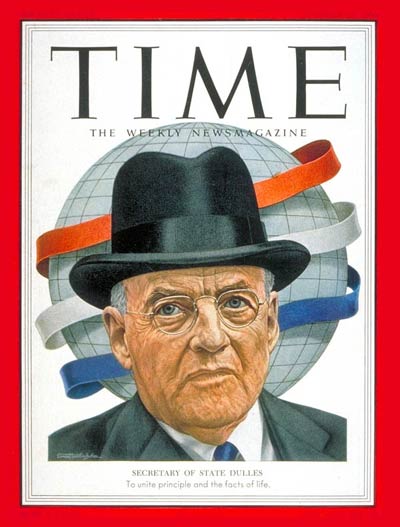
No real sense here that blaming the victim is a potential downside of such an interpretation. The perspective seemed so often in TRJ to be that Machen was a man on a mission and looking for a controversy. The bureaucrats and seminary administrators were innocent. (Yes, the lawyer who defended modernists in the 1920s, John Foster Dulles, became the Secretary of State who crafted the Eisenhower administration’s Cold War policies — the very administration that the founding editors of TRJ questioned.) The Presbyterian hierarchy simply responded — with a hammer, mind you — to Machen’s provocations. That could have been the case but no one argued that. They largely reduced Machen to a cantankerous figure who got what most of us would expect if we rock the boat the way he did.

And now in hindsight I wonder what these same men would think of Abraham Kuyper who was also part of a church that came out of the Netherlands’ state church. Didn’t Kuyper’s GKN (Reformed Churches of the Netherlands) make it a lot harder for conservatives who stayed in the NHK (Dutch Reformed Church)? And didn’t Kuyper’s Free University make life more complicated for orthodox theologians who remained at Leiden or Utrecht? (In other words, why wouldn’t it be possible to imagine Machen akin to Kuyper? Why doesn’t the Kuyper glow trickle down to Machen? Because Kuyper became Prime Minister and Machen merely president of the Independent Board for Presbyterian Foreign Missions?)

And what of John Calvin? Was he wrong to leave France? Did he leave Huguenots in the lurch? Was the Roman Catholic Church worse off without Calvin’s ministry and theological reflection? Or does the mind boggle at the questions you need to start asking other historical figures when you become so demanding of a figure of which you disapprove?

Fundamentalist Controversy Redux

John Allen explains how Roman Catholicism has come along side Protestantism. The Left and Right aren’t even on the same page of what constitutes truth:

… at this point most defenders of Pope Francis haven’t accused critics of being dissenters, nor have they suggested that people who uphold contrary positions on the substantive positions associated with the pontiff, such as opening Communion to divorced and civilly remarried Catholics, are thereby committing heresy.

The implication seems to be that fans of the pope are more generous, less vicious, and less inclined to question people’s bona fides as Catholics. There is, in other words, often a presumption of moral superiority in the observation that “we don’t talk that way.”

Simply as a descriptive matter, that proposition seems a bit disingenuous. Many in the pro-Francis camp don’t invoke concepts such as “heresy” and “dissent,” because frankly, it’s not the worst insult they can think of with which to slur an opponent.

Instead, they use terms that Francis himself also regards as abhorrent, such as “rigid,” “inflexible,” “legalistic,” “clerical,” and, of course, worst of all, “anti-Vatican II.”

In effect, what’s on display here is one of the defining differences between the Catholic left and the Catholic right over the last fifty years.

For the right, “heresy” and “dissent” are about the worst things imaginable, so when they want to say “x is terrible,” that’s the language that comes naturally. For the left, the equivalent horror is “rolling back the clock” on the Second Vatican Council, so when they want to call something or someone awful, that tends to be the verbal packaging in which the complaint comes wrapped.

Someone trying to remain objective about today’s debates would probably have a hard time concluding that either side has a claim on the moral high ground, since both are charging the other with virtually the vilest crime in their respective vocabularies.

At the same time, gatekeepers like John Allen don’t see when modernism is part of the warp and woof of church life:

Despite challenges intolerance brings, Camilleri stressed that religion, Christianity included, has an endless capacity for good, not only for individuals and communities, but for society as a whole.

The Church, he said, “does not pretend…to substitute for politics. Nor does the Church claim to offer technical solutions to the world’s problems since the responsibility of doing that belongs elsewhere.”

What religion does, then, is offer specific guidelines to both the community of believers, and to society as a whole.

Religion by its nature “is open to a larger reality and thus it can lead people and institutions toward a more universal vision” and a “horizon of fraternity” capable of enriching humanity, Camilleri said.

The Holy See, then, “is convinced that for both individuals and communities the dimension of belief can foster respect for fundamental freedoms and human rights, support democracy and rule of law and contribute to the quest for truth and justice.”

Dialogue and partnerships between religions and with religions, he said, “are an important means to promote confidence, trust, reconciliation, mutual respect and understanding as well as to foster peace.”

If religion did all that, I’m sure President Obama would have gotten on board. Wait. He did:

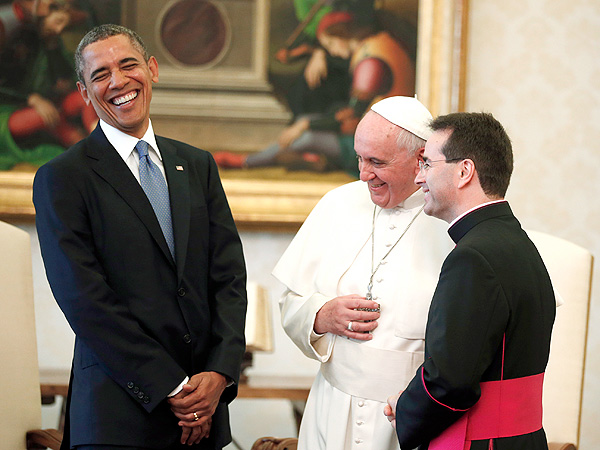
Holy Father, your visit not only allows us, in some small way, to reciprocate the extraordinary hospitality that you extended to me at the Vatican last year. It also reveals how much all Americans, from every background and every faith, value the role that the Catholic Church plays in strengthening America. (Applause.) From my time working in impoverished neighborhoods with the Catholic Church in Chicago, to my travels as President, I’ve seen firsthand how, every single day, Catholic communities, priests, nuns, laity are feeding the hungry, healing the sick, sheltering the homeless, educating our children, and fortifying the faith that sustains so many.

And what is true in America is true around the world. From the busy streets of Buenos Aires to the remote villages in Kenya, Catholic organizations serve the poor, minister to prisoners, build schools, build homes, operate orphanages and hospitals. And just as the Church has stood with those struggling to break the chains of poverty, the Church so often has given voice and hope to those seeking to break the chains of violence and oppression.

And yet, I believe the excitement around your visit, Holy Father, must be attributed not only to your role as Pope, but to your unique qualities as a person. (Applause.) In your humility, your embrace of simplicity, in the gentleness of your words and the generosity of your spirit, we see a living example of Jesus’ teachings, a leader whose moral authority comes not just through words but also through deeds. (Applause.)

You call on all of us, Catholic and non-Catholic alike, to put the “least of these” at the center of our concerns. You remind us that in the eyes of God our measure as individuals, and our measure as a society, is not determined by wealth or power or station or celebrity, but by how well we hew to Scripture’s call to lift up the poor and the marginalized — (applause) — to stand up for justice and against inequality, and to ensure that every human being is able to live in dignity –- because we are all made in the image of God. (Applause.)

You remind us that “the Lord’s most powerful message” is mercy. And that means welcoming the stranger with empathy and a truly open heart –- (applause) — from the refugee who flees war-torn lands to the immigrant who leaves home in search of a better life. (Applause.) It means showing compassion and love for the marginalized and the outcast, to those who have suffered, and those who have caused suffering and seek redemption. You remind us of the costs of war, particularly on the powerless and defenseless, and urge us toward the imperative of peace. (Applause.)

Holy Father, we are grateful for your invaluable support of our new beginning with the Cuban people — (applause) — which holds out the promise of better relations between our countries, greater cooperation across our hemisphere, and a better life for the Cuban people. We thank you for your passionate voice against the deadly conflicts that ravage the lives of so many men, women and children, and your call for nations to resist the sirens of war and resolve disputes through diplomacy.

You remind us that people are only truly free when they can practice their faith freely. (Applause.) Here in the United States, we cherish religious liberty. It was the basis for so much of what brought us together. And here in the United States, we cherish our religious liberty, but around the world, at this very moment, children of God, including Christians, are targeted and even killed because of their faith. Believers are prevented from gathering at their places of worship. The faithful are imprisoned, and churches are destroyed. So we stand with you in defense of religious freedom and interfaith dialogue, knowing that people everywhere must be able to live out their faith free from fear and free from intimidation. (Applause.)

And, Holy Father, you remind us that we have a sacred obligation to protect our planet, God’s magnificent gift to us. (Applause.) We support your call to all world leaders to support the communities most vulnerable to changing climate, and to come together to preserve our precious world for future generations. (Applause.)

Your Holiness, in your words and deeds, you set a profound moral example. And in these gentle but firm reminders of our obligations to God and to one another, you are shaking us out of complacency. All of us may, at times, experience discomfort when we contemplate the distance between how we lead our daily lives and what we know to be true, what we know to be right. But I believe such discomfort is a blessing, for it points to something better. You shake our conscience from slumber; you call on us to rejoice in Good News, and give us confidence that we can come together in humility and service, and pursue a world that is more loving, more just, and more free. Here at home and around the world, may our generation heed your call to “never remain on the sidelines of this march of living hope.”

For that great gift of hope, Holy Father, we thank you, and welcome you, with joy and gratitude, to the United States of America. (Applause.)