When the Election is not about the Nation but MmmmeeeeEEEEE

Why do Christians on both sides of the Tiber frame the current presidential contest in a secular republic no less in terms of what a believer’s vote says about his or her devotion or virtue? Here are a few samples.

First, how the character of a candidate may affect the character of the voter:

Christians can, morally, either support Trump over Hillary or not support either. Nearly all Christians who support Trump over Hillary do so without adopting strong-man messianism. Being clear that one is not endorsing specific moral flaws, and having one’s eyes wide open about the calculation, is not an internal threat to the Church. It’s not even a problem unique to this election cycle.

Whew. If I vote for Hillary I won’t stain my soul.

But morality won’t resolve my dilemma of for whom to vote (if I’m Roman Catholic):

. . . it’s plain to see that Catholic moral reasoning does not map on to the current American political grid. What then should Catholics do? What should be the final thought of the undecided American Catholic voter, behind the sacred veil of the voting booth?

Some Catholics react to their complicated political instincts by isolating one issue about which to make an electoral decision. At the national level, we find many “single-issue voters” on the topic of abortion. As a fundamental matter of life and death, one of the non-negotiables of Catholic moral teaching, it makes sense why many Catholics highlight abortion as a way to clear a path toward a conscience-protecting vote. But there are other non-negotiables in Faithful Citizenship too, such as torture and racism. And some Catholics also believe that recent uses of American military power, especially targeted killings through drone strikes or accidental bombings of allies, have crossed the line of non-negotiable moral teaching about the dignity of human life and the protection of noncombatants during war.

Uh oh.

For Protestants, voting winds up functioning as a part of self-disclosure:

A vote for Trump is a vote signifying that evangelicals are owned by the GOP. Part of the tragedy here is that evangelicals are still a big enough voting bloc that we could prevent either candidate from winning the election.

Let that sink in. If evangelicals just said, “No, I refuse to be coerced into supporting candidates who do not meet a very basic standard,” we could swing the election. You probably read that sentence and immediately dismissed it, thinking something like, “That is a fantasy. The reality is people are going to vote for one of the two major candidates.”

People won’t vote for a third party candidate because third party candidates don’t win because people won’t vote for a third party candidate—which is great for the two major parties because they don’t really have to even try to address the concerns of voters.

A vote for Trump also communicates to our neighbors that we believe he would be an acceptable leader for our country. Sure, you can qualify your Trump support by saying you have reservations but you believe he’s better than Clinton; however, by casting a ballot for him you are fundamentally claiming that it would be good for Trump to govern you and your neighbor.

How would anyone actually know how I vote? Isn’t the ballot supposed to be private? If so, then maybe ordinary Christians should not be so glib about how they are going to vote. Propriety, people!

But no. For some this election season is so wicked and Trump so depraved that the only response is revulsion (which it seems you should display so that people know you are not so morally compromised):

I believe that the proper response of the well-former mind and heart to the very idea of Donald Trump as President of the United States is, to put it bluntly, revulsion. . . .

What concerns me far more deeply is the ordinary, everyday Christian — the person who claims to be an evangelical Christian — who is not revolted by Trump, who lacks the requisite “wisdom of repugnance.” I think, for instance, of the people who have compared Trump to King David, presumably because both are guilty of sexual sin. But those who make this comparison have failed to recognize the difference between one who says “For I know my transgressions, / And my sin is ever before me” and one who says that he doesn’t “bring God into that picture” when he does something wrong and follows up by saying “I am good. I don’t do a lot of things that are bad.” And if you don’t understand that distinction — and equally if you understand it but for political reasons pretend not to — there is very little about the Christian message that you truly grasp.

By the way, I’m not talking about Hillary Clinton here because there is so little evangelical support for Hillary Clinton. She also offers much for us to be appalled by.

And I’m not even making the argument that an evangelical Christian should never in any circumstances vote for Trump. (Not today, anyway.) I am simply saying this: the fact that so many American Christians feel no revulsion at the thought of electing Donald Trump — this man so palpably “unsound, uninformed, unhinged and unfit” — as the leader of this or for that matter any other nation, but rather express great enthusiasm at the prospect, indicates not just a lack of knowledge but also, and more important, a lack of moral training. The immediate responses are missing or wrong.

Voting as fruit of the Spirit. Politics as sanctification.

It seems to this 2ker that investing voting with such moral and spiritual significance is to overestimate (way way so) the United States or a Christian’s place in the nation. Everyone has ideas about American government, what would be good for the nation, which candidate may offer a corrective to certain trends, which figure symbolizes a part of the nation’s worthwhile qualities. Of course, Americans could be more informed about policies and how government works, though if members of Congress can’t parse the Affordable Care Act which of us can stand in that pretty good day of national or state debate? Chances are that after this election, even if Congress impeaches the next president (which could happen to either major candidate), the republic will go on and the forces of consolidation and centralization will also remain thanks to the United States’ standing as a global hegemon.

Life will go on.

Sanctification for the saints will continue.

Christians will more or less throw themselves into policy, activism, party politics.

CNN and Fox will sensationalize.

Large sums of money — almost as much as professional athletes make — will go to politicians in hopes of access.

It’s all bigger than mmmmeeeeeeEEEE.

So it’s time to switch from the summer cocktail of choice — the gin and tonic — to the one for cooler temperatures — the whiskey sour. Somewhere in the world it’s 5:00.

I Just Wanna End Small Group Prayer

This should put a stop to it — just have believers think about what they say before they pray:

1. Avoid vain repetition. The one leading in prayer should be careful not to say, “O Father,” “Holy Father” or “Lord” over and over and over again.

2. Avoid hesitation and stumbling. The one leading in prayer should spend time on the prayer prior to the service so that he does not come across unprepared.

3. Avoid ungrammatical expressions. For example, the one leading in prayer should avoid such phrases as “Grant to give us…” “Grant to impart to us…” Grant and give are verbs expressing the same thing. This is a redundant and inaccurate use of language.

4. Avoid disorder. We need regularity and order in our prayer. The ACTS acronym is helpful: Include prayers of Adoration, Confession, Thanksgiving and Supplication (i.e. Petition and Intercession). By following an order, the one leading in prayer can help those he is leading pray along unhindered.

5. Avoid praying in minute detail for certain things. Balance out prayers in general. Especially for a Lord’s Day morning service. It is good to pray according to the same general nature for all the things for which the one leading prays. If there is a man or woman who has a terminal sickness, it is sufficient to plead with the Lord to heal that individual. There is no need to go into all the specifics of that with what he or she is dealing.

This is based on Samuel Miller’s thoughts on prayer which goes on for another 13 items. Not quite Rick Warren like, so not enough for forty days of driving your way to a life of purpose. But if Christians ever had to consider that praying in public does not come naturally to some believers, this post might get them started. And it really would throw a wrench into the praying patters of the seemingly intimate small group.

When the Gospel (Coalition) Needs Conservatism

At a time when out-of-wedlock births are skyrocketing (forty percent in 2013) and straining urban life in major ways, Bethany Jenkins, who writes with the blessing of the Gospel Coalition and who swims the the heady streams of New York City evangelicalism, considers being a single mom:

These days it almost seems passé to talk about needing marriage before having children. Today’s single woman doesn’t need marriage—or even a man.

Single mothers by choice (SMBC)—in contrast to by circumstance or chance—are single women who have chosen to have children through sperm donation (75 percent) or adoption (25 percent). The difference between these women and women like me who choose to remain childless, says Kate Bolick in Spinster: Making a Life of One’s Own, is desire:

Again and again, the [SMBC] I spoke with described how they’d wanted to be a mother for as long as they could remember and how the urge to get there became so overpowering, it felt less like a rational decision than a compulsion. This conviction—that no matter what, they would have a child—is, I’ve concluded, the most common denominator uniting all choice moms.

Such women are praised for their courage and confidence. One SMBC, who became a mother through sperm donation, says her friends called her “amazing” and “brave.” Yet she confesses she didn’t feel brave. “It’s not about being brave—it was about wanting to stop feeling like a childless mother, and take the next step before I ran out of time.”

My single friend, Christine, on the other hand, became a mother by adoption. Her journey was less a pursuit of self-actualization or self-fulfillment and more a response to a need—not a need she felt within herself, but a need she saw in someone else.

While working with high schoolers through the faith-based nonprofit Young Life, Christine met Ana, a 15-year-old expectant mother. When Ana’s water broke, her mother refused to take her to the hospital. That’s when Ana called Christine. Christine drove her to the hospital and stayed with her through the birth, holding her hand in the delivery room. Over the next few years, it became apparent that Ana and the birth father couldn’t care for their daughter, María.

It wasn’t easy, but Christine stepped up. At one point, she and María shared a 425-square-foot apartment and, since María’s biological familial ties weren’t completely severed, there were some relational challenges, too. But Christine says María is the greatest joy she has ever known—in spite of the obstacles. She also says she didn’t stumble into motherhood: “I longed to become a mom, so I diligently prayed for God to give me a child. When this opportunity arose, I had eyes to see it. If this hadn’t happened, I believe I’d have seen another opportunity. I was on the lookout for it.”

Hasn’t she heard about the importance of fathers in socializing children (especially boys)?

Meanwhile, Gracie Olmstead who writes regularly for American Conservative, puts motherhood in perspective, as in it’s not all about her but about the child:

Motherhood is not easy. It is often painful, frustrating, and difficult. It involves a host of unpleasantries. In our age, in which the self reigns supreme, motherhood runs counter to every society-endorsed impulse and mantra. Motherhood is all about sacrifice—from the moment our bodies begin to reconfigure themselves in order to grow a new human being.

Motherhood means sleepless nights, sore nipples, baby blues, weight gain, aching backs, temper tantrums, frightening doctor’s appointments, endless laundry, constant cleaning, incessant worry, near heart attacks, and lots and lots of money. Motherhood isn’t about self-filling. It’s about self-emptying.

That isn’t to say motherhood can’t be fun and joyous. It truly is and can be. But in order to embrace it, one must believe that all of the pain and hardship involved in motherhood is good, and that the child that results from all our work and hardship is inherently, intrinsically good as well. One must have a moral imagination, a “stable sentiment.” Mothers must have chests.

Olmstead adds that today’s decision to have a child could turn into tomorrow’s regret at giving birth:

As soon as we take away the idea of virtue—the idea that an act, despite the pains and sacrifice it might require, is objectively good and worth pursuing for its own sake—we permanently impede humankind’s ability to pursue selfless action. It does not matter if you tell a woman she should procreate “for the good of the species,” or tell her that she’s biologically predisposed to want children. If there is no overarching moral code related to the bearing and raising of children, then motherhood is subjugated to the wild and changeful whims of human emotion and desire. One second, you might want a baby; the next, you might spurn your child—and there is no law or code that can suggest you should do otherwise. “Instinct” becomes “impulse,” and so we waffle from whim to whim.

What accounts for the difference between an evangelical and conservative outlook on motherhood? Could it be that born-again Protestants really put the mmmmmeeeEEEE in all about mmmeeeeEEEE since personal experience and fulfillment is so important to being an evangelical? In contrast, conservatives (who may also be evangelicals) tend to think about the traditions and webs of social networks that go with marriage and rearing children. If the New York evangelical intelligentsia had given Bethany more instruction in conservatism than the gospel, maybe she’d see the problem with single parenthood.

Church Planters in the City Have it Rough

But is that because the city is so tough or because the folks who go into urban church planting actually believe the hype?

City people are fast paced. They adapt to change without giving too much thought to it and that’s why life becomes chaotic and out of control in the first place. When city people end up pausing to think about their overwhelming state, it’s usually too late. Ministry in the city requires a lot of reflection, prayer and, Scriptural meditation. It’s much easier to be in sync with the pace of the city than the pace of God’s heart for the city. . . .

Cities demand quality, often without compensation. Think of the talented 50 year old sax player in the subway. Get the point? Pastors in cities have to find a healthy way to deal with slow growth and even failure. Unless they do so, they will likely hit the bottle, the spoon, their wives and kids or, the x-rated sites. . . .

The city demands that you give a good reason for what you do and say. At the same time it’s always bargaining with you ideologically. It’s very hard not to compromise biblical doctrine in exchange for the approval of its inhabitants and even harder to find an honest, respectful, clear, and contextual way to communicate truth. . . .

Woody Allen would be embarrassed.

Would urban church planters have an easier time if they simply ministered to people rather than urban people? At a time when race, partisan politics, immigration, and sex balkanize people into their segregated affinity groups, do really need to add cities to the list of characteristics that isolate us from a common humanity (or nationality)? Whatever happened to neither Jew nor Greek, male nor female, slave nor free? But urban or suburban (don’t even think about rural) abideth.

Re-THINK!

Here‘s how comprehensive Christianity breeds Manichaeism (and paranoia) to boot:

In the meantime, we live in the midst of a cosmic struggle. As C. S. Lewis once said:

There is no neutral ground in the universe. Every square inch, every split second is claimed by God, and counterclaimed by Satan.

Thus every act of obedience—including political obedience—is a part of Christian mission, a bold declaration that we support God’s claim to the throne. And because the assault on that throne comes from every nook and cranny of creation, we must aim our redirective efforts at every nook and cranny as well.

Does Bruce Ashford really mean to implicate cats?

But consider where this notion that the assault on Christ’s reign comes from everywhere. Christians in the United States live with non-Christians. So how do comprehensive Christians live with Jews, Mormons, Roman Catholics, and Muslims? And wouldn’t such either-or language signal some kind of aggression to those who don’t trust Christ? In other words, doesn’t this use of the antithesis turn non-Christians into people “of Satan”? If Aryan science is bad, why not Christian culture?

That’s why those inspired by Abraham Kuyper need to take a page from Augustine:

This heavenly city, then, while it sojourns on earth, calls citizens out of all nations, and gathers together a society of pilgrims of all languages, not scrupling about diversities in the manners, laws, and institutions whereby earthly peace is secured and maintained, but recognizing that, however various these are, they all tend to one and the same end of earthly peace. It therefore is so far from rescinding and abolishing these diversities, that it even preserves and adopts them, so long only as no hindrance to the worship of the one supreme and true God is thus introduced. Even the heavenly city, therefore, while in its state of pilgrimage, avails itself of the peace of earth, and, so far as it can without injuring faith and godliness, desires and maintains a common agreement among men regarding the acquisition of the necessaries of life, and makes this earthly peace bear upon the peace of heaven…

Roman Catholic 2k

David Schindler and Peter Leithart would likely disapprove:

If a Catholic makes a speech or writes an article attacking the principles and the methods of say, the Lutherans, that act would not necessarily stir up religious strife dangerous to the public peace. But if a Catholic seeks to penalize a Lutheran because of his Lutheranism through political or legal discriminations; still more, if he seeks the support of others in an organized manner to accomplish those ends, then he is attacking religious liberty in the social, or political sphere, which is the common meeting place of all Americans as citizens. . . .

I know that the dictionary definitions of bigotry are to the general effect that it is “an obstinate and intolerant attachment to a cause or creed.” But unless obstinate and intolerant attachment to a cause or creed becomes active opposition to some other cause or creed it is non-existent so far as the general peace of society is concerned. I may be obstinate and intolerant in my private and personal attachment to the Catholic Church (of which I am a member), yet if I invariably treat with my agnostic, and Protestant, and Jewish, and atheist neighbors, in all that concerns our common relations in society — in business, politic, and all cooperative matters — without reference or relation to their beliefs or behavior in religious matters, while I may be potentially a bigot, certainly I do not, so to speak, commit bigotry. If all of us so behave, there can be no bigotry in action. But notoriously, all of us do not so behave, although such behavior is the practical ideal of the nation of the United States of America. (Michael Williams, The Shadow of the Pope, 1932)

So when Roman Catholics or Neo-Calvinists call for “all of me” comprehensive Christianity, do they destroy any possibility of a common realm shared by all sorts of believers and non-believers? And do these “all of me” Christians believe that if I am getting along with people who do have the same “all” in “all of their identity” I am guilty of bad faith?

Cop in the Hood Smoh-Kin

Peter Moskos was on a roll yesterday.

First, he brought up the problem that police fired by one city sometimes acquire jobs in another city. The Department of Justice used to have a database to track cops who lost their jobs, but that’s too expensive:

The Justice Department, which gave the association about $200,000 to start the database in 2009, no longer funds it. The department declined to explain why it had dropped its support, but a spokesman said the goal was “ensuring that our nation’s law enforcement agencies have the necessary resources to identify the best qualified candidates to protect and serve communities.”

If Washington can put a transgender in a bathroom dot dot dot

Second, Moskos linked to a story about the growing rates of heroine additionaddiction and overdoses. He added the insight that the criminal justice system will not fix this (nor should it try):

There’s still the basic and false belief among too many people that somehow, somewhere, there are “programs” to help people. Or that the criminal justice system is a system with so single goal in mind. Like police arrest you, you do time, and you come out better for it. It’s not true. And it never has been true. Sure, sometimes there’s a program here or a grant-funded thing there, but basically, no. There’s nothing. It doesn’t matter what the problem is — crime, drugs, mental illness, poverty (or all of the above) — when somebody calls 911, police will show up. But then what? A lot of people need help. But it’s not the kind of help police officers can give. Especially when police departments themselves need help.

Last, he recognized the growing interest in American hillbillies and pondered why murder rates among poor whites in Columbiana County, Ohio don’t reach the level of urban blacks in places like Baltimore. It’s not the economy, stupid, but the culture (and we’re not talking Shakespeare or Beethoven):

Baltimore City has more unemployment (7.4 percent vs. 5.3 percent). Yeah, sure. And there’s more poverty and extreme poverty in Baltimore. I’m not saying that doesn’t matter. But deep down, no. Poverty is a red herring. Culture matters. Columbiana County’s unemployment could be 20 percent and the murder rate would still be lower that Baltimore City.

There’s something else going on. The nexus of violence is not poverty and racism but public drug dealing and drug prohibition. I suspect addicts in Columbiana County buy their heroin from friends and family and coworkers. Not from Yo-Boys on the corner. Push drug dealers inside and violence plummets. But when police try and do that in Baltimore, the DOJ complains about systemic racism.

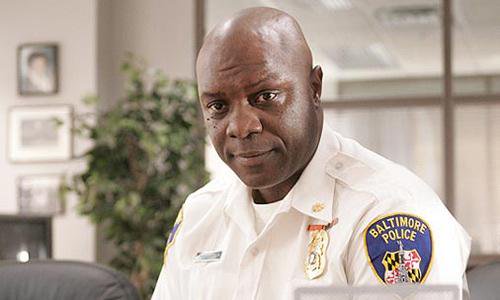
Turns out Bunny‘s problem wasn’t creating Hamsterdam but not moving drug dealers inside to the vacant houses.

Forgiving a Scapegoat?

Alan Noble raised the bar pretty high — as high as church membership mind you — when he explained why evangelicals should be never Trump:

In response to these profound violations of human decency, he scoffs, changes the subject, denies he even said it, or doubles down. As he has said, he does not ask God for forgiveness, because he doesn’t believe he needs it.

That insight into Trump’s perception of his own soul should tell evangelicals all they need to know about him as a leader. Any man who is so unaware of his own depravity that he cannot recognize his need for forgiveness is incapable of justly leading any country. There simply is no way around this fact for evangelicals.

Has anyone asked Hillary Clinton of her need for forgiveness? At least, Noble should give equal time to both candidates. He might also want to consider the constitutional qualifications for holding the office of POTUS. No religious tests. So does Noble understand how much he sounds like a Jerry Falwell (Sr.)?

At least Roman Catholics are less driven by piety than by policy. Here are the items to worry about in a Clinton presidency (via her appointments to SCOTUS):

Religious Liberty: In the highly-publicized case of Burwell v. Hobby Lobby, the Supreme Court ruled that closely held for-profit companies like Hobby Lobby could be exempt from laws that violate its religious beliefs, in this case Obamacare’s contraception mandate. This was an enormous win for religious liberty, but it was only decided by a slim 5-4 margin. With a liberal majority, you can expect the Court to rule against companies like Hobby Lobby or non-profits like Little Sisters of the Poor. Religious corporations and organizations around the country would be forced to chose between violating their consciences or paying penalties that would likely put them out of business. If liberals have their way, say goodbye to many religious retailers, charities, bookstores, hospitals, medical centers, and so on.

Transgender Bathrooms: Thirteen states are currently suing the Obama administration over its directive to public schools mandating that transgender students be able to use the bathrooms and locker rooms of their choice without having to prove their gender identity. Perhaps no issue more directly impacts the lives of our children than this. A liberal Supreme Court will undoubtedly uphold the Obama administration’s rule and force states to comply. The consequences will be catastrophic. Don’t be so naive as to think boys won’t abuse these policies and force their way into female bathrooms and locker rooms. Parents and teachers won’t be able to stop them. And aside from sexual misconduct and assault, this policy could mean the end of men’s and women’s competitive athletics as we know it.

Second Amendment: Without a doubt, the Second Amendment would become a primary target of a liberal Supreme Court. In recent years, two landmark decisions protecting an individual’s right to own and bear arms – Heller v. District of Columbia and McDonald v. City of Chicago – were each decided by just one vote. (Are you noticing the 5-4 trend yet?) Given the opportunity, a liberal Court wouldn’t hesitate to overturn those decisions. We got a glimpse of this in June, when the notoriously liberal Ninth Circuit Court of Appeals ruled that the Second Amendment does not permit the public to carry concealed firearms. A liberal Supreme Court would certainly uphold this ruling and continue to hack away at the rest of the Second Amendment.

Abortion: It was an activist, liberal Supreme Court in 1973 that decided Roe v. Wade and legalized abortion. A liberal Supreme Court in 2017 will only reinforce and protect that decision. It will likely strike down majority-supported, common sense abortion laws that have been passed in the states, like late term and partial birth abortion restrictions and pain-capable legislation. Just this June, the Supreme Court invalidated the Texas law requiring basic health standards for abortion facilities, a law passed to prevent another Kermit Gosnell house of horrors from occurring.

But the best perspective on Trump and Clinton may come from those without a faith-based dog in the hunt:

But Trump is a monster! Yes, but given the right circumstance, so are you. His ugliness is simply more apparent than that of other managers of the state’s sacred violence. Let’s be frank here: though his speech is scarily vulgar, the violence he promises is already occurring.

Think his call to deport illegally undocumented workers is fascist? The Obama administration, garbed as it is with the shimmering rhetoric of victimhood, has already deported over 2,500,000 human beings—23 percent more than Bush.

How about his pledge to torture suspected terrorists? Clinton-Bush-Obama beat him to it. They just don’t talk about it like he does. And let’s not limit it to foreigners; Obama didn’t bat an eye as elderly tax protester Irwin Schiff died of cancer chained to a prison bed far away from his family for breaking the sacred taboo against being too stingy in sharing his resources with the collective.

How about the time Trump promised to target terrorists’ families? Obama, the great defender of Islam, already trumped that when he murdered people like U.S. citizen Anwar al-Awlaki’s 16-year-old son Abdulrahman, who hadn’t seen his father for two years. This teen and his friends were blown apart by the Nobel prize winner while having a campfire dinner, apparently for the sinful dreams of his father.

Actually, a faith-based perspective makes sense of Never Trump. He’s our Scapegoat:

In today’s Christ-haunted West, we no longer have complete unanimity in our identification of common enemies, but we still seek it in the sub-factions we continually form. Yet Donald Trump’s faction is not going to prevail in any lasting way: his sacred dogma is built on “Winners.” His brand is a throwback to Nietzsche, who was himself a kind of throwback to a still older “golden age,” a time when pagan religion celebrated history’s winners, who were deemed right because of their might.

Trump even viscerally looks the part of the old scapegoat kings who would be ceremonially paraded before being sacrificed: he is often mocked for having small hands and goofy orange hair; he eats profane food like McDonald’s; he loves gaudy decoration in an age of “shabby chic”; he calls himself a winner in a culture where people must offer faux humility to gain status. Trump, who has repeatedly said that were he not her father he would be dating his daughter, is even accused of breaking the age-old taboo against incestual lust.

In the ancient cultic world of our past pagan order, hierarchies of kings, priests, and elites often killed or excluded the odd, weak, infirm, disabled, ethnic minority, or child based on the cultural fact that they were intrinsically inferior and thus deserving of a worse lot in life. But since the crucifixion meme began dominating the West, our modern cultures are increasingly self-critical and haunted by victims. Jesus robbed us of our blindness to the unjust order of “might makes right,” but he didn’t create an alternative ideology to deny us choice. We still have to choose, to a person, to model forgiveness and nonviolence as we seek to heal the victims most vulnerable to exploitation. But we’re stubborn in doing this work, and so we try to create cathartic peace and order through scapegoating—this time in the name of victims.

Labor Day Is a Holiday that Isn’t Holy

Tim Challies shows the classic confusion of redemption and providence by calling everything grace:

It is God’s grace that you can be industrious instead of idle. Flavel says, “Sin brought in sweat, but now not to sweat increases sin. He that lives idly cannot live honestly.” The Bible’s warnings about laziness and idleness are many and stern. So when God puts you into a vocation that is legal and moral, he has done you a great benefit. He has given you the blessing of allowing you to earn your own living. Your hard work allows you to avoid the temptations of idleness and to care for your own needs rather than having to rely upon others. Further, through God’s provision to you, you have enough to provide for those who cannot provide for themselves. It is, after all, more blessed to give than to receive.

But what if I am not as industrious as H. L. Mencken or Woody Allen who seemingly have not lived in a state of grace?

It is God’s grace that you have a job that is lawful before God and men and especially suited to you. There are many people who are employed in jobs that are sinful or even illegal. “They do not only sin in their employments, but their very employments are sinful.” To have a job that dishonors neither God nor men is no small mercy. To have a job suited to your passions and skills is a double mercy. Then, if your job allows you to provide for yourself and others without working you to the bone, without consuming all of your waking hours, you have more reasons still to thank God for what he has given you.

My skills as a historian, such as they are, did not come through the means of grace or conversion. I studied and learned from lots of non-redeemed historians.

It is God’s grace that he has directed you into the kind of job that neither you nor your parents may ever have expected. You may well be involved in a job that your parents did not plan for you to do, and perhaps one that even you did not plan to do. Just like a compass needle turns this way and that before settling on true north, so “a child is designed for this, then for that, but at last settles in that way of employment to which Providence designed him.” Many of us can attest that “Not what we or our parents, but what God designed shall take place.” This is certainly the case with me and I owe God great thanks and praise for his kindness and his wisdom in giving me a passion for writing and then allowing me to do it.

I say it’s providence but it’s also the accident of growing up at a time when college education became wildly available and when graduate schools were opening their doors wide. That kind of economic development is not grace. It is providence.

It is God’s grace that he secures what you have earned. God’s favor toward you is what has allowed you to earn what you have. That same favor is what has allowed you to keep what you have earned.

Let’s not forget civil magistrates and police many of whom are not living in a state of grace. Their non-sanctified labors maintain my security and property.

It is God’s grace that your vocation is sufficient for you. Some people have work, but not enough strength to complete it. Some have strength, but no work to commit it to. Some have both strength and work but even then not sufficient to provide for themselves or others. If God blesses your labors to give you enough or even more than enough to meet your needs, you ought to give him praise and thanks.

If I am content with my vocation — some days — that is partly a function of sanctification. But I know lots of non-believers who seem to have as much job satisfaction as I do.

Tim either needs to get out more or needs to read more on providence (preferably without Petra blaring in the background).

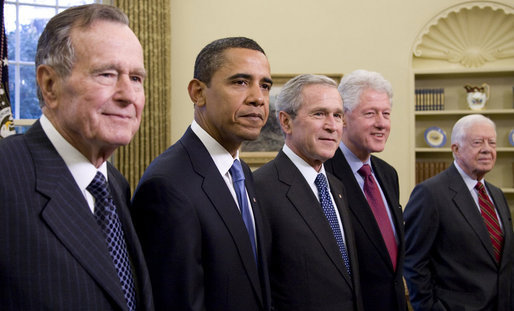
I’ll See Your 2 Popes and Raise You 5 Presidents

That would be, after the next inauguration, Jimmy Carter, George H.W. Bush, Bill Clinton, George W. Bush, and Barack Obama all improving the world during the reign of Hilary or Donald. I wonder if Michael Sean Winters had President Obama in mind when he wrote:

All politicians should write their memoirs. After that, they should retire from the public stage beyond the occasional speech and whatever work the management of a presidential library entails. It is unhealthy for a democracy if new slots on the stage are not opened with regularity. Stroking the egos of former presidents is redundant. And, creating these personalized, secular and necessarily politicized charities will, beyond doubt, harm the brand of charity over time.

When professional athletes retire, they have a long life ahead of them. But they have precedents. Color commentators. Coaches. Automobile dealerships. Not so with presidents. Where do you go after being the most powerful man in the free world? Even presiding over Harvard seems like slumming.

Winters thinks the Clintons’ problem is moral earnestness:

The real problem here is not so much the foundation itself as the tone deafness of the Clintons to the suspicions of their motives. I have noted before that there is something creepy about the ethics of the Clintons, something commonly found among the do-gooders of the world. It goes like this: I am a good person, and X is not a good thing to do, yet I did it, therefore X must not be such a bad thing after all. It is true that they no doubt mix up their prideful motives with their altruistic ones. Find me the politician who doesn’t? But they take it to a level that is noxious.

I think it has more to do with their former lack of wealth. Hilary had to find a law job after Bill lost the Arkansas governor in 1980. They were supposedly in serious debt. How do you rub shoulders with the rich and famous (and Yale Law alums) if you aren’t rich? Well, you speculate in real estate, you take really really big speaking fees. Once out of the White House, you form a charity like the Gates. That shows you are philanthropic and rich. But it doesn’t play well with the hillbilly/hound dog in Bill, just as Huma’s break with Anthony Weiner doesn’t make Hilary look all that virtuous for standing by her man.