Since We’re Talking about Talking

The Pertinacious Papist cautions Roman Catholic apologists about how to talk to confessional Protestants (via Greg Krehbiel). An excerpt:

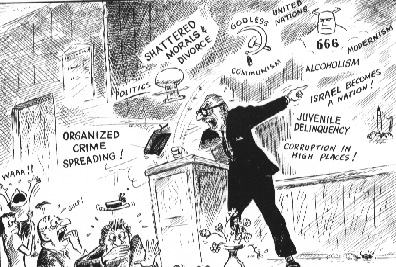
Get Over Jack Chick Already

Along with these accusations of hard hearts and thick skulls comes the staple of apologetic discussion: your apologists are meaner than ours. Yes, we all know that some anti-Catholics misrepresent Catholicism. Guess what? It goes the other way, too. And yes, we all know that some people can be very mean. Guess what? People are sinners. I even heard a rumor that one of the apostles wasn’t a choir boy.

Along those lines, former Protestants who have converted to Catholicism are not necessarily experts on any form of Protestantism, including the one they left, and they can misrepresent Protestant doctrine. Do you trust a former Catholic’s knowledge of Catholicism? Then don’t expect Protestants to trust a convert’s view of Protestantism.

When it comes to the “your apologist beats up old ladies” argument, the best thing to do is to get over it. Or, as a friend says in a slightly different context, “don’t feed the energy creature.”  I’s best to ignore rude noises at the dinner table, and I think we can treat the apologetic variety of those rude noises the same way. Fussing and whining about how mean the other guy is just makes you a crybaby.

23,000 Denominations

Some Catholics have the apologetic equivalent of Alzheimers. They criticize Protestantism because there are (so the story goes) 23,000 separate Protestant denominations, all teaching different things. And then a minute later the Catholic apologist will speak to a Methodist as if he is a Baptist, or a Lutheran as if he’s a Pentecostal. If they all teach different things, then for heaven’s sake don’t treat all Protestants the same.

It is very annoying to a confessional Presbyterian to be treated as if he’s guilty of the same errors as the non-denominational charismatic. Listen to what the other guy is really saying without putting his words through an apologetic filter that says “this guy is a Protestant, and I’ve read all about those guys.” You may find that you have more common ground than you suspected.

BAD HABIT: Learning about Protestant doctrine from Catholic sources.
BAD HABIT: Learning about generic Protestant doctrine and applying it to all Protestants.
REMEDY: Let your Protestant friend speak for himself. Listen to what he’s saying without imposing any doctrinal template on his words. . . .

No One Ever Heard of ____ Until the Reformation

It’s very common for a Catholic apologist to argue that Protestant doctrine is unhistorical, that nobody held to Protestant positions until the Reformers came along and invented them all out their fevered brains. (Remember, of course, that there are all kinds of Protestants, and on many issues the Reformers would be on the Catholic side arguing against many modern Protestant beliefs.)

The claim goes like this. “No one ever heard of sola scriptura, or sola fide, or doubted the canonicity of the deuterocanonical books, [or whatever,] until Martin Luther.”

Really now. Have you read all the Christian theologians of east and west from the time of Christ until 1517? If you’re particularly ambitious, you may have read bits and pieces from a very small sample of the church fathers. The Reformers were serious scholars, and they also read the church fathers. They did not believe their doctrines to be novelties, and only an expert on the history of doctrine is qualified to say that they were. And there are experts on both sides of that question.

Pointing out the contrast between the faith of the early church and the faith of your modern Protestant friend is a very effective apologetic tool. It’s very easy to show how Catholic doctrine developed from the faith of the early church, and it’s very hard to show any continuity between the early church and the faith of Bethel Bible Church down the road. So don’t spoil a good argument with claims you can’t prove or defend.

BAD HABIT: Asserting a universal negative.
BAD HABIT: Repeating extravagant claims you read in apologetic literature that the apologist himself could not possibly have known.
REMEDY: Stick to what you really know.

What’s that Verse Scott Hahn Uses?

Every once in a while I meet someone on the train, or in a store, and I get a sense that person is an Evangelical Christian. I spent a lot of years among Evangelicals, and I got to know their mannerisms. Sometimes it’s a certain tone of voice, or a choice of words. When someone’s been baptized into Evangelicalism, it starts to wear off on him. It makes a difference.

Scripture is the same way. When you start talking to someone about the faith, it’s very obvious who has and who has not devoted himself to Bible reading. It comes out.

Again and again I’ve run across well meaning Catholic apologists who seem to know Scott Hahn better than they know their Bibles. Believe me, it shows, and every decently trained Protestant is going to spot it and recognize that apologist for what he is. The Protestant will know that the Catholic is just proof-texting — that he hasn’t internalized the text. It’s just something he cites to prove his point, and when he does read the Bible, it’s only to find ammunition for the next battle. The Protestant will assume that the Catholic apologist lacks a personal relationship with Christ, and he’ll have all the more reason to mistrust Catholic arguments.

If you’re that apologist, it’s time to stop, retire, apologize to your opponents, wish them well, and spend some time (a few years, perhaps) getting to know God through His word. Donate all your apologetics books to your priest and spend the next few years reading nothing but the Bible and the catechism. Your goal isn’t to find 25 reasons why Protestants are wrong about Baptism. Your goal is to listen to what God says to you about your soul.

When apologetics is a distant memory, if you still feel the call to witness to other Christians about the Catholic faith, praise the Lord. You’ll be better prepared.

BAD HABIT: Using the Bible like a tool to win arguments with other Christians.
REMEDY: Quit apologetics, major in Bible study and work on your personal relationship with Jesus.

What Good is an Infallible Bible?

“What good is an infallible Bible without an infallible church to interpret it?” I’ve heard that too many times to count. What good is an infallible Bible? That any Christian can seriously ask the question defies belief. We want to know what God is like. We want to know how He regards us, and what we have to do to please Him, and here we have, not just a document, and not just a pretty good document, but the very words of God.

What good is the Bible? That kind of language makes Protestants roll their eyes. “Those Catholics really don’t get it, do they?” Any serious Evangelical knows scores of people whose lives have been miraculously transformed by reading the Bible. Besides that, the Evangelical himself has personally experienced God speaking to him in the words of Scripture.

When a Catholic says, “What good is an infallible Bible?” he has given up any claim to credibility with that Evangelical. It would be like asking a man who was just rescued from the desert, “What good is water without a crystal glass to drink it in?”

BAD HABIT: Trying to magnify the church and Catholic doctrine by disparaging the Bible.
REMEDY: Always speak of the Bible reverently. Read Psalm 19 and 119 and learn to regard the Bible the way king David did. Never, ever even consider saying “What good is the Bible?” You’d be better off to cut out your tongue and chop off your fingers.

Now, some will complain that I’ve missed the point of the question. The Catholic doesn’t mean to disparage the usefulness of the Bible, but the usefulness of the Bible as the sole guide for the church. I’ll get to that, but I felt it necessary to point out the horrible blunder that is made by making the point by criticizing the Bible.

The Catholic apologist looks around at the mess in the Protestant world and wonders why Baptists interpret the Bible one way while Presbyterians, Lutherans, Methodists and the Assembly of God all interpret it differently. He concludes, correctly, that the Bible alone is not a sufficient guide to regulate faith and life.

It is clear that something else is necessary, and that something else is an authoritative church.

But the Catholic apologist typically makes two errors while making this argument. The first is to imply that authority requires infallibility, which is clearly not true since parents and governments have authority but are not infallible. The second error is to claim that infallible Scripture requires, in the very nature of the case, an infallible interpreter: that it does no good to have infallible Scripture unless someone can tell us infallibly what it says.

The obvious reply to the question “What good is an infallible Bible without an infallible church?” is “What good is an infallible church without an infallible church interpreter?”

Just as the Catholic criticizes the variety of opinion among those who confess the authority of an infallible Bible, so the Protestant can criticize the variety of opinion among those who confess the authority of an infallible church. Traditionalists come to mind.

The problem is that there has to be a break in the chain somewhere. God is infallible, we are not. If we diagram the progression from God’s infallible self-revelation to our fallible perception of that revelation — for simplicity’s sake let’s just say the steps are A then B then C then D — the infallible part has to get lost somewhere. It starts off infallible in God’s mind and ends up a muddled mess in mine. It really doesn’t matter where you put the transition; the logical problem is the same. We can ask, “What good is an infallible A without an infallible B?” just as well as we can ask “What good is an infallible C without an infallible D?” It’s simply the wrong question.

The Protestant confesses that Scripture is infallible, but the church that tells us which books belong in Scripture is not. The Catholic confesses that the Magisterium is infallible, but the ministers who teach us what the Magisterium says are not. Both have to move from an infallible something to a fallible something, so the Catholic apologist has to guard against unleashing an attack dog that bites his own leg.

BAD HABIT: Tossing around infallibility as if it solves everything.
REMEDY: Focus on the need for an authoritative church. Once that is established, then work on infallibility.

Roman Catholics and Calvinists Together

It may not be ecumenical, but Michael Sean Winters understands what some of us have been sayin‘:

What is it about bathrooms? Throughout the Jim Crow South, there were separate restrooms for blacks and whites. When I bring my dad, my uncle and my niece to Puerto Rico every winter, my niece claims the one bedroom with the private bathroom and the guys share the other one. Three hundred years ago, it was a mark of honor to be able to accompany the monarch as he took his toilette. Now, privacy seems most significant, and therefore the most easily endangered, when we discuss bathrooms.

Still, even I have been taken aback by the current “bathroom wars,” fought over the issue of whether or not transgender persons should use the bathroom that corresponds to their gender at the time of their birth or to the gender by which they now identify themselves.

I am surprised, first, that this issue has seemingly become the next frontier in the civilizational struggle for equality. I understand that the issue is of great concern to the sliver of the population that is transgender. A family I know has a child that just changed his gender, and the process, and the result of the process, has certainly not been without anxiety and stress. The fact that the legal struggle seems focused on schools, when all kids are going through puberty, seems especially designed to throw gasoline on the fire. My sense is that this issue has less to do with the people it ostensibly concerns and more with those who are professional culture warriors on both the left and the right.

It baffles me that the Obama White House has latched on to this issue as a key part of its legacy. The fact that his administration has done so does not evidence the breadth of concern for other human beings and their travails. No, it evidences the degree to which some on the left, especially those with power, glom on to whatever issue seems trendy and cool at the moment. As Thomas Frank points out in his new book Listen Liberals, the “creative classes” that dominate the liberal establishment are far more animated by the need to get someone an abortion than they are to get people a job. Furthermore, how is this a federal issue?

It also baffles me that conservative critics of any accommodations being made for transgender people use such false and inflammatory language to describe the situation, warning darkly that the Obama Administration rules would allow men to prey on your daughters in the bathroom. (What is to prevent predators from doing that now?) A transgender person who now identifies as female and desires to use the women’s bathroom is probably going to cause less of a stir in the ladies’ room than in the men’s room. Think of Caitlyn Jenner. The way she looks now, I can’t imagine feeling comfortable if she walked into the men’s room.

Is Neutrality Anti-Religious?

The insightful Bruce Froehnen offers a standard brief against neutrality:

The lie of a neutral public square, in which we can debate important issues on the basis of “public reason,” is at its heart an anti-religious lie. It rests on the notion that we can set aside our faith and discuss important issues on the basis of reason alone. But faith and reason are not distinct categories of thought and action. Faith and reason are intimately bound up with one another and with a more generalized approach to the world—the imagination. Historically, the vast majority of people have seen the world as intrinsically moral, that is as made up of structures and choices that have intrinsic moral importance. Ethics is central to life, on this view, and is bound up with our general approach to both daily and life-changing issues such as whom to marry and what to demand of government, community, local association, family, neighbor, and self. This conception of life is intrinsically religious, for it rests on recognition of a natural order to our being that makes sense, has moral importance, and calls us to virtue, despite our own failings and limitations. It is a vision that has been under attack for more than two centuries, however, as a seemingly secular vision rooted in human emotions and impulses has sought dominance. This latter view, often termed the “idyllic” imagination and ascribed to Rousseau, sees the intrinsic goals of life as bound up with self-expression and self-actualization. It blames the injustices of life on social structures deemed oppressive or unjust and sees duty as something to be imposed on other people and especially on institutions.

But where would Froehnen put Calvinists who have a distinctly different estimate of humans’ moral potential? Is it possible for Protestants who affirm the following to have a place in Froehnen’s dressed public square:

Q. 25. Wherein consisteth the sinfulness of that estate whereinto man fell?
A. The sinfulness of that estate whereinto man fell, consisteth in the guilt of Adam’s first sin, the want of that righteousness wherein he was created, and the corruption of his nature, whereby he is utterly indisposed, disabled, and made opposite unto all that is spiritually good, and wholly inclined to all evil, and that continually; which is commonly called original sin, and from which do proceed all actual transgressions.

Q. 26. How is original sin conveyed from our first parents unto their posterity?
A. Original sin is conveyed from our first parents unto their posterity by natural generation, so as all that proceed from them in that way are conceived and born in sin.

Q. 27. What misery did the fall bring upon mankind?
A. The fall brought upon mankind the loss of communion with God, his displeasure and curse; so as we are by nature children of wrath, bond slaves to Satan, and justly liable to all punishments in this world, and that which is to come.

Such an understanding of human nature post-fall certainly qualifies Froehnen’s sense that ethics are “central to life” or that we all share an understanding of existence that “calls us to virtue.” If neutrality is deceptive, so too is an ethical public square if it leads people to think they can be good “naturally,” apart from grace. And if Froehnen wants to claim that goodness only proceeds from grace, then what does he do in the public square he envisions with people who don’t have grace? Do they need to leave? Or does he expand his understanding of grace — as so many western Christians have done while holding the keys of the establishment — to include everyone as a recipient in some sense of grace? (Say hello to Pope Francis praying with Hindus and Buddhists.)

So maybe a “neutral” public square is not so bad after all. It doesn’t mean having to cut and paste Christian orthodoxy in order to include non-Christians in a common ethical endeavor. Let the civil realm be the civil realm, and the church the church.

Can Sexism Be Far Behind?

In the run-up to the PCA’s debates about repenting corporately for racism, I wonder if the opponents of racism have left room for excluding women from church office. Consider the following definition of racism (with assertions of gender hierarchicalism for the r-word):

Racism Excluding women from special office is the denial of the image of God (Genesis 1:26, 27) and its implications to someone of another ethnicity sex. Racism Male-only elders and deacons in the church is a contradiction of the visible unity of all believers in Christ (Ephesians 2:11-22, Revelation 5:9, 7:9). Racism inside and outside the church Male privilege inside the church and the family is a contradiction of Jesus’ command to love our neighbor as ourselves (Mark 12:31, Luke 10:25-37, esp. 29, 37), and of God’s creation of all people in his image (Genesis 1:27, Acts 17:26). So theologically, racism preference for men in church office entails a denial of the biblical doctrines of creation, man, the communion of saints and is disobedience to the moral law. We will not mince words. Racism Male dominance in church office and marriage is not only sin, serious sin, it is heresy.

To be clear, racism is arguably different from excluding women from church office. Furthermore, the consequences of racism have been far more consequential than barring women from special ecclesiastical office (though I know some feminists disagree). But the question is whether the PCA’s condemnation of racism leaves wiggle room for distinguishing racial equality from equality of the sexes. (Have we all forgotten the CRC‘s arguments for ordaining women?)

In fact, the power of egalitarianism is so strong you have to wonder if the PCA will have the wits in a decade to avoid repenting not merely for tolerating financial inequality among its members but even advocating it. After all, once you start down the road of equality, doesn’t history suggest your brake fluid runs dry? Consider the logic of social justice warfare among Roman Catholics:

We have an economy of exclusion, and a polity that refuses to challenge the ideology of the market that has generated the economy of exclusion. We do not start with the most basic human quality, work. We start with an alien and hateful ideology rooted in supposed “economic laws” that are, in fact, human creations, not natural ones, but which are so prevalent, no one dares to question them. This is why, if you go to a conference on Laudato Si’ and they do not speak about both human ecology and multinational corporations, they don’t get it.

Deadbeat Trapped Inside the Body of a Bill Payer

Explanations of corporate America’s support for LBGTQ(xyz) are almost as simplistic as laments about falling sky. Rod Dreher quotes this:

This social order of consumer-based options tends to forge a new conception of the human person as a sovereign individual who exercises control over his or her own life circumstances. Again, traditional social structures and arrangements are generally fixed in terms of key identity markers such as gender, sexual orientation, and religious affiliation. But globalized societies, because of the wide array of options, see this fixedness as restrictive. And so traditional morals and customs tend to give way to what we called lifestyle values. Lifestyle values operate according to a plurality of what sociologist Peter Berger defines as “life-worlds,” wherein each individual practices whatever belief system deemed most plausible by him or her. These belief systems include everything from religious identity to gender identity.

Thus, lifestyle values and identities are defined and determined by consumerist tendencies and norms. Commercial advertising is not merely central to economic growth, it is also of central influence to inventing the self through offering variant lifestyle features and choices. In the words of social theorist Anthony Giddens: “Market-governed freedom of individual choice becomes an enveloping framework of individual self-expression.”

I would therefore argue that the corporations promising to boycott states like North Carolina for their traditionalist politics are not so much for LGBT rights as they are against arbitrarily restricting lifestyle options, since such limitations are deemed inconsistent with a society comprised of consumer-based self-expression.

But what about people who work hard, buy stuff, and pay bills on time? Aren’t they better for the economy (global or local) than people who might find that after making a purchase they regard the credit card bill as merely a convention of arbitrarily chosen identities? If you ask me, corporations support gay rights and marriage for its p.r. value, which is to say, they don’t want to appear intolerant. Can’t say that analysis is all that profound either since the numbers show that heteros have more buying units than gays or those who transcend gender. This is nothing new. Remember the NFL penalizing Arizona (as host of the Super Bowl) for not making Martin Luther King Day a holiday.

But Rod buys it hook, line, and sinker:

Cavanaugh says that the free market is based on the definition of freedom as an absence of external constraints. The wider your choice, the freer the market. This is problematic from a Christian point of view, as well as from a virtue ethics point of view, because it is agnostic about the existence of good and evil. The free market, thus conceived, catechizes us into believing that there is no truth, only individual desire. But desires are unavoidably social, so the will to power in society belongs to those who maximize individual choice by tearing down any structure or belief system that denies the primacy of individual choice.

You mean my latest statement from Bank of American isn’t true? Woo hoo!

One Man’s Modernism is Another Woman’s Sacramentality

Apparently Tracey Rowland doesn’t read Geerhardus Vos or Eric Voegelin and so isn’t worried about “immanentizing the eschaton.” On her recent visit to Scotland she found that Rome’s sacraments are exactly what ails the land of Presbyterianism:

On a recent trip to Scotland Bishop Gilbert of Aberdeen asked me whether I was familiar with the Scottish writer George Mackay Brown. I had to confess that I had never heard of him. A few days later I was rummaging through second-hand book stores searching for everything and anything by Mackay Brown.

Bishop Gilbert had got me hooked by suggesting I read Mackay Brown’s essay “The Treading of Grapes,” which takes the form of three homilies on the Wedding Feast of Cana. One is delivered in 1788 by a classically Calvinist Presbyterian minister, down on every kind of human enjoyment from wine to party dresses. He uses the story of Cana to berate his flock about spending too much money on their wives’ wardrobes, and drinking too much at weddings. He compared their enjoyment of ale to piglets sucking on the teats of a sow.

The second homily is delivered in the 20th century by a modern liberal Protestant minister, who uses the homily to explain that Jesus didn’t really turn water into wine. There was no miracle. Jesus was simply a good organizer who saw to it behind the scenes that supplies were sufficient.

Finally, one is treated to a homily by a Catholic priest delivered in 1548. Rather than berating people as piglets, or denying the reality of miracles, the priest tells his congregation that at the wedding feast of the Lamb they will all be princes. Therefore, he says, I will call you Olaf the Fisherman and Jock the Crofter no longer, but I will call you by the name the Creator will call you on the last day—princes! Prince Olaf! Prince Jock!, et cetera.

The priest left out that his auditors may not be at the wedding feast but still waiting in purgatory.

Still, Rowland thinks the sacraments break down dualism and allow Christianity to flourish:

It can’t be all that difficult to compete with liberal Calvinism and garden-variety New Age paganism when one has the full treasury of a sacramental Catholicism—a faith for which there is “no separation,” no iron curtain standing between the sacred and the profane, no unbridgeable gulf between heaven and the Highlands and the valley of the River Clyde.

Apparently, Professor Rowland is unfamiliar with modernism and its dangers (even though Pius X should have registered a few dents in the Communio mind). According to William R. Hutchison who wrote THE book on Protestant modernism, modern Christians are all in favor of doing away with dualism of all kinds:

[Modernism] generally meant three things: first and most visibly, it mean the conscious, intended adaptation of religious ideas to modern culture. . . . for the Protestant theologians, preachers, and teachers who either championed or opposed the idea of cultural adaptation, two further and deeper notions were important. One was the idea that God is immanent in human cultural development and revealed through it. The other was a belief that human society is moving toward the realization (even though it may never attain the reality) of the Kingdom of God. (Modernist Impulse in American Protestantism, 2)

I don’t know about Professor Rowland, but maintaining some distinction between the sacred and secular, between the Mass and the Happy Meal, is fairly basic for preventing Christians from reverting to the pagan world where gods and spirits infested so many aspects of nature that chopping down a tree was no different from destroying the statue of a saint.

Jen Makes Hats

But who the hades is Jen Hatmaker?

I confess. I study religion in the United States and had never heard of this Hatmaker person until she made “mainstream” news by affirming the LBGT community.

So?

This got me thinking once again about the networks, ecclesial affiliations, and sources of information available to American Christians. I wonder, for instance, how many members of NAPARC churches have heard of or follow Jen Hatmaker. Conversely, how many of Hatmaker’s followers and readers have ever heard of Dick Gaffin? What does it say about a group that they don’t know about the other group? And how might a group change if it knew about figures from the other? Would Jen Hatmaker’s readers leave her if they read Dick Gaffin on union with Christ? And if Orthodox Presbyterians read Jen Hatmaker, would they sing more worship songs accompanied by guitars?

We often hear in this age of the internet how the old gatekeepers (magazines and newspapers) have vanished and readers are left with Google searches to figure out what’s important. And yet, the case of Jen Hatmaker suggests a world of gates with keepers that don’t regularly come onto my reader. Apparently, Jonathan Merritt thought Hatmaker was sufficient newsworthy and he’s at one of the old gatekeepers, The Atlantic. Plus the editors at Christianity Today also know about Merritt and Hatmaker to feature the story in their updates. For some reason, they didn’t feature Old Life’s series on Nelson Kloosterman.

In which case, mainstreams, creeks, and banks still seem to exist. Every once in a while we receive a reminder that we are several ditches away from the creek that runs into the river.

On the other hand, does Jen Hatmaker know about Glenn Loury? Would she be less popular if she did? Perhaps, the evangelical mainstream is several miles away from conversations that are arguably more central to life in the U.S. than dipping into the Bible for tips about “relationships, work, stress, sexuality, and forgiveness.”

Sure, forgiveness is weighty. Not sure it should be paired with stress.

If Contemporary Worship Won, What’s Up with “Thou”?

I sang “Be Thou My Vision” over the weekend and the accompaniment was folksy — no keyboard. The guitar player also stood up front at a microphone. I was surprised that no one has tried to update the language of the hymn, especially after hearing so many complaints about inaccessible King James English.

Here’s the text (sung to the tune, Slane, it has its moments):

Be Thou my vision, O Lord of my heart;
Naught be all else to me, save that Thou art.
Thou my best thought, by day or by night,
Waking or sleeping, Thy presence my light.

Be Thou my wisdom, and Thou my true word;
I ever with Thee and Thou with me, Lord;
Thou my great Father, I Thy true son;
Thou in me dwelling, and I with Thee one.

Be Thou my battle shield, sword for the fight;
Be Thou my dignity, Thou my delight;
Thou my soul’s shelter, Thou my high tower:
Raise Thou me heavenward, O power of my power.

Riches I heed not, nor man’s empty praise,
Thou mine inheritance, now and always:
Thou and Thou only, first in my heart,
High King of Heaven, my treasure Thou art.

High King of Heaven, my victory won,
May I reach Heaven’s joys, O bright Heaven’s sun!
Heart of my own heart, whatever befall,
Still be my vision, O ruler of all.

Not only are the “thee’s” and “thou’s” arresting in this age of contemporary English, but the third stanza did not seem to follow a coherent line of thought. We go from fighting, to dignity, to delight, and back to fighting and the need for a tower. And then it looks like we die in battle and go to heaven. But we must not because we still have two stanzas to go.

I wondered what a vernacularized rendition of the hymn might sound like, so I went to the Dialectizer for help. Here is “Be Thou My Vision” in Cockney:

Be Fou me vision, right, O Lord of me ‘eart;
Naught be all else ter me, Chas’n’Dave that Fou art.
Fou me Mae West ffought, by day or by night,
Wakin’ or sleepin’, Fy presence me light.

Be Fou me wisdom, right, and Fou me true word;
I ever wiv Thee and Fou wiv me, Lord;
Fou me great Favver, right, I Fy true son;
Fou in me dwellin’, right, and I wiv Thee one.

Be Fou me battle shield, sword for the fight;
Be Fou me dignity, Fou me delight;
Fou me soul’s shelter, Fou me ‘igh tower:
Raise Fou me ‘eavenward, O power of me power.

Riches I ‘eed not, nor man’s empty praise,
Fou mine inheritance, now and always:
Fou and Fou only, first in me ‘eart,
High Kin’ of ‘eaven, my treasure Fou art.

High Kin’ of ‘eaven, my victory won,
May I reach ‘eaven’s joys, O bright ‘eaven’s sun! Right!
Heart of me own ‘eart, wotever befall,
Still be me vision, O ruler of all.

Modesty Defeats Zeal

John Piper whose earnestness has been known to tighten jaws knocks it out of the park on cremation (via Challies):

The body is good:

First, biblical faith, unlike Greek religion, does not view the body as the prison of the soul. So the afterlife has never been viewed as the “immortality of the soul” finally liberated from its physical prison. Rather, Christianity has always viewed the body as essential to full humanity so that the life to come has primarily been seen as the resurrection of the body in glorious eternal life. Paul did not consider the intermediate bodiless state, between death and resurrection, as ideal (2 Corinthians 5:4).

Burning bodies is bad (anyone remember Germany?):

The use of fire to consume the human body on earth was seen as a sign of contempt. It was not a glorious treatment of the body but a contemptuous one. This is the meaning of Achan’s cremation. He had betrayed Israel and so was not only stoned with his family, but deprived of an ordinary burial by being burned.

Joshua said, “Why did you bring trouble on us? The Lord brings trouble on you today.” And all Israel stoned him with stones. They burned them with fire and stoned them with stones. (Joshua 7:25)

Funerals are expensive (so are weddings so we should encourage “cake & punch” receptions):

I am encouraging churches to cultivate a Christian counter-culture where people expect simple, less expensive funerals and burials, and where we all pitch in so that a Christian burial is not a financial hardship on anyone. And because of the biblical pointers and the additional reasons above, I am arguing that God-centered, gospel-rooted burial is preferable to cremation. Preferable. Not commanded, but rich with Christian truth that will become a clearer and clearer witness as our society becomes less and less Christian.

Without the zeal, Mr. Piper does okay.

If To Die is Gain, Is Climate Change Loss?

Here‘s an old-fashioned Christian way of viewing death:

For the faithful—and Mother Mary Angelica was surely that—the day we die is the greatest day of our life on this earth. And even if some final purifications await us, the beatific vision for which we long lies just ahead; the exile in this valley of tears is ended.

Is calling the day we die the greatest day of our life too strong a statement? I have seen some fellow Christians wince when I say this. But in this age of emphasis on worldly comforts, medicine, and the secular, this age in which we rarely speak of Heaven (or Hell), I wonder if we have lost some of our longing for Heaven and cling too strongly to the trinkets of this life.

So do those Christians who advocate care for the creation take proper note of the impermanence of this world compared to the “solid joys and lasting treasures” that await believers in glory (and we know which ones go straight there)?

Or do Christian environmentalists wind up turning creation care into a gospel endeavor to make up for what the Bible teaches about the death of saints?

The former National Association of Evangelicals (NAE) official stated that some on the Left believe it is “our job, our calling” to restore the goodness to creation and that “ours is the work of being good people”.

Recalling a visit with an environmentalist from Maine who claimed the trees sent him, Cizik replied, “For me, it is the salvific work of Christ” that drove special concern for the environment.

Cizik compared climate change skeptics to the biblical persecutor Saul, who in the book of Acts sees Jesus and is blinded.

“Human beings are in rebellion against God and suppress the truth – faith comes by the supernatural work of God’s spirit in regenerating a person – given that they are our friends then (many of whom do follow Jesus) and yet do not see any responsibility to address the care of creation or the coming catastrophe called climate disruption – what gives?” Cizik asked. “What is this blindness?”

I wonder if Mr. Cizik should be more careful throwing around “blindness.”