How Broad Can Confessional Presbyterians Be?

The subject of confessionalism in relation to the Gospel Coalition has again come up, this time with a charitable defense of the organization from Ligon Duncan. The article that elicited this response is not at issue here.  I have not read it nor is that as pertinent as what Duncan says about confessionalism:

None of us are a part of TGC because we don’t care about our ministerial vows or because we don’t really believe our Confession.

We are a part of TGC because TGC beautifully promotes certain important things in the wider Christian and evangelical world that are needed, vital, true, good, right, timely, healthful, and which are also perfectly consistent with our own confessional theological commitments, so we want to be a part and a help. We also think that we have a thing or two to learn from our non-Presbyterian friends in TGC that “sweetly comport” with our vows and our church’s doctrine and practice. And we love the friendship and fellowship we enjoy with like-minded brethren from and ministering in settings denominationally different from our own, but committed to the same big things.

Just as Charles Hodge of Princeton (not one shy of his confessional Presbyterian commitments), for similar reasons, was happy to participate in the Evangelical Alliance in the nineteenth century, so also I am happy to participate in TGC.

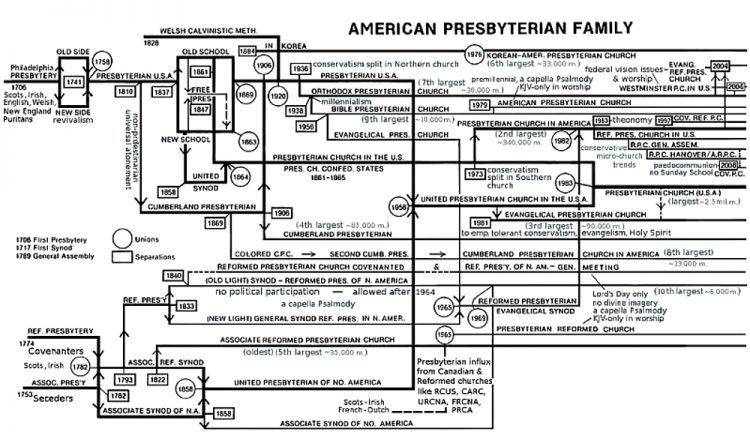
This is an important historical matter that deserves more attention. What was the relationship of Hodge’s Old School Presbyterianism to interdenominational endeavors like the Evangelical Alliance? And how did Hodge’s own opposition to the 1869 reunion of the Old and New School churches relate to endeavors like the Evangelical Alliance?

One way of answering that question is to notice that the sorts of cooperation in which mainline Protestants engaged after the Civil War, with the 1869 Presbyterian reunion paving the way, fueled ecumenical and social gospel endeavors that produced conservative opposition in the 1920s and 1930s. The Evangelical Alliance was the Moral Majority of its day, wanting immigrants to conform to Protestant norms, opposed to Romanism and communism (for starters), and it provided the vehicle for Protestants to unite to defend a Christian America. Those ecumenical impulses eventually produced the Federal Council of Churches in 1908 and the Plan for Organic Union in 1920, a proposal that would have united all mainline Protestants into one national church — the way Canadian Protestants at roughly the same time formed the United Church of Canada (1925).

What the period of interdenominational cooperation meant for Presbyterians was a 1903 revision of the Confession of Faith. That revision enabled the PCUSA to receive the Cumberland Presbyterians. Revision softened the Confession’s Calvinism to make room for a body that had left the church almost one hundred years earlier over objections to election and limited atonement. Presbyterians going along for the ecumenical ride included the president of Princeton Theological Seminary, J. Ross Stevenson, who presented the Plan for Organic Union to the 1920 General Assembly. J. Gresham Machen was a first-time commissioner to that Assembly and Princeton’s faculty’s opposition to that plan was start of a denomination wide controversy that forced the 1929 reorganization of Princeton Seminary (to make it tolerant of diversity) and the simultaneous founding of Westminster Seminary.

According to Lefferts Loetscher, who wrote a book with a title that frightened conservatives in the PCUSA and the PCUS, The Broadening Church (1954), the reunion of Old and New School in 1869 touched off developments that saw the PCUSA recover its historic breadth:

Once again in 1869, as in 1758, the Presbyterian Church was restoring unity not by resolving its differences, but by ignoring and absorbing them. Men who had been denounced as “heretics” in 1837 and who had professed no change of theological viewpoint in the interim were welcomed in 1869 as honored brethren. The result was, of course, that the theological base of the Church (especially of the former Old School branch of the Church) was broadened and the meaning of its subscription formula further relaxed. The gentlemen’s agreement of 1869 to tolerate divergent types of Calvinism meant that clear-cut definitions of Calvinism would not be enforceable in the reunited Church, and that it would be increasingly difficult to protect historic Calvinism against variations that might undermine its essential character. (8)

No one actually doubts whether the Old and New Schools were liberal. By almost every measure, both sides would come out as evangelical today (especially if you don’t apply the category of confessionalism). And yet, the breadth necessary for combining both sides also made room for a range of theological ideas that spawned liberalism.

In other words, breadth is not a good thing. Broadening churches are usually ones that become liberal.

So why is an organization that tolerates a diversity of “evangelical” convictions going to avoid that problems that usually surface when you recognize you need to be broader than your own communion is? The answer is not that the Gospel Coalition is going liberal. But an objection to the Gospel Coalition is that it does not have built in transparent mechanisms for identifying and disciplining liberalism.

And here are a couple ways that the Coalition’s breadth could collide with my own Presbyterian confessionalism. If I am a member of the Council and an officer in a confessional Presbyterian church, and my communion has a controversy over someone ordained who does not affirm the doctrine of limited atonement, will I receive support for my opposition to this erroneous officer from my friends and colleagues at TGC? Or what about the Federal Vision? If my church decides that Federal Vision is a dangerous set of teachings that need to be opposed, will my friends and colleagues at TGC support my church in its decision? Will people who write for Gospel Coalition even be clear about the covenant theology that is clearly taught in the Confession of Faith? Or will some of them think that my communion is too narrow in its understanding of Reformed Protestantism? Will they think that the proper response should be one to include a breadth of views in denominations because that is the norm for the Coalition? I could well imagine feeling some pressure to weigh matters before a presbytery or Assembly with my peers in the Coalition in mind? Will I disappoint them? Maybe that’s the wrong way of asking the question. What if they don’t care about the affairs of my communion the way I do? (Why should they care since they are not members or officers of my denomination?)

These are real dilemmas for anyone who has subscribed the Confession and Catechisms and been ordained in a Presbyterian communion while also belonging to an evangelical organization with standards different from the church. They are concerns that have been around for almost 160 years. The Gospel Coalition has not brought an end to church history.

How Smart are Presbyterians?

From James Burtchaell’s history of Christian colleges and universities, The Dying of the Light:

Originally Davidson tied its identity to the Presbyterian church and required that the church serve as the guarantor of the college’s fidelity. When that became outdated the college undertook to vouch for its own fidelity. With the 1972 bylaws it fairly well disengaged itself from any norm or authority for faithful discipleship — Calvinist fundamentals, church, Westminster, Scriptures, or Jesus. The president and twenty-two of the forty voting trustees had to be members of the PCUS. No one else at Davidson College, including the educators, had to be in communion with that church. The only entity binding them together was a statement of purpose, which both Clarence Darrow and H. L. Mencken could perhaps have found their way to embrace. At this very time the moderator of the General Assembly was lecturing the church on their need to learn to live with the new onset of pluralism within their fellowship. . . .

There seems to be a problem in the bloodstream of the Presbyterians that has affected their colleges. The church was, from the beginning, largely composed of an industrious bourgeoisie. They were already well educated, and their Calvinist consciousness of public polity had from the beginning made Presbyterians instinctively supportive of the American civil authorities (as distinct from the British authorities, who had awarded them a hedged citizenship). Over here the Presbyterians were culture-friendly, and from the beginning they marketed their colleges openly: not simply to attract students and income, but because they saw the nation as a divinely blessed commonwealth. In this mood their educators were wholly undisposed to see their colleges as intellectually set apart. For moral purposes they were prepared to make their campuses defensive havens against a threatening environment, but not for intellectual purposes. Marsden and Longfield see this:

In 1935 H. Richard Niebuhr had warned that “if the church has no other plan of salvation . . . than one of deliverance by force, education, idealism or planned economy, it really has no existence as a church and needs to resolve itself into a political party or a school.” By the latter half of the twentieth century most mainline Protestant church schools had resolved themselves into being simply schools. . . Twentieth-century mainline Presbyterians, assuming that they were part of the cultural establishment, have seldom seen American culture as a threat and so have trusted in education. (221, 234-35)

Two Kingdom Theology and Same Sex Attraction

Remember when two-kingdom theology was the easy and quick explanation for Reformed churches friendly to homosexuality? Steven Wedgeworth clarifies what everyone knew when anti-two kingdom folks were using Meredith Kline as the whipping boy for moral relativism. The folks at Memorial Presbyterian Church in St. Louis who sort of oversaw the production, “Transluminate: A Celebration of Transgender, Agender, Non-Binary, Genderqueer and Genderfluid Artists,” are not two-kingdom proponents:

To understand how the Transluminate event could happen within the PCA, readers should see it as an extreme but perhaps predictable ramification of a certain philosophy of ministry, common in our day. Evangelical and particularly “missional” churches routinely advocate for various kinds of parachurch ministry in the world of arts and culture. Some call for an aggressive or confrontational approach, while others say that mere “faithful presence” is a more effective strategy. This term, “faithful presence,” was originally coined by James D. Hunter in his book To Change the World, but has become a shorthand way, not unlike the term “common good,” to express the concept of Christians interacting with the secular public realm, not in overtly distinctive ways, but simply according to basic morals and friendly manners. This posture is frequently described as winsome or hospitable. It argues against direct criticism or evangelism, at least in any public way, in favor of building more long-term relationships. After these relationships of trust are sufficiently built, opportunities for evangelism may make themselves apparent. Some proponents of this philosophy even deny that specifically evangelistic activity, arguing that the relationship itself or the image and reputation such faithful presence creates will itself be a sufficient Christian testimony. Memorial Pres. certainly seems to promote this view of evangelism and outreach.

Jake Meador partly agrees:

Our outreach to the world cannot simply be a gesture of welcome, but must also include a call to repentance and to adopt the practices of Christian piety in grateful response to God’s offer of grace in the Gospel. What conservatives fear is that this inherently confrontational aspect of Gospel proclamation is lost or watered down by some on the church’s progressive side. And this is not a wholly groundless concern.

Parachurch ministry in the realm of arts and culture, welcoming congregations, “faithful presence” — these are all features (not bugs) of Redeemer New York City and its spin offs. And yet, the Gospel Coalition has not clarified the missional approach to ministry. In fact, they have benefited from Tim Keller’s presence and stature.

Do Senior Christian Market Church Leaders Talk?

With the appeal of Donald Trump in 2016 and Bernie Sanders in 2020 (which may turn out to be the political equivalent of Dave and Busters), some political commentators have observed that Democratic and Republican leaders have not served the American voters well. Party elites continued to play by old rules of analysis and missed the effects of economic and cultural changes on the electorate. The same point could well be made about leaders of the PCA — leaders, that is, who emerged as such through the platforms created by big evangelicalism.

Tim Keller and Bryan Chapell have emerged as pastors whose assessment of the church and its relationship to the world matters. Like E. F. Hutton, when they speak, people listen.

But why? When it comes to assessments of the culture and what Christians should do in response, consider the following. Remember in 2015 when during what was approaching peak intersectionality awareness, Chapell identified pluralism as the major challenge facing the PCA:

If we do not see pluralism for the enemy it is, then we will not make appropriate alliances, link arms for necessary purposes, or allocate resources and align priorities for the greater ends required. If we do not recognize how seductive pluralism will be for all of us (and all we love) with its promises of societal approval and acceptance, then we will not embrace the means, manner, and message that will communicate the true beauty of grace that is the power of the Gospel.

Without clear identification of the external enemy’s magnitude, the dynamics of a largely homogenous social and doctrinal association will only make us less patient with our differences. We will also become increasingly insensitive to how much we need one another to maintain a voice for Christ in an increasingly pluralistic culture.

Right now our eyes are not focused on pluralism as our greatest enemy. We are more focused on what others in our ranks are doing or not doing. Debates about charismatic gifts are unlikely to divide us. Discussions about the role of women will continue to marginalize us but probably will not break us. Dealing with changing sexual mores may drive our youth away but will probably not divide us. All these issues are secondary to the challenges of pluralism.

Two years later, in the wake of Donald Trump’s victory, Keller corrected course. Uniting in response to a perceived enemy — looking for denominational cooperation — is part of what produced evangelical support for Trump:

In a book published earlier this year, “In Search of Ancient Roots: The Christian Past and the Evangelical Identity Crisis,” the historian Kenneth J. Stewart makes the case that the evangelical impulse in Christianity has been with us for centuries, taking on many different forms and bearing many different names, while maintaining substantially similar core beliefs. Many have analyzed the weaknesses of the current iteration of this movement. The desire by mid-twentieth-century leaders to foster more widespread coöperation between evangelicals and downplay denominational differences cut believers off from the past, some religion scholars have found. The result was an emphasis on personal experience rather than life in a church with historical memory. This has made present-day evangelicals more vulnerable to political movements that appeal to their self-interest, even in contradiction to Biblical teachings, for example, about welcoming the immigrant and lifting up the poor.

The lesson appears to be that a broad interdenominational cooperation by post-World War II evangelicals made born-again Protestants more political and less ecclesiastical.

It is at the very least, advice with a mixed message and could raise questions about the capacities of pastors to assess culture and society.

It is also a tad ironic for Keller to critique downplaying denominational differences when City-to-City is hardly a program of the PCA’s Mission to North America or Mission to the World.

Have Senior Christian Market Pastors Served the PCA Well?

If Tim Keller is someone to read for political philosophy, what about urban design and planning? It turns out that much Christian reflection on the city is similar to Christian thought about government and society — it is pietistically utilitarian. The city or politics are ways to evangelize or carry out God’s will for me and others, not a common arena of human life that relies on the sorts of human inquiry that may involve both sides of the antithesis.

Here is one of Tim Keller’s typical briefs for the city:

social scientists tell us that across the whole planet there are at least 5 million people moving into cities from the countryside every month. The number of churches per capita in the country and towns dwarfs the number of churches in cities. People are moving to cities with fewer places of gospel witness for the population, and that situation is worsening by the day. For example, New York City will be gaining a net of 1 million people over the next 25 years. That’s bigger than Charlotte, North Carolina. Yet will we be planting as many new churches here as there are churches in Charlotte? Probably not.

So put the balance like this: we need churches everywhere there are people—but the people of the world are moving into cities much faster than the church is. Jesus told us to go into the world to make disciples (Matt 28:18–20). If we fail to go where the world is going, then we aren’t heeding our Lord’s command. Certainly we must never insist that everyone should do city ministry, nor that gospel ministry in one place is intrinsically better than in another, but we shouldn’t shrink from emphasizing city ministry as never before.

Don’t romanticize or demonize or shrug at the city. Love the city, as Christ loved you.

Treat cities like a mission field.

But if you are going to transform a city with a gospel ecosystem, you may need to read urban designers and planners. And if you read the history of the cities, you may encounter a less than onward-and-upward understanding of the city. Cue James Howard Kunstler:

The city is perhaps the greatest cultural artifact of the long-running human project, which now faces an array of predicaments at a larger scale than at any previous inflection point in our history. These include population overshoot, the fossil-fuel quandary, competition over dwindling resources, an unsound banking system, climate uncertainty, and much more. These dynamics are expressing themselves currently in political disorders and cultural hysterias, and the anxiety over what happens next appears to be driving us crazy. . . .

The urban metroplexes of the U.S. have assumed a scale and complexity of operation that cannot be sustained in the coming disposition of things. They will contract substantially. Some of them in especially unfavorable locales—Tucson, Miami, Houston—may disappear altogether, but the rest will have to become a lot smaller and the process is liable to be messy as various groups fight over who gets to inhabit the districts that retain value: for example, riverfronts and original urban cores. This will occur against the backdrop of more generalized political disorder and the failures of national government, especially where fiscal management is concerned. State governments, too, may be broke and impotent. (That implies a devolution of political power from the grand scale to the local level, where decisions and action will matter.)

Cities that are overburdened with skyscrapers and megastructures face an added degree of failure. These buildings will never be renovated in the coming era of resource and capital scarcity. Professional observers like Krieger’s colleague, Edward Glaeser of Harvard’s Kennedy School of Government (author of Triumph of the City, 2011), is exactly one of those who expects only more-bigger-higher-denser cities in the years ahead. That will be another disappointment for the wishful-thinking techno-narcissists of this land. More likely we will see skyscrapers and megastructures convert from being assets to liabilities in very short order. We may not even have the financial mojo to pay for their disassembly and the salvage of their modular materials.

The places in our country that stand a chance to carry on are the very places that have gone through the most catastrophic failure and disinvestment the past 50 years: the small towns and small cities that are scaled to the capital and resource realities of the future—especially the ones that have a meaningful relationship to food production. Many of these places lie along America’s inland waterway system (the Ohio, Mississippi, Missouri, Great Lakes, including the Hudson River estuary and the Erie and Champlain Canals). As the trucking system collapses, we will have to move more things by boat. The conventional futurists don’t even see this coming.

But you don’t read about this side of the city when you see descriptions of gospel ecosystems:

When a gospel movement is underway, it may be that the Body of Christ develops to the point that a whole city tipping point is reached. By that I mean the moment when the number of gospel-shaped Christians in a city reaches critical mass. The Christian influence on the civic and social life of the city—on the very culture—is recognizable and acknowledged. That means between 10 and 20 percent of the population.

. . . In New York City, some groups have a palpable effect on the way life is lived when their numbers reach at least 5 to 15 percent and when the members are active in public life. . . . In other words, something is going on in New York that goes beyond one church, one network, or any one denomination. It goes beyond any particular race or ethnic group. It’s a movement.

We’re a long way from getting to the place we need to be, a city tipping point, when 10 to 20 percent of the population goes to those churches, and you begin to realize that the whole city, the whole culture is going to change because of the impact of Christians in a place like New York.

That’s what we’re after. It takes a movement to reach a city, and that’s more than just planting a church, or even seeing your denomination growing.

Someone needs to ask, what will remain of the city when the movement arrives?

The PCA’s Strategic Plan Was So “Sleep”

It can be a cliche to say that the church’s task remains the same, yesterday, today, and tomorrow. But more Presbyterians may be tempted to adopt that somewhat stodgy outlook if you look at what has become of the PCA’s Strategic Plan from a decade ago. Finding it on-line is a challenge, but a video of Bryan Chapell introducing the Plan gives a fairly good indication of the concerns that animated its authors:

About six minutes in, you will see a list that includes:

Strangled secularism

Loss of Piety

Loss of the Young

Loss of Mature Members

Longing for Biblical Responses

Those concerns contrast with those that motivate Presbyterians in pursuit of social justice (from Covenant Seminary’s website):

While some branches of liberal theology have erred gravely by equating issues of social justice with the gospel and downplaying or eliminating the call to repentance and personal faith in Jesus, we must ensure not to make the opposite mistake of removing the biblical call for social righteousness and justice from our understanding of the gospel.

What situations do our neighbors find themselves in as they hear this proclamation that require tangible acts of Christ’s love that flow out of that gospel? Today, we face a wide range of issues that are matters of neighbor love expressed in biblical social justice. These include but are not limited to abortion, human trafficking, racial discrimination, gender discrimination, abuse of women and children, misuse of power, criminal justice, and lack of educational and economic opportunity for the marginalized in our society. The Bible starts with creation and ends with new creation, and the impact of the fall affects everything, including the creation itself and the structures of society. The gospel of God’s saving and restoring grace is set into this framework. Love for God and love for neighbor are always to be held together by the people of God.

Covenant Seminary is the denominational seminary of the Presbyterian Church in America (PCA), with our main campus located in St. Louis, Missouri. As the denominational seminary, we exist to serve the denomination and its churches as we prepare leaders to engage the pressing issues of our time. A key current issue in the PCA is racial reconciliation and justice . . .

That way of looking at the church’s current ministry is distinctly different from Chapell’s remarks a decade ago.  If some thought the Strategic Plan sounded New School Presbyterian — somewhat uncomfortable with confessional narrowness, the old Strategic Plan looks downright Old School compared to the advocates of social justice.  What a difference a decade makes.

But now, Bryan Chapell is back with a statement about the PCA’s current predicament as he explains how he will serve as Stated Clerk if chosen by the upcoming General Assembly:

I believe our beloved PCA is at a crossroads with regard to her influence in both the wider church and surrounding culture. We carry a unique calling as a Reformed church with a missional zeal. Our historic strength has been maintaining a Bible-centered mission that does not yield to the singular pressures of Reformed fundamentalism, distinction-less Evangelicalism, mere social progressivism, or strident political conservatism. Each of these emphases have sought ascendency in our ranks, yet we have continued to evaluate ideas and establish priorities based on Scripture. Most in our movement remain committed to respect those among us who differ in perspective but prioritize God’s Word. Still, as our culture polarizes and our denomination becomes more distant from her roots, it becomes increasingly difficult for the strands of our biblically Reformed rope to stay woven together for the purposes of our original vision and our future calling.

All things considered, Chapell looks like a moderate and the advocates of the 2010 Strategic Plan look conservative compared to progressives in the PCA.  That is actually encouraging to other churches in NAPARC.

But it does cast doubt about the wisdom of calculating the church’s mission in relation to changes in the culture.

Why Presbyterians Are Ambivalent about Evangelicals

Chris Gerhz is a good historian and generally thoughtful about a number of matters (even when you disagree), but his piece about the virtues of mainline Protestantism is an indication of how thin the ties are within the bond of evangelical Protestantism. In the post, he is frank about the mainline’s numerical decline and mentions a few reasons for it. But Gehrz also mentions several features of the mainline that he appreciates and would hate to go away. First up, women’s ordination:

In an inscription on the balcony in our sanctuary, the Apostle Paul reminds us that it is by “the power of the Holy Spirit” that we “may abound in hope” (Rom 15:13). Truly, I have hope for the renewal of the ELCA, the mainline, and all the church, because I trust that God’s Spirit continues to move in our midst: comforting, counseling, and gifting us to accomplish more than we can imagine.

Whenever I need to be reminded of that truth, I turn my head to the right of the choir loft, where I see the two women who serve as our senior and associate pastors preaching the Word and administering the sacraments. Then I think of the women on our staff who direct the church’s excellent children and youth ministries. And while I don’t put a lot of credence in church hierarchies, I may even recall that women currently serve as the bishop of our local synod and as the denomination’s presiding bishop.

In a time when most (non-Pentecostal) evangelical denominations deny such roles to women or fail to back up egalitarian words with regular calls to pastoral ministry and leadership, it’s the mainline that best embodies the Pentecost message that God has poured out his spirit on all humanity, such that daughters and sons alike will speak for him.

Say what you will about the significance of women’s ordination — some could conceivably liken it to Sabbath-Day desecration, which is hardly an offense worthy of ecclesiastical discipline in the Presbyterian world — but what sort of support might a fellow like Gehrz render to fellow Presbyterians if he were in a common endeavor with them? Chances are if a vote came up about recognizing a female pastor or an organization’s ties to a communion that ordained women, Gehrz would vote with mainline Protestants against those Presbyterian communions that refuse office to women. That’s not inherently bad. But it makes difficult the thought that an Orthodox Presbyterian and an evangelical Pietist-turned-mainline-Lutheran could meaningfully cooperate in so-called Christian organizations.

Gehrz also appreciates the mainline’s ecumenical posture:

Here I don’t so much mean the institutional ecumenism of the National and World Councils of Churches as the lived faith of congregations like ours, where we’re regularly reminded both of our Lutheran distinctiveness and our participation in the unity of the church catholic….

“Go in peace,” we’re told at the end of worship, “and serve the Lord.” That’s a charge we can only fulfill together, with Christians who might belong and believe differently than us. During Sunday’s education hour, we learned about our church’s partnership with Dorothy Day Place, which continues that Catholic writer’s commitment to living in solidarity with the poor. The week before, children of all ages had assembled materials for Bridging, a local nonprofit that helps Minnesotans transition out of homelessness; its Catholic founder had died the day before.

There goes the spirituality of the church (or the idea that the church provides services — chiefly spiritual and eternal — that non-government agencies or government welfare can). When the idea of Christian unity comes from race, class, and gender, what’s a Presbyterian to do about the Shorter Catechism or the regulative principle of worship?

Finally, Gehrz thinks the mainline has contributed well to congregational singing and liturgical music (it is hard to disagree, especially if evangelicalism is known primarily for Praise & Worship worship music):

In Paul’s much-debated passage on the mutual submission that marks a united church, he also describes being “filled with the Spirit” in these terms: “you sing psalms and hymns and spiritual songs among yourselves, singing and making melody to the Lord in your hearts, giving thanks to God the Father at all times and for everything in the name of our Lord Jesus Christ” (Eph 5:19).

Of course, there are many ways of living this out in practice. We all have our own preferences. You won’t be surprised that an evangelical who laments the removal of hymnals is no fan of worship that takes its cue from megachurches, where the congregation is too often reduced to a passive audience standing silent as professional performers sing words that are too shallow to the accompaniment of tunes that are too monotonous. …

Of course, “traditional” worship has its own problems. … But at its vibrant, creative best, such worship embodies Pelikan’s definition of tradition (“the living faith of the dead”). For example, my heart swells as the centuries-old words of Nicolai’s Epiphany chorale again “teach us / God’s own love through you has reached us.” And it’s worth pointing out that five of the eight texts our congregation or choir sang in that single hour of worship were written by authors born in the 20th century. This, too, is living tradition: Christian composers and writers continuing to adapt old musical forms to accompany still older words (mostly from Scripture itself)… and Christian laypeople continuing to sing them, actively participating in worship. (Many of them even singing in four-part harmony, another way we may learn Christian unity.)

That this happens is not the result of mere inertia. It has taken the conscious, ongoing investment of mainline churches in publishing houses that encourage musical creativity and in colleges that provide musical training for professionals and amateurs alike.

At this point, Gerhz might appreciate the OPC and URC’s cooperation in producing a Psalter-Hymnal, an expression of Reformed Protestantism’s tradition of congregational song. What is unclear is how interest in the past when it comes to worship fits with the relative recentness of ideas about ordaining women and the social gospel. It actually looks like the mainline tradition, as it appeals to some evangelicals, is a relatively arbitrary collection of ideals and convictions — good taste when it comes to music, overturning hierarchies when it comes to gender and class.

To his credit, Gehrz concedes that mainline Protestantism can go wrong:

Beautiful music can become the end of worship, rather than one of its means. Practiced for its own sake, ecumenism easily turns bureaucratic or latitudinarian. And the conviction that the Spirit is bringing renewal can tempt us to exchange dead orthodoxy for living heterodoxy.

But I don’t suspect he will want any help from confessional Presbyterians in spotting if and when the mainline veers from orthodox norms.

Which makes me wonder again why conservative Presbyterians ever thought they would get much in return for joining forces with so-called evangelicals. Heck, it looks like evangelicals — think Charles Erdman — resonate more with liberal Protestantism than with confessional Protestantism. It is another variety of third-way Christianity — neither modernist nor historic. But always with a nod to the Holy Spirit. Just not too much like those crazy Pentecostals.

Ecclesiastical Networkionalism

If you think about Congregationalists, Baptists, Methodists, Presbyterians, and Episcopalians as the church equivalent of PanAm Airlines and Sears & Robuck, you may have a point. Denominations have been in decline numerically for some time just like the blue chip businesses of the 1950s. Some of that is a function of the mainline’s problem with message — are they a church, an NGO, or a wing of the Democratic Party? Some of it is a function of conservatives perhaps being too zealous about what makes their denomination distinct — the OPC is the denomination Jesus founded!! But much of it comes from not understanding the point of being connected to other congregations and using those ties to organize larger ministry endeavors (e.g., evangelism, missions, education, ecumenism). A pastor in a small town may find that the congregation in which he ministers is sufficient to carry out its work, and that denominational expectations and funding is a restriction.

At the same time, the work of independent congregations has to be difficult. Where do you find trained pastors if yours retires? What about pension funds for pastors? What about supporting foreign missionaries? If someone proposes a joint-worship service among local churches, how does an independent church decide whether to participate? Denominational committees help with a lot of the activity that goes beyond a congregation. In other words, a local congregation has trouble functioning as its own denomination. This is especially true when it comes to planting churches. From where do you acquire the funds to support a like-minded ministry until it is self-sustaining?

Networks appear to be the current remedy. These are the new sources of venture capital (apparently) for church start ups. It seems to be a case of financing the church the way entrepreneurs find patrons for businesses in Silicon Valley.

Apostles Church (three separate congregations) in New York City seems to be an example of the new world of ecclesiastical entrepreneurship. One of its pastors, John Starke, used to write for The Gospel Coalition, and since these churches are in New York City, Ground Zero of urban ministry for urban ministries, you might think Apostles might be a partner with both the Gospel Coalition and Redeemer City-to-City. As it turns out two of the three Apostles’ congregations do show up as partners. But not with Apostles Downtown. That raises a question of how much the three Apostles congregations are in full partnership with each other. But since they are urban and in NYC, it seems odd that Redeemer is not a partner.

Instead, the churches have ties to these networks:

Send North America: Our strategy is simple and straightforward. We believe that the Church is God’s plan—you are God’s plan—to reach North America and the nations with the hope of the gospel.

As a part of the Southern Baptist Convention, the North American Mission Board is here to help local churches send the hope of the gospel across North America in two primary ways: compassion ministry and church planting.

Hope For New York: Our vision is a New York City in which all people experience spiritual, social, and economic flourishing through the demonstration of Christ’s love.

Our mission is to mobilize volunteer and financial resources to support non-profit organizations serving the poor and marginalized in New York City.

Sojourn Network: …by offering the pastors in our network a strong vision of planting, growing, and multiplying healthy churches and by providing them with thorough leadership assessment, funding for new churches and staff, coaching, training, renewal, and resources, we can best steward their gifts for the benefit and renewal of their local congregations.

Since 2011, our aim at Sojourn Network has been to provide the care and support necessary for our pastors to lead their churches with strength and joy – and to finish ministry well.

Of course, other networks have been around for a while. Willow Creek is now long in the tooth and struggles, I imagine, after revelations about its founder, Bill Hybels and guru, Gilbert Bilzikian. Acts 29 is also about as old as Redeemer NYC and its founder, Mark Driscoll, has had Trumpian moments.

But if someone wanted to plant a church, the prospects never appear to have been better. Lots of energy, money, and people are starting churches and finding funding outside the denominations, whether small or large. But what gives these networks an identity? Can you substitute Sojourn for Methodist, Acts 29 for Episcopalian, Redeemer City-to-City for Presbyterian? As tired or as broad as the older denominational names have become, they have direct reference to a specific historical moment and a distinct set of ideas and practices. What is a network other than a mechanism for funding churches and consoling psychologically damaged church planters?

Tim Keller once said of churches that:

promote cooperation between individuals and the kind of associational life that is necessary for human happiness and social success. Without informal shared trust, things are more litigious and combative. Life is much better when neighbors pull for each other, help each other, collaborate together. But this kind of “social capital” is very difficult to generate through public policy. Governments cannot duplicate the effect of religion as a source of shared values.

Well, don’t denominations create associations where networks create websites and podcasts? So why start a network when you are in a denomination? And why start a church planting network when you are in a denomination that has an agency devoted to church planting — called, Home Missions?

Yuval Levin recently wrote about the decline in institutional life in the United States. Some of this owes to businesses or political parties or churches where executives or officers abuse power and betray trust. But Levin adds a wrinkle. It is those people who use institutions to advance their para-institutional endeavors:

What stands out about our era in particular is a distinct kind of institutional dereliction — a failure even to attempt to form trustworthy people, and a tendency to think of institutions not as molds of character and behavior but as platforms for performance and prominence.

In one arena after another, we find people who should be insiders formed by institutions acting like outsiders performing on institutions. Many members of Congress now use their positions not to advance legislation but to express and act out the frustrations of their core constituencies. Rather than work through the institution, they use it as a stage to elevate themselves, raise their profiles and perform for the cameras in the reality show of our unceasing culture war.

President Trump clearly does the same thing. Rather than embodying the presidency and acting from within it, he sees it as the latest, highest stage for his lifelong one-man show. And he frequently uses it as he used some of the stages he commanded before he was elected: to complain about the government, as if he were not its chief executive.

The pattern is rampant in the professional world. Check in on Twitter right now, and you’ll find countless journalists, for instance, leveraging the hard-earned reputations of the institutions they work for to build their personal brands outside of those institutions’ structures of editing and verification — leaving the public unsure of just why professional reporters should be trusted. The same too often happens in the sciences, in law and in other professions meant to offer expertise.

Or consider the academy, which is valued for its emphasis on the pursuit of truth through learning and teaching but which now too often serves as a stage for political morality plays enacted precisely by abjuring both. Look at many prominent establishments of American religion and you’ll find institutions intended to change hearts and save souls frequently used instead as yet more stages for livid political theater — not so much forming those within as giving them an outlet.

Artists and athletes often behave this way too, using reputations earned within institutional frameworks as platforms for building a profile outside them. When he was inducted into the National Baseball Hall of Fame, the former Chicago Cubs second baseman Ryne Sandberg implored fellow players to remember “that learning how to bunt and hit-and-run and turning two is more important than knowing where to find the little red light on the dugout camera.” When vital institutions across American life fail to produce people who remember that, they become much harder to trust.

I cannot prove it but I have a pretty good sense that this is what is happening with networks in relation to denominations. We see pastors and denominational leaders working outside denominational structures in networks. They use their denominational standing to generate interest in an activity and alliance outside the denomination. This is not simply a function of the parachurch sort of replicating what the church does in forms of preaching- and teaching-like activities. This is supplying funding for congregational startups that could very well be part of a denomination’s church-planting effort.

Denominations are by no means above criticism. But how do you start a network even while you belong to a denomination? If the federal government had any regulatory power over religion, this would be high on the list of investigations.

And You Thought Presbyterian Polity Is Onerous

So many alliances and networks, so little church discipline:

The roots of the Sojourn Network go back to the early 2000s, where Sojourn was invited to join Acts 29, a diverse global family of church-planting churches. Mike Cosper and other members of Sojourn participated in boot camps and events, using this experience of brotherhood and curiosity to influence the development of the Sojourn Network.

With extreme diversity consisting of multi-city and multi-campus churches to conservative Presbyterian churches, Acts 29 was dealing with a lot of tension due to the different views on what it means to be a church and a real community. In efforts to relieve the tension, Acts 29 began the transition from regional affiliated networks to infinity affiliated networks.

Soon realizing that Sojourn was the only network who chose to make the change to an infinity network, Acts 29 inspired them to go out and start something new. It was an exciting time for everyone to see new networks growing and moving forward in new directions.

Wanting to put more resources to the church planting mission, Mike Cosper and Daniel Montgomery set out to find a leader with a passion to coach and mentor church planters. The ideal candidate had to be devoted to the local ministry while pioneering the network simultaneously. Finally, they discovered Brian Howard, a member of Acts 29 and a church planter in Southern California looking spend more time on church planting and working with planters.

After joining Sojourn, Brian not only served as a pastor, but he helped launch the East campus and the J Town campus, evolving the network’s vision. Dave Owens first joined the Sojourn Network in 2011 as Brian’s administrative assistant. Though his experience as an assistant was humbling and transforming, Dave knew his passion lied with planting churches and helping other planters.

Defining the vision
With several leadership transitions redefining the network’s mission, the Sojourn board of directors wanted to focus on crafting lasting values and a vision for the future.

Many church planters believe a network can only be a head or hands network, meaning the focus is either to take time to ensure beliefs are lined up or to just get it done. The Sojourn Network questioned this status quo and wanted to bring both soul and a healthy posture back to ministry. With this value, Sojourn became known as the place where church planters came to be healthy, quickly shifting the network’s grand visions of planting thousands of churches to simply helping church planters recover from spiritual warfare and disillusionment. Mike recognized many church planters were burnt out, working as both a pastor and a planter. Sojourn realized this was not a sustainable or healthy path. Knowing Sojourn would take a few years to take off, the members focused on holistic renewal to prepare church planters for multiplication, growth and outward energy, driving passion for church planting.

At this time, Sojourn started to look inward for inspiration to develop the vision and values. Sojourn ran the 930 art center, a diverse, artistic place from wood carving to videography to skateboarding. This culture around art, music and literature helped the network realize the ultimate goal is transforming communities and lives.

As God continued to send creative and artistic people to Sojourn, the network understood their culture flows from creative contextualization coupled with health and wholeness. Praying for the lord to lead the way, Sojourn found themselves defining a vision based on sustainable, healthy growth.

This may be the most challenging paragraph:

With extreme diversity consisting of multi-city and multi-campus churches to conservative Presbyterian churches, Acts 29 was dealing with a lot of tension due to the different views on what it means to be a church and a real community. In efforts to relieve the tension, Acts 29 began the transition from regional affiliated networks to infinity affiliated networks.

What is an affiliated network as opposed to an allied network?

What is an infinity network as opposed to a finite network?

What is wrong with Redeemer NYC that it has not solved the “extreme diversity consisting of multi-city and multi-campus churches to conservative Presbyterian churches”?

Acts 29?

Ordinary Posts from 2019 (and before)

A sampling:

You Don’t Have to Untuck Your Shirt (partially) to Follow the OPC

The Missional Church in Free Fall?

Presbyterian Sex

Transforming New York City was Always Going to be a Slog

When the PCA Might Actually Want to Follow the Southern Baptists

Those were the days.