When the PCA Might actually Want to Follow Southern Baptists

I do not pretend to know the Byzantine world of Southern Baptist life but I do follow one SBC website, SBC Today, to keep tabs on the opposition to Calvinism in the Convention. Some of the staunchest voices against the so-called Calvinist takeover appear at SBC Today.

Another arresting wrinkle to these anti-Calvinists is first their defenses of Paige Patterson and their current opposition to Social Justice Warriorism. Here is an excerpt from a resolution the editors posted today:

Whereas social justice is showing it’s true colors at George Washington University and other campuses in 2018 where they are holding classes and seminars seeking to combat “Christian Privilege,” and attacking Christianity for it’s prominence in society using the social justice ethic, wherein the seminar at GWU students are taught “American Christians receive things they don’t deserve and are not worthy of getting,” and

Whereas Southern Baptists ought to furthermore be warned by the example of the Methodist and Episcopal denominations that have already embraced the social justice movement, and instead of growing in number, these same denominations continue to lose membership at an alarmingly fast rate, and

Whereas we have a present crisis point in the Southern Baptist Convention, in that the same social justice has been recently defended and promoted by Russell Moore of the ERLC within the Southern Baptist Convention, with Dr. Moore writing multiple articles and hosting events promoting social justice, and

Whereas the social justice agenda in the Southern Baptist Convention has become pervasive in some seminaries and state conventions, even to the point that it is apparently an unwritten rule not to speak against the social justice movement, or one’s job or position will be in jeopardy, and

Whereas we are repeatedly warned in Scripture concerning such error and being deceived, with Ephesians 5:6, Hebrews 13:9, Colossians 2:8, and 1 Timothy 4:1 being just a few of these warnings, and

. . .Whereas true Christian theology builds people up to be resilient in the face of trials, but social justice seeks to stoke discontentment (1 Corinthians 10:10; Hebrews 13:5), and

Whereas our own denomination must reject this harmful social justice philosophy in it’s entirety, and

Whereas biblical doctrine and the Christian ethic must be chosen over social justice, then be it

RESOLVED, That the messengers to the Southern Baptist Convention, meeting in Dallas, Texas, June 13–14, 2018, decry and reject the terms and framework of social justice as insufficient to adequately reflect the Gospel of Jesus Christ and the Christian worldview; and be it further

RESOLVED That the entities of the Southern Baptist Convention be encouraged to avoid the terms “social justice” and social justice warrior” when referring to Christian ethics or activism, and that the Holy Scriptures be used as a guide without mimicking the verbiage of the Anti-Christian social justice movement, and be it

RESOLVED That all SBC Colleges and Universities be encouraged to review their teaching programs with special attention given to Humanities Departments to ensure that Marxist based social justice is not being taught in our colleges, universities, and seminaries, and be it

RESOLVED, That we encourage churches in preaching, teaching, and in discipleship to address the issues of racial reconciliation, poverty, the environment, sexual and gender issues, immigration, and education from a Christian worldview and reject the ideological underpinnings and verbiage of the social justice movement.

So here’s another wrinkle. Why are Calvinists in the PCA and SBC more prone to heed the calls for social justice while the opponents of Calvinism in the SBC find it easier to spot the errors implicit in certain efforts to use the gospel to underwrite politics? Just today, another Protestant declaration went live and invoked the legacy of Martin Luther King, Jr. to support a set of policy ideals that target the Trump administration’s errors. Will the recent defenders of King in the PCA and SBC worlds sign this new resolution? I doubt it if only because the worlds of Red Letter Christians and The Gospel Coalition are so far apart, and such support could be toxic in PCA and TGC networks.

But of late, they have been tracking in remarkably similar trajectories. And when that happens, when those who affirm total depravity, limited atonement, and perseverance of the saints wind up in gospelly poses with Protestants for whom Calvinism is bizarre, Reformed Protestants want to know what’s in the New Calvinist water.
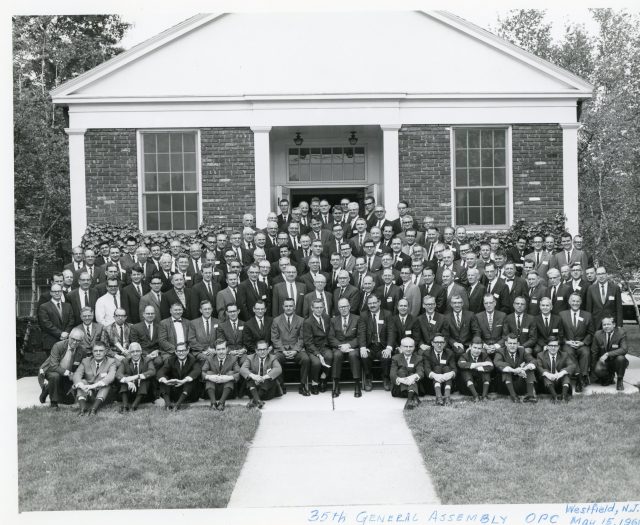
How Orthodox Presbyterians became PCA

Another way to supplement Chris Gordon’s post about the demise of confessionalism in the CRC and lessons for the PCA is to consider what happened to the OPC after the failure of union between the CRC and the OPC.

The merger that the OPC and CRC contemplated between 1956 and 1972 never took place but at roughly the same time that those negotiations died, the PCA was born and for the next twenty years became the chief player in ecclesiastical mergers-and-acquisitions. First the PCA acquired in 1982 the Reformed Presbyterian Church, Evangelical Synod (an earlier merger of revival-friendly Covenanters and dissident – read agreeable – Bible Presbyterians of the McIntire variety) and then the PCA almost in 1986 absorbed the OPC (a majority of Orthodox Presbyterians voted in favor but not by the two-thirds majority required for sending the plan to presbyteries for ratification). In the aftermath of that failed plan for Joining & Receiving, congregations in the OPC and PCA had the liberty to re-align if they chose. This was opening for a number of New Life churches (among them the Glenside congregation where Tim Keller learned the ways of New Life Presbyterianism) to join the PCA during the late 1980s.

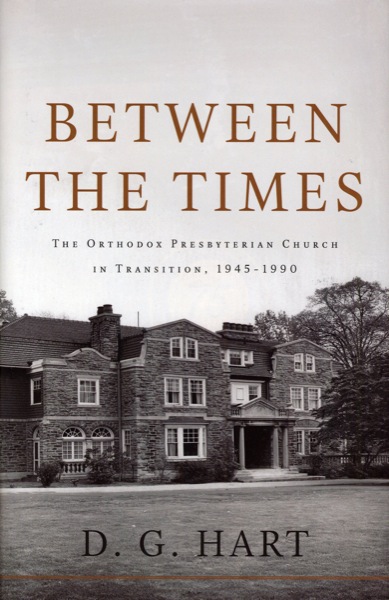
Again, a piece of OPC history (self-promotion alert) that fills out Gordon’s observations:

In 1988 the effects of the OPC’s change of direction were still visible but not altogether clear. Again the church experienced a growth numerically, rising to 19,422 members but it also lost two more congregations to the PCA, one (New Life) in Philadelphia and one in Southern California. Only in 1989 did the OPC’s statistician start to notice these numerical changes as part of a “step backward.” That year was the peak of membership and congregational loss. The church’s total membership decreased by 3.5 percent to 18,689. [ed. no snickering] Meanwhile, five congregations transferred to the PCA, among them New Life in Escondido, California. This was the same year that the Assembly’s decisions about Bethel church took their toll. A majority of the Wheaton congregation (162 out of 301) left the OPC to form an independent congregation, which eventually affiliated with the Evangelical Presbyterian Church. In 1990 the “step backward” statistically lengthened. The OPC lost another 546 members and three congregations; among them New Life, Glenside, joined the PCA. Only by 1991 did the hemorrhaging stop and membership begin to rise again. In 1992 the OPC added 525 members and total membership increased to 18,767.

The movement of OPC congregations into the PCA was the occasion for a exchange between John M. Frame and Richard B. Gaffin, Jr. in New Horizons on realignment at the same time that statistics were revealing the consequences of congregational transfers. It was a telling exchange because it revealed an important aspect of Orthodox Presbyterianism that after the semi-centennial was beginning to reassert itself within the life of the communion and causing sufficient discomfort for others to look for another denominational home. That characteristic of Orthodox Presbyterianism was the Reformed doctrine of the church in which membership in particular communion was not a supplement to Christian identity but its embodiment. As Gaffin explained in this exchange, the OPC was not merely a denomination; “it is a church, a church that exists by divine warrant.” As such, he added, “Biblical presbyterianism has no place for loyalties torn between the denomination and the local congregation, or for greater loyalty to either one.” In contrast, Frame, who was then an associate pastor of the New Life congregation in Escondido that had realigned with the PCA, explained that the reason for transferring was to partner more effectively with other church planting efforts in southern California. Denominational affiliations for him were at best accidental, at worst sinful. Either way, he hoped that denominational “barriers” would become less important and that Orthodox Presbyterians would understand that transferring to the PCA was not a sign of disloyalty or contempt. The move was simply practical.

Clearly, Frame did not see the switch to the PCA as the serious risk that Gaffin said it was. Gaffin believed such transfers were dangerous because they nurtured a mind set that increased divisions in the church, not along lines of biblical witness, but according to personal preferences or styles of ministry. As such, Gaffin was expressing a doctrine of the church that had deep roots in American Presbyterianism reaching back to Old School Presbyterianism and even to the Old Side Presbyterians of the colonial era. Frame, in contrast, was more typical of a view of the church characteristic of New School and New Side Presbyterians, where the formal work of ministry was supplemental to the religious endeavors of all believers. In other words, whether Frame or Gaffin acknowledged the history of American Presbyterianism in their reflections, they spoke volumes about Orthodox Presbyterianism and how it emerged and developed in relation to its Presbyterian past. Among the many convictions for which the OPC had stood historically, the doctrine of the church as part of biblical teaching and necessary for faithful witness was one of the hallmarks of Orthodox Presbyterianism. During the 1970s and 1980s that ecclesial conviction had begun to wane if only because it was not producing the size and influence that some Orthodox Presbyterians desired. But as the OPC began to take stock of its past, it also recovered one of its most noticeable features. Furthermore, just as that commitment to biblical Presbyterianism had been a source of frustration to Bible Presbyterians in the 1930s, neo-evangelicals in the 1940s, and more generally to Orthodox Presbyterians like Edwin H. Rian who had hoped the OPC would turn out to be a conservative version of culturally established and respectable Presbyterianism, so in the late 1980s as the OPC recovered its doctrine of the church some felt compelled to look for better, friendlier, or less restrictive expressions of American Presbyterianism than the OPC. (Between the Times, 316-18)

In other words, the consequences of Reformed ecumenism from the 1970s and 1980s were having consequences for all of the players — the CRC, OPC, and PCA. Where Presbyterians went, their forms of association, and their understand of the church were factors in the witness they embraced.

How the OPC Avoided becoming the CRC

Chris Gordon’s piece on how the CRC lost its Reformed bearings has wisdom not only for noticing similarities between the CRC and New Calvinists but also contains a warning about developments in the PCA:

NAPARC churches should not forget their older brother, the CRC. Unless these concerns are taken seriously, I foresee the PCA and other Reformed denominations following this trajectory heading for fights, splits, and empty pews. They will be on a fast track to becoming just another mainline liberal denomination scratching its head at General Assembly meetings as they desperately try to find answers. I pray that my dear brothers and sisters in NAPARC will hear this humble plea from a brother in Christ who learned how true it is that those who forget their (church) history, are most certainly doomed to repeat it.

One difference between the CRC and PCA is the former’s ethnic outsider self-identity compared to the latter’s effort to become the Presbyterian insider. In other words, the CRC wanted to leave the ghetto and enter the mainstream; one way to do that was to embrace some forms of evangelicalism. For a time the CRC even considered merging with the OPC (as explained in Between the Times — self-promotion alert!):

Decreasing familiarity with the OPC was one of the factors to which Henry Zwaanstra pointed in this study of the CRC’s ecumenical relations. In fact, his narrative highlights developments in 1967 as decisive for sinking the project. The previous year, according to Zwaanstra, the OPC’s committee was requesting “their general assembly to declare that the joint committee should work toward the definite goal of organic union.” But the following year, the OPC’s Assembly “retired its representatives from the joint committee and appointed new members.” The reason for the new appointments, according to Zwaanstra, was “mandate to investigate trends toward Liberalism in the CRC.” . . .

Indeed, the overwhelming factor that prompted the OPC to worry about liberal theological trends in the CRC was a re-ignition of anti-liberal polemics during the mid-1960s over the PCUSA’s adoption of The Confession of 1967. During the 1960s leadership within the OPC spent considerable time disputing the mainline Presbyterian Church’s revision of its confessional standards and faulting the denomination for embracing a Barthian doctrine of the Word of God. This view, exhibited in the Confession of 1967, distinguished in effect between the sort of encounter with divine revelation that came through Scripture rather than regarding Scripture itself, its words, paragraphs, and books, as the Word of God. One Orthodox Presbyterian who was particularly vocal in defending the Reformed doctrine of Scripture and in criticizing was E. J. Young, newly appointed to the OPC’s committee to confer with the CRC. The Old Testament professor was by no means insensitive to the assistance the CRC had given to the OPC since Young had served with the likes of Van Til, Stonehouse, and Kuiper, and as a renowned scholar had trafficked in Christian Reformed circles at conferences and lectures. And yet, Young was adamant in his diagnosis of Barthian developments in the PCUSA and was likely sensitive to similar trends in the CRC even if evident in much less noticeable ways.

Thanks to arguments by Young and Van Til, for instance, by the second half of the 1960s the OPC’s sensitivity to defective expressions of the doctrine of Scripture was at an all time high and undoubtedly many pastors and teachers detected echoes of a Barthian view in Dutch Calvinist circles. Whether members of the CRC themselves actually resembled Barth or were simply guilty of not condemning Barth’s influence upon the GKN is a debatable point. Either way, the controverted status of Barthianism for Orthodox Presbyterians was certainly a factor in the growing distance between the OPC and the CRC. (161-62)

The OPC did not have a front-row seat to changes in the CRC, but it had more familiarity than most Presbyterian churches. In which case, reading about OPC-CRC relations between 1956 and 1970 is a supplement to Gordon’s post (read: buy the book).

Bigger is Bigger

The appeal of Roman Catholicism is size. It has 1.2 BILLION members. It has 2000 years of history. It has oh so many paintings, galleries, cathedrals, yada yada. Size matters.

Redeemer Big Apple’s appeal is also to size — but it is the big city, and being connected to churches in other big cities, in following a pastor who has enough celebrity even for New York City editors. It’s size has almost nothing to do with the past, at least if Kathy Keller is to be believed:

I’ve saved my most important value for last: carefully screening our language is the most critical thing we can do.

I can’t find enough words to stress how important this is. We must have a care for how we choose our words, our images, and our ideas when we communicate, no matter what we’re communicating — whether it’s donor updates, lectures, or emails about events that are coming up. You absolutely must comb out all of the Christian subcultural phrases that clutter up so much of the Christian church. This is vitally important, and perhaps it’s even more important today than it was 30 years ago, because the cultural moment that we’re in now loathes evangelical Christians, and we don’t need to give them any more reasons to disrespect and dislike us.

Redeemer has been pretty good at this, partly because it was actually one of the major parts of my job description to search and destroy any piousbabble. That’s the word I coined to describe the-language-that-must-not-be-spoken. You’ve heard of psychobabble? That’s pop psychology drawn from catchphrases, media, podcast pontification and other non-academic sources.

Piousbabble are those phrases and those words that creep into your prayers and into your language.. Lord, we just, we just, Lord … We want traveling mercies, we want to bathe it in prayer, and we need prayer warriors, and we need a hedge of protection. All that sounds kind of normal-ish to most Christians. But it’s like Swahili to the nonbelievers and the seekers who are coming.

Does pious babble extend to words like Presbyterian, justification, Holy Spirit (Ghost is even more alarming, I guess), eschatology, ministry, or vocation?

That may explain why Tim Keller thought he needed a catechism other than the one his own communion uses.

But isn’t this piousbabble?

Sixth, that we do not hurt, or hate, or be hostile to our neighbor, but be patient and peaceful, pursuing even our enemies with love. Seventh, that we abstain from sexual immorality and live purely and faithfully, whether in marriage or in single life, avoiding all impure actions, looks, words, thoughts, or desires, and whatever might lead to them. Eighth, that we do not take without permission that which belongs to someone else, nor withhold any good from someone we might benefit.

Even so, if I can count on Kathy Keller to renounce the use of such pious phrases as “dead orthodoxy,” I’m on board.

Presbyterianism In Secret or in Private?

1“Beware of practicing your righteousness Presbyterianism before other people in order to be seen by them, for then you will have no reward from your Father who is in heaven.

2“Thus, when you give to the needy commission deaconesses, sound no trumpet before you, as the hypocrites do in the synagogues and in the streets, that they may be praised by others. Truly, I say to you, they have received their reward. 3But when you give to the needy, do not let your left hand know what your right hand is doing, 4so that your giving may be in secret. And your Father who sees in secret will reward you.

So what does it mean when a pastor is Presbyterian in name but known nationally and interdenominationally by his own evangelical brand? You could say, he is practicing his Presbyterianism in secret and God, who sees in secret, will reward such Protestantism. He keeps his Presbyterianism to himself. Likewise, it could be that the critics of parachurch evangelicalism on Presbyterian grounds are the hypocrites who practice their Presbyterianism in public by identifying with a particular denomination or communion and letting that shape their reputation. This is a form of practicing Presbyterianism for others to see.

But what if practicing Presbyterianism in secret also cuts you off from practicing evangelicalism in public? Isn’t the point of the Sermon on the Mount partly to avoid hypocrisy? In which case, ministering in a Presbyterian church is inconsistent with ministering in an interdenominational setting. And avoiding an evangelical ministry because of Presbyterian convictions is a version of practicing Presbyterianism in secret since the confessional Presbyterian’s absence from the Gospel-Industrial-Complex conference is invisible — no one knows the Presbyterian isn’t there or why he or she is not.

So isn’t an application of Christ’s warnings about practicing piety in public that you better mean what you believe (and oh, by the way, vow)? And if you mean what you confess as a Presbyterian, why and how can you minister with non-Presbyterians?

At Least It’s Not a Conference about Lent

Redeemer Big Apple is sponsoring a conference during this Lenten reason not about repentance and abstinence but about work:

When we see that work is created to glorify God, our work doesn’t necessarily get easier, but it does become more meaningful. The pain in our work is faced with greater honesty, where the brokenness can finally be named and seen. The unseen potential of our work is faced with greater imagination, where an innovative spirit can unleash what yearns to be resurrected. In short, when we discover that we’re formed to work for God’s glory, we find that our small tasks aren’t so small, and our big tasks are in better hands. Work becomes desirable. Rest becomes possible. Faith becomes essential.

Join us for a two-day experience where we’ll investigate how we are formed to work for the glory of God. Artists and educators, designers and technicians, homemakers, engineers, managers, entrepreneurs, doctors, and everyone in between are welcome.

Plumbers? Janitors? Bakers? The only non-professionals included in that list are homemakers.

But the oddest part of the conference is its “Glimpses,” or “exciting opportunities throughout the city to participate in diverse experiences centered around work, culture and sabbath.” These include:

GREAT GOTHAM CHALLENGE

In this thrilling urban scavenger hunt, you’ll experience New York City as you never have before. Within teams, you’ll work through city-centric challenges and puzzles and learn new things about the Big Apple along the way.

COMEDY SHOW

Join us for a stand-up comedy performance followed by an in-depth look into how the gospel intersects with the entertainment sector.

ALPHABET SCOOP

Have some ice cream and see this newly opened and highly lauded East Village shop that blends a great product with a powerful mission.

TOWN REAL ESTATE WORKSITE VISIT

Come visit one of the largest real estate firms in New York City, where we’ll see how urban homes are found and made, and hear from a broker about the inner workings of the vast and complex NYC market.

FLOWER ARRANGING

Learn a simple and practical method for bringing God’s beauty into your personal space. Together we’ll learn a new restful hobby and the spiritual importance of fostering beauty in your daily life.

RUNNING TOUR OF CENTRAL PARK

How can running be a form of practicing rest? Come find out and run through a guided path with a group.

GOLDMAN SACHS TRADING FLOOR VISIT

Get an inside look at the excitement and energy of a trading floor. We’ll also hear from a panel of finance industry employees to hear about the shifts, values, and complexities of the financial sphere.

TOUR OF LOWER MANHATTAN/REVOLUTIONARY NEW YORK

With more than 400 years of history, come see the Lower Manhattan neighborhood where what once were cow paths and trading posts are now skyscraper lined streets.

MOVING MEDITATION: YOGA SESSION

Knowing His great care for our bodies, how can we invite God into our physical workouts? Through meditation and prayer, we’ll discover how to connect God to breathing and movement in this meditation that will also include an hour long yoga class and journaling.

Aside from blessing Goldman Sachs at a time when I would have thought progressive-leaning, Ta Nehisi Coates-reading evangelicals were woke about neo-liberalism (not to mention the 2008 financial collapse and the federals’ bailout), could this list of consumption, tourism, and entertainment be any more of a cliche? It would be like the OPC selling shirts that can’t be tucked in, pocket protectors, and slide rules at one of its pre-General Assembly conferences?

Or could it be that when you are this cool, you don’t worry about optics?

The Point of Being Presbyterian

Yes, Presbyterianism is historic — it predates the conversions provoked by Jonathan Edwards. But that doesn’t mean that Presbyterianism uses whatever bits of Christian history that also qualify as historic. Presbyterianism says history doesn’t matter compared to something even more historic — God’s revelation in the Old and New Testaments and the acts of redemption therein revealed.

This lesson from Presbyterianism 101 comes from awareness (supplied by our northern correspondent) that the Presbyterian pastor identified in the following article is part of the PCA, and therefore a man eligible to preach and administer the sacraments in our local OPC congregation.

E. C. is a Presbyterian. I am not. I know that he’d love to make me so. He fits Presbyterianism. He loves the arc of the liturgy, the commitment to ever put God’s grace and covenantal faithfulness in the foreground, and their interpretive lens toward scripture. While I respect his convictions, I am not particularly drawn to the Presbyterian ethos. My friend Bruce is a Quaker. He loves the communal discernment of the Spirit and the diligent pursuit of acknowledging the image of God in every human. I’m not antagonistic toward either of those positions, but they aren’t enough to make me a Quaker. I’m something else. And yet, every winter we three pastors leave the comfort of our desired theological homes to share an Ash Wednesday service.

We can join together on Ash Wednesday because the day is about humility. When else in the Christian life do we acknowledge that we are but dust?

Remember you are dust, and to dust you shall return. ~Traditional Ash Wednesday Blessing

To have the ashes smeared on our foreheads is to embrace a grim truth about our limits: We are not God. From dust we were made—we all arrive here from the same humble beginnings. No one among us came from anything other than the earthly design of human birth. And to dust we shall return—we are mortal. What we have on this earth will end. After a good long life, perhaps, or maybe far too early. Regardless, death’s grim grip will overwhelm even the strongest will.

The thing is, praying before a meal, conducting family worship, attending worship every Sunday morning and evening is also a reminder of our limits and mortality. Ash Wednesday comes once a year. But you can hear “Our help is in the name of the Lord, who made heaven and earth” (Ps. 124:8) every Lord’s day and remember that you are a finite critter who depends on God almighty.

The Presbyterian pastor involved in this Ash Wednesday service has his own justification for observing Lent:

Lent spans 40 workdays beginning on Ash Wednesday and culminating on the Saturday before Easter. The Sunday’s within Lent are not counted part of the 40 day duration, but rather are called Sunday’s In Lent. The significance of 40 days can be traced to many things within the bible, but in this instance refers to and honor’s the 40 days Christ spent in the wilderness preparing for his ministry. Within CVP, Lent is a time of preparation and prayer spent in readying for Easter and our Savior’s resurrection. As such, we don’t “give something up for Lent”, but rather if something is distracting from focusing on Lent and Christ’s sacrifice, we may set it aside temporarily.

As one gets closer to the end of Lent, we enter what is known as Holy Week. This is started with Palm Sunday, otherwise known as Passion Sunday, and observes the triumphal entry of Jesus into Jerusalem where folks waved palm branches proclaiming him as the messianic king. The word passion refers to the final journey of Jesus to the cross and crucifixion. Next would be Maundy Thursday which refers to series of events that took place the day before Jesus was arrested. These events include the last supper where communion has it’s origins, Jesus’ betrayal by Judas, and ended with Jesus praying in the garden of Gethsemane prior to his arrest to be taken before Caiaphas. Prior to the last supper, Jesus washed his disciples feet to illustrate the humility involved in servanthood. He also taught his disciples a new commandment quoted in John 13:45-45 NIV “A new command I give you: Love one another. As I have loved you, so you must love one another. By this everyone will know that you are my disciples, if you love one another.”

Good Friday and/or Tenebrae are one and the same day and come on the last Friday of Lent. The church observes the day of Jesus’ arrest, trial and crucifixion. Not even a week before on Palm Sunday, the people proclaimed Jesus king and now on this day, they demand his death. Tenebrae is a way the church observes the coming darkness of a world without God by selected bible readings and a growing darkness (either by turning off lights one by one, or extinguishing ceremonial candles). Tenebrae typically concludes with a loud noise symbolizing the closing of Jesus’ tomb. Lent concludes on Holy Saturday – the day Jesus rested in the tomb.

Nifty. I guess this points to something a little more mysterious, a little more cosmic, something with a little more umph than your average Protestant service which — oh by the way — only relies upon the inspired and infallible word of God, recorded, written, and given over five centuries before anyone dreamed of using ashes to put the sign for addition on someone’s face. The Bible, as common as it is, really is spooky. Of course, it doesn’t help when Protestants turn Scripture into a manual for everyday living, complete with instructions for thinking the right thoughts while you cross the street (unless you get distracted by a fast-approaching car).

Yes, low church Protestants messed up the awe and reverence that God speaking to you and memories of Christ’s death (in the Supper) should instill. Why and how Presbyterians contributed to this debasement of worship is a long and sorry story. But today’s Presbyterians who are trying to be historic should know better because Reformed Protestants did something to upend the direction of Western Christianity. You really can turn the clock back before Whitefield and Edwards without losing your Presbyterian self. Keep it simple, keep it biblical, and remember you are a sinner coming in the presence of a holy God. You don’t even need to wear dirt on your forehead.

But Larry Ball does not blame Ash Wednesday practicing pastors for problems in the PCA. He blames 2k. Easy peasy.

Irish Presbyterians are Exceptional

If you take that word, exceptional, as synonymous with unusual. In other words, the Presbyterian communions in Ireland don’t line up with the mainline vs. conservative brands that we know in the U.S.

Here‘s one piece of evidence. Two former moderators of the Presbyterian Church in Ireland have issued a statement opposed to abortion. If you didn’t know better, you might think the PCI is the mainline equivalent of the PCUSA. The PCI is closer to the mainstream of Irish life than the Evangelical Presbyterian Church, a communion that started with some inspiration from J. Gresham Machen and set up a rival communion to the PCI. But I can’t imagine this ever happening in the PCUSA:

Two former moderators of the Presbyterian Church in Ireland have written to all TDs and Senators expressing grave concern at recommendations that unrestricted abortion be allowed in Ireland up to 12 weeks and for health reasons thereafter.

In their letter, Rev Dr Trevor Morrow and Rev Dr Norman Hamilton have said “our church holds a strongly pro-life position, while recognising that there can be very exceptional circumstances when the termination of pregnancy may be necessary”.

They continued: “However, we are very gravely concerned about the [Oireachtas] Committee’s recommendations to introduce abortion with no restriction as to reason until the 12th week of gestation, and beyond 12 weeks on health grounds.

“Even if the recommendation of abortion on request is excluded, the health proposals on their own will create similar provisions to those in Britain, which have, in practice, brought about abortion on request (we note that one in five pregnancies ends in abortion in Great Britain and that of the 190,406 abortions in England and Wales in 2016, 97 per cent took place on health grounds).”

For some reason, apparently, Irish Presbyterians do not stumble over Orwellian language like “women’s reproductive health.”

Another indication that Irish Presbyterians are exceptional odd comes from this recent announcement:

True Christian Piety

Speaker: D.G. Hart

Subject: “True Christian Piety”

Dates: 2-3 August 2018

Times: 10am-4pm

Venue: Stranmillis Evangelical Presbyterian Church

Darryl Hart teaches at Hillsdale College, USA, and is a well-known writer on historical and ecclesiastical matters. On 2-3 August 2018, he will lead a workshop that will explore major themes in his work, teaching and leading discussions on such themes as the Sunday gatherings, marriage as a means of grace, and sanctified work. Attendees should prepare for the workshop by reading Darryl’s books, “Recovering Mother Kirk,” “The Lost Soul of American Protestantism,” and “Deconstructing Evangelicalism.”

Cost: £40 for both days, including lunch and refreshments.

For some reason, Irish Presbyterians do not consider “Old Life” and “True Christian Piety” oxymoronic.

What would He Think of Machen?

This is about the reporter who has had many fruitful interactions with Tim Keller:

The late writer Christopher Hitchens had what you might call an intellectual jumper cable routine: he would wake up in the morning, open the New York Times, read its front page motto “All the News Fit to Print,” and allow that hackneyed boast to enrage him into carrying out his polemical duties. Lately I’ve found myself accidentally mimicking Hitchens, but with the Washington Post, which since Trump’s election has been running with the slogan “Democracy Dies in Darkness.” So long as that shamelessly self-aggrandizing, wokeness-overdosed, low-rent Dashboard Confessional refrain-cum-greasy fortune cookie slip remains the ethos of my local paper, it’ll only take one cup of coffee to wake me up, thanks.

This week, though, it’s the Times that’s got my goat, probably because, unlike the Post, I read as much of it as possible every morning (for its excellent foreign coverage, not its masthead). Last week the Gray Lady published a column by op-ed page fixture Nicholas Kristof, the Tom Bergeron of liberal internationalism, titled “Trump’s Threat to Democracy.” Kristof cites two political science academics at Harvard who list four omens as to whether a “political leader is a dangerous authoritarian”: he “shows only a weak commitment to democratic rules,” “denies the legitimacy of opponents,” “tolerates violence,” and “shows some willingness to curb civil liberties or the media.” “Donald Trump,” the profs ruefully announce, “met them all.” And then the clincher: “With the exception of Richard Nixon, no major-party presidential candidate met even one of these four criteria over the last century.”

Come again?

That timespan easily covers Franklin Delano Roosevelt’s presidency, during which the mildly anti-civil liberty policy of rounding up 120,000 Japanese Americans and interning them in camps was implemented. But you don’t even need to go back that far to refute Kristof’s professors: events still in the public memory can provide. The George W. Bush administration instituted a surveillance regime that stretched the Fourth Amendment into cellophane, and then tried to browbeat a hospitalized (and possibly addled) John Ashcroft into granting it his approval; it allowed prisoners to be indefinitely detained and tortured, and even mulled using the military against terrorism suspects on U.S. soil. Barack Obama assassinated American citizens with drones, invoked the Espionage Act to spy on reporter James Rosen, launched a war against Libya’s Moammar Gaddafi without congressional authorization, and set a record for the most Freedom of Information Act requests denied in American history. Bush and Obama didn’t just “show some willingness to curb civil liberties or the media,” to use the academics’ soupy words; they rammed right through them with the brunt power of the federal government.

With friends like these. . .

What If Redeemer NYC Were Big Enough?

Some big changes at the most influential PCA congregation IN THE WORLD!

Here is the text of yesterday’s announcement:

The Center for Faith & Work (CFW) is pleased to announce the newest phase of its fifteen-year history as its staff joins Redeemer City to City (CTC) and continues to serve the Redeemer churches and New York City, while over time broadening its reach to global cities.

“Redeemer is changing with CFW because Redeemer is now not one church, it’s a family of three churches, which means it’s immediately looking outward to bless the whole city,” says Redeemer’s founding pastor Tim Keller. “Redeemer has become centrifugal; that is, it’s starting to push out to start new churches and help others start new churches. And so Redeemer is actually looking outwards, just like CFW will be looking outward, beyond Redeemer. They’re both making the same change at the same time. If CFW stays locked in Redeemer alone, then I don’t think a lot of its wisdom will be as available to the world. This is why now is the optimal time to do this.”

So apparently, Redeemer NYC is too New York to be of use to the rest of the world, unlike Redeemer CTC which is apparently global in orientation and structure. Do the folks who are New York Presbyterians really mean to imply that understandings of vocation in New York are parochial and cannot work in other parts of the world, unless integrated into a global organization? Since Tim Keller recently explained his worries about nationalism, what must he make of metropolitanism, something like the hyping of the Big Apple above the needs and realities of the rest of the world?

As the announcement explains:

Throughout its existence, CFW has encountered New Yorkers of all backgrounds facing a decidedly more global vocational culture. In our quickly changing world, the need for new tools, curriculum, and communities that help Christians wisely and meaningfully bring their faith to bear at work, across all spheres, is paramount.

City to City provides a developed network and infrastructure to strengthen CFW in its three-fold aim of equipping, connecting, and mobilizing Christians around the world in faith and work integration. City to City ensures a centralized effort towards that global expansion, while continuing a close and collaborative relationship with the Redeemer Presbyterian Churches.

So being a Christian banker in Beijing is decidedly different from banking on Wall Street?

Aside from vocation, this announcement raises questions about organizational footprint of Redeemer’s operations and Keller’s alliances. Are we really supposed to believe that Redeemer NYC — whichever congregation — was too inflexible a platform for the Center for Faith & Work? When did ecclesiology or administrative restrictions prevent Redeemer NYC from expanding its reach, or starting new programs? Heck, I suspect the PCA’s Mission to the World could have incorporated the work that the Center does if New York’s administrators had decided to work with PCA missionaries and their offices in different parts of the world? Is the Center’s activity really so special that the PCA’s structures can’t handle it? After all, the reading list available at the Center’s website is very, oh so very neo-Calvinist, with Al Wolter’s Creation Regained occupying the “advanced” understanding of vocation:

Few contemporary books have been cited as often by those who are writing about taking up callings and vocations faithfully. This this serious little book walks us through the key Biblical themes of the goodness of creation, the seriousness of the fall into sin, the decisive redemption gained by Christ, and the implications of working out the promised hope for a creation-wide restoration. With the keen eye of a philosopher and the passion of a Bible scholar, Wolter’s offers one of the definitive, concise books about a Christian worldview. One of the most important books for those of us in CFW and highly recommended to understand a uniquely Christian view of cultural and vocational engagement.

Granted, the neo-Calvinists never took root in NYC after the English displaced the Dutch colonists about two-thirds into the seventeenth century. But what is distinctly global about a set of readings that come largely from Christian Reformed writers living in North America and published Dutch-American editors in Grand Rapids?

And what about The Gospel Coalition? Is it parachurch chopped liver? Don’t the Allies have branches all over the world? If Redeemer can partner with TGC on The New City Catechism (TGC has a link at it’s menu page), why can’t the Center for Faith & Work collaborate with the Coalition in it’s own Faith & Work work?

The word that comes to mind is marvelous. But the marvel experienced here is that anyone in Presbyterian ministry has time for all of these structural niceties even when the bells and whistles of Presbyterian polity don’t seem to be all that important.