The Virtue of Being Vindictive

Morning reading left me stunned with this observation about the way Americans understand recent terrorist acts:

When Muslim Americans commit acts of terrorism, we hold ISIS and Hezbollah and “radical Islam” accountable for their actions, even if they are mentally unstable, and even if there is no direct connection between them and the groups that inspired them. We call these terrorists “self-radicalized.” It is how we see Dzhokhar and Tamerlan Tsarnaev, who bombed the Boston Marathon in 2013; and Omar Mateen, who went on a murderous rampage at the Pulse Night Club in Orlando last June; and Mohamed Lahouaiej-Bouhlel, who killed 86 people and injured 434 at a celebration in Nice on Bastille Day. They did not go to a terrorist training camp, or join an organized cell, or attend an anti-Western madrassa. They learned to hate from a network of web sites and magazines and videotapes. Their madrassa was the media….

[Robert] Dear became radicalized in precisely the same way. But because the media he listened to advocated war in the name of a Christian god, and argued for an ideology considered “conservative,” he is portrayed as no one’s responsibility. In fact, as I learned from hours of speaking with Dear, the narratives he learned from Rush Limbaugh and Alex Jones and Bill O’Reilly and countless far-right web sites meshed perfectly with his paranoid delusions, misogynist beliefs, and violent fantasies. The right-wing media didn’t just tell him what he wanted to hear. They brought authority and detail to a world he was convinced was tormenting him. They were his shelter and his inspiration, his only real community.

The point of Amanda Robb’s piece, coincidental that it comes in New Republic’s issue on President Obama’s legacy, seems to be that right-wing media is evil (just like the party they support). The Planned Parenthood shooter received lots of ideas from radio preachers even more obscure than Jen Hatmaker:

In those days, thanks to the Fairness Doctrine, major broadcast outlets were forbidden from running partisan content without providing equal time to opposing views. But on shortwave channels, right-wing broadcasts were proliferating. Dear tuned in as often as possible. “That’s what turned me on to the conspiracies and the Bible prophecies,” he recalled. His favorites included Brother Stair, a Pentecostal minister who has predicted the end of the world; William Cooper, who preached that aids was a man-made disease; Pete Peters, whom the Anti-Defamation League has called a “leading anti-Jewish, anti-minority, and anti-gay propagandist”; and Texe Marrs, leader of the Power of Prophecy Ministries, who claimed that the federal government committed the Oklahoma City bombing and framed Timothy McVeigh.

Dear also became fixated on small magazines devoted to right-wing conspiracies. He spent hours at Barnes & Noble poring over magazines like The Prophecy Club, The Spotlight, and Paranoia, obsessing over their brand of crackpot theorizing: how the Robert Bork confirmation battle was connected to the JFK assassination, how the World Trade Organization ran a secret “Codex Alimentarius,” how the government operated a series of Deep Underground Military Bases, how it was planning an “American Hiroshima.”

But you know, the Fairness Doctrine paved the way for Rush Limbaugh, Bill O’Reilly’s John the Bapist:

Those in the right-wing media who traffic in hate and conspiracy theories are quick to deny that they should be held responsible for the consequences of their words. After Waco, Rush Limbaugh took to the airwaves to predict that “the second violent American revolution” was imminent. Yet two weeks after the Oklahoma City bombing, he published an op-ed in Newsweek entitled “Why I’m Not to Blame.” After running 29 shows attacking George Tiller as “Tiller the Baby Killer” and saying there was “a special place in hell” for him, Bill O’Reilly dismissed any accountability for inciting the doctor’s murder: “I reported extensively on Tiller and after he was assassinated by a man named Scott Roeder, some far-left loons blamed me.”

So, if we blame ISIS for random acts of mass murder, why not the right-wing media? Possibly because POTUS and the Department of Justice and mainstream media have warned us from jumping to conclusions about Islam or Islamic organizations.

Here’s how the New York Times handled the Boston bombers’ religion:

While Dzhokhar’s adjustment seemed to be going smoothly as he reached his teens, Tamerlan’s disillusionment with their adopted country grew as he got older, as did his influence on his younger brother.

Baudy Mazaev, a Chechen friend of the Tsarnaevs, said that Tamerlan and his mother, Zubeidat Tsarnaeva, “had a deep religious epiphany” involving Islam a few years before the bombing.

Initially, according to friends, Tamerlan’s new religious devotion seemed to only irritate Dzhokhar: Mr. Mazaev said that on one of his visits to the Tsarnaev house during that period, Tamerlan ordered him and Dzhokhar to read a book about the fundamentals of Islam and prayer. After that, Mr. Mazaev said, they began avoiding the apartment.

But the family’s relationship to Islam, and one another, evolved. In February 2011, roughly when the boys’ mother embraced Islam, she separated from her husband, Anzor, a tough man trained in the law in Russia who in Cambridge was reduced to fixing cars in a parking lot. The two divorced that September, and Anzor returned to Russia; his ex-wife followed later.

Tamerlan filled the void as head of the family’s American branch. On Twitter, Dzhokhar wrote that he missed his father. Days before his citizenship ceremony — on Sept. 11, 2012 — he expressed wonder at why more people did not realize that the 2001 attack on the World Trade Center “was an inside job.”

Not exactly a slam dunk link to ISIS or Hezbollah.

What about this treatment of Omar Mateen?

Other hints of a disturbed mind continued to emerge. In 2013, G4S removed Mr. Mateen from his security post at the St. Lucie County Courthouse after he had made “inflammatory comments” about being involved somehow in terrorism. Though far-fetched and even contradictory — he claimed connections to Al Qaeda, the Sunni extremist group, and ties to its near opposite, the Shiite Hezbollah — his comments were troubling enough for the county sheriff’s office to notify the Federal Bureau of Investigation.

The bureau’s subsequent inquiry was inconclusive.

The next year, Mr. Mateen again attracted federal scrutiny, after an acquaintance from his mosque, the Islamic Center of Fort Pierce, carried out a suicide bombing in Syria. According to F.B.I. Director James B. Comey, federal investigators concluded that Mr. Mateen knew the bomber only casually.

The mosque’s imam, Syed Shafeeq Rahman, insisted that Mr. Mateen had never heard teachings at the mosque that would have radicalized him. “There is nothing that he is hearing from me to do killing, to do bloodshed, to do anything, because we never talk like that,” the imam said.

But if you can link an attack on Planned Parenthood to the media that opposed President Obama, well, why not?

And this was an issue of New Republic that celebrated the President’s decency, centrism, and dignity. According to Andrew Sullivan:

People will see the sheer caliber of this man [President Obama]. The grace and poise with which he conducted himself in unbelievably difficult circumstances; the way he withstood abuse and disrespect with extraordinary calm and goodwill. He will in his post-presidency become a symbol, maybe somebody we need more than when he was president, to remind us of what it is to be dignified in public life. Especially if this hideous monster who’s succeeding him continues to despoil the public culture.

So why exactly did the editors include a piece so out of sync with the President’s virtues? Maybe because they only want the other side to be virtuous?

You Don’t Need an Education to be Outraged

Molly Worthen wrote a good piece at the New York Times about the way that conservatives take ideas seriously (and by implication, liberals not so much):

The syllabuses and faculty range from say, the secular Jewish milieu of Hertog to the libertarian Cato Institute to the Christian traditionalism of the John Jay Institute. But all these programs seek to correct the defects they see in mainstream higher education by stressing principles over pluralism, immersing students in the wisdom of old books and encouraging them to apply that wisdom to contemporary politics.

Liberals have their own activist workshops and reading groups, but these rarely instruct students in an intellectual tradition, a centuries-long canon of political philosophy. Why have philosophical summer schools become a vibrant subculture on the right, but only a feeble presence on the left? The disparity underscores a divide between conservatives and liberals over the best way to teach young people — and, among liberals, a certain squeamishness about the history of ideas.

Liberals, however, can’t afford to dismiss Great Books as tools of white supremacy, or to disdain ideological training as the sort of unsavory thing that only conservatives and communists do. These are powerful tools for preparing the next generation of activists to succeed in the bewildering ideological landscape of the country that just elected Mr. Trump.

One reason that liberals and progressives don’t study the past or its leading voices is that so many of the authors fail so quickly on the left’s moral grid of identity righteousness/victimhood (race, class, gender, sexual orientation). If John Stuart Mill was on the wrong side of women’s liberation or Immanuel Kant wasn’t a proponent of civil rights for blacks — a bit anachronistic, mind you — then what could they possibly teach about the plight of trannies in search of a public bathroom? It worked the same way in the world of mainline churches. Who reads Henry Sloane Coffin, William Adams Brown or their evangelical enablers like Robert Speer? These modernists or doctrinal indifferentists were on the cutting edge of reducing the conservative orientation of the PCUSA. But by the 1960s when sex, Civil Rights, and Vietnam were the topics of debate, the old contests of the 1920s had no value.

In point of fact, activism needs no serious reflection if you listen to interviews with contemporary Ivy League students like this. Sure, the Princeton University editor is respectful and intelligent in some respects. But he has no clue about the impropriety of going to college to learn while also saying that faculty need to be re-educated about race and safe spaces. If this student is representative, today’s college students, the really smart ones, can’t tell the difference between being policed in Ferguson, MO or by campus police at Princeton University. Heck, they even think that the oppression African-Americans have confronted historically is on a par with what women, gays, and trannies face.

Meanwhile, the therapeutic quality of contemporary activism should never be discounted. The idea of not hurting students’ sense of empowerment is prominent in discussions of critical race theory like Henry Louis Gates, Jr.’s in Speaking of Race, Speaking of Sex. Where that leads was the subject of Judith Shulevitz’s New York Times piece on safe spaces discussed here.

With all the smart people running the world for the last 8 years, you might think that colleges and universities would themselves provide the sort of intellectual training for which Worthen calls. Why do you need supplemental education when you are in a four-year accredited and, in some cases, prestigious university? The reason is that universities, even the good ones, treat students like this:

But the fixation on diversity in our schools and in the press has produced a generation of liberals and progressives narcissistically unaware of conditions outside their self-defined groups, and indifferent to the task of reaching out to Americans in every walk of life. At a very young age our children are being encouraged to talk about their individual identities, even before they have them. By the time they reach college many assume that diversity discourse exhausts political discourse, and have shockingly little to say about such perennial questions as class, war, the economy and the common good. In large part this is because of high school history curriculums, which anachronistically project the identity politics of today back onto the past, creating a distorted picture of the major forces and individuals that shaped our country. (The achievements of women’s rights movements, for instance, were real and important, but you cannot understand them if you do not first understand the founding fathers’ achievement in establishing a system of government based on the guarantee of rights.)

When young people arrive at college they are encouraged to keep this focus on themselves by student groups, faculty members and also administrators whose full-time job is to deal with — and heighten the significance of — “diversity issues.” Fox News and other conservative media outlets make great sport of mocking the “campus craziness” that surrounds such issues, and more often than not they are right to. Which only plays into the hands of populist demagogues who want to delegitimize learning in the eyes of those who have never set foot on a campus. How to explain to the average voter the supposed moral urgency of giving college students the right to choose the designated gender pronouns to be used when addressing them? How not to laugh along with those voters at the story of a University of Michigan prankster who wrote in “His Majesty”?

Imagine that: a good novel, historical investigation, and even philosophical deliberation might lift a person out of their own set of ideas and consider those of other people. They might even experience empathy with hillbillies (or they can simply deconstruct and carry on impervious to others).

Yes, there are lots of good faculty, serious students, and great classes across the board in U.S. colleges and universities. But the limits of smarts are well on display. Can U.S. higher education self-correct? Can the Vatican? You do the math and set the odds.

Republicans are Always Evil Everywhere

I still remember my days at Harvard Divinity School when most if not all of my friends mocked Ronald Reagan as a boob and a divorcee who had snowed God’s faithful within the Moral Majority. In fact, every nominee of the GOP since Goldwater (in my memory) has been of dubious character and intellect. That makes evangelical support for Republicans the height of hypocrisy, not to mention a threat to the Republic.

I went to church with some of my friends on a number of occasions, mostly to see what they were teaching their followers. While I disagreed with much of it, I couldn’t help but like the people I met there and admire their sense of community and devotion to something bigger than themselves. I took part in discussion groups with church members too, and again, while I thought much of it was intellectually indefensible, the intent was genuine and their desire to do good in their communities laudable.

I could not for the life of me understand how these good people could vote for someone like George Bush and Dick Cheney — oil funded war hawks who spent their political careers wrecking social programs for the poor and doing everything in their power to trash the environment. The contradiction between their personal humility and willingness to vocally support and vote for greedy millionaires with a penchant for violence in the Middle East was completely alien to me.

So why be shocked if those same evangelical Protestants vote for Trump? Because he is so much more wicked?

White evangelical Christians came out in droves to support Donald Trump — a man who exemplifies literally everything Jesus Christ stood for. Trump is a rich braggart who has made a name for himself flaunting his wealth. He openly denigrates women, has a lurid history of sexual assault, insults minorities and holds petty grudges against anyone who speaks out against him. In no rational universe can these two completely contradictory beliefs be reconciled. If you believe that the gospels accurately depict the life of Christ, then supporting a man who calls women “pigs” and “dogs” and has spoken about grabbing them “by the pussy”, you cannot be called a Christian in any meaningful sense of the word.

Did this narrative of Republican depravity help either evangelicals or editors at the New York Times tell the difference between decent and vulgar GOP nominees? Not really, but one of the blessings of Trump is adding nuance to perceptions of the Republican Party (barely):

This uniquely American phenomenon of equating greed, misogyny and racism with moral righteousness appears to be getting more and more pronounced. In retrospect, George W. Bush was a shining example of moral virtue when compared with Donald Trump.

Hmm. What if the mainstream media had treated George W. Bush, John McCain, and Mitt Romney — all persons who had served in public administration and were serious politicians (compared to Trump) — as real players in U.S. politics rather than benighted fools of questionable morals? Perhaps the electorate might have had the tools to discern the difference between Trump and John Kasich. Maybe some voters would not have sensed that they were damned no matter for which Republican they voted.

But from the perspective of the elite press rooms, spotting the difference among Republicans is as unusual as white Americans thinking Asian Americans look different.

I guess evangelicals are guilty of introducing self-righteousness into politics, but I blame the Puritans and all graduates of their universities, you know, the schools from which anyone worth a darn graduates (think Harvard and Yale).

Giving Credit Where It’s Due

Sure, we’ve heard lots about how evangelicals overwhelmingly voted for Donald Trump and then the after-doom and gloom of evangelical leaders considering turning in their born-again credentials. But it turns out the really decisive demographic in the election was Roman Catholics (from one of our southern correspondents):

You only think you know what won the election for Donald Trump.

Hillary’s corruption? The betrayal of the American Dream? Vladimir Putin? Wrong. Wrong. Wrong. Let me tell you the real story, and the person behind it.

Elections are won by the marginal voter, the swing voter, the guy right at 50 percent. And in American politics he’s generally a Catholic. That’s the story this time, too.

It wasn’t the white Evangelicals. They went overwhelmingly for Trump, but that was also true in 2012 when they weren’t even sure Romney was Christian. They aren’t the swing voters.

Catholics, on the other hand, were plus-2 for Obama in 2012 and plus-7 for Trump this year. Evangelicals helped Trump in states he was mostly going to win anyway. Catholics? Now we’re talking about Pennsylvania, Ohio, Michigan and Wisconsin. And that was the election.

It nearly didn’t happen. Trump’s outreach people were tone-deaf about Catholic voters. They were putting their eggs in baskets marked Evangelicals, African-Americans and Hispanics. Catholics were of secondary importance.

But one Catholic leader, Deal Hudson, didn’t believe this, and he single-handedly organized a big-name Catholic Advisory Committee, a conference call with state campaign directors, a conference call between Trump and Catholic leaders, a tweet and video from Trump when Mother Teresa was canonized and an interview with Trump on the Catholic EWTN television network.

Meanwhile, the liberal press ran stories about how Catholics hated Trump and bishops condemned Trump’s immigration rhetoric. As for the Catholic intellectuals, they mostly went full-bore NeverTrump (with some honorable exceptions, such as Jim Piereson and Roger Kimball).

You mean all those stories about evangelical voters were fake? The wrong narrative?

It’s Fascist When You Exclude the Universities?

Michael Kinsley thinks Donald Trump qualifies technically as a fascist:

The game has several names: “Corporate statism” is one. In Europe, they call it “dirigisme.” Those two other words for it — “Nazism” and “fascism” — are now beyond all respectability. It means, roughly, combining the power of the state with the power of corporations. At its mildest, it is intrusive regulations on business about parental leave and such. At its most toxic, it is concentration camps. In the 1930s, a few Americans (including a few liberals) bought into it. Pearl Harbor ended that argument. Even for Trump, “fascism” itself now is a dirty word, not just a policy choice. Even Trump would not use it — least of all about himself.

Did Kinsley worry about combining the power of the state with the power and prestige (we’re the smartest people in the world) of universities? It’s not as if nothing could go wrong (beware the negatives):

Indeed, illiberal progressive elitism has only become more pervasive as the gap between the “educated and the ignorant” has widened.

With the rise of think tanks, research universities, and advocacy foundations and nonprofits—the vast, interlocking, insulated complex we’ve constructed to formulate, advocate, and execute public policy—we have only reinforced the barrier between the everyday voter and governance. In order to understand, much less engage in, today’s abstract, detached, and data-saturated discourse of public policy, participants require ever more specialized academic expertise. If a problem can’t be expressed in a statistical formula—with the obliteration of nuance, detail, and local variability this entails—then the problem simply doesn’t exist.

What we now call the “rise of the meritocracy” may have begun well over a century ago. But as it accelerates today, its costs are becoming more apparent. The meritocrats sort themselves out not only socially, but geographically as well, into coastal and university enclaves. There, in a contemporary bow to positive eugenics, they engage in assortative mating. Their children then follow the sheltered path from university day school to Princeton to a career in social entrepreneurship, convinced that they can “change the world,” as the slogan goes, without ever touching down in that vast swath of cultural desolation unhappily separating Nassau Hall from Palo Alto. The distance between the “educated and ignorant” grows ever larger, both literally and figuratively.

You could also call this “corporate statism” since the biggest and smartest universities in the U.S. are corporations whose assets tax collectors cannot touch.

From Duck Dynasty to Kim Davis to Fixer Upper

Matt Walsh does his impersonation of Perpetua:

Chip and Joanna Gaines became a target because they are, by all accounts, devout Christians. That’s the only reason. If they were not Christian, or if they had a reputation for being the unserious, heretical, “progressive” sort of Christians, they wouldn’t be under fire. That’s why, as many people have already observed, Muslims and members of other faiths that also reject gay marriage don’t receive the same scrutiny. Progressives don’t hate Muslims. They hate Christians. They hate Christians for being Christian, and for no other reason.

It’s not just about gay marriage or abortion or any other specific issue. They hate Christianity because it is Christianity. They hate it simply for being true, just as Christ was crucified simply for being God. Those who hate truth and hate God will lash out at the closest things to Him. When they had the chance to get their hands on Him in the flesh, they beat Him, whipped Him, and nailed Him to a cross. But now that they are deprived of the opportunity to crucify Christ directly, they must settle for the second best target: you. This is the price that Truth must pay when it enters into a fallen world. And those of us who profess and believe the Truth will pay our own price, even if it is not nearly so brutal.

We should only be worried if we aren’t being made to pay the price. If we get along just fine every day, at our jobs, with our friends, out in the world, and nobody ever insults us, or tries to hurt us, or plots to undermine us and destroy our reputations, then we ought to take that as a hint that we aren’t living our faith openly enough.

So whenever I upset my wife it’s because I’ve achieved holiocity? What a great excuse. And martyrdom sure trumps victimhood.

Which Bible, Whose Public School?

Are U.S. Christians really comfortable with bringing prayer and Bible reading back to public schools? If so, what do they do with this passage (which was part of yesterday’s Scripture readings)?

As they were making their hearts merry, behold, the men of the city, worthless fellows, surrounded the house, beating on the door. And they said to the old man, the master of the house, “Bring out the man who came into your house, that we may know him.” And the man, the master of the house, went out to them and said to them, “No, my brothers, do not act so wickedly; since this man has come into my house, do not do this vile thing. Behold, here are my virgin daughter and his concubine. Let me bring them out now. Violate them and do with them what seems good to you, but against this man do not do this outrageous thing.” But the men would not listen to him. So the man seized his concubine and made her go out to them. And they knew her and abused her all night until the morning. And as the dawn began to break, they let her go. And as morning appeared, the woman came and fell down at the door of the man’s house where her master was, until it was light.

And her master rose up in the morning, and when he opened the doors of the house and went out to go on his way, behold, there was his concubine lying at the door of the house, with her hands on the threshold. He said to her, “Get up, let us be going.” But there was no answer. Then he put her on the donkey, and the man rose up and went away to his home. And when he entered his house, he took a knife, and taking hold of his concubine he divided her, limb by limb, into twelve pieces, and sent her throughout all the territory of Israel. And all who saw it said, “Such a thing has never happened or been seen from the day that the people of Israel came up out of the land of Egypt until this day; consider it, take counsel, and speak.” (Judges 19:22-30 ESV)

Or are those who want more Christianity in the public sector more comfortable with Mr. Jefferson’s Bible, the one that leaves parts like Gibeah’s crimes on the editing room floor?

From What Machen Tried to Spare American Protestants

Walter McDougall reminds of the synergy between progressive theology and progressive politics:

Historians disagree on how to date and define the Progressive Era except to say it had everything to do with reform.[16] By the 1890s it was apparent that American institutions couldn’t cope with the modern problems thrown up by industrialization, urbanization, and immigration, including corporate trusts, labor strife, corruption, big city machines, public health, women’s rights, and more. To elites in the academy, government, business, and the clergy it seemed the modern solution to those modern problems was scientific management by credentialed experts. As one scholar put it, “The Progressives believed in a … national government directing the destinies of the nation at home and abroad. They had little but contempt for the strict construction of conservative judges, who would restrict the power of the national government to act against social evils and to extend the blessings of democracy to less favored lands. The real enemy was particularism, state rights, limited government.”[17]

Note the words “believed in,” “contempt,” “social evils,” and “real enemy.” We think of Progressivism as a secular movement inspired by the natural and social sciences of that era. Why then does a language of faith and good vs. evil come so easily to the historian of Progressivism and why does it go unnoticed by most readers? The short answer is that secularism is a myth or, to put it another way, if you don’t believe in sectarian religion you will believe in some species of civil religion.

For a hundred years after 1789 Americans were not conscious of a potential conflict between their mostly Protestant faith and their civil faith because the former encouraged republican virtue and the latter ensured free exercise of religion. But under the stress of the Civil War and the onslaught of modernism (Charles Darwin first published in 1859) the main-line Protestant churches surrendered their prophetic role to the civil religion, surrendered their faith in an inerrant Bible, and surrendered cultural authority to … the Progressives! That is why, in the words of my colleague Bruce Kuklick, “We should associate Progressivism most with the rise of a more relaxed Protestantism in higher education after the Civil War.” Ivy League universities, new ones like Chicago, Johns Hopkins, and Stanford, and land-grant universities devoted themselves to secular research on the German model, and the knowledge generated in science and engineering, sociology, political science, and economics easily persuaded politicians that cultural authority must pass from the clergy to the intelligentsia, who knew how to “manage God’s universe for the benefit of mankind.”[18]

Progressives meant to break up capitalist concentrations of power and wealth, purge federal, state, and municipal governments of corruption, and protect and empower the people. We know their accomplishments including trust-busting, the Pure Food and Drug Act, civil service reform, the income tax, direct election of senators, the Federal Reserve bank, women’s suffrage, and Prohibition. But these were also the heyday of Jim Crow laws. There was no contradiction in that because the science and social science of that era endorsed racial hierarchy, Social Darwinism, and “the propriety of American imperialism.”[19]

What has all that to do with “a more relaxed Protestantism”? The answer lies in the parallel Social Gospel movement whose preachers imagined their modern spirituality was the counterpart to modern science. “The law of progress is the same in both,” said Lyman Abbott, whose “applied Christianity” blessed philanthropic cooperation with Progressive government. The Social Gospel dismissed the Augustinian distinction between the City of Man and City of God.[20] It stressed collective reform over personal salvation. It made peace with evolution, put its faith in progress, and imagined good government could perfect society over time. In Walter Rauschenbusch’s exultation, “The social gospel registers the fact that for the first time in history the spirit of Christianity form a working partnership with real social and psychological science.”[21]

The origins of liberal theology are legion: the rationalism of the Enlightenment, the “Higher Criticism” of the Bible, Darwinian evolution, discoveries in geology and paleontology that seemed to debunk the Genesis account of Creation, psychological theory that seemed to debunk the concept of sin, and technological wonders that seemed to leave nothing beyond mankind’s reach. In the intellectual universe of liberal pastors Christ ceased to be a redemptive messiah and became a prophet of social uplift. Some post-millennialists even believed America was called to build a literal heaven on earth in preparation for the Second Coming and thousand-year reign of the saints.

The American Civil Religion implications of the Progressive Social Gospel were profound.[22] The cross got confused with the flag, which preachers like Josiah Strong and politicians like Beveridge made into a veritable fetish. “We cannot retreat from any soil where Providence has unfurled our banner … for liberty and civilization are God’s promises fulfilled, and the flag must henceforth be the symbol and sign to all mankind.”[23] William Guthrie, a University of Chicago professor, even preached a “religion of Old Glory” and “evolutional view of good and evil,” even prophesying the Stars and Stripes would become “the flag of a Federation of Nations” and “the Ideal of the Kingdom of Heaven on Earth.”[24]

In sum, the Social Gospel was the marriage bed wherein mainline Protestantism mated with the civil religion. Their offspring was a newly Progressive ACR that no longer preached virtue, prudence, humility, and self-reliance, and instead preached power, glory, pride, and paternalism at home and abroad.

Reading McDougall (and Machen) gives a new meaning to woke.

It’s Only POTUS

Michael Brendan Dougherty echoes the point that presidential elections are destroying America (and so we should let Congress pick POTUS):

The length of our presidential campaign atrophies self-governance. Instead of citizens governing themselves, Americans increasingly define their political lives by their membership in one tribe, and their support for its candidates. Instead of electing a leader, we pledge fealty as followers.

The bulk of our attention flows to the presidential race. And because there is so much attention there, the process attracts candidates who are merely seeking attention for themselves and not high office. In fact, that may be why the primaries feel more and more like reality television, and produced a reality TV president. Each debate is a new episode, and the political press waits for the latest news about which contestant is eliminated.

Because our mode of engaging with politics feels tribal, and because the process takes two years, many people experience it as a crushing psychological and social blow to be on the losing side. Citizens who identify with the losing presidential candidate feel like they are no longer a part of their country. They experience the transfer of the executive branch from one party to the other as a regime change that threatens them. Remember the red and blue maps of Jesusland and America that appeared during the Bush administration? Back then there was heady talk of Vermont seceding from the union to become a bastion of tolerance. Fast forward a few years, and conservatives were the ones spreading stories about Texas’ secession. This is not healthy. But it’s going to continue if we don’t begin to tame the presidential election itself.

The presidential election increases our sense that all issues are national issues. Even people who say they are addicted to politics often have no idea what is happening in their state or county government.

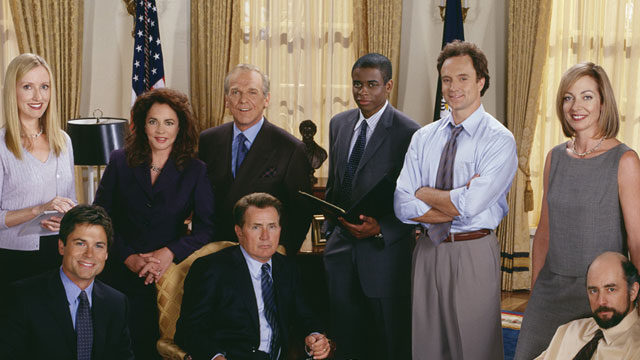
Dougherty adds a point that Aaron Sorkin, the creator of Jed Bartlet, the POTUS on West Wing, should take to heart:

One cause for the gigantism of our presidential election is the gigantism of the executive branch. The federal government employs more than 2 million people in the process of governing us.

Too bad that Sorkin doesn’t seem to recognize the monster that he fed (even if he did not create). His letter to his wife and daughters was typically hysterical (thanks to one of our southern correspondents):

White nationalists. Sexists, racists and buffoons. Angry young white men who think rap music and Cinco de Mayo are a threat to their way of life (or are the reason for their way of life) have been given cause to celebrate. Men who have no right to call themselves that and who think that women who aspire to more than looking hot are shrill, ugly, and otherwise worthy of our scorn rather than our admiration struck a blow for misogynistic s‑‑‑heads everywhere.

But if POTUS were little more than a glorified dog catcher, would the stakes be so high?

Thankful for Trump

I rarely see eye-to-eye with Michael Novak, but m(mmmmeeeeEEE)y reaction to the election was similar to his in the sense that I dreaded four more years of progressivism at that center of American life and felt a sense of relief when news came that Hillary Clinton did not win.

But a better expression of my thoughts comes from Damon Linker who recognizes, as few do inside the bubble of progressivism, that the United States includes more than elite institutions and their unofficial establishment:

The urge toward exclusion is a perennial possibility of politics. That’s because politics takes place on two levels. On one level is the back and forth of partisan conflict, involving persuasion, argument, electoral battles, triumphs, and defeats. On this level, pretty much anything goes as long as it abides by the rules of the political game. But there’s also a second, more fundamental level of politics that involves a competition over who gets to set the rules, the boundaries of what is publicly acceptable, in the first place — and precisely where those boundaries will be positioned.

The most obvious example of second-order politics in the American system is the judiciary, and especially the Supreme Court. Until the Obergefell decision in 2015, for example, the American people were engaging in a free-flowing debate about same-sex marriage, with some people in favor of allowing it and others opposed, and public opinion shifting rapidly in the “pro” direction. That was politics conducted on the first level. But then the Supreme Court stepped in to declare gay marriage a constitutional right. That was second-order politics in action: Suddenly the rules were changed, with the “pro” side summarily declared the winner throughout the nation and the “anti” side driven — and permanently excluded — from the political battlefield going forward.

But second-order politics isn’t only found in the formal strictures of a Supreme Court ruling. It comes into play when prominent institutions in civil society (such as mainstream media outlets, universities, corporations, movie studios, and other arms of the entertainment industry) informally unite in deciding that an issue, or a specific position on an issue, is simply unacceptable because it crosses a moral line that leading members of these institutions consider inviolable. Over the past several decades, a range of positions on immigration, crime, gender, and the costs and benefits of some forms of diversity have been relegated to the categories of “racism,” “sexism,” “homophobia,” “white supremacy,” or “white nationalism,” and therefore excluded from first-order political debate.

I’m not going to cry for progressives. They still have elite journalism, Hollywood, the most exclusive colleges and universities, and lots of agencies related directly and indirectly to the federal government. They just don’t have the White House for the next four years. Let’s see Aaron Sorkin make a television show about that.